LE TOUT PREMIER 😮
Félix Auger-Aliassime 🇨🇦 est le premier Canadien à atteindre les quarts de finale de tous les tournois du Grand Chelem 👏
Il a eu raison d’Alejandro Tabilo en trois manches et affrontera maintenant Flavio Cobolli
En savoir plus 👉 https://t.co/a49CDzE4f1
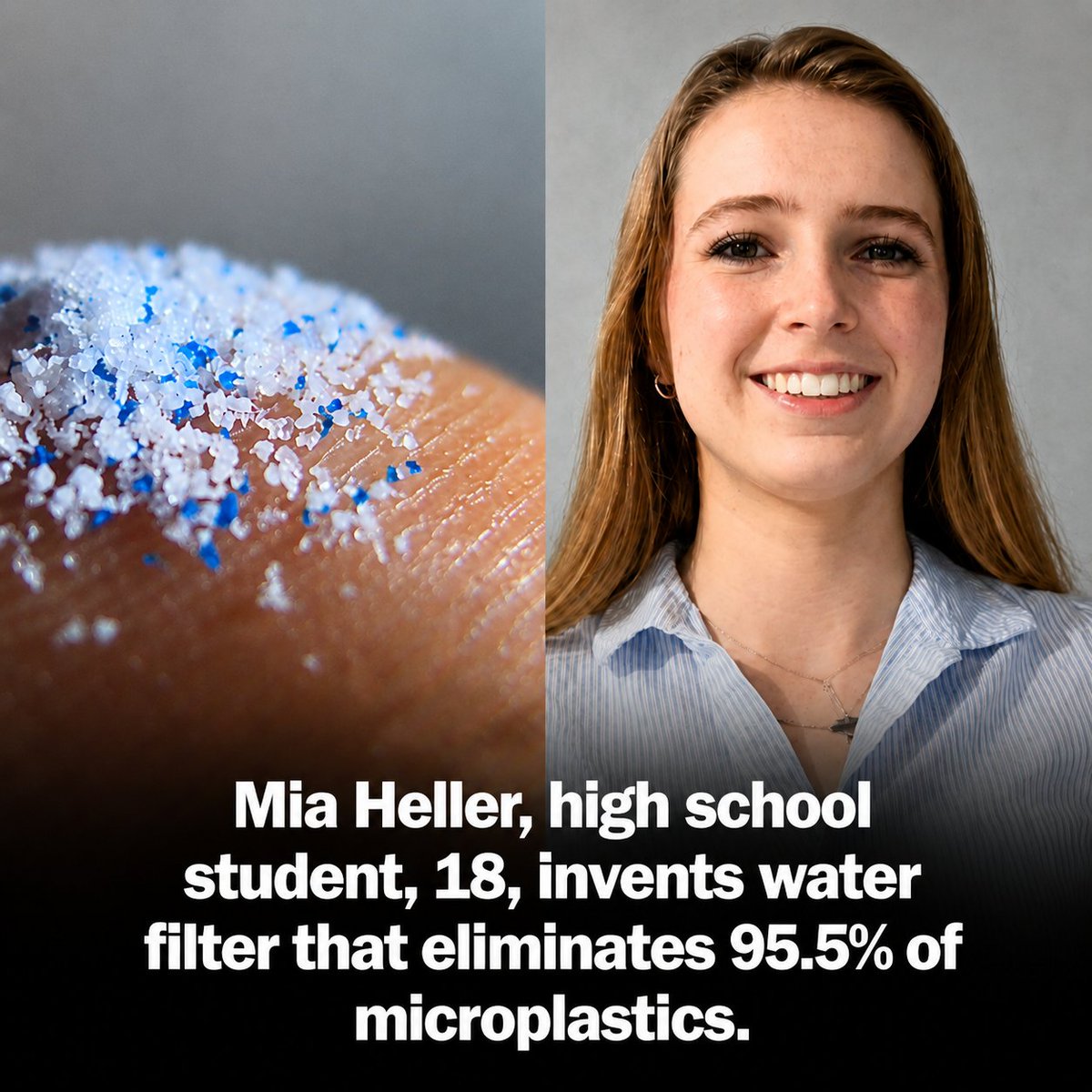
An 18-year-old just did what billion-dollar water companies couldn't.
Meet Mia Heller.
A high school junior from Warrenton, Virginia who built a water filter in her garage that strips out 95.5% of microplastics from drinking water.
That's better than most government treatment plants, which sit somewhere between 70% and 90%.
Her secret weapon? Ferrofluid. A magnetized liquid made of oil and powder that latches onto microplastic particles. Then a magnet yanks them out. No membranes. No constant filter replacements. No endless maintenance bills.
The ferrofluid even gets recycled, around 87% of it, in a closed loop.
The spark for all of this wasn't a classroom project. It was a local newspaper article warning that her town's tap water was loaded with PFAS and microplastics, and that nobody was coming to fix it.
So she watched her mom swap out filter after filter and thought, there has to be a smarter way.
She built the prototype herself. Tested it with a homemade turbidity sensor. Then walked into the Regeneron International Science and Engineering Fair and walked out with a special award from the Patent and Trademark Office Society.
Up against nearly 1,700 students from 62 countries.
She's now eyeing a household version that sits under your kitchen sink.
The future of clean water might not come from a lab in Silicon Valley. It might come from a teenager's garage in Virginia.
Source: Smithsonian Magazine
On this day in 2006, Capt. Nichola Goddard was killed in Afghanistan. She was the first female Canadian soldier to die in combat.
She was posthumously awarded the Meritorious Service Medal.
Two schools and a Coast Guard patrol vessel are named for her.
📸 Sally Goddard
Ho Lee Shit! Trump flew all the way to China to inform Chinese people that Chinese restaurants exist in America. Sweet & Sour Jesus, this fucking wonton is one egg roll short of a combo platter.
30 years ago we released our fifth full-length studio album, ‘Trouble At The Henhouse’. It was the first record we self-produced, a turning point that helped shape the sound we carried forward.
What does this album mean to you?
“From Day One, I knew how I wanted the show to end. It ends like the book, after high school, so this was always the plan. To get to the finish line and to get to walk away the way you want to is rare," says Mark Critch about end of @SonOfACritchTV https://t.co/0uxyPN2Irg
On Sunday, Prime Minister Mark Carney described Canada’s relationship with the United States as a “weakness”—a striking reversal of a partnership long seen as foundational.
It is not the first time Canadians have confronted that reality.
In 1812, American leaders believed Canada would fall easily. Thomas Jefferson called its conquest “a mere matter of marching.” Proximity, they assumed, meant inevitability.
They were wrong.
Carney himself invoked Isaac Brock—the soldier who moved decisively at Detroit, transforming vulnerability into momentum and proving that Canada could not simply be absorbed.
But Brock was not alone.
Years earlier, during the American Revolution, Guy Carleton faced a similar assumption. American forces marched north expecting Quebec to welcome them. Instead, Carleton held the line—militarily and politically—preserving British North America at a moment when its future was anything but certain.
Two different wars. The same miscalculation.
That Canada’s closeness to the United States would determine its fate.
In both cases, Canadian survival depended not on geography, but on leadership—on a willingness to resist the idea that proximity equals dependence.
Today, Carney is making a modern version of that argument.
Canada sends the majority of its exports south, tying its economic fortunes to decisions made in Washington—decisions increasingly shaped by tariffs, uncertainty, and even rhetoric about annexation.
What was once stability now carries risk.
And so the question returns, as it has before:
When a powerful neighbour changes, what must Canada become?
In Brock’s time, the answer was bold action.
In Carleton’s time, it was endurance.
Today, it may be something else entirely—but the principle is the same:
Canada’s future has never been secured by proximity.
It has always been secured by choice.
History isn’t repeating itself exactly.
But it is asking the same question again.
#Canada #History #ContextMatters