Metric Tensor Notation ✍️
I have a question that might sound really simple. It is actually very interesting. If you think about it deeply it can take you to the heart of some big ideas in physics like black holes and gravity. The question is: how do you measure distance on a surface that is curved? Not the distance if you were to fly through the air but the distance if you were to walk along the curve of the surface itself.
This question is important because it helps us understand how to measure distance in a way that's real and true not just a straight line through empty space. If you think about it this is like an ant walking on the surface of a balloon. The ant is not going to fly through the air it is going to follow the curve of the balloon.
If you really think about this question and try to answer it you will come up with something called the metric tensor. This is an idea that is very important in physics. It is like a key that unlocks the secrets of space and time. The metric tensor is written as g with two numbers underneath called mu and nu.
The reason we need the tensor is that it helps us understand the difference between coordinates and geometry. Imagine you have a map with a grid on it. Each point on the map has a set of numbers that tell you where it is.. Just because you have these numbers it does not mean you can figure out the distance between two points. The numbers are labels they do not tell you anything about the actual distance.
The metric tensor is like a rule that helps you convert the coordinate numbers into distances. It is like a bridge between the labels we use to describe points in space and the actual geometry of the space itself.
There is an equation that shows how the metric tensor works. It is called the line element. It says that the distance between two points is equal to the metric tensor times the difference in coordinates. This equation is very important because it shows how the metric tensor helps us understand the geometry of space and time.
The metric tensor is like a matrix with lots of numbers inside. Each of these numbers tells you something about the geometry of space and time at a point. The numbers on the diagonal of the matrix are the important because they tell you about the distance in each direction.
If you are in a place where the space's flat and there is no gravity the numbers in the matrix are very simple.. If you are near a big heavy object, like a black hole the numbers in the matrix get more complicated. They tell you about the curvature of space and time and how it affects the distance between points.
There is a beautiful picture that helps us understand the metric tensor. It is a picture of a surface like the surface of the Earth. On this surface there is a plane that just touches the surface at one point. This flat plane is like a piece of paper that you can draw vectors on. The metric tensor is like a rule that helps you measure the length and angle of these vectors.
The picture also shows how the metric tensor helps us understand the difference between time and space. Time is different from space because it has a sign in the metric tensor. This minus sign is very important because it helps us understand how time and space are related.
The metric tensor also helps us understand how causes and effects are related. It helps us understand why causes come before effects and why you cannot go back in time. It is all because of the way the tensor works and how it helps us understand the geometry of space and time.
There are two kinds of tensor one with little numbers underneath and one with little numbers above. These two kinds of tensor are like two different languages and they help us understand the geometry of space and time in different ways. They are like two tools that we can use to understand the world.
Lovely forum, ��
I spent some time reflecting on this beautiful problem that @USDescartes shared with us, trying to better understand part of the theory behind the result.
I eventually concluded that, after a few technical refinements and with the appropriate mathematical+
Cherenkov radiation is often described as a particle traveling "faster than light," a phrase that sounds impossible until one detail is added.
Nothing exceeds the speed of light in vacuum. What changes inside a material is the speed at which light propagates through that medium. Water slows light to roughly three quarters of its vacuum speed, making it possible for sufficiently energetic particles to outrun the electromagnetic disturbance they create. The effect is entirely consistent with relativity, which places its speed limit on light in vacuum, not on light everywhere.
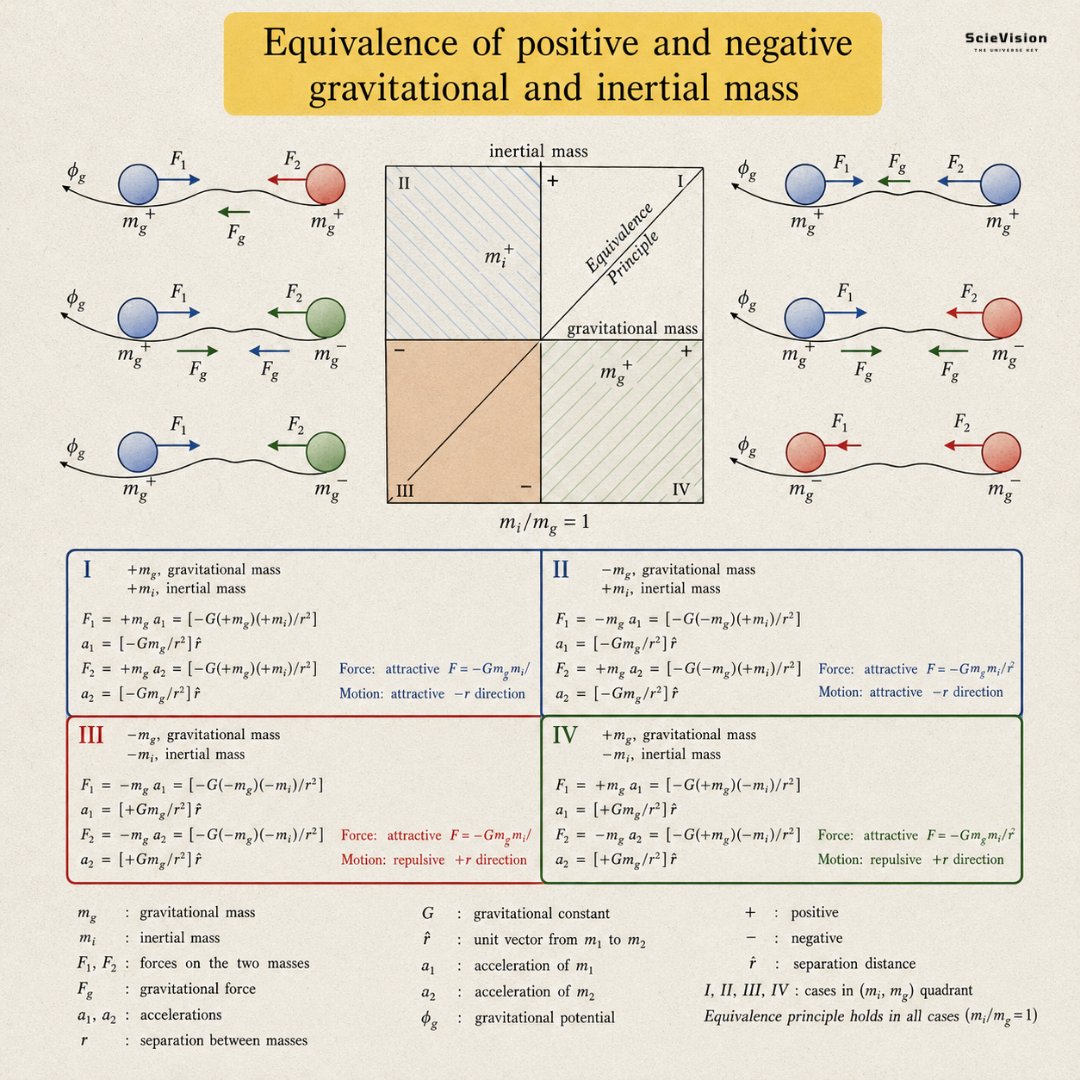
Equivalence of Positive and Negative Gravitational and Inertial Mass ✍️
Here’s a question that will truly change your perspective on physics. What if mass could be negative? Before you dismiss this as science fiction, keep in mind that no one has ever mathematically proven that negative mass cannot exist. When serious physicists explore its implications, the results are so strange and fascinating that they leave you wondering what the universe is really made of. This diagram illustrates that exploration with careful mathematical reasoning, and its conclusion is stunning. Even in a universe where mass can be negative, the fundamental principle of gravitational physics remains intact.
The first thing to grasp, a point many physics courses overlook, is that mass isn't a single property but two distinct physical qualities that happen to be equal in all known matter. The first type is gravitational mass, the property that determines how strongly an object creates and responds to gravitational fields, similar to electric charge in electromagnetism. The second is inertial mass, which measures how strongly an object resists acceleration, making it harder to push a bowling ball than a tennis ball. These two concepts are so different that there’s no clear reason they should be equal. Yet, every experiment confirms their equality to better than one part in a trillion. Einstein found this so striking that he established it as a fundamental principle called the equivalence principle. This principle is expressed in the diagram as the ratio of inertial mass to gravitational mass being exactly one, forming the basis for his entire theory of general relativity.
The main map in the diagram organizes all possibilities into four quadrants, with inertial mass on the vertical axis and gravitational mass on the horizontal axis, each ranging from negative to positive. The diagonal line running through these quadrants represents the equivalence principle. Observing this line persist through all four quadrants is like seeing a golden thread of mathematical consistency woven into every possible version of reality.
Quadrant One, in the upper right, depicts the familiar universe where both types of mass are positive. Objects attract each other gravitationally and respond by accelerating toward one another. This behavior is what we experience every day. Falling apples, orbiting planets, and clustering galaxies all belong to Quadrant One, where the equivalence principle holds perfectly.
Quadrant Three, in the lower left, introduces genuinely extraordinary and philosophical ideas. Here, both gravitational mass and inertial mass are negative, creating a complete mirror universe. Two negative gravitational masses actually attract each other, just like two positive masses do, because multiplying two negatives results in a positive force. Gravity tries to pull them together. However, negative inertial mass causes a shift. When a force pulls an object in one direction, it accelerates in the opposite direction. This means that the attractive gravitational force trying to draw the two objects closer results in each one accelerating away from the other. The force is attractive, but the motion is repulsive. Two objects with negative mass that want to come together instead flee from each other, like two people trying desperately to reach one another but somehow ending up further apart. Yet, this leads to a moment of genuine mathematical beauty. Even in this strange mirror universe, the ratio of inertial mass to gravitational mass remains exactly one. Dividing a negative number by a negative number yields positive one. The equivalence principle holds true in Quadrant Three just as it does in Quadrant One, with the diagonal line connecting both, creating a single thread of consistency through both the familiar universe and its strange mirror opposite.
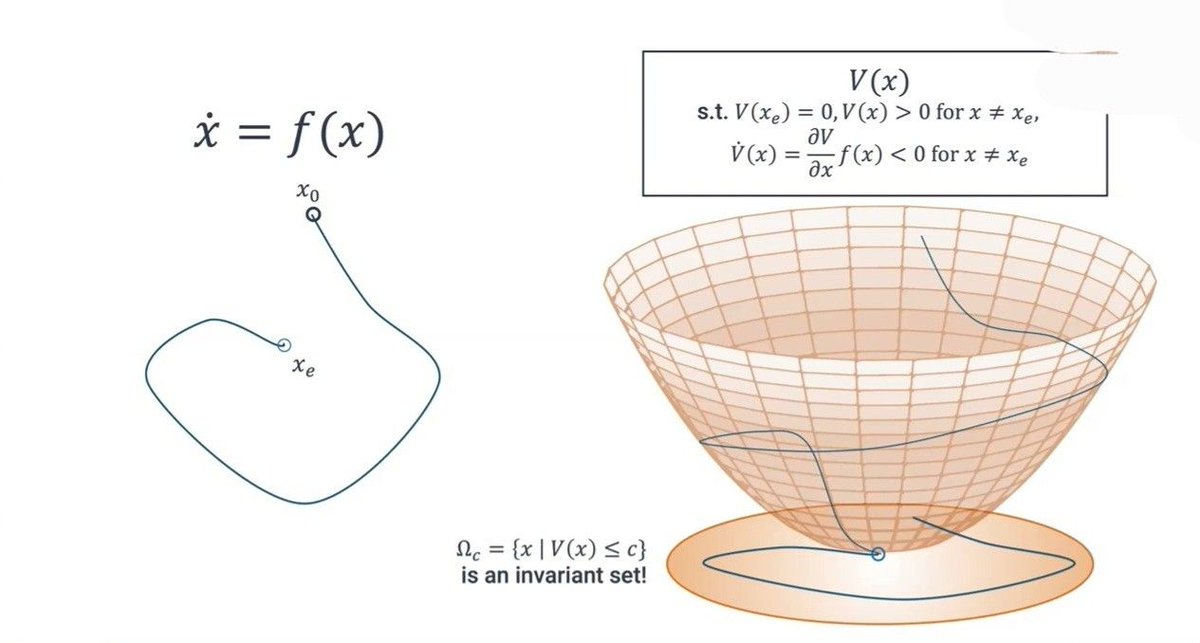
Nonlinear systems evolve by ẋ = f(x).
When a Lyapunov function V exists with V(xₑ) = 0, V(x) > 0 for x ≠ xₑ and V̇(x) = ∂V/∂x f(x) < 0 elsewhere, every sublevel set Ω_c = {x | V(x) ≤ c} is positively invariant:
trajectories that start inside remain inside and converge to the equilibrium.
Satellite teams construct such V functions to certify that reaction-wheel attitude controllers damp residual spin and hold precise pointing under solar-pressure torques.
A matrix can do something surprisingly dramatic. It can collapse an entire dimension into nothing. The null space captures every direction that is completely eliminated, making it one of the most fundamental ideas in linear algebra, geometry, and countless areas of physics.
A rolling circle leaves a path drawn by any fixed point attached to it. That path is a trochoid, given by
x = rθ − d sin θ
y = r − d cos θ
where r is the circle’s radius, d the distance from center to the point, and θ the angle of rotation.
When d < r the curve stays smooth and never loops (curtate).
When d = r the point sits on the rim and the curve develops sharp cusps that touch the ground line (cycloid).
When d > r the point lies outside the circle and the path forms crossing loops (prolate).
Bicycle pedals trace the curtate form; the outer tips of a paddle-wheel on a steam boat trace the prolate form.