Frankenstein of cameras — a field hack for military photography
A Canadian night-vision dealer came up with an adapter that literally fuses NVGs with regular cameras. Not exactly “high-tech,” but it takes photo and video capture to a whole new level — with plenty of military applications.
Funny part? It started as a hobby project by a group of enthusiasts who just wanted cooler night-shooting pics. Somewhere along the way, it turned into full-on production.
In the photos: pieces of a GPNVG-18, PVS-14, and BNVD-1431 rigged into the setup.
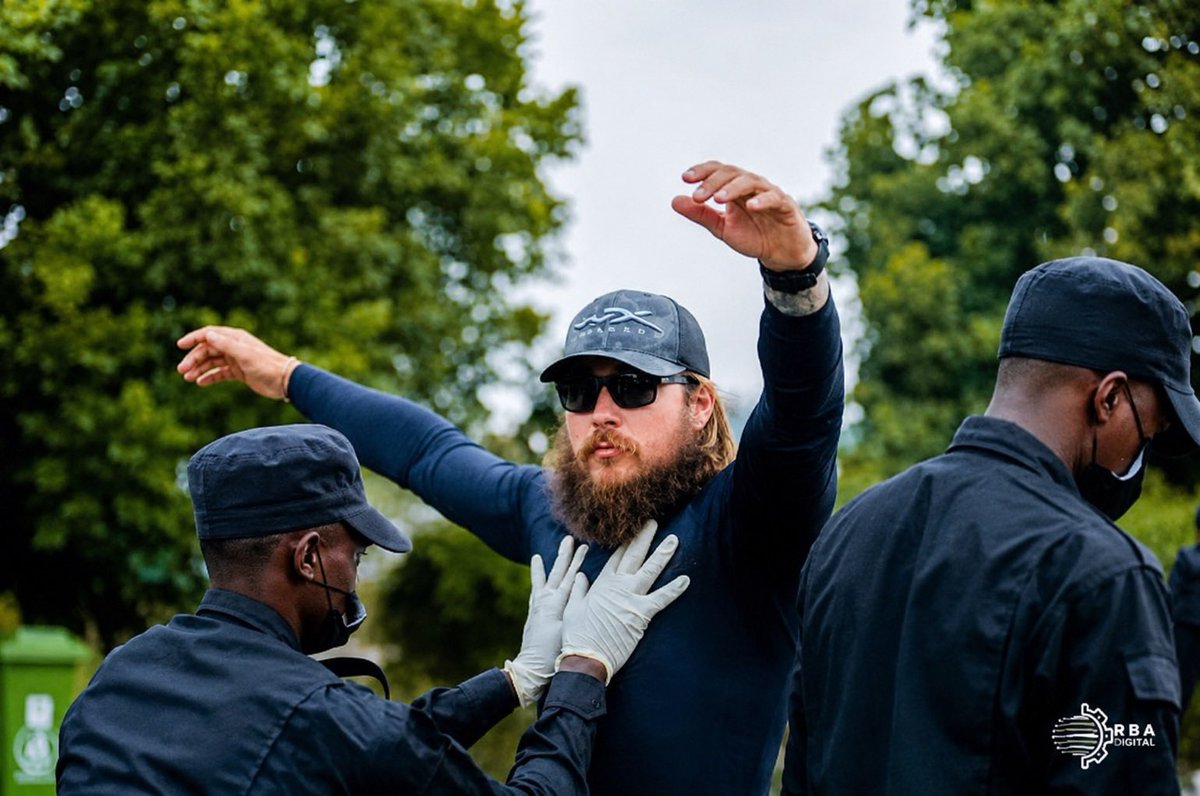
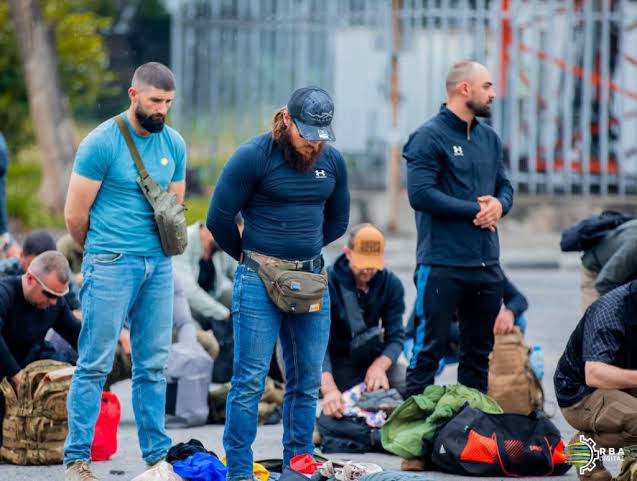
🔺Romanian PMCs and the Largest Mass Surrender in the History of the Private Military Industry
In 2022, the Democratic Republic of the Congo faced a renewed offensive by the M23 rebel movement, which had been destabilizing the country’s eastern regions for years.
To strengthen its overstretched military, Kinshasa hired foreign contractors, most of them from Romania. The contract went to Congo Protection, a company led by Horațiu Potra, a former French Foreign Legion member.
Contractors reportedly earned $5,000+ per month, while an average Congolese soldier received around $100.
Their responsibilities included:
- Training Congolese troops
- Operational planning
- Advising commanders
- Escorting military units and senior officials
Over time, however, many contractors found themselves being used as frontline assault infantry—well beyond the scope of their original contracts.
Everything changed in early 2025, when M23 launched a large-scale offensive against Goma, the largest city in eastern Congo.
What surprised many observers wasn’t just the speed of the advance, but the professionalism of the offensive.
According to numerous assessments, M23 benefited from substantial Rwandan support, including:
- Intelligence
- Modern communications
- Drone capabilities
- Artillery support
As Congolese defenses collapsed, 288 Romanian contractors abandoned their positions and sought refuge at a UN peacekeeping base.
Following negotiations, they surrendered their weapons, underwent security screening by M23 fighters, and were then transferred to Rwandan authorities for evacuation.
The incident is widely regarded as the largest mass surrender involving private military contractors in modern history.
Following the incident, Congo Protection never recovered from the reputational damage and ultimately ceased operations.
GTA V can actually be used as a drone training simulator.
The feature isn’t available in the single-player campaign — only in GTA Online.
Interestingly, this isn't without precedent. Syrian and Libyan irregular forces once used ARMA 3 as a makeshift simulator to build basic skills for operating improvised fixed-wing UAVs.
🇰🇵 The Most Expensive Kalashnikov? What North Korea Actually Produces
North Korea remains one of the most closed-off states in the world — a system operating in near-total isolation.
It’s hard to think of anything made there that’s widely used globally. But there is one exception — and it keeps showing up across conflict zones.
Sanctions and embargoes shaped everything that followed. Later North Korean variants featured intentionally confusing markings — designed to obscure their origin and complicate tracing.
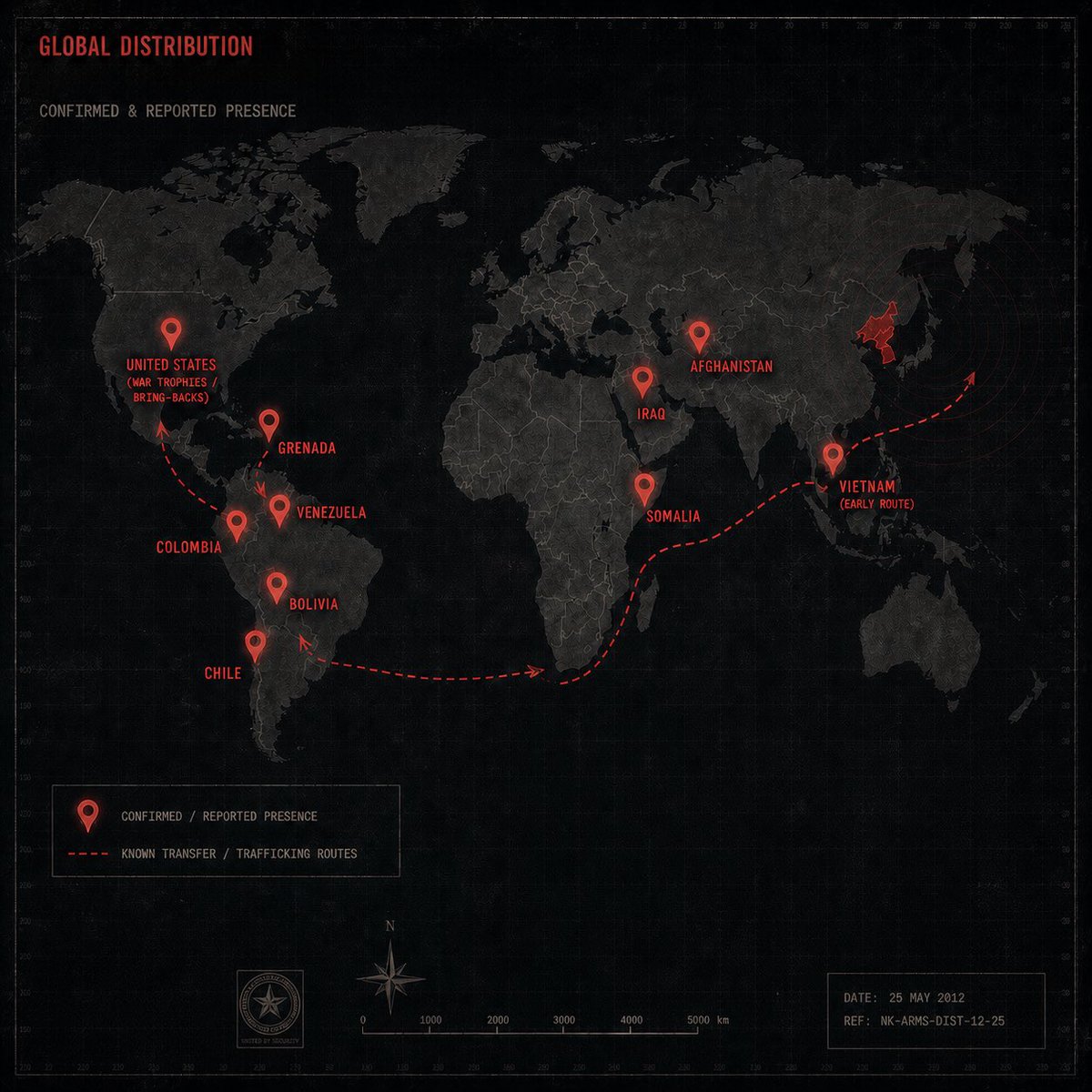
Despite the secrecy, these rifles have surfaced across multiple conflict zones: Afghanistan, Iraq, Grenada, Somalia, Venezuela, Colombia, Bolivia, and Chile.
Some made their way to the U.S. as war trophies (often called "bring-backs" by collectors) — initially through Vietnam, and later from other regions.
🇺🇸The collapse of EW: Autonomy at the point of impact
Not long ago, the outcome of an FPV strike came down to seconds. Lose the link — and the drone turned into useless plastic. The last 100 meters were chaos, where luck often beat technology.
That segment is now the most predictable — and the most lethal.
The Prism SKR update by Teledyne FLIR isn’t just software. It’s the moment a drone stops being a tool and becomes an autonomous effector.
Pixel-Lock. Re-ID. 3D targeting. Behind the terminology is the real shift: the algorithm makes the final decision.
The old kill chain was simple: operator - signal - target. Break the link — survive.
That logic is gone.
Once a drone locks onto a target visually, it can continue the attack in a completely RF-silent state. No GPS. No coordinates. No control link required. Captured pixels become the kill chain.
This breaks the foundation of modern defense. Electronic warfare was built on one principle: jam and deny.
But if the signal isn’t needed — there’s nothing left to jam.
In practice, this turns a basic FPV drone into a new class of guided munition — cheap, scalable, and increasingly reliable.
Operator skill becomes secondary. Acquire the target — and it becomes fire-and-forget. From there, it’s just code.
The real effect is scaling. Open architecture means this logic can be integrated anywhere — from improvised FPVs to full-scale strike platforms.
This isn’t a product. It’s a software layer that can sit on top of any hardware. Effectively — an operating system for warfare.
Strategic implications
• The decline of EW as a universal solution
• The democratization of precision strike capabilities
• The shift toward autonomous swarms, where each unit can complete the attack independently
But there’s another layer — psychological.
The realization that a drone won’t stop even after you “jam” it changes behavior on the battlefield. It introduces inevitability.
And inevitability is a weapon in itself.
Bottom line
Humans are no longer required in the final phase of the attack. Only at the beginning — to designate the target.
After that, the logic is simple:
detect - lock - strike
And the outcome is no longer negotiable.
🇸🇾 Members of the “Xhemati Alban” paramilitary group at an oil field in Syria.
A small formation composed of ethnic Albanians from Kosovo, North Macedonia, and Albania.
In Syria, they are referred to as “inghimasiyun” — assault elements operating deep behind enemy lines.
Despite still being designated as a terrorist group, they have been integrated into the new security structure following Assad’s fall. They now operate under transitional authorities and coordinate with them in operations against ISIS.
Next-level corner shooting
The GLORYFIRE Corner Prism is a compact periscope-style attachment that lets you aim and observe from cover without exposing yourself.
Its dual-prism design maintains a correct, non-inverted sight picture, giving you a clear view of danger zones while staying behind hard cover.
Built to pair with red dots, it features an adjustable fit and mounts directly onto a standard Picatinny rail.
A simple but clever solution for tight angles control the corner without showing yourself.
🇺🇸🇮🇷 How a U.S. Navy intelligence specialist with TOP SECRET clearance defected to Iran
Pictured is Monica Witt — now one of the FBI’s most wanted fugitives. But it didn’t start that way. She was a seasoned signals intelligence specialist with over a decade of operational experience.
Starting in 1997, Witt worked as a cryptologic linguist. Fluent in Farsi, she collected and processed intelligence aboard the RC-135 Rivet Joint reconnaissance aircraft. Later, as an agent with AFOSI, she operated across Qatar, Jordan, the UAE, and Tajikistan. Her SCI clearance (Sensitive Compartmented Information) gave her access to highly classified programs far beyond standard clearance levels.
In 2012, she traveled to Iran for the “Hollywoodism” conference as part of a foreign delegation. Three months later, the FBI warned her she had likely become a recruitment target for Iranian intelligence. Soon after, an Iranian TV host contacted her with a job offer tied to an anti-American film project.
On June 30, 2013, during a solo trip to Afghanistan, Witt walked into the Iranian embassy in Kabul and offered her services. By August 28, she had arrived in Tehran and formally defected, receiving housing and employment under the Islamic Revolutionary Guard Corps (IRGC).
Her actions caused significant damage to U.S. intelligence:
🔺She helped build targeting packages on former colleagues, later used in cyber operations and phishing campaigns by IRGC-linked units.
🔺She exposed the identities of covert operatives working inside Iran.
🔺She transferred sensitive intelligence on Pentagon programs related to surveillance and special operations.
As of today, Monica Witt remains on the FBI’s Most Wanted list. She is classified as a fugitive and faces life imprisonment if captured.