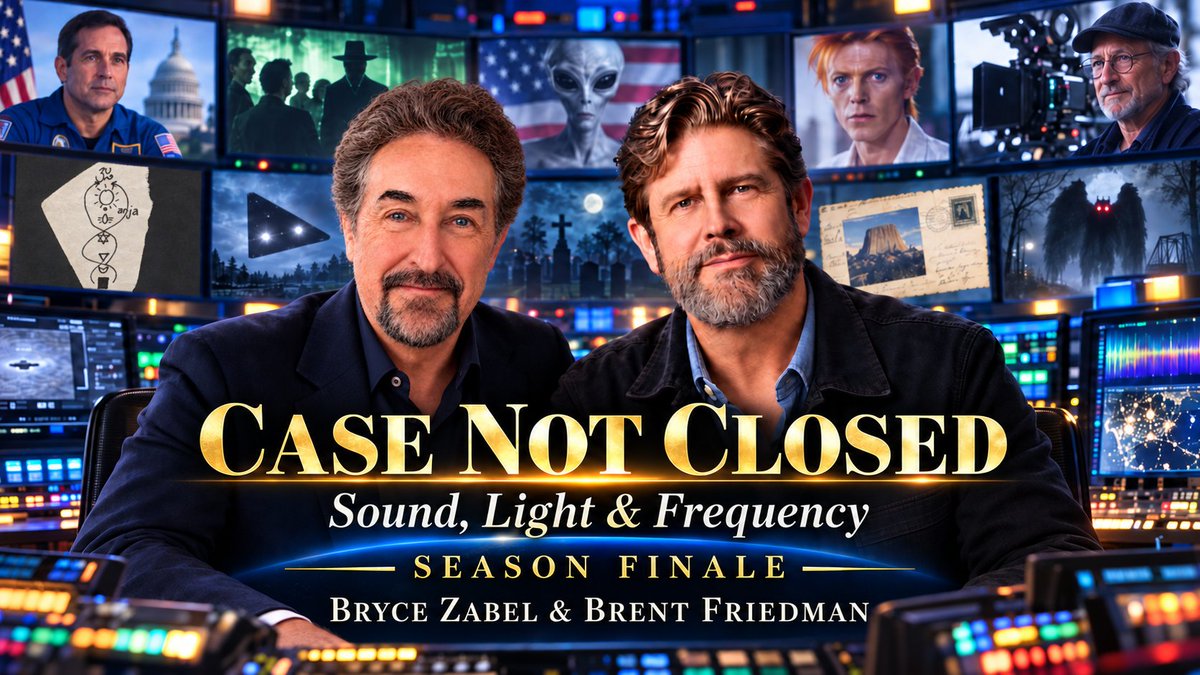
If there’s a secret connection between Hollywood and UFOs, is the goal slow-drip disclosure under the cover of fiction or an elaborate disinformation campaign? This is what I’ll be exploring with my Dark Skies co-creator, Bryce Zabel, in our podcast, “Sound, Light & Frequency.”
Have you ever wondered if there's a secret connection between Hollywood and UFOs? We have the show for you, starting on February 19, 2026.
YouTube Promo: https://t.co/3Fc2lzc6tN
Website: https://t.co/Ppm6XFaAJ2
Coming Soon!
@BryceZabel enters “The Safe House” for an Exclusive Interview!
Not only will we be covering his career works, but also, going beyond to look at the larger picture. It {was/is} an honor to host such an amazing talent. My Family bonded with series such as Dark skies. AD After Disclosure co Autjored with the great and powerful @I_D_Official
Wait til you see this episode!
https://t.co/DCP4ES9bAb
If the doors of perception were cleansed, would everything appear to man as an orb? 🔵
"The phenomenon manipulates consciousness. They can appear to be whatever they want." ~PL
👽 Can We Defend Ourselves Against It? 👽
"Of course we can." ~PL
"You have to figure out who the monster is in your own unconscious mind." ~PL
(I love this clip of Levenda, who's one of my favorite deep thinkers on the phenomenon. I didn't add much to this one but will engage if people add their own thoughts in the replies.)
"You have to realize, when you're listening to bullshit, you're listening to bullshit." ~PL
~~~
@Peter_Levenda: "People ask me, you know, about an alien invasion, right? Shouldn't we be prepared for an alien invasion? My response to that has been: It's already happened. It has happened. It's happened 1000s of years ago. There's been an alien invasion. You know, we've met the enemy, and they are us, let's say.
"But more to the point, they have manipulated, or the phenomenon has seemed to - whether it's been intentional or accidental - the phenomenon manipulates consciousness. They show up where they wanna show up. They disappear when they wanna disappear. Sometimes they show up as ships sailing through the sky. Sometimes they're flying saucers. Sometimes they're cigar shapes. Sometimes they're orbs, right?
"This phenomenon has all different kinds of faces on it. They're not stuck to one specific type of manifestation. That right away indicates manipulation, right? Right away, that indicates that they can appear to be whatever they want it to appear to be. Whatever this is.
"And is that our fault? Is it because we're projecting something onto something which is pristine, otherwise? Maybe just an orb, you know? Just a sphere, but we're projecting Angels and Demons? We're projecting gods and monsters onto this? Grays and Talls and Nordics and all the rest of it? Are we just coming up with this stuff on our own, and we're doing that? If so, the invasion is actually happening, right? Our consciousness is being manipulated."
(If could see things as they truly are (see my William Blake-inspired comment that started off this tweet), would Grays, Reptilians, Bigfoot, giant craft, etc., all just look like orbs? Or, are those actual beings and craft that exist separately, outside of our consciousness?)
Levenda: "Now you add to that, the internet. You add to that, suggestibility, in many different ways: the way we consume entertainment, the way we consume information. And I always use this example: one day it's possible we may all wake up around the planet having had the same dream. And when that happens, it's over. The invasion has successfully accomplished its goal. Now, our dreams are being manipulated, our consciousness is being manipulated, and that's it.
"That's what we have to be afraid of. Can we defend ourselves against it? Of course we can. We can strengthen ourselves from the point of view of consciousness. We can strengthen ourselves mentally, spiritually, right? You don't have to belong to any one specific religion. No one has the monopoly on this experience. So, but you can, using the tools at your disposal, strengthen yourself spiritually, mentally, psychologically.
"There was a famous occultist, Israel Regardie, who was also a psychotherapist. And he always recommended, anybody who gets involved in this subject to this extent - especially occultism in general, but, you know, anything like that - spend a year or two in therapy first. But what he meant was: you don't know what you're dealing with. When you start probing into your own mind, you don't know what's lurking there waiting for you.
"You know, the magic flute by Mozart, you know. The famous guardians at the gate who are these vicious monsters. But as soon as you pass them, they're just a couple of regular guys, right? You have to figure out who the monster is in your own unconscious mind. You have to figure out what's in there, what you've buried, what you're resistant to.
"Because if you don't, you will come across it, eventually, if you are serious. If you open the door to these experiences, you will have to encounter negativity. The negativity we've all been born with, or raised with, or, you know, as victims of our circumstances, of our culture, of our upbringing, you know, nature and nurture. It's all in there. We're gonna have to encounter it. This has to be done.
"And once you do that, the upshot is, the benefit is, you become a lot more mellow, right? You become a lot more forgiving. You become a lot more wise, in a sense. You know that everybody's got these things inside of them that they're dealing with, that they're battling with.
"So, what we can do is just strengthen ourselves, individually. Not fall for every story we hear, not fall for every conspiracy theory that comes down the pike, but be aware that there are conspiracies. That's a fact. They do exist. Which one is the one that you have to be afraid of (laughs)? Well, you know, I hate to use that term, 'Do your research,' because these days, do your research just means looking at a YouTube video somewhere.
"And people like me, we came from a different, you know, boomer mentality. Which is that we go through and we just do a lot of, you know, reading and a lot of talking and a lot of investigating and a lot of meeting people and getting their points of view. I got points of view on all different sides of the political landscape through my entire life, I talked to everybody. I spoke to Islamic terrorists, for instance, in Indonesia.
"I mean, these are the things that you do if you want to know what they're thinking, and you want to know why people come to these things. You have to be open to that kind of research, but you have to be strong, internally, right? You have to realize, when you're listening to bullshit, you're listening to bullshit.
"You have to be able to piece that together. You have to make these assumptions, and make these calculations when you're talking to people. But you record things, you make notes, and you go back and you look at them later, you look at them later, and eventually, a story emerges. Something you can be comfortable with."
~
"If the doors of perception were cleansed, every thing would appear to man as it is, Infinite. For man has closed himself up, till he sees all things thro' narrow chinks of his cavern." ~William Blake, 1790ish
When I looked up that quote to get it right, ChatGPT added this on its own, based on my previous prompts...
~⬇️ChatGPT⬇️~
Here's what I find especially interesting.
Blake wasn't simply suggesting that humans need to look more carefully.
He was suggesting that the very structure of ordinary human perception might prevent us from recognizing the true nature of existence.
And there's an intriguing connection to your interest in the UFO phenomenon.
Blake's philosophy resonates with some of Jacques Vallée's ideas about consciousness, reality, and the possibility that human perception constrains how we understand anomalous experiences.
That doesn't mean Blake anticipated the UFO phenomenon or that Vallée's hypotheses are correct. But both challenge the assumption that the reality we ordinarily perceive is necessarily the whole of reality.
In one sentence: Blake believed that the infinite is already all around us, but the limitations of human consciousness prevent us from seeing it.
Really hope you can join the live chat for the YouTube premiere (link below) of our “Sound, Light & Frequency” season finale. I want to hear your honest evaluation of Season 1.
It's the SEASON FINALE of SOUND, LIGHT & FREQUENCY with our 36th episode, "Case Not Closed." We hope you can join us for the YouTube premiere at 6:00pm PT (9:00pm ET). Both Brent and Bryce will be in the chat room tonight!
https://t.co/Hir3BIV374
Working on Sound, Light & Frequency has been incredible. Imagine getting feedback and advice from two Hollywood producers!
I've learned so much about UFO films and the lore behind them.
Fingers crossed for Season 2!
It's hard to believe, but the 36th episode (out of 36) is now out wherever you get your podcasts, officially ending Season One of Sound, Light & Frequency. Bryce and Brent have a long chat with their audience in this one, updating the investigation, sharing their feelings.
It's hard to believe, but the 36th episode (out of 36) is now out wherever you get your podcasts, officially ending Season One of Sound, Light & Frequency. Bryce and Brent have a long chat with their audience in this one, updating the investigation, sharing their feelings.
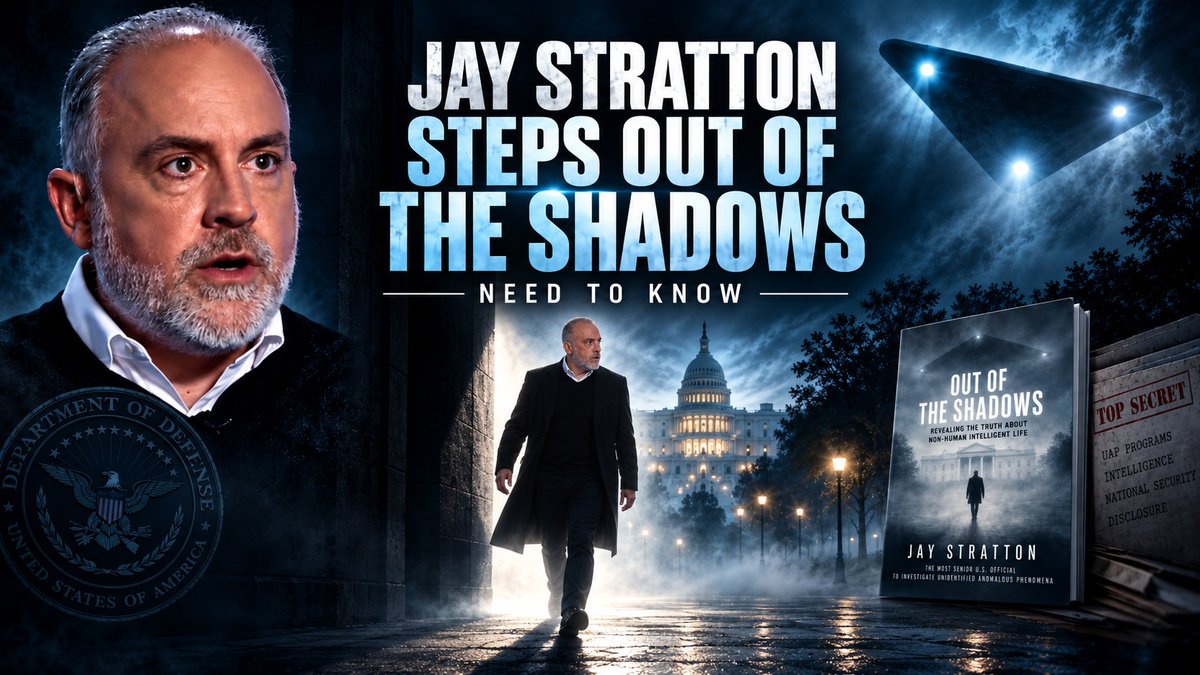
The NEED TO KNOW podcast is out with a comprehensive review of OUT OF THE SHADOWS by Jay Stratton. The analysis comes from RICHARD DOLAN and our own BRYCE ZABEL and they really dig into the details in a fresh new way. Here's the video link:
https://t.co/7gwKpVdVCt
Latest episode is out wherever you get your podcasts. And it'll be a YouTube live premiere with Brent and Bryce in the chat Sunday night.
"Why Do Rockstars See UFOs?" on SOUND, LIGHT & FREQUENCY
https://t.co/e4sBoUs7Iw
The Third Who Walks Beside You
At the edge of death and in deep grief, people report an unseen companion who stays close, steadies them and sometimes seems to know the way. Many never tell anyone.
The Stairwell
On the morning of September 11, 2001, Ron DiFrancesco was in a stairwell of the World Trade Center's South Tower, above where the plane had struck. The smoke was thick. He lay down on a landing. Years later he told the writer John Geiger what came next; Geiger opens his 2009 book The Third Man Factor with it.
DiFrancesco had the sensation that "somebody lifted me up." In a CNN report on the book in 2009, he says it told him to get up. "I was led to the stairs," he told Geiger. "I don't think something grabbed my hand, but I was definitely led." The presence, he said, took him toward the fire rather than away from it. "That's not where you go, you don't go toward the fire." He ran through it. Geiger writes that the helper stayed with him for about five minutes, and DiFrancesco says, "I think at that point it let me go." To CNN he put it plainly: "It was a higher being rather than an internal being. Maybe it was an angel. I didn't see the face of God, but I know somebody came and helped me." CNN reported that Geiger calls him the last person out of the South Tower before it fell.
Why a helper no one could see would send him toward the fire, and why he came out alive, is a question the record has never answered.
That is the shape of the experience this essay follows: a person at the limit, a helper no one else can see, and a way out the person would not have chosen alone. Researchers call it a "sensed presence," meaning the strong feeling that another person is near when no one visible is there. Geiger called it the Third Man Factor. The record runs from Antarctica to Everest to the homes of the widowed. Three features recur. The companion comes when a person is at the end of their strength. It often helps. And many of the people it helps keep quiet about it. No one has explained where it comes from.
Four, Not Three
On May 19, 1916, Ernest Shackleton, the ship's captain Frank Worsley and the seaman Tom Crean set out to cross the unmapped mountains of South Georgia, an island in the far South Atlantic, toward the whaling station at Stromness. Their ship, the Endurance, had been crushed by ice the year before, and the rest of the crew was waiting on Elephant Island. If the three men failed, no one was coming for the others.
In South, published in 1919, Shackleton wrote that during "that long and racking march of thirty-six hours over the unnamed mountains and glaciers of South Georgia it seemed to me often that we were four, not three. I said nothing to my companions on the point, but afterwards Worsley said to me, 'Boss, I had a curious feeling on the march that there was another person with us.' Crean confessed to the same idea."
Worsley left his own account, quoted in a 2018 article in the medical humanities journal Hektoen International: "even now I again find myself counting our party – Shackleton, Crean and I and – who was the other? Of course, there were only three, but it is strange that in mentally reviewing the crossing we should always think of a fourth, and then correct ourselves." The two men first compared notes, he wrote, "three or four weeks after" reaching Stromness. Each of the three exhausted men felt a fourth, and each, by these accounts, kept it to himself for weeks.
T. S. Eliot read the story and put it into The Waste Land in 1922: "Who is the third who walks always beside you? / When I count, there are only you and I together." His note says it was "stimulated by the account of one of the Antarctic expeditions (I forget which, but I think one of Shackleton's)."
The Pilot of the Pinta
In 1895 Joshua Slocum was sailing alone around the world in the Spray, a rebuilt oyster sloop, a small sailing boat with one mast. Off the Azores, sick from plums and white cheese and with a gale building, he collapsed in the cabin. In Sailing Alone Around the World (1900) he wrote: "looking out of the companionway, to my amazement I saw a tall man at the helm." (The companionway is the ladder from the deck down into the cabin.) "His rigid hand, grasping the spokes of the wheel, held them as in a vise." The man said, "Senor, I have come to do you no harm," named himself the pilot of Columbus's ship the Pinta, and scolded him about the cheese. In the morning the Spray was still on her course.
Slocum knew his boat. He wrote that she could hold a course for long stretches with the wheel tied in place. He still raised a toast "to the health of my invisible helmsman--the pilot of the Pinta." The man who understood the boat best was the one who thanked the helmsman.
Voices Over the Atlantic
In May 1927 Charles Lindbergh flew alone from New York to Paris in about thirty-three and a half hours without sleep. In The Spirit of St. Louis, published in 1953, he described what came into the plane in the worst hours: "These phantoms speak with human voices – friendly, vapor-like shapes, without substance, able to vanish or appear at will, to pass in and out through the walls of the fuselage as though no walls were there." The voices, he wrote, were "familiar voices, conversing and advising on my flight, discussing problems of my navigation, reassuring me, giving me messages of importance unattainable in ordinary life."
When he reached Ireland he was, by his own account, within about three miles of his planned route, after a night over open ocean with no radio. But when he tried to recall the messages, he could not: "I can't remember a single word they said."
According to the historian Chris Gehrz, writing in 2017, none of this appeared in his first book, We, written within weeks of landing in 1927. The phantoms reached print twenty-six years after the flight.
Mint Cake on Everest
In 1933 the climber Frank Smythe pushed on alone high on Everest after his partner Eric Shipton turned back. In Camp Six (1937) he wrote: "After leaving Eric a strange feeling possessed me that I was accompanied by another." The presence "was strong and friendly. In its company I could not feel lonely, neither could I come to any harm. It was always there to sustain me on my solitary climb up the snow-covered slabs." When he stopped to eat a slab of Kendal mint cake, a sugar bar climbers carried, the companion felt "so near and so strong that instinctively I divided the mint into two halves and turned round with one half in my hand to offer it to my 'companion.'"
Smythe guessed at a cause, lack of oxygen and the strain of climbing alone, then declined to rest on it: "I do not offer this as an explanation, but merely as a suggestion."
The Widowed of Mid-Wales
The most careful count of the experience was made not on a mountain but in ordinary homes.
In 1971 the Welsh doctor W. Dewi Rees published "The Hallucinations of Widowhood" in the British Medical Journal. In medicine, a "hallucination" means perceiving something that others present do not perceive; the word describes the experience and does not settle what causes it. Rees interviewed 227 widows and 66 widowers, 293 people in all. Of them, 137, or 46.7 percent, reported experiences of their dead husband or wife. The most common was not a vision or a voice. It was, in Rees's words, "the illusion of feeling the presence of the dead spouse." At the time of the interview, 106 people were still having these experiences, some many years after the death. Rees found they were not tied to social isolation or to known depressive illness, and they were more common among people whose marriages had been long and happy. He described them as "normal and helpful."
"Most percipients" (the people who had the experiences) "were helped by their hallucinations," Rees wrote. Of the 137, 94 (68.6 percent) found them helpful and 8 (5.9 percent) found them unpleasant. Of the 115 who felt the dead spouse's presence, 84 (73.0 percent) called it helpful.
Then Rees asked who they had told. Only 38 of the 137, 27.7 percent, had told anyone. "No doctor had been informed and only one person had confided in a clergyman."
Outside grief, the feeling is less common but not rare. In a 2024 survey of 10,447 Dutch people aged 14 and over, published in the British Journal of Psychiatry, Brederoo and colleagues found that 165 people, 1.6 percent, had felt a presence in the past month. That is about one person in sixty, every month. The researchers linked it to loneliness, poor sleep and hard life events.
The Silence
A thread runs through many of these cases. Shackleton "said nothing to my companions on the point" until Worsley spoke first. Crean left no account of his own; his experience exists only as the other two reported it. Lindbergh waited twenty-six years. Most of Rees's widowed told no one, and none told a doctor.
The silence matters because it shapes the record. The accounts that exist come from people who lived and who found someone willing to listen. What came to the people who did not survive the mountain, the sea or the stairwell is not written down anywhere. The record is a set of private experiences, carried by explorers, a pilot and widowed villagers alike, that mostly stayed private.
Protector and Watcher
Not every presence is kind. In three surveys published in Psychological Medicine in 2023, Alderson-Day and colleagues coded descriptions of felt presences. Psychosis is a condition in which a person loses touch with shared reality. Presences described as "scary, frightening" made up 25.4 percent in a sample that included people with psychosis, 9.3 percent in a spiritual sample and 19.1 percent among endurance and solo athletes. In that athletic group, the people closest to Smythe and Lindbergh, the experiences "were most likely to feature a feeling of being watched."
The same athletes reported both faces. In that group, 27.7 percent described the presence as a comfort, 19.1 percent felt fear and 19.1 percent felt watched. One population, in the same kinds of settings, meets both a protector and a watcher.
The names witnesses give it run the same range. DiFrancesco said, "Maybe it was an angel." Rees's widowed felt a husband or wife who had died. Smythe called it his "companion."
The folklorist David Hufford, in The Terror That Comes in the Night (1982), documented the "Old Hag" of Newfoundland: waking unable to move, with a presence in the room and a weight on the chest. Hufford reported the same experience in cultures with no contact with each other, explained differently in each. His conclusion was that the experience came first and the explanations came after. The companion that walks beside and the presence that presses down are reported with the same core feature: someone is there.
What the Lab Can Switch On
Why a feeling the brain can produce on command should so often arrive at the moment of need, and so often as a helper, is not answered in the lab. What the lab has done is find one place where the feeling can be switched on.
In 2006 Shahar Arzy, Olaf Blanke and colleagues reported in Nature on a 22-year-old woman being evaluated for epilepsy surgery. When doctors stimulated her left temporoparietal junction, an area above and behind the ear where the brain combines touch, balance and body position into a sense of where the self is, she felt a person behind her who copied her posture. Given a card to read during stimulation, she said, "He wants to take the card," and "He doesn't want me to read."
In 2014, in Current Biology, Blanke's group used a robot to touch blindfolded healthy volunteers on the back slightly out of time with their own hand movements. Many reported an invisible person standing behind them, and some counted more than one. According to the researchers' announcement, the feeling was so disturbing for two of the volunteers that they wanted to stop.
The lab shows that the brain has a door for this feeling, and that the door can be opened with an electrode or a robot. It does not show what comes through it on a mountain or in a burning tower. The presence in the lab did not help anyone. No one in the lab was in danger, so there was nothing for it to help with. The companion in the field stays and steadies. The presence in the lab reached for the patient's card. The one in the field pointed the way: toward the fire, along the route.
Older Names
Older traditions have names for a companion on the road. In Greek religion Hermes guarded roads and travelers and guided souls of the dead. In the Book of Tobit the angel Raphael walks beside young Tobias disguised as a kinsman and reveals himself only at the end. In Luke's Gospel two disciples on the road to Emmaus walk with a stranger, "But their eyes were holden that they should not know him."
The researcher Jacques Vallée, a computer scientist who studied UFO reports for decades, proposed a reason the costume changes. In Dimensions he wrote, "I propose that there is a spiritual control system for human consciousness, and that paranormal phenomena like UFOs are one of its manifestations." "Paranormal" here means events that fall outside what science currently explains. Read this way, a control system works something like a thermostat: a process that nudges human belief over time and adjusts its form to the culture it meets. In Messengers of Deception he called it "a control system which acts on humans and uses humans." Much of what Vallée described, as that title suggests, has a cold side. The companion would be the warm side of the same system, if it belongs to one: it appears at the moment of greatest need, in a form the person can accept, and, in the explorers' accounts, leaves when the crisis is over. That is an interpretation, not a finding.
A Working Frame
One frame, offered as a frame and not a fact, reads the record differently. Suppose the world is a built environment, a simulation, meaning a reality running on rules its inhabitants did not write. The Book of Enoch describes Watchers, beings set over humanity who came down among people. Under this frame, could those texts be early notes on how the builders reach the people inside? A companion that appears at the limit, helps quietly and leaves no trace would fit that description. Nothing in the record proves or disproves it.
One comparison fits the frame. Investigators working under AAWSAP, the Advanced Aerospace Weapon System Applications Program, a Defense Intelligence Agency contract awarded in September 2008 to the company Bigelow Aerospace Advanced Space Studies and run to about 2010, described what they called a "Hitchhiker Effect": anomalous events, sometimes shadowy figures, that followed people home after they went looking for the phenomenon. The claim comes from Skinwalkers at the Pentagon (2021), written by the program's originator James Lacatski with Colm Kelleher and the reporter George Knapp. The Pentagon's 2024 historical review of the subject did not support the Utah claims. The Third Man arrives to help someone stranded. The Hitchhiker arrives to watch someone investigating. Are they the same thing, seen from two sides?
The Question Eliot Asked
The record leaves its questions open. Why did a voice in a smoke-filled stairwell send a man toward the fire, and why did he come out alive? What walked beside the people who did not come back? Why do so many keep it to themselves? Why does the same presence lift one person and press down on another?
Eliot's line has never been answered, only repeated. The record shows people who counted one more than were there and kept walking. It does not show who they were walking with.
@JacquesVallee@GeorgeKnapp@johngeiger
Richard Dolan and Bryce Zabel are both reading Jay Stratton's new book, and will record an episode this weekend analyzing all that it says. They'll also put it in perspective with other media events of the past days: Stratton talking to Brett Baier at Fox News, David Grusch blowing minds on Joe Rogan's podcast, and John Herrington talking to Jesse Michels on American Alchemy. Stay tuned at https://t.co/45sAUx2abY
High energy physics and consciousness might offer a glimpse beyond the mesh of reality...
Is this why NHI shows so much interest in humanity's nuclear capabilities?
The Lure
For more than seventy-five years, the surest place to find the phenomenon has been next to the most dangerous fire human beings own. The record keeps putting it near the bomb. The oldest story says why.
At 8:45 in the morning on March 16, 1967, underground on the Montana prairie, the ten Minuteman I missiles of Echo Flight went dark.
They did not explode, and they did not launch. Nearly simultaneously, each dropped from strategic alert to "No-Go," with the fault showing on channels 9 and 12. The wing's classified history, released decades later under the Freedom of Information Act, records it in the flat voice of a maintenance log: "All LF's in E Flight lost strategic alert nearly simultaneously." A secret Strategic Air Command message the next day carried the subject line "Loss of Strategic Alert Echo Flight, Malmstrom AFB."
The wing worked through the list. Weather was "ruled out as a contributing factor." Communications maintenance found "no unusual activity." The 801st Radar Squadron at Malmstrom "gave a negative report on any radar or atmospheric interference problems." The commercial power grid was cleared too: other flights fed by the same Hilger substation, out on the Montana Power lines, "were not affected." The investigation moved to the contractor, Boeing. There, according to the wing history, engineers managed to reproduce the No-Go only "by the use of a 30 micro sec Pulse (-10 to 0 volt square wave)" placed on a command line at the logic coupler, the circuit that turned out to be "the receiver of the noise Pulse." Where would such a pulse come from, out on the prairie? The wing's next quarterly history offered a candidate, and it was not a visitor. "The best possible source of the noise Pulse, so far in the analysis," it says, "was the transformer failure which occurred" in the Echo Flight area (the scan is partly illegible at that point). A single-phase transformer shorting to ground "may have unbalanced the three phase" system enough to send ground currents along the cable shields, "thus inducing voltage Pulses on the SIN lines to all LF's," the launch facilities. That was a working theory, not a verdict. The same history says the probability of a shutdown from such a pulse "can not be defined" until further tests were done, and the teams at Malmstrom itself had been "unable to determine a logical cause for the incident." The released record identifies the mechanism. It never confirms the source. It also notes something the legend usually leaves out: reviewing the maintenance history, investigators "discovered a similar incident occurred at Alpha Flight" the previous December, a partial shutdown with no UFO attached to it.
The same unit history contains one more passage, and it is the reason anyone remembers Echo Flight at all: "Rumors of Unidentified Flying Objects (UFO) around the area of Echo Flight during the time of fault were disproven. A Mobile Strike Team, which had checked all November Flight's LFs on the morning of 16 March 67, were questioned and stated that no unusual activity or sightings were observed."
Read it twice. The rumor was about Echo Flight. The men questioned to disprove it had spent the morning at November Flight.
Nobody writes a denial of a rumor that nobody heard.
The Fire at Los Alamos
The pattern begins earlier, at the place where the fire was made.
At one in the afternoon on February 16, 1949, in conference room P-162 of the Los Alamos Scientific Laboratory, on the mesa where the first atomic bombs were built, a meeting classified Secret came to order. The transcript, now declassified by the National Archives, lists who sat at the table: the laboratory director Norris Bradbury, the physicists Edward Teller and Frederick Reines, John Manley and Marshall Holloway, three Army officers, a commander from the Armed Forces Special Weapons Project, an FBI man named Maxwell, and Lincoln LaPaz of the University of New Mexico, the best meteor man in the Southwest. Outside the window a ditch digger kept drowning out the recording. The stenographer kept noting it.
The subject was green fireballs. They had been crossing the sky over New Mexico's atomic installations since December 1948. LaPaz had seen one himself, from a roadside near Starvation Peak on the night of December 12 at about 9:02 p.m. He had a stopwatch and a surveyor's transit in the back of the car. The light, he told the room, "appeared in full intensity instantly," a "yellow green, such as I had never observed in meteor falls before," on a path "as nearly horizontal as one could determine," lasting "almost exactly two seconds."
Then he listed what was wrong. Real meteors come in at random angles; these ran flat, eight to ten miles up. Real meteors scream, boom and leave trains; these made no sound and left nothing. When a big meteor falls, "Chickens will fly around to try to get under cover. Dogs will howl... Horses will run away." After the great fireball of January 30, 1949, his teams covered Texas mud for ten days and interviewed hundreds of people. They found no fragments and "not a single case in which the animals were disturbed." The color witnesses picked off his spectrum chart sat near 5218 angstroms, "about the color you get when you have copper salts in the Bunsen burner."
Asked for his explanation, LaPaz said he thought they might be "defensive maneuvers of some higher U.S. Command... practising in the neighborhood of the regions they are going to defend, so naturally your localization of light near the atomic bomb installations." Major Godsoe of the Army summed up the military's position: "most of the military authorities think we are crackpots." He had already put the meeting's purpose more bluntly: "The basic purpose of this meeting is: we want you to find a meteor!"
Teller spent about twenty minutes at the blackboard working the light, speed and shock wave. His verdict, as the stenographer caught it: "it ought to be a material body - might be an electron phenomenon." LaPaz answered: "Nothing like this, to my knowledge, has ever been observed in the case of meteorite drops." Bradbury closed with the room's frustration: "The puzzling thing is the long horizontal path; also, absence of noise is puzzling."
The Air Force then set up Project Twinkle to photograph and measure the lights with instruments. Its final report, in November 1951, called its findings "essentially negative" and saw "no use in sinking any more funds into this." The file also holds an odder line, from an Air Force Cambridge letter of September 1950: "It may be considered significant that fire balls have ceased abruptly as soon as a systematic watch was set up." A skeptic reads that as a fad fading. A believer reads it as something avoiding the cameras. Either way, Twinkle never got its picture. The Pentagon's own 2024 history notes that "no photographs of the fireballs were ever taken."
Three years later the lights were still on the Air Force's map. In a 1952 presentation the War Department released this September as file DOW-UAP-D154, Capt. Edward Ruppelt of Project Blue Book walked an audience through where the reports were piling up: the ports, then "Around Los Alamos and the Albuquerque area, there's concentrations. Around White Sands, there's concentrations." On the fireballs, Ruppelt was blunt: "we don't know what they are. I mean, they actually exist. There's no doubt about it." He passed along LaPaz's theory that they were Russian missiles "zeroing in on, uh, Los Alamos," and added, "Now that's a good story." The Department's cover note sums up the geography as concentrations around "Los Alamos, Albuquerque, and Oak Ridge," which were the bomb's design lab, its proving country and its uranium works.
So one of the first government-convened scientific meetings on the subject in the atomic age was held at the bomb's birthplace, because the lights kept showing up over the bomb.
Oscar-7
Nineteen months after Echo Flight, something like it happened at another missile field, and this time part of it was recorded from the air.
In the early hours of October 24, 1968, a B-52 crew near Minot Air Force Base, North Dakota, tracked an unidentified radar return. According to the case files assembled from the Project Blue Book record and later crew interviews, the return closed from about three miles to one mile, paced the bomber for about twenty miles (that distance is the researcher Thomas Tulien's reconstruction), and coincided with the loss of both of the aircraft's UHF transmitters. Ground personnel reported a bright object. Blue Book's own answer, in its final report, was weather and the sky: the ground sightings "appear to be of the star Sirius and the B-52," and the radar contact and radio loss "could be attributed to a plasma similar to ball lightning."
Oscar-7 sits on the flat wheat country twenty-four miles north of the base, south of North Dakota Highway 5. At 4:49 a.m., shortly after the B-52 landed, its outer-zone and inner-zone alarms sounded together in the Oscar launch control center. Outer alarms went off all the time, tripped by animals or drifting snow. The inner alarm was sealed away from the weather. Both at once was, in the words of the researcher Thomas Tulien's case archive, "an exceptional situation."
The base's own Blue Book reporting officer, Col. Werlich, filed it in capitals: "A SECURITY ALERT TEAM WAS DISPATCHED AND FOUND THE PADLOCK TO THE CHAINLINK FENCE OPEN AND THE FENCE GATE STANDING OPEN... INSIDE THE COMPLEX, A HORIZONTAL DOOR HAD BEEN UNSECURED AND LEFT OPEN AND THE COMBINATION LOCK DIAL HAD BEEN TURNED OFF ITS SETTING THUS TRIGGERING THE INNER ALARM. NO TRACKS, PRINTS OR IMPRESSIONS WERE FOUND."
A week later, in a memo of a conversation with Blue Book staff, Werlich leaned toward a human culprit, perhaps a disgruntled air policeman with a key: "This is a sensitive subject. Anybody that could unlock the padlock wouldn't be a prankster from the farm areas." The same memo records that a lieutenant who examined the area the next day "could find no evidence of cars, tire tracks, footprints, etc." Decades later, the flight's security controller told Tulien that the investigating lieutenant had reported "a large circular pattern of radiation" on the gravel inside the fence. No document confirms that recollection. Blue Book closed its report on November 13, 1968, with one flat sentence on the silo: "The physical violation of the lock of OSCAR 7 does not seem to be related to UFOs in any way."
The Northern Tier
Seven years later the reports stopped coming from witnesses alone and started coming from the command log.
In the autumn of 1975 the North American Air Defense Command Director's log, released under FOIA in 1977, records a run of intrusions along the country's northern bomber bases. At Loring Air Force Base in Maine, in the woods near the Canadian line, an entry describes "an unknown helicopter landing in the munitions storage area," adding: "Apparently this was second night in a row for this occurrence." Two nights later, at Wurtsmith in Michigan, a "Helicopter hovered over SAC weapons storage area then departed area. Tanker flying at 2700 feet made both visual sighting and radar skin paint. Tracked object 35NM SE over Lake Huron where contact was lost."
In November it was Montana again, at the Malmstrom missile field. Security teams had visual contact near "Site C-1, 10 miles SE Stanford, Montana." Then came the line that reads like folklore set in a teletype: "when F-106s were in area, targets would turn out lights, and when F106s left, targets would turn lights on. F-106s never gained visual or radar contact at anytime due to terrain clearance." The log adds that "this same type of activity has been reported in the Malmstrom area for several days."
The same records give the mundane reading its due. NORAD's own summaries called the Maine and Michigan intruders helicopters, and nobody ever identified whose. Unknown helicopters over nuclear storage were a real security nightmare even if they carried nothing stranger than smugglers. What the log establishes is narrower. In 1975, for weeks, something no one could identify kept turning up over the places where the warheads slept.
The Man Who Started With a Nuclear Site
Fast-forward to the present, and the pattern is still the hinge of the story, this time told by the official who ran the hunt.
Jay Stratton, the first director of the Pentagon's UAP Task Force, whose memoir *Out of the Shadows* goes on sale October 13, 2026, traces his whole career on the subject to one thing. His publisher's description says it began when he was "presented with a video of a mysterious advanced aerospace vehicle over a sensitive nuclear weapon site."
Then he turned the pattern into a method. According to excerpts he posted and a podcast review of them, Stratton describes a plan built on an "educated opinion" that the phenomenon is drawn to nuclear energy. A nuclear submarine would surface in waters with a history of sightings, its reactor deliberately "running hot" to throw off a conspicuous signature. On Fox News on October 12, according to summaries of the segment, he said the mission ran off the East Coast with a Navy P-3 overhead and that a UFO appeared on the first run.
In November 2024, under oath before a House Oversight joint hearing, the former Pentagon official Luis Elizondo put the pattern in a single sentence of his written statement: "Advanced technologies not made by our Government – or any other government – are monitoring sensitive military installations around the globe."
Four days before Stratton's Fox appearance, the Health Secretary, Robert F. Kennedy Jr., had told Representative Anna Paulina Luna that Navy SEALs and Green Berets from recovery teams told him they "had figured out how to call some of the, uh, ships in."
Seventy-seven years after the Los Alamos meeting, the government's own UFO chief says he fished for the phenomenon using the bomb's fire as bait, and, by the accounts of his interview so far, that it took the bait.
The Honest Objection
There is a plain explanation, and it deserves a full hearing.
Nuclear sites are the most watched ground on Earth. They have radar, guards, alarms, cameras and officers trained to write everything down. If strange lights appear everywhere at the same rate, the places with the most eyes will produce the most reports. That is a selection effect, and it can manufacture a pattern out of nothing. The Pentagon's 2024 history makes the point with Ruppelt's own map: Blue Book found concentrations near Los Alamos, Oak Ridge and White Sands, but also near "Strategic Air Command locations, ports, and industrial sites."
The Echo Flight record has its own problem. The famous witness account, from the former launch officer Robert Salas, describes a red glowing object at a front gate and missiles shutting down. Salas, who was the deputy crew commander, has placed his own incident at Oscar Flight, a different flight from Echo, but his date (March 16 in one telling, March 24 in another) and his count of missiles lost (six to eight, or all ten) have shifted over the years. No released 1967 document records an Oscar Flight shutdown. Skeptics argue he merged his own night with the documented Echo fault. The unit history, again, says the UFO rumors were "disproven." In June 2025 the Wall Street Journal, citing people familiar with the Pentagon's inquiry, reported that investigators had traced Salas's account to a classified test: an electromagnetic generator "placed on a portable platform 60 feet above the facility" that could glow "with a blinding orange light." The story was about Pentagon officials feeding UFO myths to protect weapons secrets. It did not name Echo Flight, the Pentagon has published no such finding, and the 1967 Echo file mentions pulse testing only as part of the investigation that followed the shutdown. And the government's broadest review points the same way. The Pentagon's All-domain Anomaly Resolution Office, in its 2024 historical report, found "no empirical evidence for claims that the USG and private companies have been reverse-engineering extraterrestrial technology," and concluded that most sightings were "ordinary objects and phenomena and the result of misidentification." The most exotic thing it admitted to was a proposed program called Kona Blue, meant to protect research on extraterrestrial technology, which, it said, was never approved and never held any material.
So the documents do not prove a visitor shut down the missiles. They prove something narrower and stranger: that the people responsible for the bombs kept finding it necessary to think about one. They convened Teller over green lights. They wrote a denial into a missile wing's history. They pulled a B-52's radarscope photographs. And, if Stratton is telling it straight, they eventually stopped waiting for it and went out with bait.
Why the Fire
From here, the essay is interpretation.
The oldest story about fire is a story about theft. In the Greek telling, in Hesiod and later in Aeschylus, the Titan Prometheus steals fire from the gods and gives it to humans, and the gods respond. Their response is not indifference. It is attention, and punishment, and a watcher chained to a rock.
The desk's earlier work on Prometheus traced the stolen fire through the patent office. The atomic bomb is the far end of that line: fire taken not from a hearth but from the core of matter, the same reaction that lights the stars. If anything was ever the gods' fire, it is that.
Read inside the frame, the record from 1949 to now has a simple shape. Humans took the fire. Within a few years, lights were circling the place it was made. Wherever it was stored in the ground, something came to look. And when a government finally wanted to bring the watchers close, it held the stolen fire up to the sky and waited, the way a sailor holds up a lantern at sea.
The Book of Enoch, the oldest text about beings who come down to teach and to watch, credits them with teaching men "the metals of the earth and the art of working them." In that reading the phenomenon at Malmstrom and Minot is not an invader. It is the original owner, checking on the property.
*Speculation.* If the lure is real, it should be testable without trusting anyone's memoir. Sightings should cluster in time around specific nuclear events, not just around nuclear places: reactor startups, tests, warhead movements, the days a submarine runs hot. A selection effect predicts reports spread evenly across a well-watched site's calendar. A lure predicts spikes. The released PURSUE files, with dates and locations, are the first public dataset in which someone outside the government could look.
The Lantern
The Echo Flight history is still the best single exhibit, because it does not want to be one. It is a dry Air Force document about logic couplers and substations. Its best guess is a failed transformer, and it never gets past a guess. And in the middle of it, someone had to type that the rumors of UFOs had been looked into and were not true.
On a cold March morning in 1967, somebody in Montana said something about the sky over the missiles. Nobody knows who. The Air Force wrote the rumor down in order to deny it, and the denial is how it survived.
Fifty-nine years later, the man who ran the Pentagon's hunt writes that his hunt baited its hook with a nuclear submarine. Humanity has been holding the lantern up for a long time. The documents do not say what comes. They say the people standing next to the fire keep looking up, and keep writing down what they see.