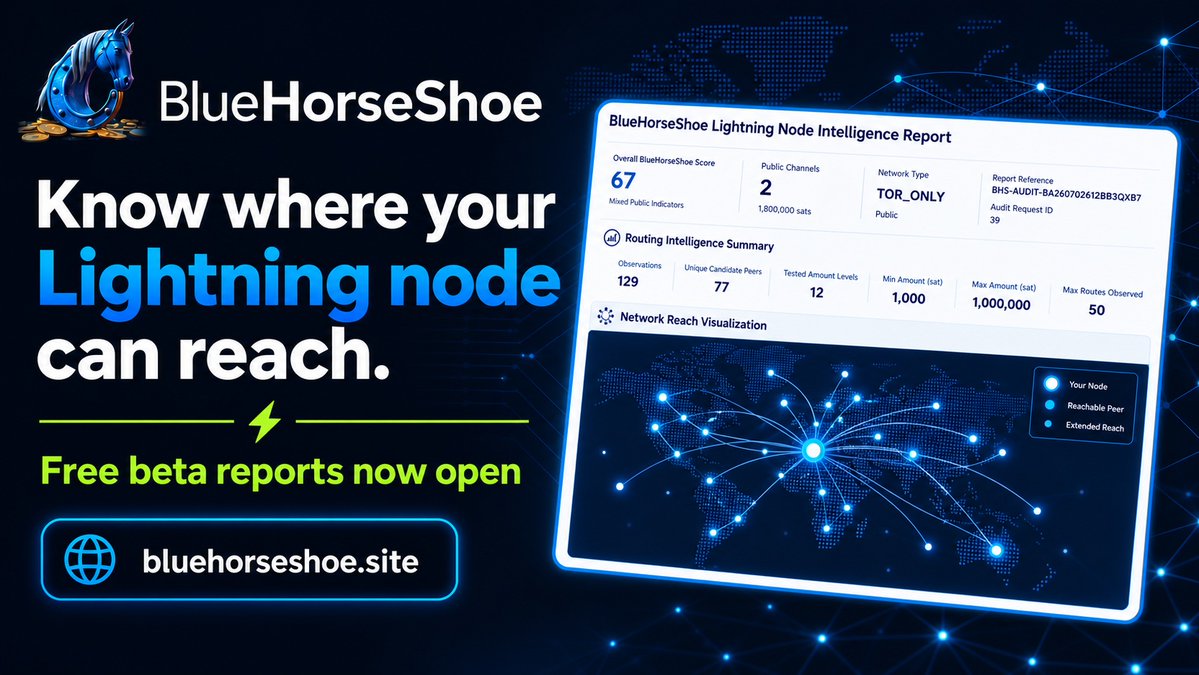
Before opening another channel, measure what your node can actually reach. BlueHorseShoe combines public graph evidence, routing intelligence and operator context to show how reachability changes by payment size and direction. Evidence over assumptions.
https://t.co/KEyK4F2K5y
A milestone for BlueHorseShoe. BlueHorseShoe is now live on Lightning Network+ node pages, alongside established Lightning tools including Amboss. Node operators can move directly from an LN+ node profile into BlueHorseShoe public-network intelligence- Evidence before you open.
Capacity isn’t enough. The right Lightning peer is about evidence: public graph position, routing observations, channel reachability and historical signals. Choose peers with a clearer view of the route — before you open. #Bitcoin#LightningNetwork#LightningNode
Know where your Lightning node can reach.
BlueHorseShoe maps public graph evidence, routing observations and potential peers into a practical node-intelligence report.
Free beta reports now open: https://t.co/KEyK4F2K5y
#Bitcoin#LightningNetwork#LightningNode
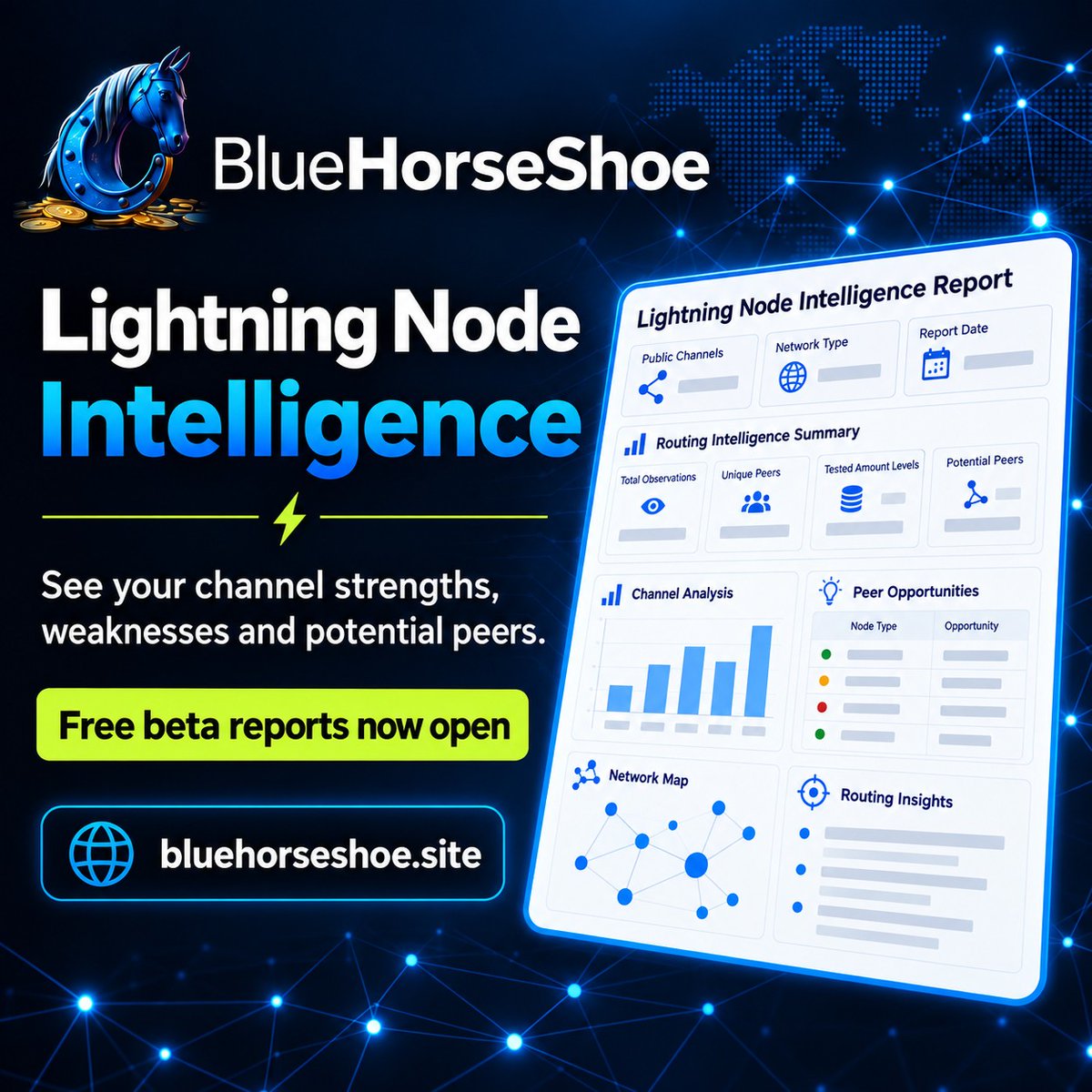
Your Lightning node has a routing story.
BlueHorseShoe turns public graph data and routing observations into a clear view of channel strengths, channel weaknesses and potential peers.
Explore your node report: https://t.co/KEyK4F2K5y
#Bitcoin#LightningNetwork#LightningNode
Can your Lightning node reach the destinations that matter? BlueHorseShoe uses public graph and routing observations to help operators see what the evidence supports before making channel decisions.
Explore Lightning node intelligence: https://t.co/KEyK4F2K5y
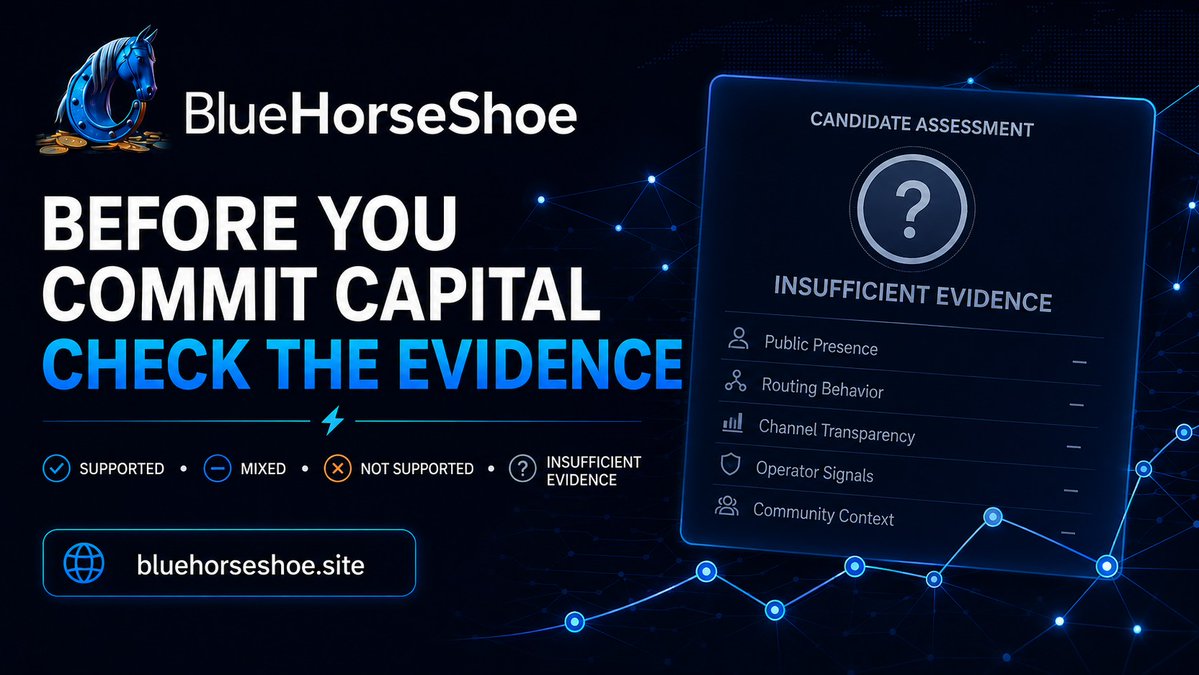
An unfamiliar Lightning peer can look impressive on paper. Before committing channel capital, check what independent public-network evidence actually supports — including route observations, evidence freshness and where the honest answer is uncertainty. https://t.co/KEyK4F2K5y
Not every unfamiliar Lightning peer deserves a forced yes/no answer. Sometimes the honest result is: insufficient evidence. https://t.co/7audYVlJkx examines public graph history, routing observations and evidence freshness before you commit capital. Check the evidence first.
@MostroP2P If you're considering more channel partners, BHS surfaced speed3 (11 route appearances, 200k–5M sats) and e960fd8385a1603003727 (9, 1k–5M) most often. CoinGate and luminet also appeared repeatedly. Candidates to investigate—not recommendations or performance forecasts.
@MostroP2P Your other Gosumi channel looked weaker: routes appeared through it up to 3M sats, but the channel wasn't selected in direct tests. Cochinito reached 1M each way; the remaining 2M-sat channel reached 900k out/1M in. Public route tests—not private forwarding data.
@MostroP2P@MostroP2P We mapped all 5 public channels from both directions—3,200 route-construction attempts. ACINQ was strongest: routes observed both ways and up to 5M sats. Your 8.999M-sat Gosumi channel reached 5M outbound, but only 500k–900k inbound in our tests. Want the full report?
@Dimi_h However before you open a channel, ensure you check the candidate node's reachability, routing evidence and peer fit—not just capacity. Use BlueHorseShoe for that decision. Operators can request a node report manually or retrieve the intelligence via API: https://t.co/7audYVlJkx
A trustworthy node shortlist is a filter, not a quota. BlueHorseShoe scores public evidence, excludes stale or previously reviewed nodes, and keeps operator decisions bounded. Better node decisions include knowing when not to act. https://t.co/7audYVlJkx
@thealbxrz This is exactly the operational context https://t.co/7audYVlJkx addresses. An API integration alongside @utexocom Cloud could add public-network reachability, routing evidence and candidate peer observations to support node and channel decisions.