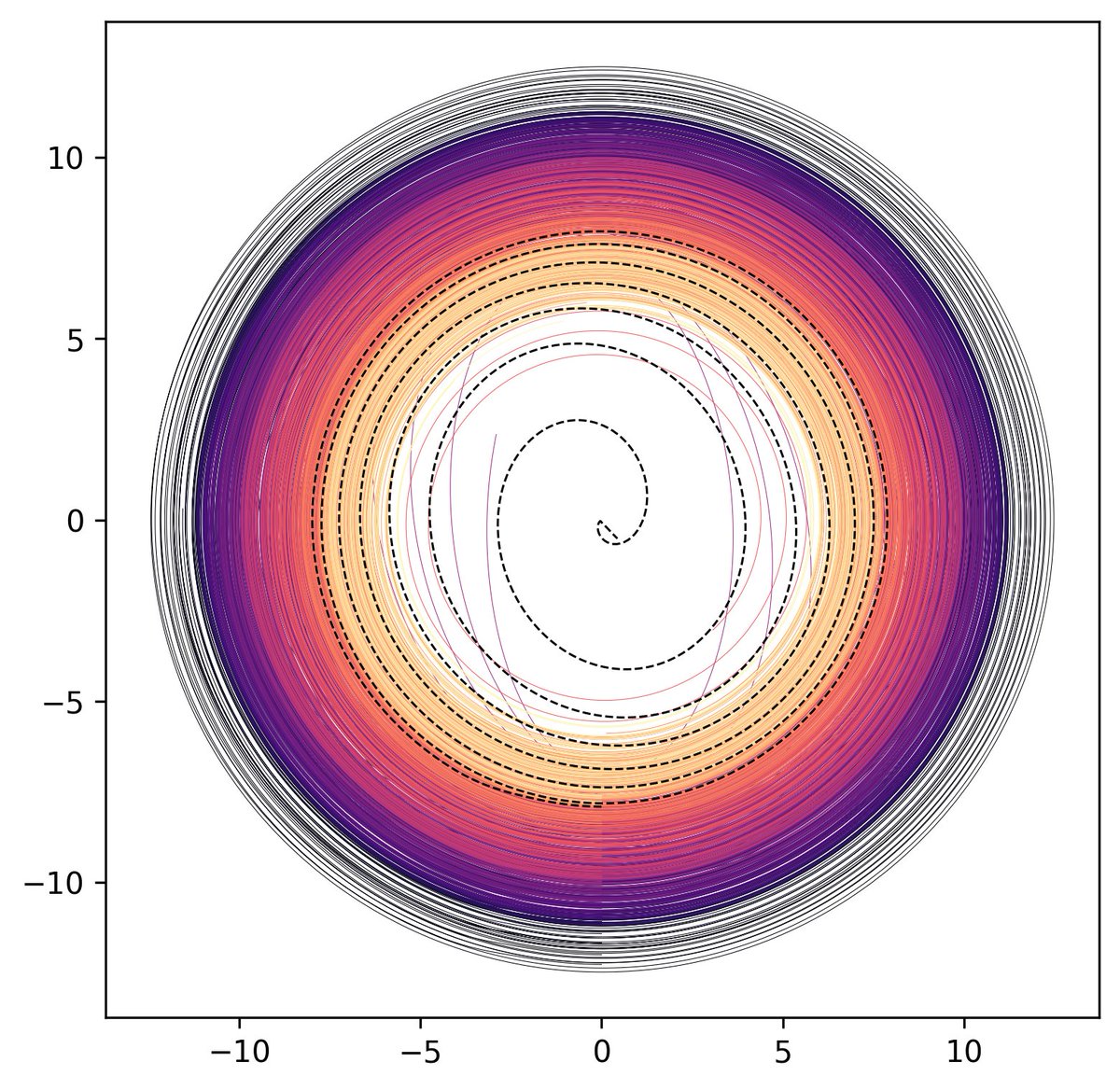
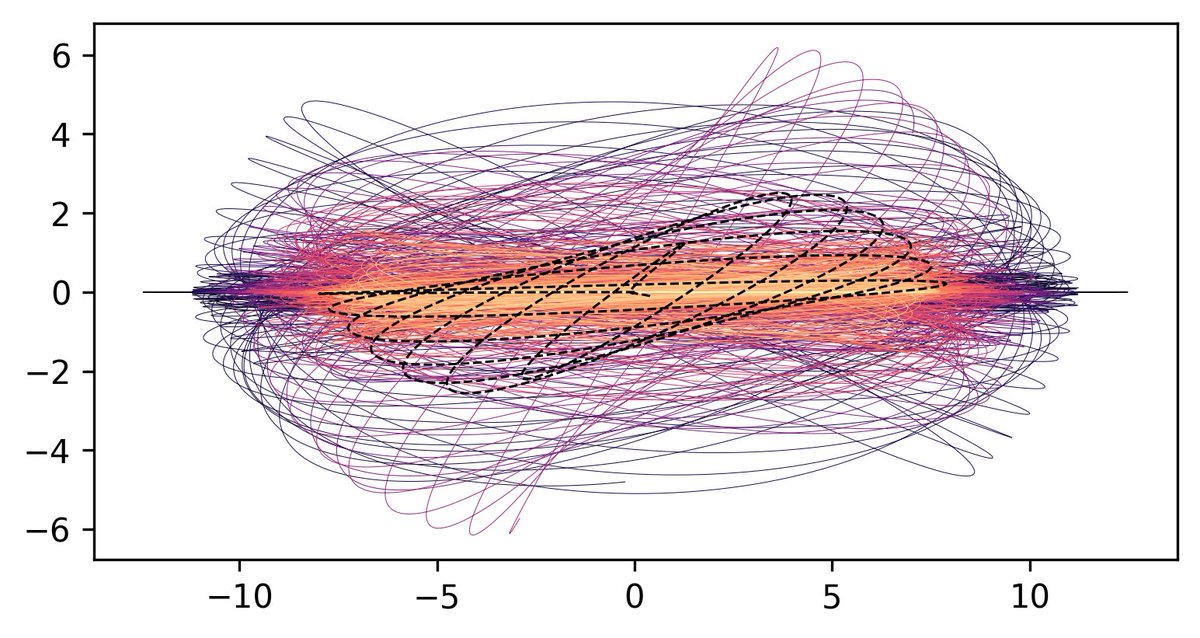
Capping off #BlackHoleWeek with a stunning BlackHoles@Home simulation of GW150914—the historic first gravitational wave detection by humanity, sparked by the merger of two black holes.
https://t.co/KkOD6fRyXR
Credit: Seth Winchell & the #UIdaho visualization team.
The main focus of the paper is on curtailing development & impact of a sharp "gauge" feature, which *dominates* binary black hole simulation errors.
Here's a companion YT video illustrating this. Top frame - original; Bottom frame - improved
https://t.co/sJUXIGOYfK
BlackHoles@Home aims to reduce the cost and increase the accuracy of binary black hole simulations. My latest paper shows these need not be mutually exclusive: https://t.co/epgXHDj636 ⚫⚫
#BlackHoles#GravitationalWaves#apsapril#NRPy
@TheBoinc Working on a paper that demonstrates how new techniques used in BH@H to solve Einstein's equations of general relativity significantly reduce errors in black hole collision simulations, with virtually no additional cost. The techniques are widely applicable.
🎉Proud to announce the release of NRPy 2.0, the SymPy-based code generation package for numerical relativity on which BH@H is based. It's a complete rewrite of the original NRPy code, and can be installed via
𝗽𝗶𝗽 𝗶𝗻𝘀𝘁𝗮𝗹𝗹 𝗻𝗿𝗽𝘆
More details: https://t.co/Dj3Gs7d6mm
Rest assured it's been a very busy 6 months on the NRPy / BH@H front. Each of these green squares represent an active day of NRPy/BH@H development, note most of the recent gaps are data collection errors.
https://t.co/aDX2FY45Iy
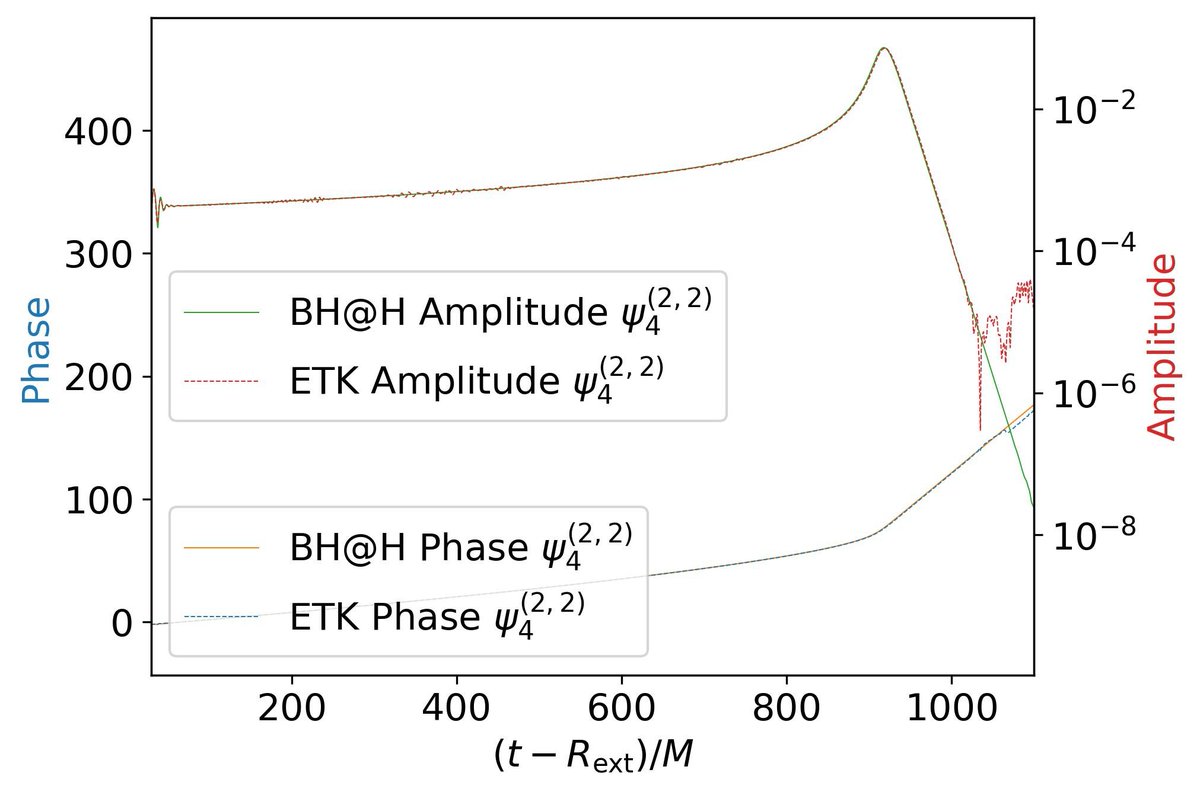
The first public release of gravitational wave data (psi_4) from BH@H:
https://t.co/sOfOV9Mome
The black hole simulation is the ETK gallery example: https://t.co/eCUxcvnrF5
Here's a comparison of the dominant GW mode. Higher-order modes in BH@H are beautiful.😀
Stay tuned for a big update. In the meantime, here's a recent article on a cluster being used for rapid BH@H testing and development:
https://t.co/beTKIfQCG7
Spent the past month updating/modernizing NRPy+, BlackHoles@Home's code-generation framework (attached image). Completed huge to-do list✅. Development focus has returned to BlackHoles@Home. Currently working to merge latest NRPy+ (https://t.co/xZUmJE3LCc) into BlackHoles@Home.
BlackHoles@Home uses and extends our NRPy+ code-generation framework. In preparation for BH@H launch, I have recently merged many of these extensions into NRPy+.🦭🦭🦭
Excited about next-gen numerical relativity? BH@H is now hiring! https://t.co/1tiFdS3TM5
With the onset of a new academic year, BH@H development generally slows a bit. I'm working to open source the latest scalability improvements, as many other important NRPy+ projects will benefit from this work: NRPyElliptic, NRPyCritCol, curviGiRaFFE, etc. https://t.co/8mpc07gSHQ
Summer 2022 update #3:
To simulate more extreme black hole mergers (with Charm++ https://t.co/DyPpzP260m) and help Leo Werneck generate fast GPU codes with NRPy+ (imagine BH@H running on GPU!), I worked to make our boundary condition algorithm far more scalable (Fig: L. Werneck).
Summer 2022 update #2:
Hackathons with Prof. Phil Chang! We're working toward the first-ever supercomputer simulations of binary neutron star mergers on moving-mesh grids, solving Einstein's equations in full. This work marries BlackHoles@Home with Phil's MANGA ALE GRHD code.
Summer 2022 update #1:
We hosted the Einstein Toolkit (ET) workshop in mid-June. I provided an update on BlackHoles@Home, how BH@H uses the ET to perform state-of-the-art black hole diagnostics, and the code release plan.
https://t.co/oQqmpERcyL
I prepared a 10-minute NRPy+ overview (https://t.co/PiwzsFcsoD) for my talk in a couple hours on NRPy+ / BlackHoles@Home (@SXSProject NR Community Call https://t.co/MoIJPNfU1v). Enjoy!
Congrats to my PhD student Thiago on his first publication in our group! NRPyElliptic generates the data needed to start black hole simulations, and we plan to eventually use it in BlackHoles@Home.
https://t.co/VExSPiiRnl ; https://t.co/YW6qPofcMg
@AnilZenginoglu No doubt there are gains to be made in this direction! I'm hopeful that an improved radial sampling will fix the attenuation more expediently. 😃
We measure gravitational waves far from the black holes, on a big spherical grid with exponentially increasing radial grid spacing. This pushes the boundary of the simulation far away, but the rapid drop in resolution causes attenuation. Working on improved radial transformation!