How LPing can look on Meteora:
- Scanner shows you the best pools right now
- Sets the ranges with the highest trading volume for you
- Monitors the token trading and your position to exit as volume falls off.
Early MVP live soon
Waitlist: https://t.co/aINMSIuo1B
Gmet
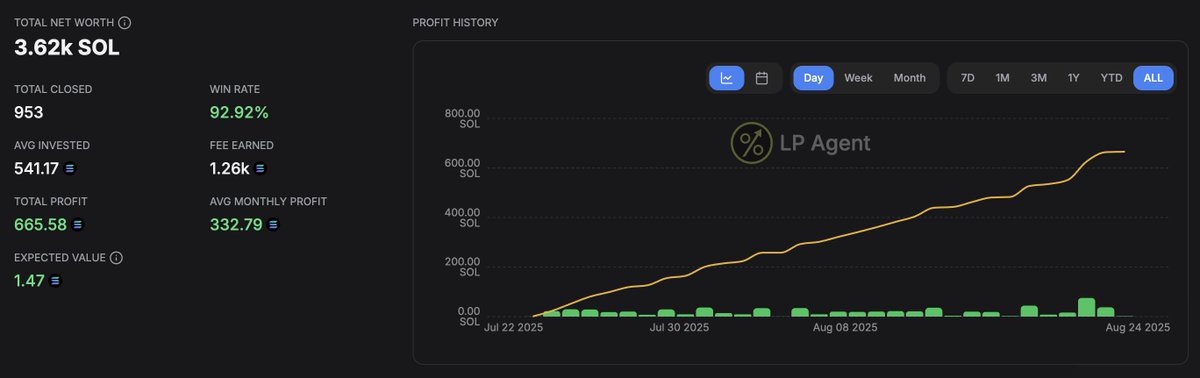
I’m excited to share the results of my slow and steady @MeteoraAG DLMM strategy over the past 30 days:
💰 +594 SOL (+19.6%)
🟢 100% daily WR
⏱️ 1–2h/day max
At this pace, the strategy compounds to >750% APY.
After months of refining and countless lessons learned, the key has become clear: target small but consistent daily gains, leverage the power of compounding, and protect capital at all costs.
Details below 👇🧵
A base position is 7% of capital; the source allows larger sizes and exceptions for strong tokens. A twice-daily routine therefore isn’t a hard loss limit.
3/4
Impermanent heart attack by @MikusLP is going into BINBOT's strategy libray.
Use when: A token expected to dump hard, in a pool whose fee (10%) is high enough to pay for the impermanent loss.
Some people call memecoin trading "gambling", which I think is partly true.
But if you want to gamble, do so smartly
Here is my "impermanent heart attack" strat 🧵
BINBOT beta checkpoint:
✓ Real mainnet positions opened and closed
✓ Internal testing underway
→ Full trading journey and recovery checks in progress
○ External beta access
Did you sign up for the waitlist already?
A pool scan tells you which pools deserve a closer look. Then you check the range.
BINBOT's scanner will sort Meteora pools by volume, liquidity and fees over the same window
These 4 rules are what make my slow cook positions safe
The goal is minimizing the risk of losing across the whole portfolio
> What safe does NOT mean
A safe position is not a wide range https://t.co/22TfMH4eqP
And it's not bid ask
> The 4 rules
1. Cut out tokens where I see a real chance of heavy dumps
2. Only tokens with print, no print means no position, period
3. If I don't like the current entry, I open in the range I want on the chart, not at market price https://t.co/PFgfQ2zRBJ
4. If there's no print even in the middle of the range, I cut the loss instead of hoping the token suddenly starts printing
> Bottom line
These rules are more than enough to show steady average profit over the long run
Which Meteora pools are paying fees right now?
I sort the pools so you can compare fees, liquidity and volume before choosing a range.
Register for early access: https://t.co/twfftQ2ugn
Bid-Ask & chill Strategy is going into BINBot's strategy library, credited to @lochie_sol.
Use on a volatile memecoin with real volume that you expect to dip and bounce.
The wide range gives up fee income to survive most dumps.
If you run it: which rule do beginners get wrong most?
Fees earned and profit made are two numbers.
A DLMM position's fees grow while its token mix changes.
To review a trade, compare starting assets, ending holdings, fees and costs in one unit.
The BINBOT AI assistant can walk you through it.
My Layer Cake Strategy 🍰
This is my favorite LP setup, a one-sided $SOL bid–ask strategy that’s proven to work in every market.
In this video, I show how I layer positions on @MeteoraAG to capture steady fees, limit downside, and stay positioned through all kinds of volatility.
It’s called the Layer Cake because you build it step by step, liquidity-layer by liquidity-layer:
Recipe:
1️⃣ Find a token with a solid uptrend and identify a solid support zone.
2️⃣ Open your first one-sided $SOL bid–ask position. The middle of the range, should be a support level on the chart.
3️⃣ When price dips 50–60% into your range, add a second layer (double the size).
4️⃣ Keep layering 2–3 times as the market builds structure.
5️⃣ Take profits or rebalance (close upper position) on bounces.
Tip: If you're a beginner, increase the range of your position by 100% of the bins.
Simple, repeatable, and scalable. This setup has carried me through every market cycle.
📄 Recipe doc:
👉 https://t.co/dLQmSrZENo
🎥 Full breakdown video below 👇