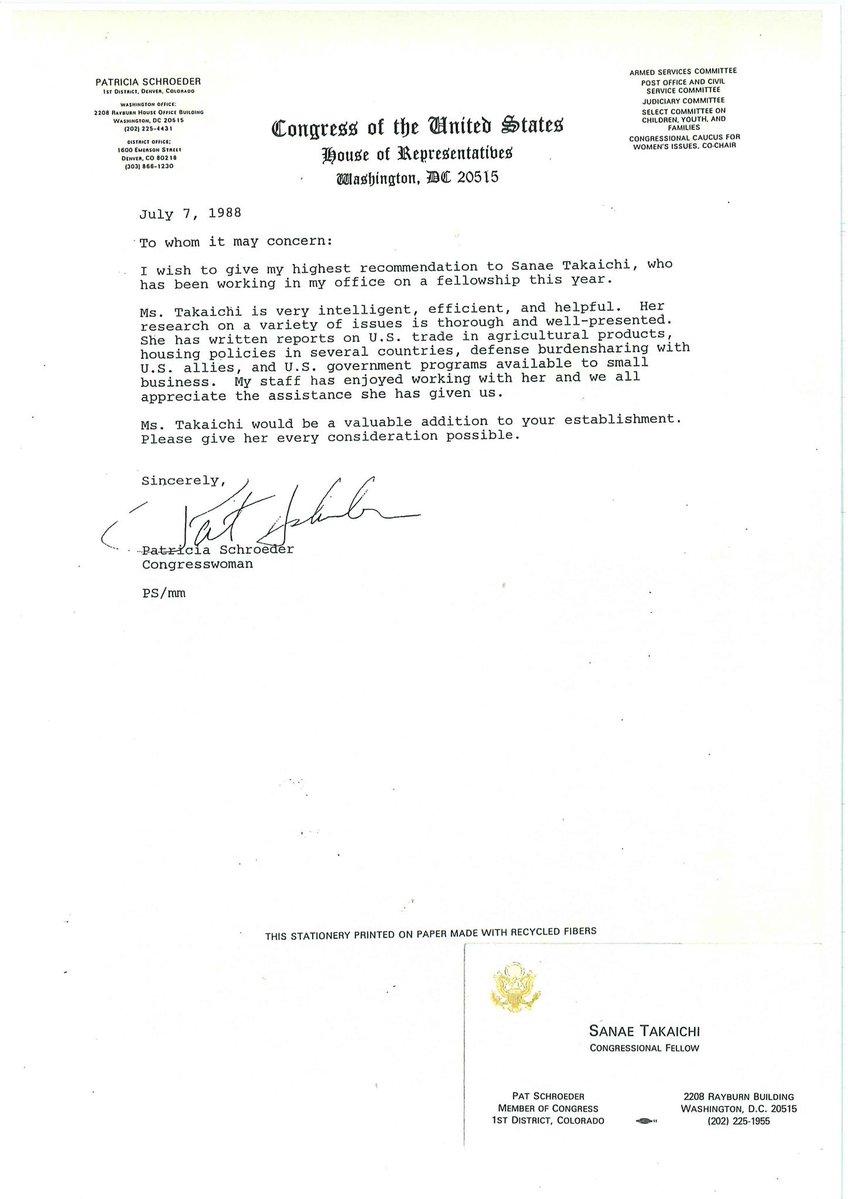
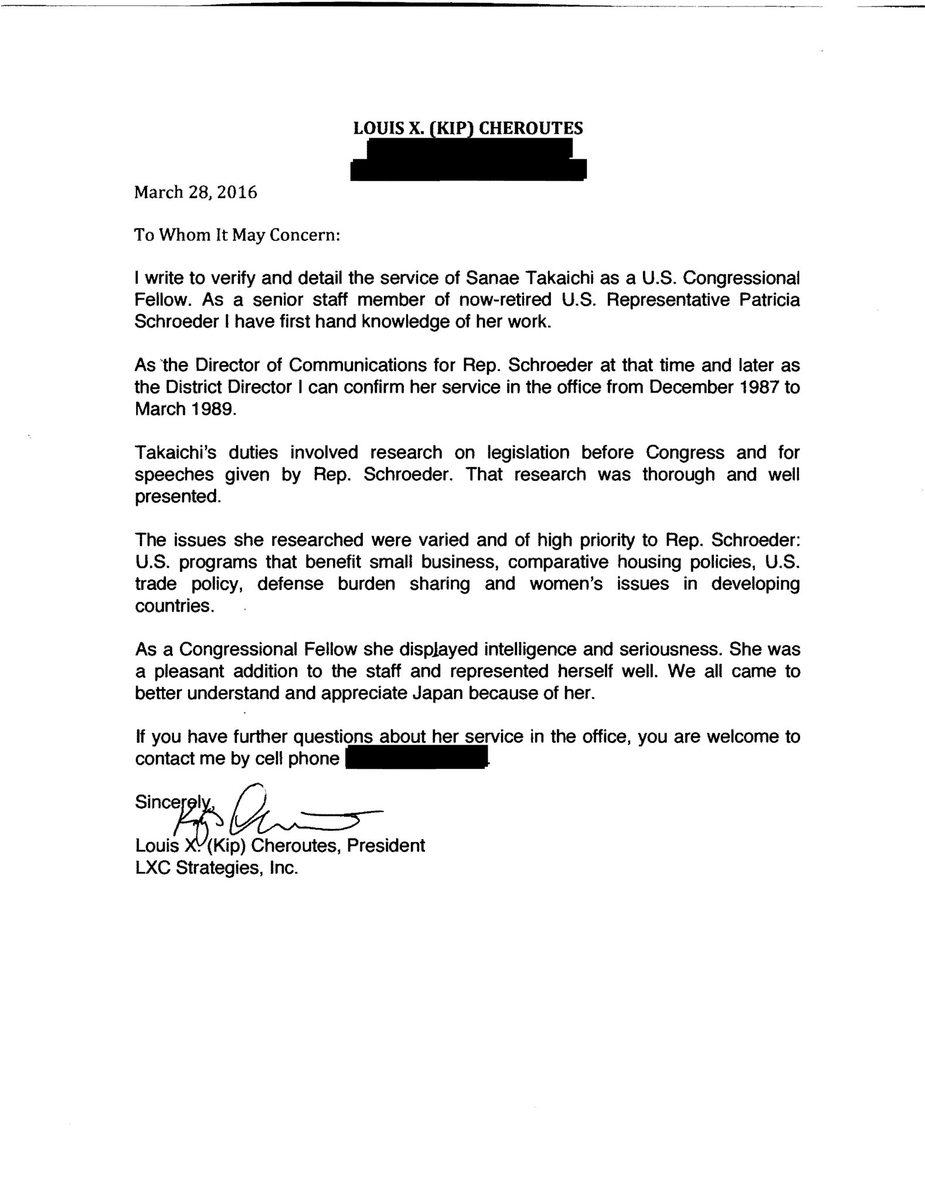
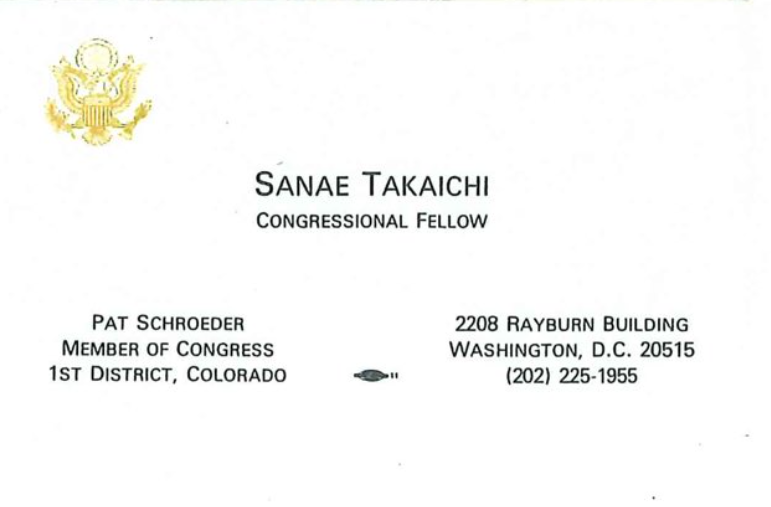
The Japanese government has posted proof that PM Takaichi worked as a Congressional Fellow in the 1980s.
The staffer who referred to her as an "intern" has said "she was technically a Congressional Fellow."
Many non-native English speakers are interpreting this in what I would consider a very wrong way. I don't think he was trying to belittle Takaichi or emphasize that she was a "fellow" in title only. In this context, Mr. Cheroutes was clearly correcting remarks he'd made to the media. He said she was an "intern," but was asked to clarify, and noted that she was a Congressional Fellow (her technical/official title).
In DC (where I was born), it is common to use the word "intern" to refer to a variety of non-permanent positions, including fellowships. In Japanese, the word intern tends to be attached to less important jobs.
Mr. Cheroutes probably had no idea that Japanese people would read his original remarks, attach their own interpretation to the word "intern," and try to label Takaichi as a fraud.
OOPS. THE RICH WORLD is pouring billions of dollars into the wrong chips, analysts are warning.
The west is betting untold fortunes on AI chips.
But China has quietly become the leader in making factories to produce classic “mature” semiconductors—which make up an estimated 65 to 70 per cent of the market.
These dominant chips are in heavy demand and are essential for hi-tech manufacturing. You can't make a car without them.
“About 50% of the new mature node capacity being built globally” is in China, said Future Digest, a tech commentary website.
.
‘SURPASSING TAIWAN’
China is working harder on this than the rest of the world.
Chinese manufacturing capacity for this larger type of processor “is projected to reach 42% of global output by 2028, up from 37% in 2026,” Lily Feng, president of Semiconductor Equipment and Materials International, told Reuters in an interview earlier this year.
Even people on the legally Chinese island of Taiwan agree that a power shift is happening in the production of the less hyped but dominant class of chips.
“By 2027, China’s share is projected to surpass Taiwan’s, while South Korea and the US, with single-digit shares, are expected to decline,” said a 2025 Taipei Times report, focusing on data from TrendForce Corp.
.
ABSOLUTELY FAB BARGAIN
Semiconductor factories (called “fabs” from the word “fabrication”) are priced differently. The west is racing to spend $15 billion to $30 billion on each AI chip fab.
But fabs for the dominant chip group cost only about $3 billion each—much cheaper, though not glamorous enough to make headlines.
The mistargeting has come about because journalists are only really interested in the tiny (about 7nm) processors favored for AI usage and made in Taiwan, analysts say.
Yet the majority of chips used in the world are classic processors, often defined as 28 nm to 40 nm (or larger).
Rand Tech warned about this in a recent report titled: “Why Mature-Node Capacity May Be the Semiconductor Industry’s Biggest Blind Spot.”
Other commentators warn that shortages of the classic chips are already happening.
“These aren’t sexy. They’re not fast. They won’t train the next ChatGPT,” said Future Digest. “But without them, your car doesn’t start. Your refrigerator doesn’t cool. Medical equipment shuts down. Industrial systems stop. Defense systems fail.”
.
PREFERRING THE OLDER CHIPS
Cost is another factor. A range of companies given the choice are actively choosing the larger chips, rather than the pricier ones made only on the island of Taiwan.
“Many industries, including automotive and IoT, prefer mature nodes (28nm and above) for their lower production costs and proven reliability,” said a recent report in Intel Market Research.
“These process nodes strike a balance between performance and cost-efficiency, making them ideal for mass-market applications.”
.
INVISIBLE ASSETS
Let’s be clear. Classic chips are NOT old, oversized, clunky things you can drop on your foot.
For visualization, 40 nm is roughly 2,500 times thinner than a human hair. So the division is between hi-tech things too small to see, and other hi-tech things which are also too small to see.
Nor are the classic chips limited to old appliances. They are the standard chips used today in cars, smartphones, and multiple modern electronic gadgets.
About 80 per cent of the 2,000 or so semiconductors in modern cars, produced today, are the classic chips, carmakers say.
.
BACK TO BASICS
Rand Tech’s Doug Getty also said investors’ focus was too limited.
“Unlike leading-edge semiconductor capacity, which has attracted massive investment and public attention, mature-node production remains constrained, fragmented, and increasingly difficult to expand,” he wrote in a June 3 report.
So, while the west is pouring massive amounts of investment at everything associated with AI, particularly advanced chips, they’ve shifted focus away from the bedrock product of modern electronics. But China hasn’t.
.
FUTURE MEETS THE PAST
But in making more classic chips, have the Chinese abandoned the cutting-edge AI market?
No – they are using innovative technology, such as chip-stacking and use of optical connects, to get past the US’s coercive behaviour, in which Washington ordered the Netherlands, Japan and Taiwan to stop selling advanced chip-making goods to Mainland China.
(Unexpected consequence: China has become a major global supplier for optical interconnects.)
Meanwhile, will the AI revolution make classic chips obsolete? No. One of the long list of items that cannot function without the standard type of semiconductors is…
…the infrastructure of AI datacenters.
WATCH: Israeli minister Smotrich shouted off stage by Gaza-border residents at memorial event.
Smotrich was forced off the stage by residents of the Eshkol Regional Council during a ceremony to lay the cornerstone for 1,000 housing units near Gaza, held at Kibbutz Ein HaShlosha.
Protesters confronted him directly over his past opposition to hostage deals:
You have no right to exist here. Get off the stage.
If you loved me, you would have protected Roni.
If you hadn't opposed the hostage deal at the time, many more hostages would have come back alive.
NEW: Google billionaire Sergey Brin is reportedly among the many New York City landlords fearing more hurt from capitalism-hating Mayor Zohran Mamdani’s rent freeze — seemingly dumping his stake in a real-estate fund for pennies on the dollar, NY Post reports
NEW: Warren Buffett is skipping his midyear donations to the Gates Foundation for the first time in 20 years while awaiting the results of a review into the organization’s links to Jeffrey Epstein, the Wall Street Journal reports.
🇨🇳🇺🇦 China "strongly" called on Russia and Ukraine to cease hostilities and resume negotiations, - Deputy Permanent Representative of China to the UN
The Chinese diplomat also mentioned the suffering of the civilian population. Lei assured that "this problem really worries Beijing".