1/ 🇺🇸 O Consulado dos EUA em São Paulo começou a reunir influenciadores da ultradireita em encontros reservados sobre "liberdade de expressão e ambiente digital". Sob esse rótulo diplomático, monta-se uma operação eleitoral. Vale destrinchar o que está em jogo.
“Antes usávamos o poder em situações perigosas em prol da democracia”, disse o alto funcionário do Departamento de Estado.
“Agora enviamos indicações políticas para desacreditar o sistema eleitoral de outro país.”
Acho que a imprensa brasileira não deu a devida importância ao ponto que esta senadora americana destaca. Mais: por que não entrevista-la?
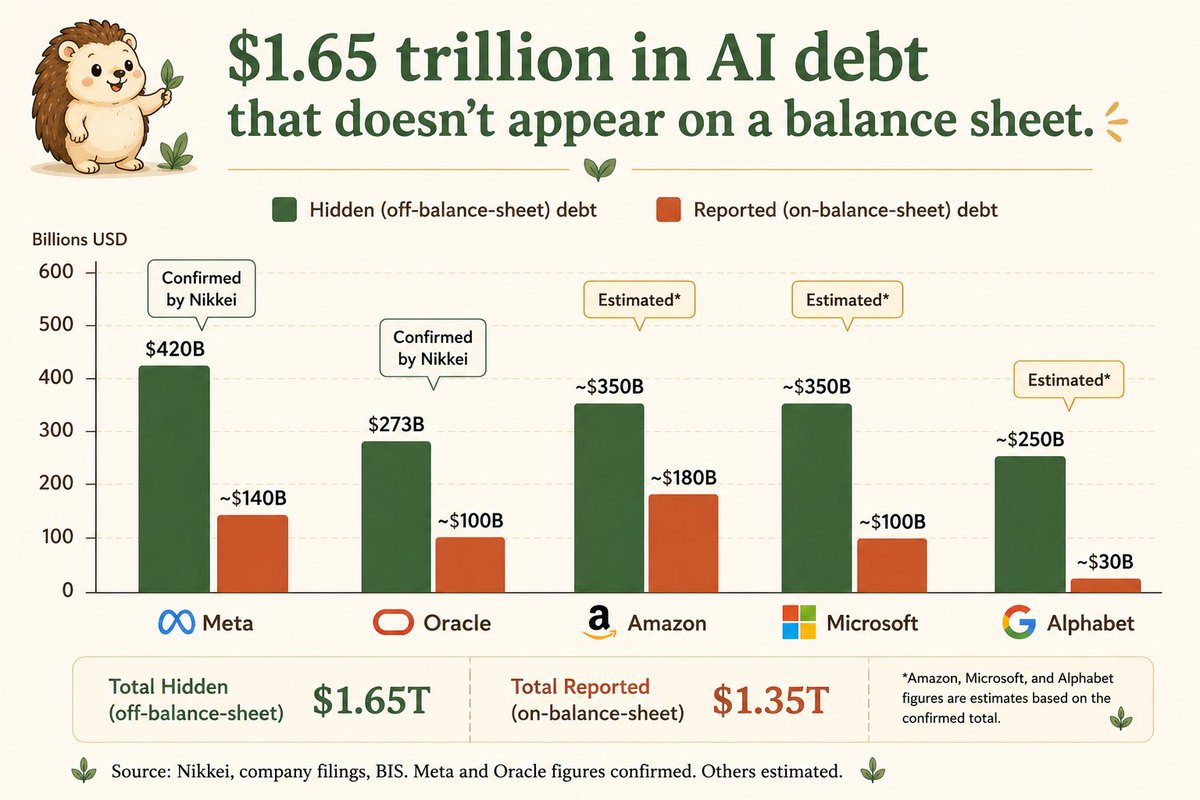
🦔A Nikkei investigation found that Alphabet, Microsoft, Amazon, Meta, and Oracle have $1.65 trillion in debt that doesn't appear on their balance sheets, more than the $1.35 trillion they officially report. These are GPU contracts, data center leases, and joint ventures that don't count as debt under accounting rules until the facilities go live. Meta's hidden debt is $420 billion, triple its reported debt. Oracle's grew 30-fold in four years. All five declined to comment.
My Take
Nikkei examined the actual filings and put a number on something the BIS already flagged as "shadow borrowing" back in March. These companies owe more off their balance sheets than on them, and the accounting rules let them keep it that way until the data centers go live. That's legal, but it means investors looking at quarterly earnings this week are seeing less than half the picture.
Four of these five report earnings in the next two weeks. The reported debt will look manageable. The $1.65 trillion in footnotes won't make the headlines. But when those data centers start operating, the leases hit the books all at once. If AI demand comes in below projections, those facilities get marked down and the losses land on the investors and insurance policyholders who funded the construction through private credit and project bonds without realizing how much total exposure they were carrying.
Hedgie🤗
🇺🇸🇷🇺NEW ARTICLE: The Ukraine War is a US war on Russia
(NOTE: Because Elon Musk's X continues censoring content together with the State Department, NEO articles are unavailable on the platform, therefore the entire article is reprinted below).
As the Western media continues shaping narratives depicting a growing divide between the US and Europe regarding the ongoing conflict in Ukraine - a narrative involving an increasingly disinterested and disengaging US with an increasingly desperate and confrontational Europe - it is important to remember precisely how this war was started and why, as well as the material reality shaping its continuation.
By doing so, it is revealed the only "division" taking place between the US and Europe is a “division of labor,” a phrase literally spoken by the US Secretary of Defense Pete Hegseth in Brussels in February 2025 delegating the continuation of what is a US proxy war on Russia to Europe while the US redirects resources toward Asia.
Precisely because the war in Ukraine is a US proxy war on Russia, and the fact that Ukraine’s trained military manpower and territory continue to contract under the pressure of Russia’s strategy of attrition, to continue the war will require introducing additional pools of trained military manpower - and to extend Russia further - to do so along a wider front.
The military build-up of the Baltic states appears to be at a minimum an attempt to fix Russian forces along their border with Russia. The worst case scenario for Moscow would be for the US to repeat with its Baltic state proxies what it has already done in 2008 with its Georgian proxies and what it has done from 2011 onward with its Ukrainian proxies - attack Russia and its allies militarily, precipitating wider war along a wider front.
Western European nations, including the so-called “coalition of the willing,” led by France, Germany, and the United Kingdom, have implemented Secretary Hegseth’s directives from February 2025 enthusiastically - directives including to “double down” on arming Ukraine, “spending more on defense,” and convincing the European public of the “threat facing Europe” (meaning Russia).
With this in mind, it is clear there is not only no split of any kind between the US and its European proxies, Washington’s European proxies have demonstrated unflinching servile obedience even at the cost of placing themselves on the precipice of war with neighboring nuclear-armed Russia themselves.
The Larger, Long-Engineered War on Russia
Surrounding Russia with a number of geopolitical and economic crises to “extend Russia” with the hope of eventually precipitating a Soviet Union-style collapse, is the subject of numerous US policy papers spanning the entirety of the post-Cold War period.
There is even a paper published by the RAND Corporation literally titled, “Extending Russia,” listing a number of measures the US has since implemented verbatim before and since its publication in 2019.
The paper lays out the economic and geopolitical measures the US has since used to both prepare the grounds for this current proxy war, and to both perpetuate and expand it over time.
These measures include targeting Russia’s energy exports including specifically targeting pipeline expansion (Nord Stream, since destroyed by the US), the imposition of sanctions on Russia, the destabilization, destruction and/or the political capture of Russia’s allies both along its borders and beyond (including Ukraine, Georgia, Belarus, and Armenia, as well as Syria), and the arming of Ukraine itself following its political capture by Washington in 2014.
This latter measure, the RAND paper admits, would inevitably invite in wider conflict with Russia - and it did. The paper also admitted the measure would likely end in “disproportionately large Ukrainian casualties, territorial losses, and refugee flows,” and that, “it might even lead Ukraine into a disadvantageous peace.”
The purpose of US policy is not to necessarily “defeat” Russia in Ukraine, or in Georgia, or Armenia, Syria, or in any other particular region - but to create a multitude of crises mounting ever increasing pressure on Russia to create cracks and collapse wherever opportunities allow, and eventually precipitate overall collapse following pressure along a large and growing collection of fronts.
And this is precisely what the US is doing.
It doesn’t matter that Ukraine can’t win the current US proxy war against Russia - or that Europe collectively might not be able to either. US objectives are to create a growing conflict that eventually outpaces Russia’s ability to respond and defend itself against.
Similar strategies have been used against other targets of US “regime change” including Libya, Syria, and Iraq spanning decades before finally and fully succeeding.
Thus, the measure of Russia’s success is not simply on the battlefield in Ukraine, but its success or failure in defending itself against this much wider campaign of US-driven encroachment - a campaign that has transcended all US presidential administrations since the end of the Cold War without exception and will continue to do so into the foreseeable future.
The Growing Drone & Missile War
Growing attention has been placed on the steadily expanding drone and missile campaign targeting Russia deep within its territory. While proponents of Ukraine claim the strikes have “turned the tide” in Ukraine’s favor, and Russian proponents claim the attacks have had no impact at all - the truth is likely somewhere in between and subject to shift as both sides adapt. .
The Western media has already admitted “Ukraine’s” deep strikes into Russia using both US and European-manufactured missiles and drones are actually the product of the US intelligence community and the US military.
In late 2025 the New York Times would admit, “the Central Intelligence Agency and the U.S. military, with [US President Donald Trump’s ] blessing, supercharged a Ukrainian campaign of drone strikes on Russian oil facilities and tankers.”
More recently, the Financial Times would explain:
"Analysts attribute the growing success of Ukraine’s drone campaign to its ability to significantly increase production, as well as improved management.
American intelligence assistance has also played a role, aiding Kyiv in charting the best paths for its drones and helping to skirt air defences, senior Ukrainian officials told the FT."
Of course, Ukraine’s “ability to significantly increase production” actually translates into expanded production by both the US and Europe who then simply transfer components, kits, or entirely assembled drones to Ukraine for storage and use.
This includes the US-made artificial intelligence (AI) driven “Hornet” drones - a result of former Google CEO Eric Schmidt’s AI drone campaign announced at least 2 years ago.
These US-made and directed drones are carrying out a large-scale region-wide campaign of strikes on Russian maritime shipping in the Sea of Azov, the Black Sea, the Mediterranean Sea and beyond, as well as military, civilian, and energy production infrastructure at further and further ranges from the Russian-Ukrainian border deep inside Russian territory.
While the damage inflicted by these attacks has not matched Russia’s missile, guided bomb, drone, and guided rocket attacks on Ukraine, it is admittedly causing disruptions even according to the Russian government itself, especially for specific regions like Crimea and logistical routes leading into it.
Remembering that Washington’s goal with its war in Ukraine on Russia and its wider campaign of encroachment is meant to “extend,” not “defeat” Russia, it cannot be denied that the US strategy has significantly raised the costs of an already expensive war forced onto Russia.
The US and its European proxies will likely never match Russia in military industrial production, but given enough time, it will certainly continue to expand its ability to inflict greater and greater costs unless and until Russia is able to fully and finally end the war in Ukraine on the battlefield.
With the prospect of Ukraine collapsing and the war ending - the temptation for the US to open up additional fronts along Russia’s borders will increase - with preparations seemingly already underway for just such a front in at least the Baltic states.
Wider War on Multipolarism
As the US continues escalating its war on Russia in Ukraine - threatening to expand it even further across the rest of Europe - the US also continues its direct war of aggression against Iran - together precipitating a widening, global energy crisis aimed directly at China itself.
Meanwhile, the United States continues shaping the Asia-Pacific region in precisely the way it shaped and transformed Europe vis-a-vis Russia and West Asia vis-a-vis Iran - for large-scale war and/or proxy war with China.
The US is in the process of transforming the Philippines in Southeast Asia into the Asia-Pacific’s “Ukraine,” while integrating the military capabilities of South Korea, Japan, and the Philippines under a single interoperable US military command.
Just as the US has utilized drone attacks on Russia laundered through “Ukraine,” the US is likewise preparing the Philippines and the Chinese island province of Taiwan as launching points for similar attacks on China.
Understanding the wider, global nature of US foreign policy the US proxy war on Russia fits into helps explain the growing degree of cooperation between the primary targets of this US foreign policy - notably Russia, China, and Iran. Understanding that the US is advancing this policy by not only directly targeting these three nations, but also targeting third-parties - undermining, politically capturing, and using them as proxies to advance this policy - helps highlight the imperative of creating a global effort to expose and defend against this threat the US pursuit of primacy poses.
This threat is not only of a military and economic dimension, but also targets information, education, and political space.
Centuries ago - securing only one’s castle against a siege gives an enemy access to all the space and resources surrounding that castle - creating dynamics of attrition that favor the enemy over time no matter how well-protected the castle itself is. A besieged castle that creates strategic depth far beyond the walls of the castle, enabling it to attack and deny an enemy the ability to approach let alone begin the siege, increases the odds of victory in the long-term.
Today, the multipolar world needs to improve its strategic depth as much as individual nations need to fortify their borders against US encroachment, aggression, infiltration, destabilization, and political capture or collapse. This must be done not only through the traditional domains of national and global security, but also by focusing on information space - a domain as important to protect in the 21st century as one’s airspace, land borders, and shores.
Integrating this policy not only nationally, but across the emerging multipolar world in a collective manner helps create the strategic depth required in the 21st century to frustrate and defeat aggression today as strategic depth has done in past centuries.
Only time will tell whether or not Russia’s advantages amid the US proxy war in Ukraine can be extended successfully to the much wider campaign of encroachment the US is pursuing against Moscow - and whether Russia, Iran, and China can combine their efforts sufficiently enough to frustrate and defeat Washington’s global campaign of encroachment and aggression it is subjecting the rest of the world to.
Brian Berletic is a Bangkok-based geopolitical researcher and writer.
@BreakPointBR Somente 04 tenistas na Era Aberta conseguiram mais de uma virada 0x2 no mesmo Slam: Nicolas Escudé (Aberto da Austrália de 1998), Albert Costa (Roland Garros de 2003), Tommy Robredo (Roland Garros de 2013) e o João.
❗️Reports by Associated Press regarding alleged 'evacuation' of the Russian Embassy in Venezuela @EmbajadaRusaVen are simply put — A LIE.
Be careful and don't fall for Western provocations!
🚀🇨🇳🇧🇷 China & Brazil Launch a Space Lab: Multipolar Power in Action
China and Brazil just opened a joint space-research laboratory and this move says far more about geopolitics than science alone.
1️⃣ China is building a global space ecosystem outside U.S. influence
Beijing is expanding into:
- Deep-space research
- Hemisphere-wide data networks
- Dual-use technology cooperation
- Science diplomacy across the Global South
A China–Brazil space lab is not symbolic, it’s structural.
2️⃣ Brazil just proved it’s not playing the U.S. “choose a side” game
By partnering with China, Brazil:
- Rejects U.S. strategic pressure
- Strengthens BRICS+ scientific ties
- Gains leverage between great powers
- Positions itself as a Global South tech leader
Latin America is shifting toward multipolarity.
3️⃣ This gives China hemispheric reach the U.S. has tried to block
Through Brazil, China gets:
- Southern Hemisphere observation capability
- Global data relay points
- Influence over future satellite networks
- Deep science partnerships in America’s former strategic backyard
4️⃣ Space cooperation is the quiet backbone of modern power
Joint labs lead to:
- Shared satellite missions
- AI-driven space data analysis
- Robotics research
- Astronomy infrastructure
- Dual-use technological compatibility
This is how 21st-century blocs are built: through cooperation, not coercion.
5️⃣ What this really means
China is creating a parallel global science ecosystem.
Brazil is stepping into its role as a rising middle power.
And the U.S. is watching its once uncontested hemisphere shift beneath its feet.
This isn’t noise, it’s the architecture of a new geopolitical order.
🇺🇸🇨🇳 The New U.S. National Security Strategy Is a Direct Message to China and Beijing’s Response Says Everything
Washington just released its updated National Security Strategy (NSS) and it is the clearest blueprint yet of how the U.S. plans to confront China over the next four years.
Here’s what’s actually going on 👇
1: The NSS practically puts “Taiwan” on page one
Washington calls China the “pacing challenge”, meaning the rival that determines U.S. military planning, spending, posture and diplomacy.
And the document makes one thing painfully obvious:
Deterring China over Taiwan is now Washington’s top near-term priority.
Not because of “democracy.”
But because Taiwan gives the U.S.:
- Control of the First Island Chain
- Direct access to the Pacific
- Leverage over global shipping routes
- Dominance over advanced semiconductors
- A strategic wedge between Northeast & Southeast Asia
Losing Taiwan equals losing the Indo-Pacific.
Washington finally said the quiet part out loud.
2: The U.S. strategy depends on forcing allies to carry the burden
The NSS admits America cannot contain China alone.
So the pressure campaign begins:
🇯🇵 Japan: more spending, more bases, more involvement
🇰🇷 South Korea: larger role in protecting the First Island Chain
🇦🇺 Australia: forward posture & AUKUS integration
🇵🇭 Philippines: more U.S. access points
🇹🇼 Taiwan: deeper military cooperation
🇮🇳 India: counterweight in the Indian Ocean
This is not cooperation.
This is Washington outsourcing containment.
3: Beijing’s response was classic: calm tone, immovable red line
China didn’t take the bait.
The Foreign Ministry replied with:
- “Stable development”
- “Win–win cooperation”
- “Manage differences responsibly”
…but repeated, with absolute clarity, that:
Taiwan is a red line tied to sovereignty, stability and national rejuvenation.
In other words:
“We’ll talk about trade, tech, climate, but not Taiwan.”
Beijing stayed measured, but firm.
4: The Busan summit didn’t solve anything, it just bought time
The Xi–Trump meeting delivered friendly optics… and zero solutions to the core disputes:
- U.S. tech controls remain
- China’s military posture remains
- Economic spheres remain in conflict
Analysts are calling this phase an “uneasy equilibrium.”
Both sides are stabilising the relationship, while preparing for a long strategic contest.
5: Washington wants to delay conflict. Beijing wants to be ready.
This is the real story:
- The U.S. is building a structure of denial
- China is building capacity, alliances and resilience
- Neither side wants war now
- Both sides want advantage before 2027–2030
We are in the preparation phase, not the confrontation phase.
Bottom line:
The NSS is not about values or global leadership.
It is an admission that the U.S. fears losing strategic dominance in Asia and Taiwan is the hinge.
China’s response shows confidence:
steady, unshaken and focused on long-term advantage.
The rivalry isn’t exploding.
It’s settling into shape.
Stability for now. Strategic competition for the long haul.
A USAID, agência dos EUA atuando no Brasil. De 2015 a 2024, investidos R$ 1,3 bilhão em 48 milhões de hectares na Amazônia. Série sobre atuação externa, Bioprospeção legal e também BIOPIRATARIA estreia terça, 18, às 19 hs no Canal Bob Fernandes no YouTube.
JAPAN JUST KILLED THE GLOBAL MONEY PRINTER AND NOBODY NOTICED
The most dangerous number in finance right now is 1.71%.
That’s Japan’s 10-year bond yield. Highest since 2008. Here’s why your retirement just got obliterated:
For 30 years, Japan printed infinity money at 0% rates and exported it worldwide. $3.4 trillion flowed into US Treasuries, European debt, emerging markets. This invisible bid kept YOUR mortgage cheap, YOUR stocks inflated, YOUR government solvent.
November 10th, 2025: The bid disappeared.
Japan’s yield hit 1.71%. They’re pumping $110 billion stimulus into their economy while debt sits at 263% of GDP. The math just became impossible. At 1.7% rates, Japan pays $27 billion MORE in interest. Every. Single. Year.
Here’s the extinction event nobody sees coming:
Japanese pension funds are pulling $1.1 trillion OUT of US Treasuries right now because keeping money in America LOSES them money after hedging costs. The largest foreign buyer of American debt is becoming a seller.
When Japan stops buying, interest rates don’t stay flat. They explode. US 10-year yields will jump 40 basis points minimum from flow dynamics alone. Your 7% mortgage becomes 8%. Corporate debt refinancing costs spike 60%. Zombie companies holding $3 trillion in junk bonds start defaulting in waves.
The yen carry trade just reversed. $1.2 trillion in borrowed yen funding crypto, stocks, emerging markets must unwind. Every hedge fund, every momentum trade, every leveraged bet built on free Japanese money is getting margin called simultaneously.
This breaks in three places:
Stock valuations were built for 2% bond yields forever. At 3.5% yields, the S&P 500 fair value drops 35%. Emerging market currencies collapse without Japanese capital inflows. Europe’s debt crisis returns because Italy and Spain lose their silent buyer.
December 18th the Bank of Japan meets. 50% chance they hike again. If they do, sell everything not nailed down.
Your 401k doesn’t price this in yet. The Fed can’t stop this. No central bank can.
The world’s biggest piggy bank just cracked open and the money is flowing backwards.
Position accordingly or get destroyed.
Full article here - https://t.co/NAuONH2jlj
China’s economy stats for July:
🔹Retail sales: UP 3.7%
🔹Industrial production: UP 5.7%
🔹Exports: UP 7.2%
NY Times headline:
“China’s economy slows BROADLY”
This is called negative propaganda.






![BrianJBerletic's tweet photo. 🇺🇸🇷🇺NEW ARTICLE: The Ukraine War is a US war on Russia
(NOTE: Because Elon Musk's X continues censoring content together with the State Department, NEO articles are unavailable on the platform, therefore the entire article is reprinted below).
As the Western media continues shaping narratives depicting a growing divide between the US and Europe regarding the ongoing conflict in Ukraine - a narrative involving an increasingly disinterested and disengaging US with an increasingly desperate and confrontational Europe - it is important to remember precisely how this war was started and why, as well as the material reality shaping its continuation.
By doing so, it is revealed the only "division" taking place between the US and Europe is a “division of labor,” a phrase literally spoken by the US Secretary of Defense Pete Hegseth in Brussels in February 2025 delegating the continuation of what is a US proxy war on Russia to Europe while the US redirects resources toward Asia.
Precisely because the war in Ukraine is a US proxy war on Russia, and the fact that Ukraine’s trained military manpower and territory continue to contract under the pressure of Russia’s strategy of attrition, to continue the war will require introducing additional pools of trained military manpower - and to extend Russia further - to do so along a wider front.
The military build-up of the Baltic states appears to be at a minimum an attempt to fix Russian forces along their border with Russia. The worst case scenario for Moscow would be for the US to repeat with its Baltic state proxies what it has already done in 2008 with its Georgian proxies and what it has done from 2011 onward with its Ukrainian proxies - attack Russia and its allies militarily, precipitating wider war along a wider front.
Western European nations, including the so-called “coalition of the willing,” led by France, Germany, and the United Kingdom, have implemented Secretary Hegseth’s directives from February 2025 enthusiastically - directives including to “double down” on arming Ukraine, “spending more on defense,” and convincing the European public of the “threat facing Europe” (meaning Russia).
With this in mind, it is clear there is not only no split of any kind between the US and its European proxies, Washington’s European proxies have demonstrated unflinching servile obedience even at the cost of placing themselves on the precipice of war with neighboring nuclear-armed Russia themselves.
The Larger, Long-Engineered War on Russia
Surrounding Russia with a number of geopolitical and economic crises to “extend Russia” with the hope of eventually precipitating a Soviet Union-style collapse, is the subject of numerous US policy papers spanning the entirety of the post-Cold War period.
There is even a paper published by the RAND Corporation literally titled, “Extending Russia,” listing a number of measures the US has since implemented verbatim before and since its publication in 2019.
The paper lays out the economic and geopolitical measures the US has since used to both prepare the grounds for this current proxy war, and to both perpetuate and expand it over time.
These measures include targeting Russia’s energy exports including specifically targeting pipeline expansion (Nord Stream, since destroyed by the US), the imposition of sanctions on Russia, the destabilization, destruction and/or the political capture of Russia’s allies both along its borders and beyond (including Ukraine, Georgia, Belarus, and Armenia, as well as Syria), and the arming of Ukraine itself following its political capture by Washington in 2014.
This latter measure, the RAND paper admits, would inevitably invite in wider conflict with Russia - and it did. The paper also admitted the measure would likely end in “disproportionately large Ukrainian casualties, territorial losses, and refugee flows,” and that, “it might even lead Ukraine into a disadvantageous peace.”
The purpose of US policy is not to necessarily “defeat” Russia in Ukraine, or in Georgia, or Armenia, Syria, or in any other particular region - but to create a multitude of crises mounting ever increasing pressure on Russia to create cracks and collapse wherever opportunities allow, and eventually precipitate overall collapse following pressure along a large and growing collection of fronts.
And this is precisely what the US is doing.
It doesn’t matter that Ukraine can’t win the current US proxy war against Russia - or that Europe collectively might not be able to either. US objectives are to create a growing conflict that eventually outpaces Russia’s ability to respond and defend itself against.
Similar strategies have been used against other targets of US “regime change” including Libya, Syria, and Iraq spanning decades before finally and fully succeeding.
Thus, the measure of Russia’s success is not simply on the battlefield in Ukraine, but its success or failure in defending itself against this much wider campaign of US-driven encroachment - a campaign that has transcended all US presidential administrations since the end of the Cold War without exception and will continue to do so into the foreseeable future.
The Growing Drone & Missile War
Growing attention has been placed on the steadily expanding drone and missile campaign targeting Russia deep within its territory. While proponents of Ukraine claim the strikes have “turned the tide” in Ukraine’s favor, and Russian proponents claim the attacks have had no impact at all - the truth is likely somewhere in between and subject to shift as both sides adapt. .
The Western media has already admitted “Ukraine’s” deep strikes into Russia using both US and European-manufactured missiles and drones are actually the product of the US intelligence community and the US military.
In late 2025 the New York Times would admit, “the Central Intelligence Agency and the U.S. military, with [US President Donald Trump’s ] blessing, supercharged a Ukrainian campaign of drone strikes on Russian oil facilities and tankers.”
More recently, the Financial Times would explain:
"Analysts attribute the growing success of Ukraine’s drone campaign to its ability to significantly increase production, as well as improved management.
American intelligence assistance has also played a role, aiding Kyiv in charting the best paths for its drones and helping to skirt air defences, senior Ukrainian officials told the FT."
Of course, Ukraine’s “ability to significantly increase production” actually translates into expanded production by both the US and Europe who then simply transfer components, kits, or entirely assembled drones to Ukraine for storage and use.
This includes the US-made artificial intelligence (AI) driven “Hornet” drones - a result of former Google CEO Eric Schmidt’s AI drone campaign announced at least 2 years ago.
These US-made and directed drones are carrying out a large-scale region-wide campaign of strikes on Russian maritime shipping in the Sea of Azov, the Black Sea, the Mediterranean Sea and beyond, as well as military, civilian, and energy production infrastructure at further and further ranges from the Russian-Ukrainian border deep inside Russian territory.
While the damage inflicted by these attacks has not matched Russia’s missile, guided bomb, drone, and guided rocket attacks on Ukraine, it is admittedly causing disruptions even according to the Russian government itself, especially for specific regions like Crimea and logistical routes leading into it.
Remembering that Washington’s goal with its war in Ukraine on Russia and its wider campaign of encroachment is meant to “extend,” not “defeat” Russia, it cannot be denied that the US strategy has significantly raised the costs of an already expensive war forced onto Russia.
The US and its European proxies will likely never match Russia in military industrial production, but given enough time, it will certainly continue to expand its ability to inflict greater and greater costs unless and until Russia is able to fully and finally end the war in Ukraine on the battlefield.
With the prospect of Ukraine collapsing and the war ending - the temptation for the US to open up additional fronts along Russia’s borders will increase - with preparations seemingly already underway for just such a front in at least the Baltic states.
Wider War on Multipolarism
As the US continues escalating its war on Russia in Ukraine - threatening to expand it even further across the rest of Europe - the US also continues its direct war of aggression against Iran - together precipitating a widening, global energy crisis aimed directly at China itself.
Meanwhile, the United States continues shaping the Asia-Pacific region in precisely the way it shaped and transformed Europe vis-a-vis Russia and West Asia vis-a-vis Iran - for large-scale war and/or proxy war with China.
The US is in the process of transforming the Philippines in Southeast Asia into the Asia-Pacific’s “Ukraine,” while integrating the military capabilities of South Korea, Japan, and the Philippines under a single interoperable US military command.
Just as the US has utilized drone attacks on Russia laundered through “Ukraine,” the US is likewise preparing the Philippines and the Chinese island province of Taiwan as launching points for similar attacks on China.
Understanding the wider, global nature of US foreign policy the US proxy war on Russia fits into helps explain the growing degree of cooperation between the primary targets of this US foreign policy - notably Russia, China, and Iran. Understanding that the US is advancing this policy by not only directly targeting these three nations, but also targeting third-parties - undermining, politically capturing, and using them as proxies to advance this policy - helps highlight the imperative of creating a global effort to expose and defend against this threat the US pursuit of primacy poses.
This threat is not only of a military and economic dimension, but also targets information, education, and political space.
Centuries ago - securing only one’s castle against a siege gives an enemy access to all the space and resources surrounding that castle - creating dynamics of attrition that favor the enemy over time no matter how well-protected the castle itself is. A besieged castle that creates strategic depth far beyond the walls of the castle, enabling it to attack and deny an enemy the ability to approach let alone begin the siege, increases the odds of victory in the long-term.
Today, the multipolar world needs to improve its strategic depth as much as individual nations need to fortify their borders against US encroachment, aggression, infiltration, destabilization, and political capture or collapse. This must be done not only through the traditional domains of national and global security, but also by focusing on information space - a domain as important to protect in the 21st century as one’s airspace, land borders, and shores.
Integrating this policy not only nationally, but across the emerging multipolar world in a collective manner helps create the strategic depth required in the 21st century to frustrate and defeat aggression today as strategic depth has done in past centuries.
Only time will tell whether or not Russia’s advantages amid the US proxy war in Ukraine can be extended successfully to the much wider campaign of encroachment the US is pursuing against Moscow - and whether Russia, Iran, and China can combine their efforts sufficiently enough to frustrate and defeat Washington’s global campaign of encroachment and aggression it is subjecting the rest of the world to.
Brian Berletic is a Bangkok-based geopolitical researcher and writer.](https://pbs.twimg.com/media/HNZ2_n8aQAAs9xK.jpg)