2026 has been a pretty ridiculous year for investors.
The first couple of months saw international equities and cyclicals outperforming. Then we had the March/April selloff, an enormous amount of fear around the geopolitical situation, and an equity recovery that was increasingly led by technology.
A lot of people got thrown off by those shifts.
I discussed this with @Ashton_Addison_ earlier this week on the @CryptoCoinShow and why I'm most interested in the final quarter of the year.
Q4 of a US midterm election year has historically been one of the strongest periods of the presidential cycle, with that strength often extending into the following year.
Meanwhile, earnings growth across the AI infrastructure companies I've been following remains exceptional.
I've stayed heavily exposed to that part of the market throughout the year.
The next few months will be interesting to watch, especially with yields remaining elevated and the dollar continuing to influence liquidity conditions.
Full interview here: https://t.co/zICgMFLPlt
The media is quick to use anything they can to propagate the "AI Bubble" narrative. And honestly?
I'm all for it.
Continue to force under researched retail out of this market and give us more buying opportunities in quality ai supply chain names like $MU.
Just look at what a member sent me yesterday who when I first onboarded, was closer to approaching markets like the retail trap investors I'm describing above.
Now he knows to tune out the noise and focus on making decisions with fundamentals.
I encourage everyone to learn how to invest like this. It's truly liberating and confidence instilling.
I just published the full framework behind how I’ve built my portfolio for the next decade. I call it the Bulletproof Portfolio.
The portfolio architecture revolves around three asset classes:
- Businesses for productive growth.
- Gold and physical scarcity for monetary protection.
- Bitcoin for asymmetric exposure to digital scarcity.
The traditional 60/40 portfolio was designed for a very different economic environment. Today we have persistent fiscal deficits, enormous AI infrastructure spending and a monetary system that will need to finance a lot of it.
This is a big picture portfolio built around where I see the world is going and how that future gets financed.
I break down the full strategy, the role of each asset and how I think about weighting them in this video: https://t.co/xSnNmkVwHy
I got asked whether I think OpenAI and Anthropic are overvalued during my interview with @CryptoCoinShow.
It's an interesting question when you consider how much capital is going into these companies at private valuations. But I've personally been much more interested in owning the companies they're spending that money with.
$MU is a great example of that in my portfolio. Same with $TSM.
The model labs are scaling at a pace we've never seen in business history and the demand they're creating for compute keeps growing.
I'm curious to see where their valuations sit once they're accessible in public markets.
Full discussion:
Google just signed a 20-year power agreement with $CEG that will support 890MW of additional nuclear generation.
This is more than $4.3B of investment across 11 existing reactors and Amazon is onboard too, signing a smaller agreement for 190MW last week.
I've been holding Constellation in my portfolio since June because I expect securing power to become an increasingly important part of the AI infrastructure buildout.
What I find the most interesting here is how that additional capacity is coming online: They're upgrading reactors that already exist, increasing their output and getting more electricity onto the PJM grid.
The first upgrades are expected to be completed in 2028.
Let's see how this changes the economics of America's existing nuclear fleet as more hyperscalers start funding capacity expansions themselves.
But the AI bears say the demand is non-existent? Right...
$TSM September revenue just came in 54.6% above last year.
Revenue through the first nine months of 2026 is up 41.1%.
Do you remember how much of July was spent debating whether AI infrastructure spending was about to peak? Well clearly, not yet.
I'm still holding TSMC in my portfolio, and bought even more in September.
Next up is TSMC's earnings call on October 15. I'm very interested to hear what they say about capacity and 2027 demand.
My goal here on X is 25k followers by EOY.
Can we 10x? I think why not. My work is full of gold, especially if you are watching my Youtube updates.
If you can share my account around or repost my work that you find valuable, I would greatly appreciate it.
The more we grow, the more research we can post here.
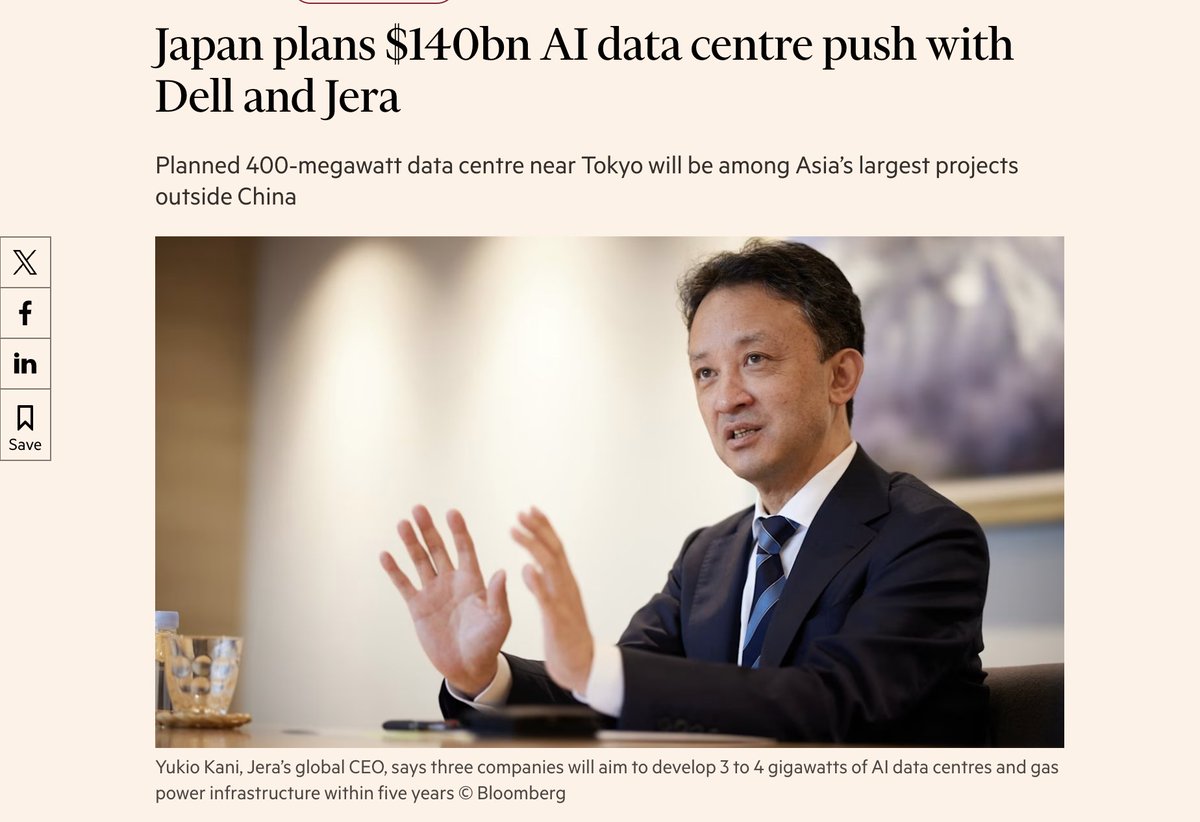
Japan is reportedly planning a $140B push into AI data centers.
The first project is a $15B, 400MW campus near Tokyo with Dell, Jera and Rhaelm. The broader plan targets 3 to 4GW over five years.
I'm spending more time recently on sovereign compute research as part of my Intelligent New World thesis work.
AI capacity is starting to be treated like strategic infrastructure. Governments want domestic access to compute, power and data-center capacity as intelligence becomes more economically important.
This creates another source of demand for the equipment and energy supply chains I've already been following closely.
This is good for infrastructure / supply chain names in my view.
I've owned $MU primarily because I think memory is one of the largest and most crucial bottlenecks in the AI buildout.
Yesterday's earnings call added another layer to that thesis.
Micron now has 26 long-term customer agreements covering an estimated 35%+ of revenue through 2030.
Customers have made $32B of financial commitments against those agreements.
More than 75% of 2027 output is already committed, and most of the conversations happening today are around 2028.
The scarcity is starting to change how customers buy memory.
They want supply locked in years ahead because getting caught without enough memory can hold back the rest of the AI infrastructure they've already spent billions building.
That gives Micron a level of forward visibility you can't associate with the memory industry historically.
Yesterday I said PCE and Micron would tell us a lot about the market we're dealing with in 2026.
Now we have both...
Core PCE came in at 0.2% MoM and 3.0% YoY. That gives the Fed a little more room, even with headline inflation still running at 3.4% and long-term yields sitting around levels that make capital expensive.
A few hours later Micron reported $54.2B in quarterly revenue. A year ago that number was $11.3B. They guided the next quarter to roughly $61.5B and expect fiscal 2027 to set another company record.
This is the part of 2026 I keep coming back to: The economy is carrying a high cost of capital while one section of the earnings cycle is growing at a pace we almost never see at this scale.
For the AI infrastructure names I own, that earnings growth is giving them a huge amount of room to absorb what is still a difficult macro environment.
Yesterday gave us a pretty clean example of it.
Great to be quoted by @TheStreet on the Uptober vs Rektober debate.
I'm in the Uptober camp.
Bitcoin (bitcoin:native) already showed it can hold up through a pretty brutal September macro backdrop.
Now inflation is cooling and tightening expectations are easing.
Bitcoin seasonality is nice. The improving fundamental demand setup underneath it is even nicer.
https://t.co/W2azWoGg30
You could almost use today as a case study for the entire market in 2026.
PCE this morning tells us what happens next to the discount rate.
Micron ($MU) tonight tells us what happens next to one of the fastest growing parts of the AI earnings cycle.
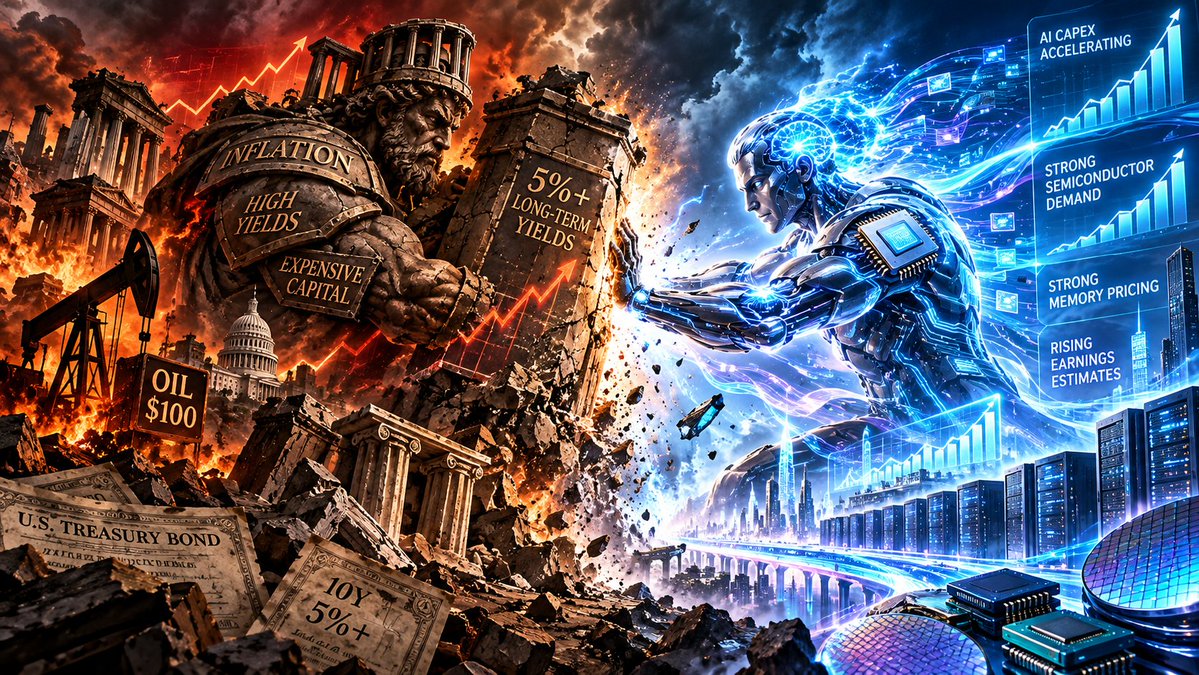
Those two forces are fighting each other constantly right now.
On one side:
- Sticky inflation.
- 5%+ long-term yields.
- Expensive capital.
- Oil near $100.
On the other:
- AI capex still accelerating.
- Semiconductor demand still strong.
- Memory pricing still strong.
- Earnings estimates still moving higher.
This contrast is why the market has been so interesting (and challenging for most) this year.
The macro backdrop is not supportive by many historical standards, but the fundamental acceleration underneath AI has so far proven powerful enough to absorb a very surprising amount of it.
In short: Macro is trying to compress the multiple. AI is trying to grow the earnings underneath it.
Right now those two forces are fighting each other every day.
And so far, the earnings have been a lot harder to kill than people expected.
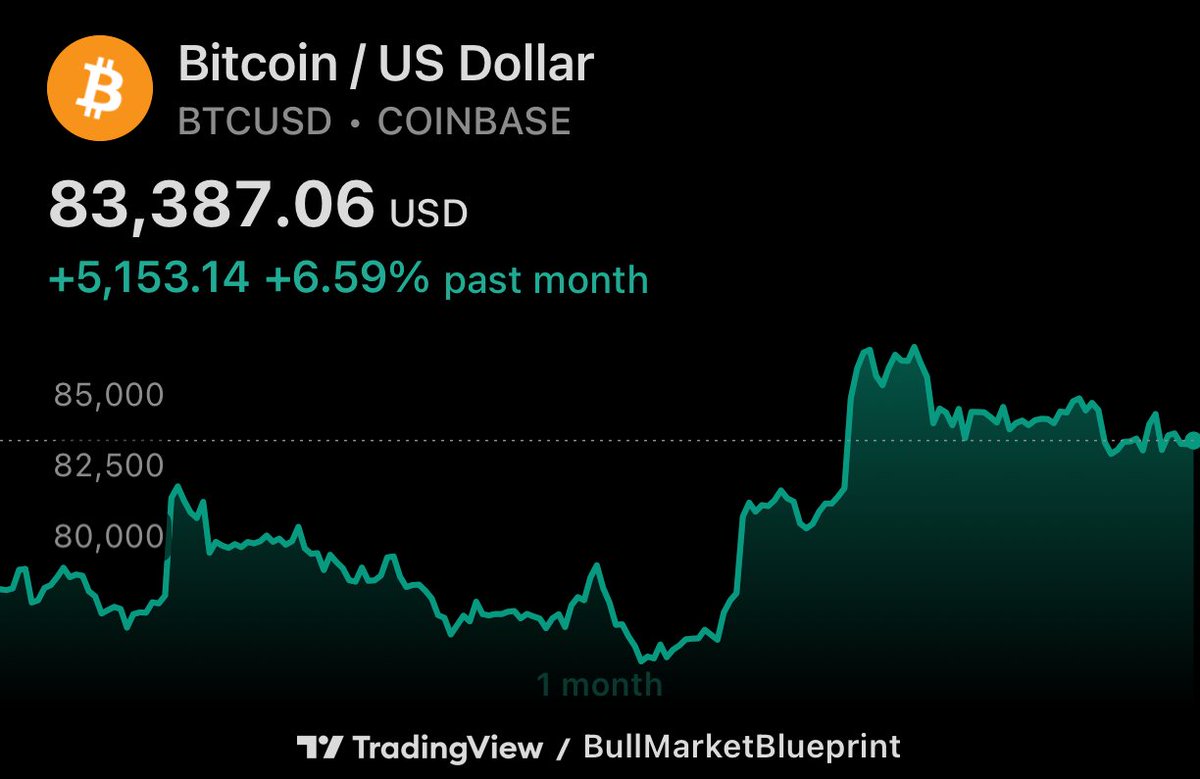
Bitcoin is around the low-$80Ks going into month-end and September has been positive despite historically being one of BTC's weaker months. IBIT was still up about 5.5% for September as of yesterday even after six straight down sessions.
Before you scroll just take a sec to digest that Bitcoin spent September dealing with:
- 5%+ Treasury yields.
- Oil shock.
- Fed repricing.
- Risk-off equities.
Yet it will finish one of its historically weakest months higher.
I'm very bullish on Bitcoin's outlook from here into 2027 where the real fun should start to happen...
Funny how quickly gold woke back up as soon as the bond market got a little relief.
30Y hit 5.6% yesterday. Williams says there's no urgency for another hike. Yields ease. Gold +1%.
The structural gold thesis has in no way disappeared. It's just been fighting one of the nastiest rate backdrops we've seen in decades.
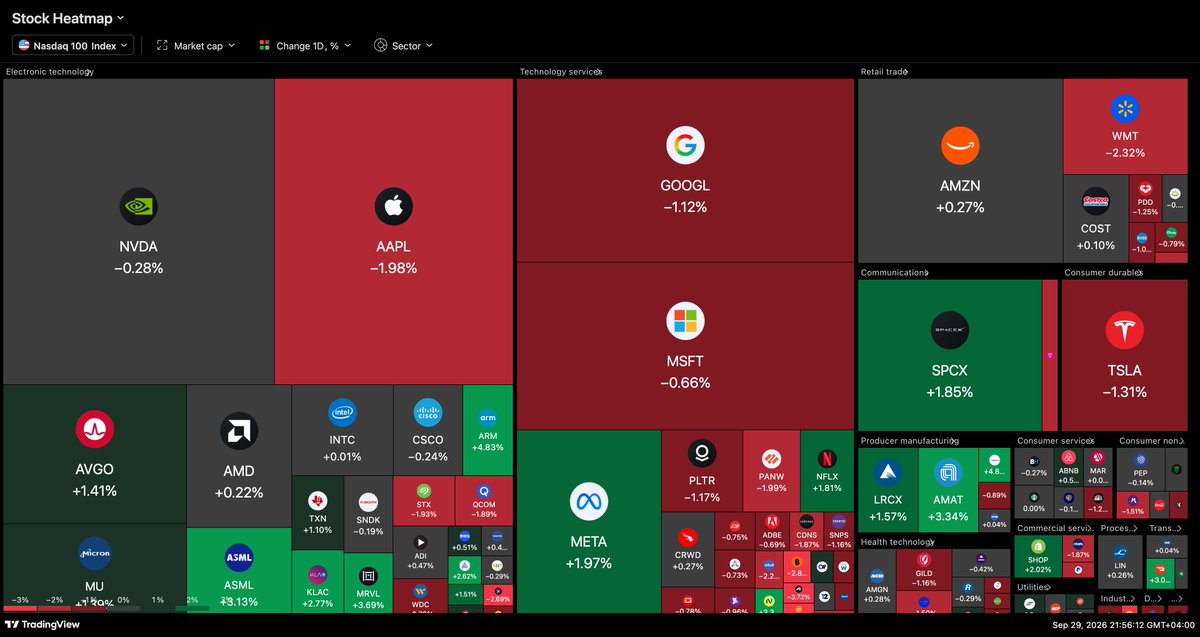
S&P red. Nasdaq red. 10Y back around 5.3%.
Yet my portfolio is green...
Semis are one of the strongest parts of the market again today. This is the type of relative strength I pay attention to.
When the macro tape is trying to make life difficult and your thesis names still refuse to go down, the market is telling you something.
The bears can keep debating whether AI demand is real or not...
- TSMC August revenue: +53.3% YoY.
- 2026 YTD revenue: +39.3%.
But I continue to prefer watching what the companies sitting directly in the supply chain are reporting (and maintaining ownership in them until the fun dries up).