I'm proud to promote this software case management platform One Counsel Inc., the culmination of our proven system at BOBLAW: The Law Firm of Benjamin O. Bengtson put into a turn-key single pane of glass solution for personal injury attorneys.
ONE COUNSEL Inc.:
Personal injury lawyers are drowning. The good ones want to fight for their clients — but most of the day gets swallowed by paperwork, tracking down medical records, drafting the same letters over and over, and rebuilding the mental picture of a case they haven't touched in six weeks. So they cap out around a hundred clients, because one lawyer only has so many hours. Their clients get less of them, and quality quietly slips.
One Counsel is the software that gives that day back. It runs a personal injury practice end-to-end — gathering evidence into structured records as it comes in, generating the routine letters and demand packages automatically, tracking every phase of every case on checklists so nothing falls through, and drafting the first pass of the attorney's written opinions on fault, insurance coverage, and case value. The reasoning that used to take an hour of file review before every client call now takes about a minute. The attorney's judgment stays where it belongs — on the calls that matter and the decisions that matter — and everything else runs.
Which means one attorney can carry three hundred clients as real relationships, litigate a real share of those cases when a fight is warranted, and end up with clients happy enough to send their families and friends back. Built on the methodology of a Georgia personal injury practice that has spent a decade proving it works.
Task lists are the most terrible thing ever imposed on human beings
Think about making one. Is the task to "request the records"? No — requesting was never the point; the point is to get them.
So now it's two tasks. Three with the follow-up. Four or five if you're honest about how many follow-ups it really takes. One outcome has become five entries before a single piece of actual work has happened.
And the due date? You're writing it down because it should already be done — so whatever date you pick, it's born overdue.
Then it compounds. New tasks arrive faster than finished ones leave, and thirty items deep, the list itself becomes the thing you can't face. A system built to get things done becomes, by design, a system that can never be done.
In our office, we ditched tasks, task lists, automated creation of tasks so that routine work never runs on them. It runs on procedure checklists — because a checklist is closed. A defined set of things and the procedure isn't finished until every one is complete. Yes, technically the things are still "tasks" but it is the checklist that needs doing and it feels different, somehow more do-able.
Sounds like a small distinction. It changed everything. Have you reached the same conclusion?
If you are st^bbed at work by a customer and the conflict is about your work, then the good news is you will automatically be entitled to medical treatment and lost wage benefits under workers' compensation - but you cannot sue your employer.
GA Court of Appeals reverses in Peachstate Concessionaires v. Bryant:
A Dunkin’ Donuts cashier stabbed by an angry customer after a menu dispute cannot sue her employer for premises liability because the injury arose out of and in the course of her employment.
The Court held the assault was not personal, but directly connected to Bryant’s job duties, making workers’ compensation the exclusive remedy, and ordered summary judgment for the employer, dismissing the employee's lawsuit.
Georgia Court of Appeals: Trip-and-fall case—DEFENSE WIN.
Wells v. Khan Shell, LLC (A25A2101)
Plaintiff tripped on uneven concrete in a gas station parking lot. She admitted the condition was visible—she just wasn’t looking. The Court of Appeals affirmed summary judgment for the property owner: uneven pavement is a static, open-and-obvious condition, and the plaintiff had equal knowledge as a matter of law.
Result: No liability. Case over.
We represent people who have been injured. But sometimes people want to know about the damage to their vehicle. This is a video where we talk about the importance of gap insurance.
https://t.co/jrfuIbMvYN
New Georgia Supreme Court Decision
SMG Construction Services, LLC v. Cook (Oct. 15, 2025)
The Court vacates the Court of Appeals and sends the case back.
Key holding:
➡️ The contractor had actual knowledge of the open ledge he fell from.
➡️ Misjudging the exact edge doesn’t erase actual knowledge.
➡️ Court of Appeals must now analyze SMG’s defenses (assumption of risk, contractor responsibility, etc.)
Result: Vacated + Remanded
Not over yet. ⚖️
https://t.co/Jx05dLiulN
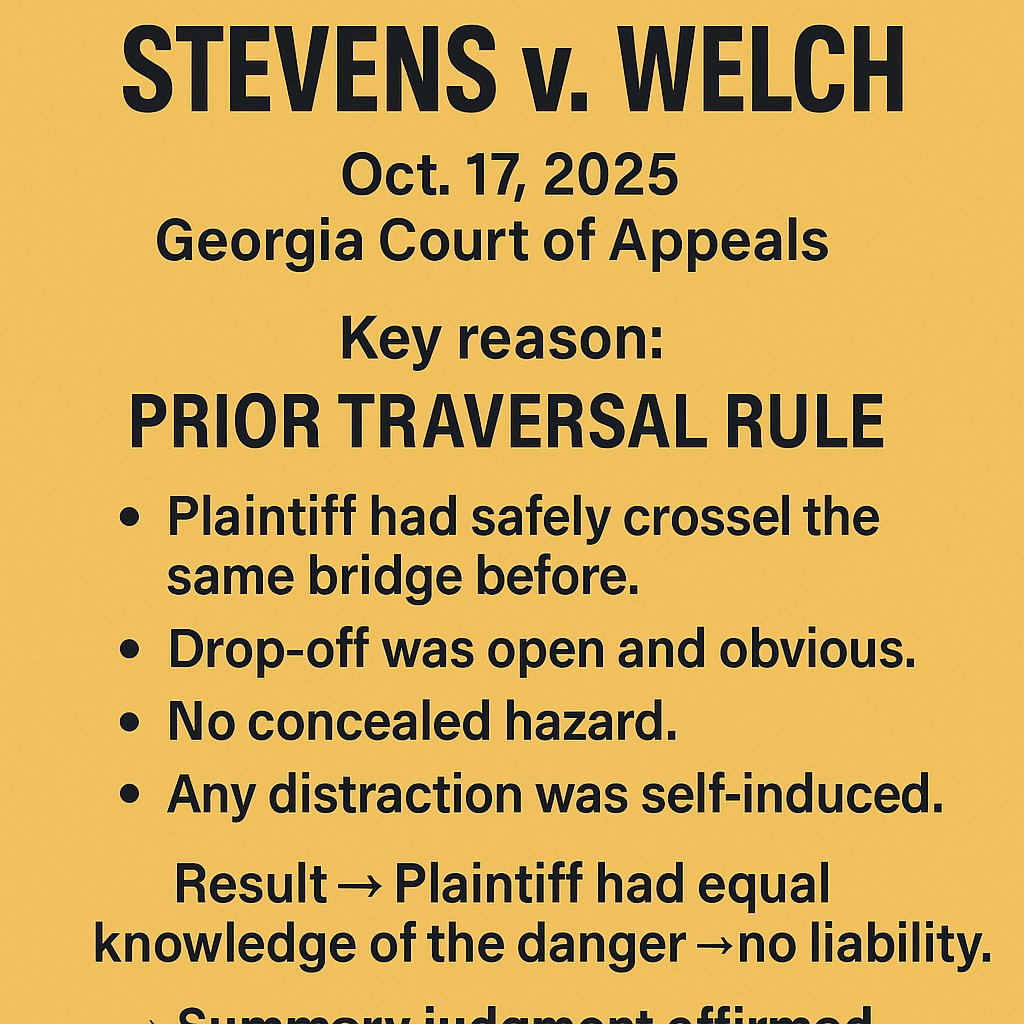
New Georgia Premises Liability Case — Stevens v. Welch (Oct. 17, 2025)
GA Court of Appeals affirms summary judgment for a property owner after a tragic fall from an unguarded bridge.
Key reason: Prior Traversal Rule.
The plaintiff had safely crossed the same bridge before.
The drop-off was open and obvious.
No concealed hazard.
Any distraction (looking at firewood) was self-induced.
Result → Plaintiff had equal knowledge of the danger → no liability.
https://t.co/og3ByQi4jz
Parents sued Grandma for failing to watch behind her to prevent a rear ender?
New GA Court of Appeals decision: Slate v. Turner (2025)
Construction zone. I-85 in Troup County.
Grandmother (Turner) slowing from ~60 → ~6 mph in a merge.
Rear driver (Eason) falls asleep and plows into her Prius, pushing her into the car ahead.
Parents of injured child sue both drivers, the one who fell asleep and rear-ended Grandma - AND they sued Grandma for not keeping a lookout behind her!
Trial court grants summary judgment to Grandma.
Court of Appeals affirms.
Key points:
GA law does not impose a general duty to constantly watch traffic behind you (outside contexts like lane changes).
Turner was lawfully slowing for construction and focused on the stopped traffic ahead.
Eason admitted he fell asleep + paid “following too closely” ticket → prima facie negligence on him.
Plaintiffs offered no concrete evidence that Turner could have safely avoided the crash or that her following distance worsened the injuries. Speculation ≠ proximate cause.
Result: No negligence, no jury question, summary judgment for Turner stands.
Perfect citation for “negligence can’t be presumed” and “front driver isn’t automatically on the hook in a rear-end when the rear driver passes out at the wheel.”
On November 18, 2025, the Georgia Court of Appeals issued an opinion in the case of Lester v. Hampton
Facts: The plaintiff in a motor vehicle accident case sent an offer to the defendant's insurer to settle the case for $25,000. Then the insurance company accepted the offer. Then the plaintiff stated that there WAS NO settlement and tried to get out of it. Then the trial court ordered that there WAS a settlement. Now the Court of Appeals is saying there was no settlement.
Holding: The Court of Appeals reiterated the holding from Georgia Supreme Court case Grange Mut. Cas. Co. v. Woodard, 300 Ga. 848 (2017), that a pre-suit offer to settle MUST contain A) the time period (at least 30 days) B) the amount C) the parties released D) the type of release and E) the claims released. OCGA 9-11-67.1. Then the Court of Appeals held in this case that because one or more of the items were missing from Lester’s offer, it was not a valid offer and could not have been accepted by Hampton’s insurer Progressive. So there was no settlement.
Questions:
1. Why did the plaintiff NOT want there to be a settlement? He did make an offer to settle and the insurer tried to accept it – now he is arguing to the Court of Appeals that there was no settlement?
2. Does this have implications for other cases where we DO actually want to settle?
https://t.co/LeGofkZzlX