#NPFL24/STARTIMES:THE NEED FOR AN APPRAISAL
It's not time to roll out drums to celebrate,rather it's time to roll up the sleeves and work. If we are to call a spade a spade,the StarTimes deal is gotten on a platter of Gold,not because of the commercial viability of the league.
My thoughts on the NPFL and the licensing requirements.
Earlier this year, I was invited to speak at the African Football Convention in Morocco, and during one of the sessions the conversation turned, as it always does, to regulating football finance in Africa. Someone asked me what new regulations we needed to bring order to the domestic game.
My response was simple: we do not need new laws. We need to ensure that the laws that exist are actually followed. Laws are not shiny toys or spoils of war that you display to tourists.
The purpose of a regulation is seen when it is live, when it is enforced, and when it is used as a means to an end, whether that end is justice or order. A law that exists only on paper is decoration, and African football has had enough decoration.
Let's bring this back home.
I am in support of rigorous club licensing in the NPFL. A system that tolerates failure guarantees it, and we have been tolerating failure for long enough that it has started to feel like the standard. Hon. Bukola Olopade's position on limiting the 2026/27 season to only compliant clubs is the right instinct.
But the conversation cannot start and stop at the ₦2 million minimum monthly salary and other requirements without first examining whether the environment has been made genuinely conducive for clubs to meet that standard.
Let me give you a concrete example of how far we are from even enforcing what already exists. When I went through the NLO framework, I found that players in the Nationwide League One are supposed to have insurance coverage covering mild injuries, career-threatening injuries, and death. The life insurance cover mandated for players in the NLO is ₦1 million. One million naira.
That is the value Nigerian football has placed on the life of a player at that level. And the more revealing part is not even the amount. It is the fact that the majority of clubs do not carry out this insurance policy at all and are still allowed to participate in the NLO season after season without consequence. That is the enforcement problem in its most human form. That's where I think we should start.
The NFF Club Licensing Regulations, adopted in 2014 in line with FIFA and CAF directives, already cover six key areas: sporting criteria, infrastructure, personnel and administration, legal, financial, and business and commercial requirements.
Clubs are supposed to have written player contracts, qualified medical and technical staff, approved home grounds, CAC registration, and proof of financial sustainability before they are granted a license to compete. These standards exist. The framework is there.
What has been consistently absent is the will to apply it without fear or favour, which is exactly what Ibrahim Gusau directed the new NPFL board to do when he addressed the NFF Executive Committee in Asaba recently. Clubs treat these regulations as mere suggestions rather than rules that they MUST follow.
However, there has to be a balance.
Enforcement alone, without first creating the conditions for compliance, is punitive rather than developmental. And here is the mathematics that Hon. Olopade's office needs to sit with before the ₦2 million minimum salary becomes a hard requirement.
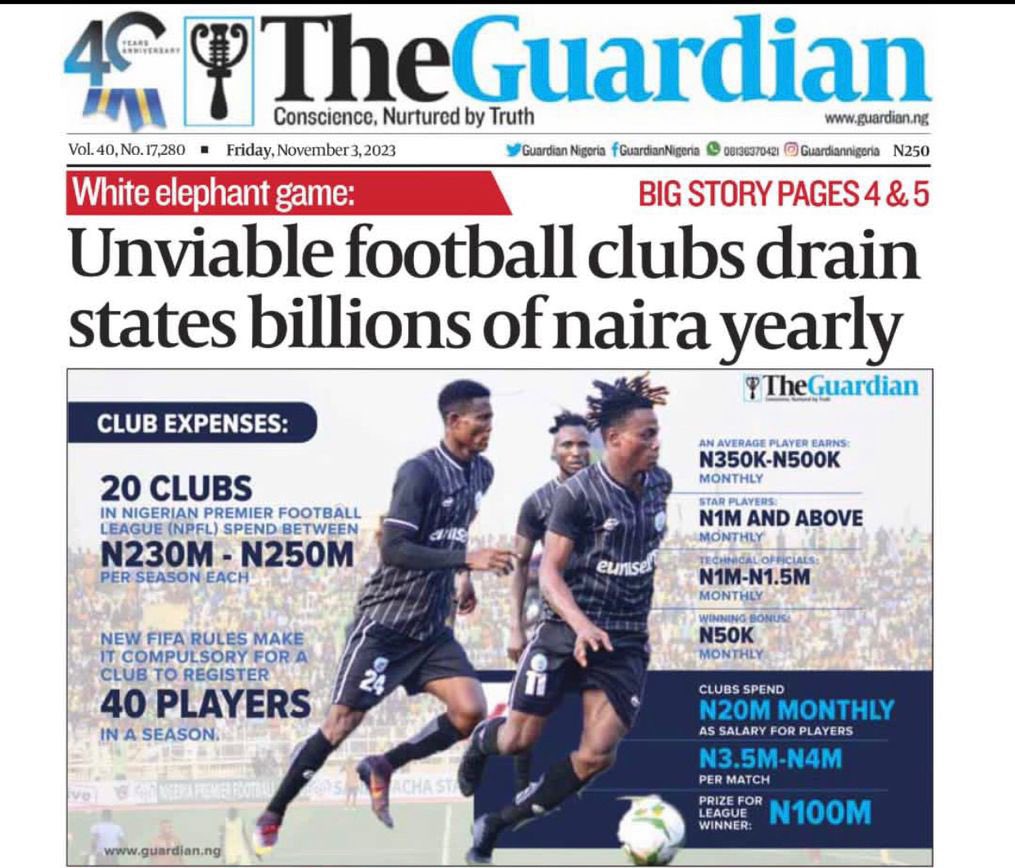
According to some NPFL Adminsitrators that I have spoken to, running an NPFL club currently costs approximately ₦500 million per year, and that is on salaries that range an average of ₦300,000 to ₦800,000 per player. If the minimum salary is raised to ₦2 million per month across a squad of 25 players, clubs are now looking at ₦50 million per month in player wages alone, which is ₦600 million per year before a single operational cost is accounted for.
By the time you calculate electricity, transport, medical staff, stadium maintenance and administration, the actual running cost will soar comfortably above ₦1 billion per year per club once you include wages at the new minimum.
If we take a look at "saner climes", we would see that clubs across Europe operate on a squad cost ratio of approximately 60 to 70 percent of total annual revenue. That is the UEFA benchmark, and it is the model that keeps clubs financially sustainable.
At ₦600 million in player wages alone, the recommendation is that clubs should be generating at least ₦1 billion in annual revenue. In England, France, and Germany, that revenue comes from matchday income, broadcast rights, sponsorship, merchandise, and commercial activity driven by fans who have enough disposable income to spend on football.
In Europe, citizens spend between 9 and 16 percent of their income on discretionary items, which includes tickets, jerseys, fan merchandise, and subscriptions. In Nigeria, that discretionary spending capacity exists for approximately 1 to 3 percent of the population.
The commercial ecosystem that funds European clubs simply does not exist at the same scale in Nigeria yet, and raising salary minimums without first building that commercial base puts the financial burden entirely on club proprietors, most of whom are already subsidising Nigerian football from their personal resources with minimal to no return.
What Hon Olopade needs to put in place before the salary demand becomes enforceable is a commercialisation strategy that actually generates revenue for clubs. The ₦2.5 billion prize pool announced for the 2026/27 season is a meaningful step. The ₦2 billion broadcast and data deal signed in 2025 is another. But broadcast revenue needs to be distributed in a way that reaches all clubs, not just the title challengers.
Sponsorship frameworks need to be created at league level and not left entirely to individual clubs to negotiate. Matchday infrastructure needs investment so that attending an NPFL game becomes a genuine commercial proposition for fans and not an act of loyalty to a broken experience.
The licensing framework is not wrong. The salary ambition is not wrong. What would be wrong is demanding compliance from clubs in an environment that has not yet been built to support it, and then calling it reform.
My name is Ajoje and I am a FIFA Licensed Agent and International Sports Lawyer. I talk about the Law and Business of Football, a lot. Repost and Follow me if you want to read more posts like this.
👏 A fitting celebration as Beyond Limits Football Academy President, Hon. Kunle Soname, celebrates with the players and backroom staff after successfully defending the Gothia Cup title in Gothenburg, Sweden.
🏆 Back-to-back Gothia Cup champions! 🇸🇪🇳🇬
In just two days, Beyond Limits, the academy side of Remo Stars, announced the transfers of two players to Europe. 🇪🇺
Oreoluwa Agbenla → AIK Fotboll 🇸🇪
Muhammed Abdulla → FC Vysočina 🇨🇿
In recent years, Beyond Limits have transferred more than 15 players to Europe, the most by any Nigerian club. 👏
🚨Oreoluwa Agbenla to AIK Fotboll
“E dun set” and confirmed ✅
The midfielder has signed a four years contract, joining from Beyond Limits.
Like Zadok Yohanna, AIK now have another brilliant Nigerian in their ranks.
The Gothia Cup Opening Ceremony never disappoints… and neither do our boys!✨
Looking sharp, standing proud, and representing 🇳🇬
Let the football festival begin!🔥
#BLFAxGothiaCup | #NoLimits
For me to take this seriously, I would like to see the @NatSportsComm policy document (if there is one) that outlines the feasibility of this proposal, taking into consideration the socioeconomic context of the country where the league operates.
"Our football space must become a thriving ecosystem. The NPFL has to be on television, it must be properly commercialised, and we must create wealth, not just for the players, but for everyone within our football ecosystem.
The days of paying our players peanuts must come to an end. Even the journalists who dedicate themselves to covering our league deserve to earn a decent living from it."
Director-General of the National Sports Commission (NSC), Hon. Bukola Olopade, on the vision for football reforms in Nigeria.
"Our football space must become a thriving ecosystem. The NPFL has to be on television, it must be properly commercialised, and we must create wealth, not just for the players, but for everyone within our football ecosystem.
The days of paying our players peanuts must come to an end. Even the journalists who dedicate themselves to covering our league deserve to earn a decent living from it."
Director-General of the National Sports Commission (NSC), Hon. Bukola Olopade, on the vision for football reforms in Nigeria.
One would think the rosy picture painted cuts across all villages, until you find yourself in an Island hamlet that's literally competing with Abuja on prices of basic commodities.
Benefits of serving in a village PPA 🇳🇬
1. Food items are cheaper to get in the village.
2. You will find all you need in the village, not all you want.
3. Because you don’t have the luxury of seeing many things you want, you’ll be able to save more.
4. You eat real food, most times directly from the villagers farms.
5. Integrating with your host community is at the very peak. Almost everyone in the village knows, loves, and hails you when lever they cross your path
6. There’s little or no competition. Most rural Corpers have better accommodation. Sometimes one Corper per room(I’m a living testimony) compared to the city where survival of the fittest is the theme of the day
7. In the village, you experience the people more. A small community of people who speak same language and do things in their way. You learn new language and new ways of doing things away from home.
8. You’re like a government official sent on vacation. Serene atmosphere, calm environment (even though mosquitoes fit dey 😅). Less noise compared to the city and less pollution.
Serving in a rural community may come with some limitations but it also comes with lots of advantages.
I’ll choose a village PPA over one in the city any day.
Your thoughts 💭?
New waves of commissioning of major projects in the State University today by Governor Ademola Adeleke
1. FIFA STANDARD SPORTS COMPLEX
2. LABORATORY COMPLEX (OSOGBO CAMPUS)
3. 250-CAPACITY LECTURE THEATER (OSOGBO)
4. 500-CAPACITY LECTURE HALL (OSOGBO)
5. 500-CAPACITY LECTURE HALL (OKUKU CAMPUS)
6. FACULTY BUILDING (OKUKU CAMPUS)
7. HEALTH SERVICES APARTMENT (IFETEDO CAMPUS) and many others
#ImoleCarryOnAccordingly
This piece of infrastructure will be a game-changer for showbiz in the country. Aside from musical concerts, Nigeria will be well-positioned to host international boxing bouts, grade-A basketball matches, and a host of other world-class events.
The Lagos Arena will be a game changer for our entertainment industry, tourism sector and Detty December.
This video will definitely put a smile on your face.