$EGLD : Review 📜
What if a blockchain solved the scaling problem years before its rivals, and then broke the one promise its holders cared about most?
Meet MultiversX, the first network to implement all three types of sharding in production, and as of today running 600-millisecond blocks after its Supernova activation.
The engineering has been ahead of the field for six years, approved almost unanimously by its own community. In October 2025, that same community voted to remove the hard supply cap the project had promoted since launch.
Let's explore the sharpest split between technology and trust in the series. 👇
⚪ MultiversX at a Glance
Marketplace Insight: MultiversX has one of the strongest technical records in crypto and one of the most damaged token narratives. It shipped adaptive state sharding in 2020 while Ethereum's sharding roadmap was repeatedly redesigned, and Supernova now delivers a tenfold speed increase on identical validator hardware, approved by governance with 99.64% support.
The clean contrast is what the community will and will not unite behind. The same holders who backed the technical roadmap almost unanimously were sharply divided by the October 2025 vote that removed the supply cap the project had promoted for years. The engineering keeps its promises. The monetary policy did not.
⚪ Mission
MultiversX exists to make blockchain scale without fragmenting the user experience. The founding argument was that scaling through layers and bridges forces users to manage assets across competing environments, and that the better answer is a single network that splits itself internally instead. Adaptive State Sharding does that by partitioning state, transactions, and network communication simultaneously, with shards merging or dividing automatically as demand changes, so throughput scales without users ever choosing a chain or bridging an asset.
🔵 A Brief History
MultiversX was founded in late 2017 by brothers Beniamin and Lucian Mincu alongside Lucian Todea, with Beniamin having previously served as Head of Product and Business at NEM Core and both brothers having founded MetaChain Capital. Development began in earnest in August 2019 and mainnet launched in July 2020 as Elrond, with EGLD trading around $13.
The token's own history involved a dramatic restructuring. Originally issued as ERD on Binance Chain with a 20 billion supply, 500 million were burned in November 2019, and a September 2020 swap converted holdings at 1,000 ERD to 1 EGLD, collapsing supply from 20 billion to 20 million and establishing the scarcity model the project would promote for years.
November 2021 brought the peak at $542.58, followed by a rebrand from Elrond to MultiversX in November 2022, repositioning around the metaverse, a narrative that did not age well. The technology kept advancing regardless, with the Andromeda upgrade halving required confirmation blocks and pushing toward near-instant finality.
October 2025 was the turning point for the token. A governance proposal from within the Foundation moved EGLD from its fixed roughly 31.4 million supply to a model with approximately 9.47% annual tail inflation, burning 10% of validator fees. It passed despite public opposition from Justin Bons of CyberCapital, who argued the inflation was too high and the burn too low. Further pressure followed, with Binance delisting EGLD/ETH and EGLD/BTC pairs in June 2026 over low liquidity, and the token reaching an all-time low of $2.77 that month.
The engineering did not slow. Stripe's Machine Payments Protocol integrated in March 2026 for agent-to-agent settlement, followed by Google UCP. Supernova, the largest protocol change in the network's history, passed governance in January 2026 with 99.64% approval, ran on devnet from late August, and reached mainnet node software v2.0.6.0 on 4 September.
By 6 September roughly 84% of nodes had migrated to the new client, up from 4% five days earlier. Activation is set for 10 September at epoch 2233, with a planned 22 to 24 minute drain window so no transaction is caught between the old six-second clock and the new 600-millisecond one. The token rallied roughly 80% to 100% into the event.
🔵 Ecosystem Narrative
The organizing idea is that a single network should scale internally rather than pushing complexity onto users.
➛ Adaptive State Sharding. The network splits state, transactions, and network communication across shards that merge or divide automatically with demand, the first production implementation of all three sharding types, live since 2020 while competitors deferred their own designs.
➛ Supernova. Consensus decoupled from execution so validators vote without re-executing blocks, cutting block times from six seconds to 600 milliseconds on unchanged hardware, with intra-shard finality targeted below 250ms and cross-shard settlement near 2.4 seconds. Validator requirements stay at 4 cores, 8GB RAM, and 2,500 EGLD, so the tenfold gain costs operators nothing.
➛ Machine payment rails. Stripe's Machine Payments Protocol and Google's UCP both integrate MultiversX for agent-to-agent settlement, use cases where sub-second finality is a hard requirement rather than a convenience.
➛ Developer economics. Developers receive 30% of the gas fees generated by their own smart contracts, a direct revenue share that few networks offer and a genuine structural incentive to build, supported by a Cookbook now at 61 complete projects.
➛ Consumer and payments surface. xPortal has surpassed 3 million users with over 100,000 staking EGLD, xMoney handles SmartBill invoice payments and card funding, and Guardians extends 2FA-style protection to wrapped BTC and to agents rather than only humans.
➛ Unified user experience. One wallet covers the entire network natively, with no bridging between shards or managing assets across competing layer twos, which is the practical payoff of sharding over rollups.
⚪ Token Utilities
$EGLD secures and powers the network.
➛ Gas: pays for transactions, smart contract deployment, and all network operations, with 30% of contract gas routed to the developer.
➛ Staking: validators stake EGLD under Secure Proof-of-Stake with rating-based selection, securing the network across a record 3,259 nodes with roughly 14.5M EGLD staked.
➛ Governance: holders vote on protocol decisions, including both the Supernova approval and the 2025 vote that removed the supply cap.
➛ Fee burn: 10% of validator fees are burned, the partial offset against tail inflation.
⚪ Key Features
➛ Adaptive State Sharding across state, transactions, and network, live since 2020.
➛ Supernova delivering 600ms blocks and sub-250ms intra-shard finality on unchanged hardware.
➛ Secure Proof-of-Stake with validator rating scores across 3,259 nodes.
➛ 30% of smart contract gas fees paid directly to developers.
➛ Stripe Machine Payments and Google UCP integrations for AI agent settlement.
➛ Protocol development using Runtime Verification's formal methods framework.
🔵 Meet the Team
MultiversX has one of the more stable and technically credentialed founding teams in the sector, with all three co-founders still in place nine years on.
▶️ Core Members:
➛ Beniamin Mincu [ @beniaminmincu ] - Co-Founder and CEO | Previously Head of Product and Business at NEM Core, and an early investor in Binance, Brave, and Tezos. He co-founded MetaChain Capital and ICO Market Data before starting Elrond, and remains the project's principal public voice.
➛ Lucian Mincu [ @lucianmincu ] - Co-Founder and CTO | Brings IT engineering and security experience from Uhrenwerk 24, Cetto, and Liebl Systems, and co-founded MetaChain Capital alongside his brother. He owns the technical architecture behind the sharding design.
➛ Lucian Todea [ @luciantodea ] - Co-Founder and COO | The third founder from 2017, running operations across the organization through the Elrond era and the MultiversX rebrand.
➛ Adrian Dobrita [ @AdrianDobrita ] - Head of Engineering | Built software for Samsung, Intel, and Continental before joining, anchoring the engineering discipline behind a network that has shipped major upgrades on schedule for six years.
🔵 Ratings
➛ Use Case: ★★★★ (4/5). MultiversX has a genuine and rare technical claim: it shipped all three types of sharding in production in 2020, years before competitors delivered comparable designs, and Supernova now delivers a tenfold speed increase on identical validator hardware with sub-250ms intra-shard finality. Stripe's Machine Payments Protocol and Google's UCP integrating it for agent settlement are real validation of that speed, the 30% developer gas share is a structural incentive few networks match, and a record 3,259 nodes give it meaningful decentralization. The 1-point deduction is adoption relative to capability. Ecosystem TVL sits in the low millions against Solana, Sui, and Aptos, the 2022 metaverse repositioning was a narrative misstep that cost momentum, and the network's throughput has consistently exceeded the demand for it.
➛ Tokenomics: ★★★ (3/5). The structure has real positives: supply is effectively fully circulating with no unlock overhang or vesting cliff, staking utility is genuine with roughly 14.5 million EGLD staked across a record validator set, and 10% of validator fees are burned. The 2-point deduction is a broken commitment, and it is specific rather than general. The project promoted a hard cap of roughly 31.4 million EGLD for years, with its own website stating only 30 million could ever exist and positioning the asset explicitly against currencies that can be printed endlessly. The October 2025 vote removed that cap and introduced roughly 9.47% annual tail inflation, drawing public objection from a serious institutional fund manager on the grounds that the inflation was too high and the burn too low. Whatever the technical merits, a project that reverses its central scarcity promise carries that on its record.
➛ Audits: ★★★★ (4/5). MultiversX's security foundation is stronger than most and rests on formal methods rather than periodic review. The project has worked with Runtime Verification, a specialist firm applying a framework pioneered at NASA, since inception, using it across the protocol, core components, and applications, and Runtime Verification later became a staking provider on the network. Secure Proof-of-Stake with validator rating scores adds an operational security layer, and the network has run since July 2020 through multiple major upgrades without a protocol-level exploit. The staged Supernova rollout across devnet, testnet, and mainnet with a planned drain window reflects genuine operational discipline. The 1-point deduction is that no verified top-tier security score or specific published formal verification report is available for review, and Supernova introduces substantial new consensus surface that is hours old at time of writing.
➛ Community: ★★★★ (4/5). The distinction between what this community unites behind and what divides it is the most informative thing about it. Supernova passed governance with 99.64% approval and validators migrated to the new client at pace, reaching 84% within five days of release, while validator count hit an all-time high of 3,259 nodes during a period when the token was near its lows, which is real operational conviction rather than sentiment. xPortal has over 3 million users with 100,000-plus staking, the developer Cookbook has reached 61 complete projects, and the network was cited among the top six in Web3 by commit volume. The 1-point deduction is the trust damage from the supply cap reversal, which divided the same community that backs the roadmap almost unanimously, compounded by exchange delistings at Binance, Bitfinex, and KuCoin narrowing access.
🔵 Conclusion
MultiversX is a case study in how far excellent engineering can carry a project, and where it stops. The network shipped adaptive state sharding in 2020 while Ethereum's own plans were deferred, and as of today Supernova delivers a tenfold speed increase on the same validator hardware, approved by 99.64% of governance and migrated to by 84% of nodes within five days. Stripe and Google both route machine payments through it. Validator count sits at an all-time high. The founding team is intact after nine years.
The risks are real and largely self-inflicted. The project spent years telling holders that only 30 million EGLD could ever exist, then voted to remove that cap in favour of roughly 9.47% annual inflation. Exchange access has narrowed through delistings at three major venues, the token trades far below its 2021 high, and adoption has never matched the throughput the network provides.
But the bull case is arriving in real time. If machine-to-machine payments become a genuine category, sub-second finality stops being a specification and becomes a requirement, and as of today MultiversX has it live with Stripe and Google already integrated.
The technology was never the question. What MultiversX has to rebuild is the belief that the people running it will not change the rules again.
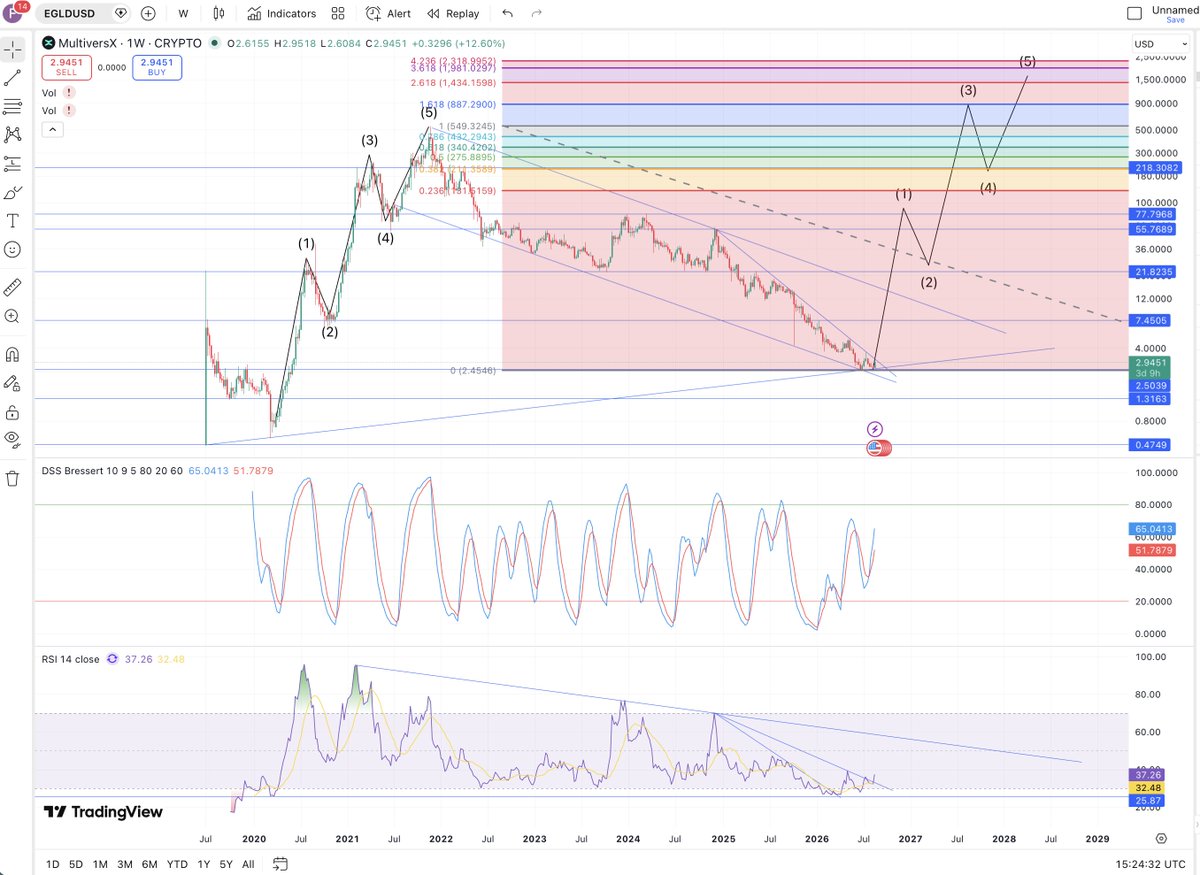
elrond-erd-2:native M.CAP UPDATE!!! (from Jul 10)
The retrace to 300 mil started as planned!
35x if we can escape this falling channel and 100x with expansion (not likely tho...)
Not Fa!
STAY TUNED!
#MULTIVERSEX
🌏 NEPAL 🇳🇵 | CHINA 🇨🇳 | 🚨 URGENTE - MILES DE PERSONAS ENTERRADAS VIVAS, PUEBLOS BORRADOS DEL MAPA: LOS HUMANOS SOMOS NADA ANTE LA NATURALEZA.
En segundos el alud se llevó todo, hizo desaparecer pueblos enteros, miles de personas han muerto y otras miles están desaparecidas.
$EGLD Midline Bounce Delivered. Bigger Move Loading 📈
MultiversX is preparing to break out of the double bottom formation on the daily chart.
Those who entered on the midline bounce are already sitting on solid gains. But the real move is still ahead.
Target levels after a confirmed breakout:
🎯 $4.90
🎯 $7.00
🎯 $11.00
🎯 $14.60
🚨 ¡EL LÍMITE DE VELOCIDAD OCULTO ES UNA LOCURA! 🚨
La comunidad ha estado probando los nuevos umbrales de velocidad en el motor de eFootball 2027 (v6.0.0) y descubrieron algo gravísimo que cambia por completo cómo debemos entrenar a los jugadores.
📉 La trampa del 96 al 99: Las pruebas de tiempo en media cancha demuestran que pasar de 96 a 99 de velocidad NO da ninguna mejora. Con 96 de stat, el jugador corre a 32.4 km/h. Con 99 de stat... ¡corre a los mismos 32.4 km/h! Subir esos puntos es un desperdicio total.
🚀 La Zona Booster (100+): ¿Dónde se rompe el límite? A partir de 100. En cuanto entras a la fase Booster, la estadística vuelve a tener efecto, llegando a casi 33 km/h en el nivel 105. Básicamente, el equipo de desarrollo ya no se guarda nada: están impulsando las cartas Booster para que rindan más que nunca.
⚙️ Dato técnico: El límite teórico actual del motor ya permite llegar hasta 111 en una stat (por el stack de +12 de los doble Booster). Parece que Konami irá desbloqueando los topes poco a poco para ajustar el impacto máximo de cada carta.
🧠 En resumen: Para esos velocistas icónicos que NO tienen Speed Booster, el tope real al que los debes entrenar es 96. Gastar puntos hasta llegar a 99 es tirarlos a la basura.
¿A qué jugador de su plantilla se le viene a la mente que deban reajustar tras saber esto? 👀👇
#eFootball #eFootball2027
🚨 Italy | Pack Review 🔥🚨
This is an "early review" as the pack will be released in a couple of hours ❗️
*** Please note: when comparing players, I will disregard the second booster impact for both players to ensure a fair & transparent comparison!
1) Maldini (Build Up | High Line Master): Compared to the Milan Defensive Fullback Maldini, the new Build Up Maldini has +3 in Acceleration, +2 in Physical Contact, +1 in Defensive Stats & Speed. However, Build-Up Maldini has only 27 levels (vs. 33 levels for Defensive Fullback Maldini). Maldini also traded in Shadow Hunt for Aerial Fort, which is a downgrade in my opinion. Maldini also has a second Defensive playstyle: "High-Line Master", which maintains an effective defensive line, keeping the shape intact as they defend. Overall, I believe Defensive Fullback Maldini is still better than Build-Up Maldini, and there is no reason to upgrade! 👀 If you don't have any Maldini, however, then it is worth going for this card as he will be a Top 5 CB. This is also the first "Build-Up" Maldini since the PES days! Score: 9 / 10
2) Nesta (Covering Role): Nesta will have a new Defensive playstyle: "Covering Role", which actively covers for teammates conducting Match-up roles. 👀 Compared to Lazio Nesta, the new Italy Nesta has +2 Low Pass and +1 Defensive Awareness, Tackling & Jump. New Nesta also has three Showtime skills: Long Reach Tackle, Aerial Fort, and Fortress. If you have Lazio Nesta, there's no need to upgrade for the extra "Fortress" skill. If you don't have any Nesta, though, it is worth going for this card, as Nesta will likely be a Top 5 or Top 10 CB. Score: 8.5 / 10
3) Cannavaro (Destroyer): New Cannavaro has +2 Acceleration and +1 Speed, Tackling & Defensive Engagement. He also has exactly the same Showtime skills as old Cannavaro: Shadow Hunt and Aerial Fort. Personally, I am not a fan of Cannavaro as he's simply too short (176 cm) to compete against the likes of Koller, Ibrahimovic, and Gullit. Score: 7.5 / 10
My Ranking is the following:
1) Maldini 🥇(Top 5 CB + Unique "Build-Up" Playstyle)
2) Nesta (Top 5 or Top 10 CB) 🥈
3) Cannavaro 🥉
Conclusion: This is a great "value-for-money" pack if you don't have any good defenders, but not if you already have a Maldini or a Nesta ❗️
#イーフト #eFootballアプリ #eFootball #eFootball30th #eFootball2027 #eFootball27
Yesterday our Devnet started producing ten blocks in the same time it used to take to make one.
6s → 600ms
Supernova is the largest upgrade in our history.
Sub-second finality, with the same validators, the same security, and the same low fees.
The internet-scale blockchain.
🛠️ Code doesn't lie!
Chainspect just ranked blockchains by total number of commits in 2026.
Top 6:
1. Polkadot – 702K
2. Ethereum – 525K
3. Cardano – 303K
4. Arbitrum – 200K
5. Optimism – 182K
6. MultiversX ( $EGLD ) – 174K
The ecosystems that are really shipping show up here.
Who’s your favorite in this ranking? 👀
🛠️ Code doesn't lie
The strongest blockchain ecosystems are improved one commit at a time by developers who keep shipping
We ranked networks by total commits to reveal where Web3 is actually being built 👇
📊 https://t.co/wgvfZ1InFX
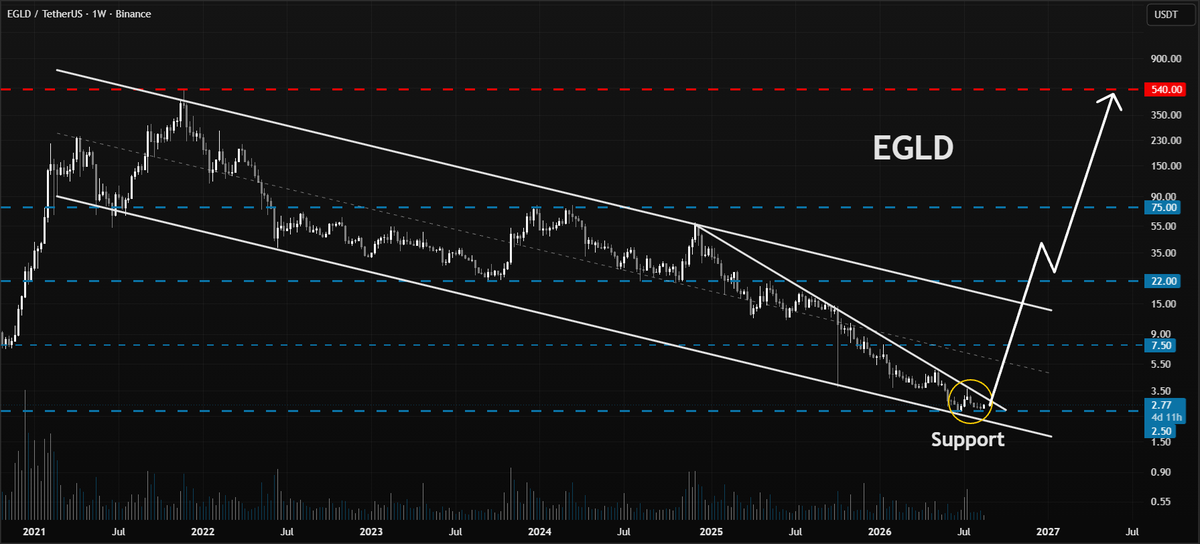
#EGLD Channel Support Holding Strong🔥
MultiversX is facing the lower boundary of the descending channel on the weekly chart🔍
✅ Bulls are defending this critical level with conviction
✅ Buying pressure is building at support
Targets: $7.50 → $22.00 → $75.00 → $540🎯





![0xchainink's tweet photo. $EGLD : Review 📜
What if a blockchain solved the scaling problem years before its rivals, and then broke the one promise its holders cared about most?
Meet MultiversX, the first network to implement all three types of sharding in production, and as of today running 600-millisecond blocks after its Supernova activation.
The engineering has been ahead of the field for six years, approved almost unanimously by its own community. In October 2025, that same community voted to remove the hard supply cap the project had promoted since launch.
Let's explore the sharpest split between technology and trust in the series. 👇
⚪ MultiversX at a Glance
Marketplace Insight: MultiversX has one of the strongest technical records in crypto and one of the most damaged token narratives. It shipped adaptive state sharding in 2020 while Ethereum's sharding roadmap was repeatedly redesigned, and Supernova now delivers a tenfold speed increase on identical validator hardware, approved by governance with 99.64% support.
The clean contrast is what the community will and will not unite behind. The same holders who backed the technical roadmap almost unanimously were sharply divided by the October 2025 vote that removed the supply cap the project had promoted for years. The engineering keeps its promises. The monetary policy did not.
⚪ Mission
MultiversX exists to make blockchain scale without fragmenting the user experience. The founding argument was that scaling through layers and bridges forces users to manage assets across competing environments, and that the better answer is a single network that splits itself internally instead. Adaptive State Sharding does that by partitioning state, transactions, and network communication simultaneously, with shards merging or dividing automatically as demand changes, so throughput scales without users ever choosing a chain or bridging an asset.
🔵 A Brief History
MultiversX was founded in late 2017 by brothers Beniamin and Lucian Mincu alongside Lucian Todea, with Beniamin having previously served as Head of Product and Business at NEM Core and both brothers having founded MetaChain Capital. Development began in earnest in August 2019 and mainnet launched in July 2020 as Elrond, with EGLD trading around $13.
The token's own history involved a dramatic restructuring. Originally issued as ERD on Binance Chain with a 20 billion supply, 500 million were burned in November 2019, and a September 2020 swap converted holdings at 1,000 ERD to 1 EGLD, collapsing supply from 20 billion to 20 million and establishing the scarcity model the project would promote for years.
November 2021 brought the peak at $542.58, followed by a rebrand from Elrond to MultiversX in November 2022, repositioning around the metaverse, a narrative that did not age well. The technology kept advancing regardless, with the Andromeda upgrade halving required confirmation blocks and pushing toward near-instant finality.
October 2025 was the turning point for the token. A governance proposal from within the Foundation moved EGLD from its fixed roughly 31.4 million supply to a model with approximately 9.47% annual tail inflation, burning 10% of validator fees. It passed despite public opposition from Justin Bons of CyberCapital, who argued the inflation was too high and the burn too low. Further pressure followed, with Binance delisting EGLD/ETH and EGLD/BTC pairs in June 2026 over low liquidity, and the token reaching an all-time low of $2.77 that month.
The engineering did not slow. Stripe's Machine Payments Protocol integrated in March 2026 for agent-to-agent settlement, followed by Google UCP. Supernova, the largest protocol change in the network's history, passed governance in January 2026 with 99.64% approval, ran on devnet from late August, and reached mainnet node software v2.0.6.0 on 4 September.
By 6 September roughly 84% of nodes had migrated to the new client, up from 4% five days earlier. Activation is set for 10 September at epoch 2233, with a planned 22 to 24 minute drain window so no transaction is caught between the old six-second clock and the new 600-millisecond one. The token rallied roughly 80% to 100% into the event.
🔵 Ecosystem Narrative
The organizing idea is that a single network should scale internally rather than pushing complexity onto users.
➛ Adaptive State Sharding. The network splits state, transactions, and network communication across shards that merge or divide automatically with demand, the first production implementation of all three sharding types, live since 2020 while competitors deferred their own designs.
➛ Supernova. Consensus decoupled from execution so validators vote without re-executing blocks, cutting block times from six seconds to 600 milliseconds on unchanged hardware, with intra-shard finality targeted below 250ms and cross-shard settlement near 2.4 seconds. Validator requirements stay at 4 cores, 8GB RAM, and 2,500 EGLD, so the tenfold gain costs operators nothing.
➛ Machine payment rails. Stripe's Machine Payments Protocol and Google's UCP both integrate MultiversX for agent-to-agent settlement, use cases where sub-second finality is a hard requirement rather than a convenience.
➛ Developer economics. Developers receive 30% of the gas fees generated by their own smart contracts, a direct revenue share that few networks offer and a genuine structural incentive to build, supported by a Cookbook now at 61 complete projects.
➛ Consumer and payments surface. xPortal has surpassed 3 million users with over 100,000 staking EGLD, xMoney handles SmartBill invoice payments and card funding, and Guardians extends 2FA-style protection to wrapped BTC and to agents rather than only humans.
➛ Unified user experience. One wallet covers the entire network natively, with no bridging between shards or managing assets across competing layer twos, which is the practical payoff of sharding over rollups.
⚪ Token Utilities
$EGLD secures and powers the network.
➛ Gas: pays for transactions, smart contract deployment, and all network operations, with 30% of contract gas routed to the developer.
➛ Staking: validators stake EGLD under Secure Proof-of-Stake with rating-based selection, securing the network across a record 3,259 nodes with roughly 14.5M EGLD staked.
➛ Governance: holders vote on protocol decisions, including both the Supernova approval and the 2025 vote that removed the supply cap.
➛ Fee burn: 10% of validator fees are burned, the partial offset against tail inflation.
⚪ Key Features
➛ Adaptive State Sharding across state, transactions, and network, live since 2020.
➛ Supernova delivering 600ms blocks and sub-250ms intra-shard finality on unchanged hardware.
➛ Secure Proof-of-Stake with validator rating scores across 3,259 nodes.
➛ 30% of smart contract gas fees paid directly to developers.
➛ Stripe Machine Payments and Google UCP integrations for AI agent settlement.
➛ Protocol development using Runtime Verification's formal methods framework.
🔵 Meet the Team
MultiversX has one of the more stable and technically credentialed founding teams in the sector, with all three co-founders still in place nine years on.
▶️ Core Members:
➛ Beniamin Mincu [ @beniaminmincu ] - Co-Founder and CEO | Previously Head of Product and Business at NEM Core, and an early investor in Binance, Brave, and Tezos. He co-founded MetaChain Capital and ICO Market Data before starting Elrond, and remains the project's principal public voice.
➛ Lucian Mincu [ @lucianmincu ] - Co-Founder and CTO | Brings IT engineering and security experience from Uhrenwerk 24, Cetto, and Liebl Systems, and co-founded MetaChain Capital alongside his brother. He owns the technical architecture behind the sharding design.
➛ Lucian Todea [ @luciantodea ] - Co-Founder and COO | The third founder from 2017, running operations across the organization through the Elrond era and the MultiversX rebrand.
➛ Adrian Dobrita [ @AdrianDobrita ] - Head of Engineering | Built software for Samsung, Intel, and Continental before joining, anchoring the engineering discipline behind a network that has shipped major upgrades on schedule for six years.
🔵 Ratings
➛ Use Case: ★★★★ (4/5). MultiversX has a genuine and rare technical claim: it shipped all three types of sharding in production in 2020, years before competitors delivered comparable designs, and Supernova now delivers a tenfold speed increase on identical validator hardware with sub-250ms intra-shard finality. Stripe's Machine Payments Protocol and Google's UCP integrating it for agent settlement are real validation of that speed, the 30% developer gas share is a structural incentive few networks match, and a record 3,259 nodes give it meaningful decentralization. The 1-point deduction is adoption relative to capability. Ecosystem TVL sits in the low millions against Solana, Sui, and Aptos, the 2022 metaverse repositioning was a narrative misstep that cost momentum, and the network's throughput has consistently exceeded the demand for it.
➛ Tokenomics: ★★★ (3/5). The structure has real positives: supply is effectively fully circulating with no unlock overhang or vesting cliff, staking utility is genuine with roughly 14.5 million EGLD staked across a record validator set, and 10% of validator fees are burned. The 2-point deduction is a broken commitment, and it is specific rather than general. The project promoted a hard cap of roughly 31.4 million EGLD for years, with its own website stating only 30 million could ever exist and positioning the asset explicitly against currencies that can be printed endlessly. The October 2025 vote removed that cap and introduced roughly 9.47% annual tail inflation, drawing public objection from a serious institutional fund manager on the grounds that the inflation was too high and the burn too low. Whatever the technical merits, a project that reverses its central scarcity promise carries that on its record.
➛ Audits: ★★★★ (4/5). MultiversX's security foundation is stronger than most and rests on formal methods rather than periodic review. The project has worked with Runtime Verification, a specialist firm applying a framework pioneered at NASA, since inception, using it across the protocol, core components, and applications, and Runtime Verification later became a staking provider on the network. Secure Proof-of-Stake with validator rating scores adds an operational security layer, and the network has run since July 2020 through multiple major upgrades without a protocol-level exploit. The staged Supernova rollout across devnet, testnet, and mainnet with a planned drain window reflects genuine operational discipline. The 1-point deduction is that no verified top-tier security score or specific published formal verification report is available for review, and Supernova introduces substantial new consensus surface that is hours old at time of writing.
➛ Community: ★★★★ (4/5). The distinction between what this community unites behind and what divides it is the most informative thing about it. Supernova passed governance with 99.64% approval and validators migrated to the new client at pace, reaching 84% within five days of release, while validator count hit an all-time high of 3,259 nodes during a period when the token was near its lows, which is real operational conviction rather than sentiment. xPortal has over 3 million users with 100,000-plus staking, the developer Cookbook has reached 61 complete projects, and the network was cited among the top six in Web3 by commit volume. The 1-point deduction is the trust damage from the supply cap reversal, which divided the same community that backs the roadmap almost unanimously, compounded by exchange delistings at Binance, Bitfinex, and KuCoin narrowing access.
🔵 Conclusion
MultiversX is a case study in how far excellent engineering can carry a project, and where it stops. The network shipped adaptive state sharding in 2020 while Ethereum's own plans were deferred, and as of today Supernova delivers a tenfold speed increase on the same validator hardware, approved by 99.64% of governance and migrated to by 84% of nodes within five days. Stripe and Google both route machine payments through it. Validator count sits at an all-time high. The founding team is intact after nine years.
The risks are real and largely self-inflicted. The project spent years telling holders that only 30 million EGLD could ever exist, then voted to remove that cap in favour of roughly 9.47% annual inflation. Exchange access has narrowed through delistings at three major venues, the token trades far below its 2021 high, and adoption has never matched the throughput the network provides.
But the bull case is arriving in real time. If machine-to-machine payments become a genuine category, sub-second finality stops being a specification and becomes a requirement, and as of today MultiversX has it live with Stripe and Google already integrated.
The technology was never the question. What MultiversX has to rebuild is the belief that the people running it will not change the rules again.](https://pbs.twimg.com/media/HR2F-nZa4AAw1Yv.jpg)