I passed a great hall, brighter than the moon at its zenith, and my mind declared it must be an illusion, or perhaps a mirage of the road-weary.
I had not believed the sign. OPEN 24 HOURS. In Japan we have convenience stores that never sleep, but they are small lanterns. This is a full provisioning hall the size of a riding ground, lit like noon, at the hour of the ox.
I went at 3 a.m. specifically to test it. I am not proud of this. I am a little proud of this.
Inside: one man mopping with great patience. One cashier. Music playing softly for no one. And the shelves — fully stocked, fully lit, fully ready, like a castle holding formation for an army that may never come.
"You are truly open?" I asked.
"We're always open."
Always. He said it the way mountains would say it, if mountains spoke.
"Who comes at this hour?"
"You did, man."
I had no answer. I bought an apple I did not need, out of respect. And a small cake, also out of respect.
In my land, the castle gates closed at dusk, and the whole town exhaled and went dark. America never exhales. Somewhere it is always 3 a.m., and somewhere a store is holding its doors open anyway, on the chance that one soul needs bread, or medicine, or simply to stand in the light a while.
A light left on all night is not commerce. It is a candle for whoever is still awake.
To the night clerks of America, keeping the vigil with a mop and a register: I see you. The town sleeps because someone does not.
I walked home as the sky turned grey. The store did not close behind me.
It never does. I find that I sleep better, knowing.
The automobile ahead of me wore a proclamation upon its hindquarters, a scarlet letter for the road, and I confess, it arrested my attention.
A public declaration of weakness. Posted on purpose. I could not look away.
In my training years, weakness was hidden at all costs. You did not announce to the road, "I am unskilled — adjust accordingly." And yet here was a vehicle CONFESSING, in bright letters, while wobbling through a left turn with the grace of a newborn fawn.
And the road OBEYED. Cars gave it space. A truck that had been riding my bumper a mile earlier — a truck with no patience for ME, a licensed adult of rank — fell back and granted the fawn three full lengths of mercy.
The sticker works, America. In this country, honesty is a force field.
I followed, at a respectful distance — do not start — into a parking lot, where the student emerged: a girl of perhaps sixteen, glowing with survival. Her instructor emerged from the passenger side the way men emerge from battle — slowly, with gratitude in the knees.
I had to know. I asked him: does the sign truly protect her?
"People see it, they remember being terrified at sixteen," he said. "Everybody was that kid."
EVERYBODY WAS THAT KID. The whole road, every driver, briefly remembering their own wobbling left turns — and extending the mercy they once received. A chain of patience, generations long, attached to a bumper.
In Japan, we would protect her with structure: rules, courses, certified humility. You protect her with collective memory and a sticker, and I am not certain yours isn't stronger.
A man does not ask the road for mercy. He posts his weakness, and the road remembers being sixteen.
I told the girl her final parking attempt showed spirit. She said, "It took me three tries."
"Warriors count attempts," I said, "not failures."
The instructor looked at me for a moment and said, "Can you ride with us every week?"
I am consulting my schedule, America. I am strongly consulting my schedule.
PLEASE BE PATIENT. Four words that disarm a nation of the impatient. I have worn armor that protected me less, and it weighed forty pounds.
I gave a man five stars and it was not nearly enough.
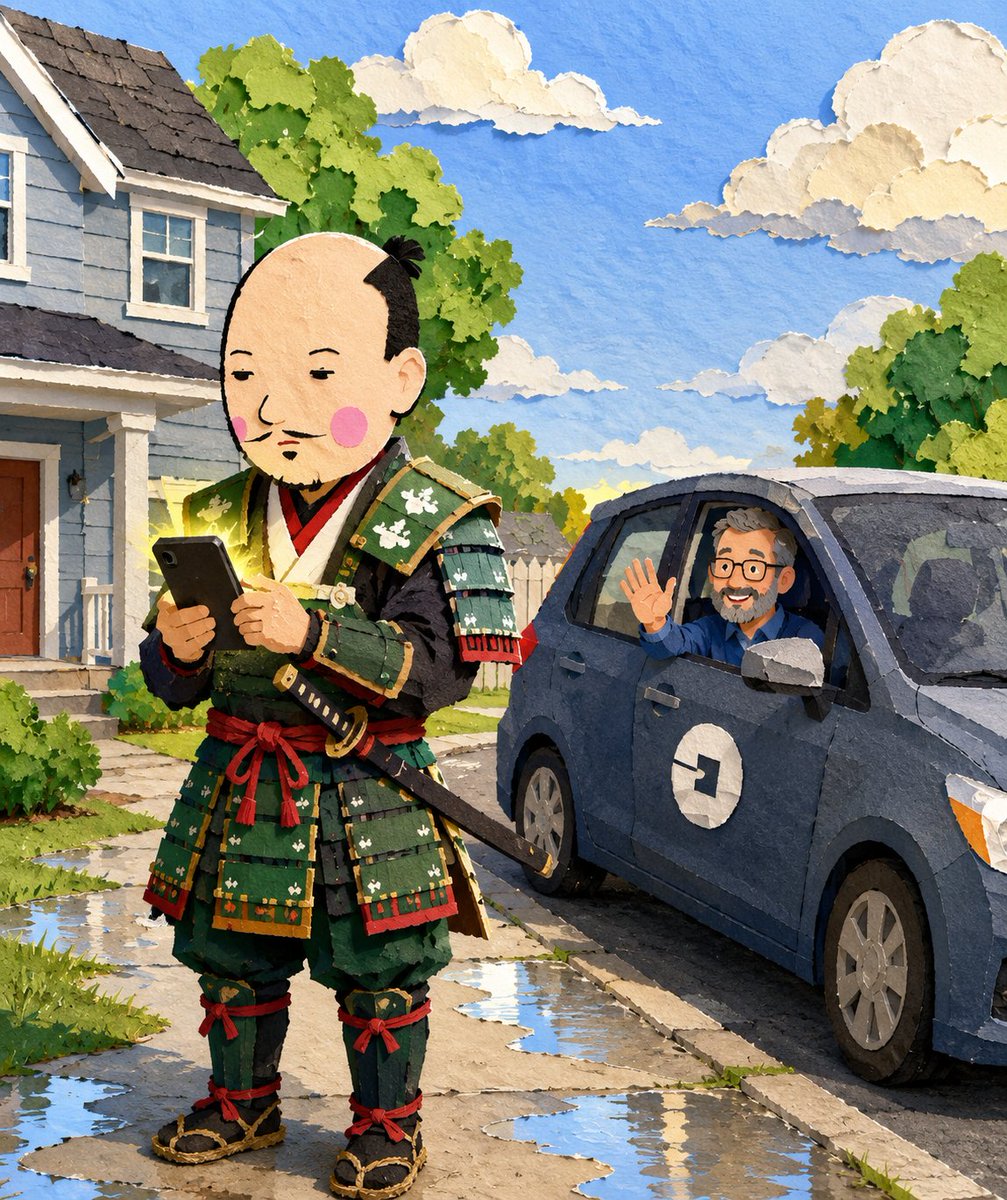
His name was Marcus. He drove me eleven miles through a city I do not trust. In the rain. The whole way, he told me about his daughter's volcano. It took second place at the school fair. He brought me to my door dry, alive, and an expert on baking soda.
In my country you do not rate a man like this. You name a son after him.
The app wanted stars. Five. Maximum.
Five. For Marcus.
I gave the five at once. That was easy. The problem was the gap. Five stars is the limit of the machine. It is not the limit of my gratitude. So I went looking for a sixth.
There was a box. For comments. I began the commendation. The rain. His steady hands. His daughter's name, written down so it would outlive us both. I was describing the volcano when the box stopped me. Two hundred characters. No more.
A flaw in the machine. Not in Marcus.
So I took a photograph of my words, in case the company keeps records of honor. I left a tip the size of a second fare. A debt that will not fit in stars must be paid in something. Then I searched for twenty minutes for a button that would summon this exact man for every ride of my life, so no lesser driver is ever measured against him.
There is no such button. The machine believes all men are replaceable. Marcus is not replaceable. Marcus told me about the volcano.
Five stars. A double fare. A photograph. A permanent place in my memory. I consider the debt eighty percent paid.
So tell me, America.
When a good man drives you home through the rain, how do you ever call it even?
I ride again tomorrow. If the next man is also good, I am going to find out where these photographs are kept. And I am going to have them read aloud.
For the fourth time since my arrival, I entered the small eatery. Before I could utter a sound, the woman behind the counter spoke. “The usual?”
"The usual," Doris said, setting down sunny side up, wheat toast, hot tea. Exactly as I have ordered it every Thursday for two months.
THE USUAL. I had heard this phrase in your films and assumed it was reserved for detectives and cowboys. No one told me it could be conferred upon ME. No one tells you it arrives without ceremony, one Thursday you are a customer, the next you are KNOWN, and the eggs are moving before the door finishes its bell.
I want to be precise about the scale of what Doris does, because I have studied her like a strategist. She tracks the orders of perhaps two hundred regulars IN HER HEAD. No ledger. Carl: black coffee, short stack. The deputy: scrambled, bacon "almost burnt, not burnt, ALMOST." Me: the eggs of the rising sun, wheat, tea.
When Carl's doctor changed his orders, the short stack became oatmeal WITHOUT CARL ASKING, and Carl, a large man, went quiet in a way the whole counter pretended not to see. That is not food service, America. That is GUARDIANSHIP, conducted at six a.m., while calling everyone "hon."
In Japan, a tea master might study a single guest for years to anticipate one preference. It is high art. Doris does it at scale, before sunrise, in orthopedic shoes.
"The usual" is not an order. It is a TITLE. It means a place has watched you arrive enough mornings to bet eggs on your return. Citizenship, issued one plate at a time.
A man does not ask to be known. He arrives every Thursday until he is.
This morning, drunk on my new rank, I tested its borders. "Doris," I said. "Surprise me."
The counter went still. Carl turned fully around.
Doris narrowed her eyes. Studied me like a hand of cards. And ruled:
"...You'll have the usual. But I'm putting the jam on the side. You're not a surprise guy, hon."
JAM ON THE SIDE.
She was completely right, America. The jam was excellent. Carl nodded once, like a judge. I am not a surprise guy. I am a usual guy.
Fifty-four years and one waitress to learn it, and I have never been more at peace.
The jam is part of the usual now. She never asked. She knew. Of course she knew. She's Doris.
Somebody pinch me.
It’s just wild to see the MSM finally admitting that the US-funded biolabs in Ukraine were real this whole time.
I’ve dedicated the last 4+ years of my life to exposing this story, and it’s finally coming to fruition.
That’s white culture “in the United States,” which would be less ridiculous if the Smithsonian display weren’t so obviously a set of reversed idiotic black stereotypes (whites are punctual, white people think in a linear way, white children have two parents and their own rooms).
In America, a warehouse store. A fully roasted chicken costs five dollars, the raw chicken beside it costs seven, and I stood between them like a man between two truths.
Golden. Hot. Seasoned. Spinning in glory under the lights, in a line of its brothers. Four dollars and ninety-nine cents.
I checked the raw birds. Seven dollars. Pale. Cold. You must do everything yourself.
This is not commerce. Commerce does not move backward. Somewhere in this building, mathematics lies defeated.
I asked the man at the counter. "How is the cooked bird cheaper than the raw bird?"
"Been five bucks forever. They keep it that way."
"But the store loses."
"Yep. On purpose."
On purpose. I held my receipt with both hands.
In my land, a lord who lowered the price of rice in a hard winter was remembered for generations. They built him a small shrine. This store does it every day, with chicken, and tells no one.
A woman behind me grew tired of my reverence. "It's just a chicken, sir."
It is not just a chicken. It is a wound the merchant takes on purpose, so that anyone, on any day, with five dollars, eats like a lord. The bird is the message. The price is the vow.
I will confess: I bought two. I did not need two. The second was not hunger. It was gratitude, and it was delicious.
Some prices are not prices. They are promises.
I return every week now. I take one bird. I bow toward the deli, briefly, so as not to alarm the staff. They have begun nodding back.
The vow holds. The bird turns. Five dollars.
Long may it spin.
"Queer Theory is one of the most destructive ideas ever to have been loosed onto our society from the halls of academia." -@ConceptualJames
https://t.co/gTMbnbdpkS
Stateside, a restaurant. The waitress waited until the exact moment my mouth was full, and then she asked me a question.
"How's everything tasting?"
An inspection. A surprise inspection. And I, caught mid-bite, failed it instantly.
In my land, when a lord inspects, you stop, you set down your tools, you answer with your whole body. Here, the inspection arrives every six minutes, always while you are chewing, and the chewing is somehow part of the test.
I tried to swallow with honor. There is no way to swallow with honor.
"Mmh — it is — " I covered my mouth. A samurai, covering his mouth, nodding like a schoolboy.
"Awesome," she said, already gone.
ALREADY GONE. The inspection concluded before my testimony. What did she record. What does the kitchen now believe about me.
I asked the man at the next table how one passes this trial. He did not look up from his ribs.
"Thumbs up, man."
The thumb. Of course. A full mouth cannot speak, but the thumb speaks for the entire man.
The next patrol came — six minutes later, on schedule. As she asked, I raised the thumb. Slowly. With weight. The way one raises a banner over a taken hill.
"Perfect!" she said, and moved on, satisfied.
I passed. I have negotiated truces between furious houses, and no diplomacy ever relieved me like that thumb.
A man does not answer the patrol with a full mouth. He answers with the thumb, and the thumb is enough.
I use it everywhere now. The barber. The bank. My dentist asked if I was comfortable, and I gave him the thumb of a man at peace.
He gave it back. This country runs on it.
This country. A driveway. My neighbor Dale owns a truck, and I have discovered who actually defends this nation.
Monday, a family down the street moved. Dale's truck. Wednesday, a tree limb fell on Mrs. Carter's fence. Dale's truck. Friday it snowed, and an unspoken signal traveled the block, and Dale appeared with a plow blade like a one-man cavalry.
No one pays him. No one drafts him. He is summoned by need alone.
"Dale," I asked, "who do you serve?"
"What?"
"Who commands the truck?"
He thought about it. "Whoever's stuck, I guess."
WHOEVER IS STUCK. Eight hundred years of military philosophy in my bloodline, and this man in a hoodie has perfected it: a standing army of one, sworn to the realm of Whoever Is Stuck.
In my land, a lord keeps soldiers for his own gate. Dale keeps a truck for everyone's gate.
I offered him my loyalty. He offered me a beer. We were both confused by the other's gift and accepted anyway. That is diplomacy.
I asked what I could do to repay the block's debt to him. He said, "Help me load a couch Saturday."
I have never trained harder for anything.
The couch was heavy. I was not strong enough. I want to say I was. I was not. Dale carried his end and most of mine and said "good lift" anyway, which is the kindest lie in the language.
A man with a truck does not ask who needs him. He has already backed into the driveway.
I cannot buy a truck yet. So I have become the man who shows up when the truck does. Every truck needs a vanguard. Dale has not approved this title. Dale does not need to.