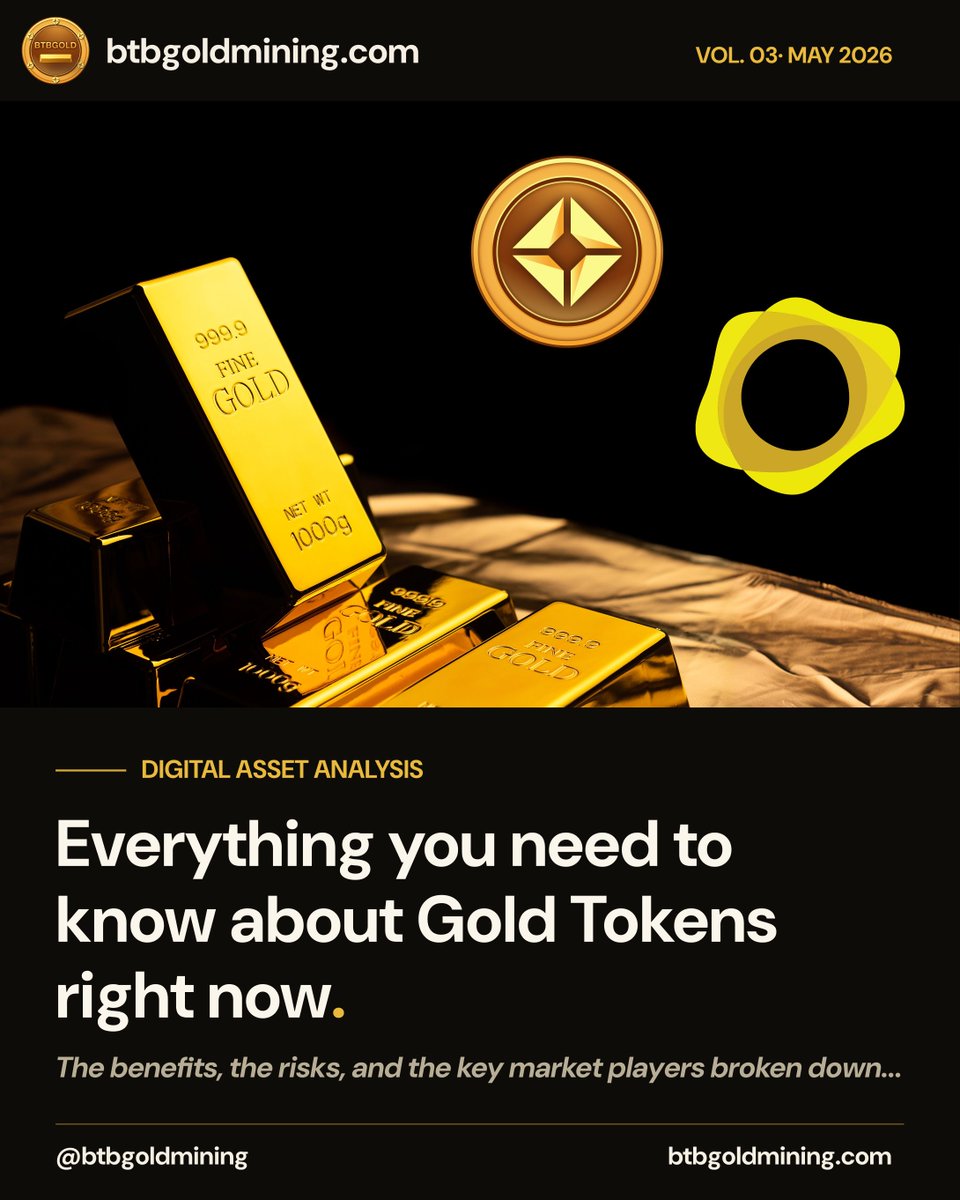
The momentum in the area of gold-backed cryptocurrencies is enormous, driven by geopolitical uncertainties and a weakening crypto market. The total market capitalization of tokenized gold has exceeded the $5 billion mark and is growing 2.6 times faster than the traditional gold market. Investors are increasingly using gold tokens as a 'risk-off' hedge. Tether Gold (XAUT) leads with approximately 45% market share, and PAX Gold (PAXG) is strengthening its ecosystem. BTBGold, based on a 2,334 square kilometer gold mine in the Congo (Brazzaville), is positioned as a future market leader and plans bearer bonds, a stock market listing, and the introduction of the BTB Goldcoin. Large institutional market participants like Wintermute are integrating gold tokens. The deep DeFi integration enables investors to use gold as collateral. A new regulatory application for 30 European markets has been submitted.
Beyond the Oil Wells:
The Untapped Potential of Congo-Brazzaville’s Gold Sector
When commodity analysts talk about the Republic of the Congo (Congo-Brazzaville), gold is rarely the first thing that comes to mind. As an established OPEC member, the country’s economic heartbeat has long been driven by offshore crude petroleum, supplemented by major reserves of potash and iron ore. Yet, beneath the surface of the ancient Congo Craton lies a highly prospective gold endowment that remains almost entirely untapped. Unlike mature mining superpowers, the gold sector here is not defined by multi-billion-dollar corporate complexes, but by thousands of independent miners operating on a fascinating, raw frontier.
The Reality of the Alluvial Frontier
Right now, gold mining in Congo-Brazzaville is an almost purely artisanal affair. Between 5,000 and 10,000 local miners drive the entire domestic output, working primarily in remote, rural pockets like the Mayombe gold belt near Kakamoeka and the Elogo region in the far northwest.
For generations, this has been a game of chasing alluvial deposits—gold that has eroded into riverbeds over millennia. Officially, the government tracks an annual output ranging anywhere from 500 kilograms to two tonnes. However, industry insiders know the true figure is likely much higher. Because the vast majority of these operations exist outside the formal banking system, a significant portion of the extracted gold quietly slips across regional borders through informal trade networks before it can ever be officially recorded.
A Stark Contrast to the Global Giants
To understand just how early-stage Congo-Brazzaville's industry is, one only has to look at the world's leading gold economies. Superpowers like China and Australia regularly pull more than 300 tonnes of gold from the earth each year. Their operations are masterpieces of heavy industrial engineering, relying on autonomous haul trucks, computerized seismology, and massive processing plants capable of crushing thousands of tonnes of hard rock every single day. Even closer to home, Ghana has successfully bridged this gap, producing over 100 tonnes annually by balancing massive multinational corporate concessions with heavily regulated, legal local cooperatives.
Congo-Brazzaville operates in a different reality. Here, extraction is still a matter of manual labor: shovels, wooden sluice boxes, and hand-cranked crushers. While this low-tech approach requires virtually no corporate capital, it means that the country's deeper, hard-rock gold veins remain completely untouched by human hands.
The Environmental Elephant in the Room
This structural informality brings severe challenges, particularly regarding sustainability. Without access to modern industrial processing equipment, many Congolese miners rely on mercury amalgamation to separate fine gold particles from river mud. It is a cheap, effective, but highly toxic shortcut. Environmental agencies estimate that these small-scale operations release over two tonnes of mercury into the local ecosystem each year, posing a direct threat to the fragile Congo Basin.
This ecological risk has recently caught international attention. A multi-million-dollar UN initiative called planetGOLD was launched in the country, aiming to give local miners a bridge to the formal economy by introducing mercury-free refining technologies. It is a slow process, but a necessary one if the country ever wants to align with global purchasing standards. In places like Australia or Nevada, using mercury has been strictly illegal for decades, and mining corporations are forced to post massive financial bonds to guarantee environmental cleanup before they even break ground.
The Next Decade: Looking for the Mother Lode
Despite these hurdles, the geological outlook is what keeps international exploration firms interested. The underlying rock formations in Congo-Brazzaville are virtually identical to the rich greenstone belts that power some of Africa's most lucrative mining hubs.
Currently, junior exploration companies from Canada, Australia, and China are flying airborne geophysical surveys and pulling drill cores from the northwestern forests. They are betting that the gold-rich rivers panned by locals are being fed by massive, undiscovered primary deposits deep underground. If the government can successfully clean up its regulatory framework, protect local mining communities, and offer a stable environment for foreign investment, Congo-Brazzaville could easily evolve from a quiet oil state into a key player in the next African gold rush.
The banking system is teetering. Zero returns and constant devaluation. If the next bank fails, your digital balance could be frozen—or vanish completely. Smart investors are withdrawing their money from this toxic system while there is still time.
Physical precious metals offer the ultimate protection. We provide our clients with the security of physical gold combined with the financial freedom of crypto—assets that can be cashed out anywhere in the world. No dependence on banks. No creeping expropriation. You retain physical control over your wealth.
The Hard Facts:
100% protection against bank failures and account freezes.
Completely tax-free profits after exactly twelve months (depending on your place of residence within the EU).
Full liquidity: Your capital remains flexibly accessible at all times—available to you instantly via our platform (Ethereum) and your digital wallet.
Click here to move your assets to safety: https://t.co/ZkCWtGDWax. BTBGOLD. * Information Advantage * Security * Flexibility * Globally Available * BTBGOLD—The Future Begins Now.
New taxes on Bitcoin and cryptocurrencies are looming at the EU level. More concrete plans came to light when, in late April, the European Parliament voted on a negotiating position for the 2028–2034 budget, in which a new tax on crypto gains was listed as a potential option.
Now, a new document from the EU Commission has emerged that analyzes various scenarios; alongside an EU-wide tax on capital gains derived from Bitcoin and similar assets, a transaction tax is also being put on the table. According to current estimates, these measures could generate billions in annual revenue.
EU Eyes New Crypto Taxes
In a new document, the EU Commission examines the potential revenue figures that these respective taxes could generate. In addition to a levy on digital corporations and a tax on online gambling, the document also addresses potential new financial burdens for cryptocurrency holders.
EU-Wide Taxes on Crypto Gains
Taxing crypto gains at the EU level is, in fact, not a new idea. The European Parliament had already identified this option as a possibility within its negotiating position for the upcoming long-term budget.
Specifically, the accompanying press release issued in late April stated the following:
"The next long-term budget should introduce new sources of revenue capable of generating approximately €60 billion annually—such as a levy on digital services, a levy on online gambling, an expansion of the Carbon Border Adjustment Mechanism (CBAM), or a levy on capital gains derived from crypto-assets."
— From the Press Release
The EU Commission has now apparently undertaken the task of quantifying this revenue potential in greater detail.
In this regard, the document indicates that between €1 billion and €2.4 billion could be generated annually. However, this estimate should be treated with caution due to a lack of data.
The EU-wide tax on crypto gains could either complement national regulations or replace them.
The [tax on crypto gains] would replace or complement existing regulations regarding the taxation of capital gains in the Member States (which are currently not harmonized).
From the document
Crypto Transaction Tax
The other crypto tax addressed in the document is a tax on transactions. This concept was not a central focus of the European Parliament's negotiating position.
The EU Commission has calculated that a tax of 0.1% on crypto transactions could generate total revenue of between 3 and 4 billion euros per year.
Regarding a tax on crypto transactions, the estimate for the year 2025—based on a rough market research projection for EU accounts and assuming a tax rate of 0.1 percent of the transaction value—would yield annual revenue of approximately 3 to 4 billion euros for the EU budget.
From the document
According to the proposed model, the transaction tax is to be remitted directly by service providers—such as crypto exchanges.
Up to 45 Billion Euros Over 7 Years
The EU Commission is therefore convinced that each of the two taxes in question could generate a sum in the ten-figure range. According to the calculations, the transaction tax would be the more lucrative of the two.
We are at your disposal at any time for further information.
BTB Goldmining—the future begins now
Information on Gold Tokens (or Tokenized Gold). Gold tokens are digital assets hosted on a blockchain, where each token represents ownership of a specific, stored quantity of physical gold—typically one gram or one troy ounce. They combine the price stability of physical gold with the speed, fractional ownership capabilities, and 24/7 liquidity characteristic of cryptocurrency markets.
Key Gold Token Investments
Several established gold tokens dominate the market, differing slightly in terms of their issuers and fee structures:
Paxos Gold (PAXG): Backed 1:1 by physical gold bars stored in Brink’s vaults and regulated by the NYDFS. You can track and trade the token via Paxos. Disadvantage: Under US jurisdiction.
Tether Gold (XAUt): Each token represents one troy ounce of gold allocated to a "London Good Delivery" gold bar. It is issued by TG Commodities Limited and traded on leading crypto exchanges. Disadvantage: No longer based in an EU member state.
HSBC Gold Token: Aimed at investors from the traditional banking sector, this token enables fractional ownership (starting from 0.001 troy ounces) based on distributed ledger technology. Disadvantage: HSBC’s history of banking scandals and legal disputes.
AMINA Gold Token (AGT): A fully regulated, bank-issued token representing direct ownership of 1 gram of fine gold stored in Swiss vaults. Disadvantage: Tax liabilities apply for EU citizens.
BTBGOLD TOKEN: We are an autonomous, independent gold mining company based in Congo (Brazzaville), holding one of the largest and richest concessions in one of the most mineral-rich regions near the Equator. Our track record speaks for itself: gold mining conducted without harmful chemicals, environmental protection achieved through the careful assessment of surface gold deposits, and a strict prohibition on child labor. Your opportunities and prospects: you are investing in a young, innovative company that brings gold and diamonds to market—whether for direct purchase, as a conservative investment vehicle in the form of shares and bearer bonds, or as tokens and gold-backed coins.
Why Investors Use Gold Tokens
Fractional Ownership: You can invest in gold with relatively small amounts, eliminating the need to purchase expensive, full-sized bars or coins.
No Storage or Insurance Hassles: The physical gold is stored and insured within professional vaults, relieving you of the burden of having to organize secure storage yourself.
High Liquidity: Unlike physical precious metals—the sale of which typically requires your personal presence or shipment—you can transfer ownership of gold tokens instantly and globally.
Risks to Consider:
Technology and Custody Risks: The security of your investment depends entirely on the digital wallet you use or the cryptocurrency exchange where you store your tokens.
Regulatory Uncertainty: Depending on your country of residence, the legal status of tokenized precious metals may vary significantly across different jurisdictions. Please feel free to send us an email; we are always happy to get in touch with you to answer any questions you may have.
A freshly poured bar from our operation in the Republic of the Congo. Mined on the concession, processed on-site, and cast at the foundry.
#goldmetal#goldmining#metals#btbgold
Analysis for Gold May 2026:
Deutsche Bank has outlined a theoretical simulation scenario in which the price of gold could rise to as much as 8,000 US dollars per ounce over the next five years.
However, this is not an official price forecast, but rather a mathematical model calculation. The basis for this extreme scenario is a fundamental structural shift within the global financial system.
The Core Factors of the $8,000 Scenario
Central Bank Reallocation: If central banks worldwide were to increase the gold share of their total reserves—currently standing at around 30 percent—to 40 percent, Deutsche Bank’s simulation suggests this would catapult the price upward by approximately 80 percent.
De-Dollarization: Emerging economies are reducing their reliance on the US dollar, as the dollar-based banking system is increasingly being utilized as a tool for political leverage. In this context, gold serves as a hedge against Western sanctions.
Expanded Buyer Base: It is no longer just major buyers—such as China or India—that are building up their holdings. Countries such as Saudi Arabia, Kazakhstan, Qatar, Egypt, and the UAE are also increasingly emerging as strategic buyers.
New Monetary System: In the long term, the analysis views these purchases of physical gold as a harbinger of a potential return to gold serving as a tangible anchor for an alternative, future monetary system.
Current Market Context (As of: May 2026)
The scenario looks back upon a period of massive price appreciation. The historical performance observed over recent months provides context for this specific price level.
Larry Fink, CEO of BlackRock and one of the most powerful men in the world, has raised over $50 billion with his Bitcoin ETF in less than 12 months. The man manages over $10 trillion. He doesn't need hype. He acts because he knows what is coming.
At the same time, the U.S. established a strategic coin reserve via presidential executive order.
Russia is utilizing crypto in its oil and gold trading because sanctions cannot stop it.
MicroStrategy holds over 500,000 Bitcoins on its corporate balance sheet.
Goldman Sachs, JP Morgan, and Fidelity have all long since begun offering crypto products.
359 institutions worldwide hold coins.
Over 1 million Bitcoins are already held in corporate treasuries—effectively taken off the market for the long term.
These are not speculators. These are the smartest capital allocators in the world. And they are all betting on the same scenario...
They do not rule out the possibility that the system as we know it will collapse. Not at some distant point in the future. But soon!
Just look at what is happening right now:
Europe is more heavily indebted than ever before! And those debts are growing faster than ever. Germany has just approved 500 billion euros in new debt. The energy crisis is hitting our industrial sector harder than any other economic region in the Western world.
Corporate insolvencies are at their highest level in decades. Silicon Valley Bank vanished overnight. One of the largest banks in the U.S. collapsed in just 48 hours. And it wasn't the last.
Added to this is what you are feeling directly here in Germany: An asset registry that could be leveraged at any moment to pay down debt. A digital euro that implies complete, one-sided transparency. And tax hikes that are inevitable—because the debts have to be paid. And a creeping abolition of cash: Large cash payments for cars, real estate, and valuables are already restricted or prohibited. You are no longer allowed to take more than €10,000 in cash across the border—at least not without a mandatory declaration.
The system is tightening. Becoming more controlled. More all-encompassing.
If hyperinflation strikes (as it did in 1923, when German savings became worthless overnight), then cash is worth nothing. Bonds are worth nothing. Stocks are worth nothing.
What matters then are assets that no government can print. Bitcoin has a fixed supply of 21 million. No government in the world can produce even a single additional Bitcoin.
But here is the decisive difference compared to real estate or cash:
Bitcoin, gold—along with their associated tokens and coins—are completely mobile.
You cannot confiscate them. You cannot freeze them. You cannot control them. They know no borders, no customs checks, and no mandatory reporting requirements. With just a password in your head, your entire wealth becomes accessible anywhere in the world.
In Ukraine, people used this method to carry their wealth across the border when bank accounts were frozen and cash became worthless.
This is not merely an investment. It is a life insurance policy. For you. For your family. For your children. For your future—and for the future of us all.
The elites have known this for a long time. That is why they are buying quietly, systematically, and without fanfare—while the average citizen is being herded into financial systems that are fully surveillable and controllable.
The window of opportunity is closing. Make the decision today to invest in a decentralized asset class that combines physical, tangible gold from our mine with the future of the crypto market—offering freedom, security, and global accessibility.
Btbgold: The future begins now.


![BTBGoldMining's tweet photo. New taxes on Bitcoin and cryptocurrencies are looming at the EU level. More concrete plans came to light when, in late April, the European Parliament voted on a negotiating position for the 2028–2034 budget, in which a new tax on crypto gains was listed as a potential option.
Now, a new document from the EU Commission has emerged that analyzes various scenarios; alongside an EU-wide tax on capital gains derived from Bitcoin and similar assets, a transaction tax is also being put on the table. According to current estimates, these measures could generate billions in annual revenue.
EU Eyes New Crypto Taxes
In a new document, the EU Commission examines the potential revenue figures that these respective taxes could generate. In addition to a levy on digital corporations and a tax on online gambling, the document also addresses potential new financial burdens for cryptocurrency holders.
EU-Wide Taxes on Crypto Gains
Taxing crypto gains at the EU level is, in fact, not a new idea. The European Parliament had already identified this option as a possibility within its negotiating position for the upcoming long-term budget.
Specifically, the accompanying press release issued in late April stated the following:
"The next long-term budget should introduce new sources of revenue capable of generating approximately €60 billion annually—such as a levy on digital services, a levy on online gambling, an expansion of the Carbon Border Adjustment Mechanism (CBAM), or a levy on capital gains derived from crypto-assets."
— From the Press Release
The EU Commission has now apparently undertaken the task of quantifying this revenue potential in greater detail.
In this regard, the document indicates that between €1 billion and €2.4 billion could be generated annually. However, this estimate should be treated with caution due to a lack of data.
The EU-wide tax on crypto gains could either complement national regulations or replace them.
The [tax on crypto gains] would replace or complement existing regulations regarding the taxation of capital gains in the Member States (which are currently not harmonized).
From the document
Crypto Transaction Tax
The other crypto tax addressed in the document is a tax on transactions. This concept was not a central focus of the European Parliament's negotiating position.
The EU Commission has calculated that a tax of 0.1% on crypto transactions could generate total revenue of between 3 and 4 billion euros per year.
Regarding a tax on crypto transactions, the estimate for the year 2025—based on a rough market research projection for EU accounts and assuming a tax rate of 0.1 percent of the transaction value—would yield annual revenue of approximately 3 to 4 billion euros for the EU budget.
From the document
According to the proposed model, the transaction tax is to be remitted directly by service providers—such as crypto exchanges.
Up to 45 Billion Euros Over 7 Years
The EU Commission is therefore convinced that each of the two taxes in question could generate a sum in the ten-figure range. According to the calculations, the transaction tax would be the more lucrative of the two.
We are at your disposal at any time for further information.
BTB Goldmining—the future begins now](https://pbs.twimg.com/media/HJq931wWoAETDEF.jpg)