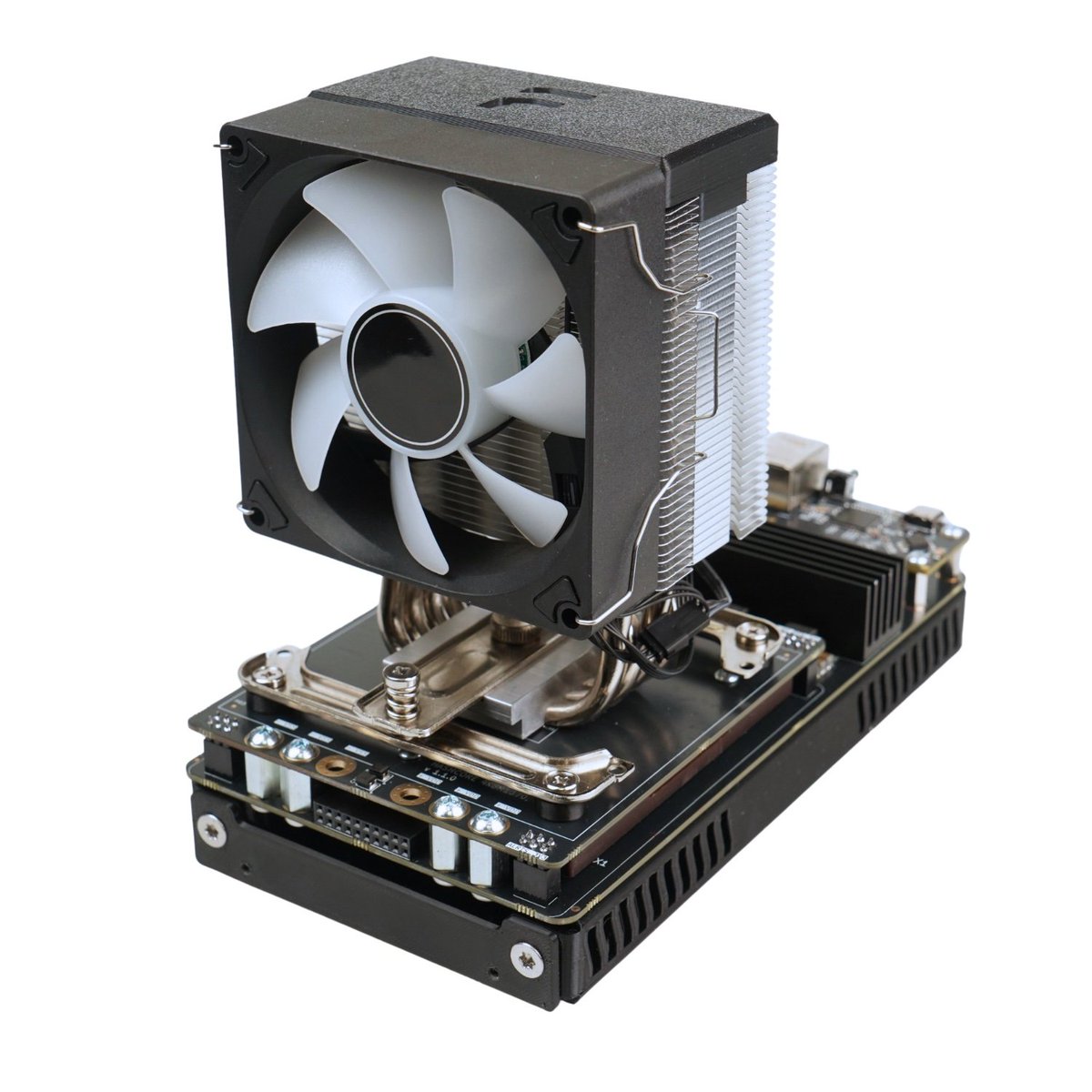
Home miners:
final hours to mine Bitcoin for 15% less 👀
The BMM 101, the Braiins Deck and all Braiins Forge merch are 15% off tonight.
Grab yours before the clock runs out.
Link in the first reply 👇🏻
🎲 Tick, tock, 2nd block. Today, a 200 PH/s solo miner hit their 2nd Braiins Solo block in 2 months, 6.29 BTC total.
• That's ~1,000 Antminer S21s, and a bit lucky: the math says ~1.7 blocks.
• Today's winning share was 199T, 48% over target.
⚠️ On plain Stratum V1, attackers can steal your hashrate. Use only secure mining connections.
A new miner comes out and your first thought is that you'll pass.
Then you read the numbers.
• 4.8 TH/s out of the box
• 6.5 TH/s overclocked
• $199 price tag (which is hard to ignore)
That resolve probably won't hold for the Forge Axe 😂💪🏻
Your #1 feature request:
4-year Bitcoin-backed loans.
Today we're launching:
Extendable Loans, for up to 4 years.
Your Bitcoin stays in the same escrow.
Collateral value increased?
You can borrow more.
Never sell your Bitcoin.
Live off it. 🔥🐟
Stratum V1 hashrate hijacking FAQs
TLDR: this is an attack on Bitcoin miners on every pool, through a weakness in plain Stratum V1. We caught it and traced it together with other teams in the mining industry.
🟧 Is this the same hack as two weeks ago?
No, it’s a different attack. The previous hack was a breach of a fleet-management platform, where attackers changed the pool settings on clients’ machines. This one does not breach machines, settings or pools, it is a breach of internet providers. An attacker reroutes internet traffic and pretends to be your pool, so nothing about your miner’s configuration changes, but it still ends up working for someone else.
🟧 Is this about Braiins, or all of mining?
All of mining. Braiins Pool and Braiins OS were not compromised, neither was any other firmware or pool. The victims were ordinary miners using Stratum V1, running >12 different firmware types on hundreds of networks. It affects any operation using plain V1, whether you run a full farm, a single mini miner or point at a solo pool.
🟧 How bad is it now, and how bad can it get?
In early November, the scope was 175 PH/s but it grew to 1.9 EH/s by Nov 20, and more than 1,000 mining sites were affected at once. The payout so far is small (CoinDesk estimates ~$17k), but between waves the attacker changed the method and moved from Latin America to Europe. They may be testing the waters.
Routing data shows that Stratum endpoints of most big pools were affected, and most of the network’s hashrate still connects over plain V1. Big farms are the likeliest targets, since they have more hashrate to take. Only hashrate gets stolen on its way to the pool, accounts, balances and payout settings are safe.
🟧 Whats happening now
In Braiins, we have already seen several Exahashes upgrade to Stratum V2 or Stratum V1+TLS. We cannot speak for other pools, but we are hoping they are helping their clients upgrade as well. This concerns all of us.
🟧 Is this a marketing tactic to push Stratum V2?
No. The weakness is old: Stratum V1 never had a way to authenticate the pool, and Dell SecureWorks documented the same routing trick taking about $83k from miners back in 2014. What’s new is the scale.
The fixes aren’t Braiins-only either. Stratum V1 over TLS works, but your FW must validate the pool’s certificate, and V2 is an open protocol any pool can run. The routing data is public, anyone can verify it.
Got a question about your setup? Ask in the replies and we’ll answer.
Mining hijacking attacks. These are done by intercepting stratum v1 between miners and pools in the internet infrastructure and do not require mining hardware or pools to be compromised.
-If your hashrate still appears at the pool, you are currently not compromised.
-Clustered mining hashrate is the most at risk - big mining farms and infrastructure. They are the easiest to attack.
-Distributed miners such as the 50k on solo ckpool are difficult to all target by nature, and are low hashrate so they are less likely to be targeted.
-On solo ckpool, minimising the hops between you and the pool minimises the potential attack vectors. Using https://t.co/zuBscHWyIJ will always choose the closest pool node to you.
-Stratum V2 protects against this very attack. If you have mining hardware that supports V2, switch now. Alternatively using a stratum v2 proxy such as ckproxy running on the local network of your miners will also protect you.
-Encrypted stratum V1 is relatively safe, but some mining firmware does not check signatures so do not rely on it - ckpool does not support this mode and may never now that SV2 is supported.
-The ultimate protection is running your own true solo mining locally. You can install your own solo ckpool on a linux machine: https://t.co/HMFNMQiJ4c
Angriffe auf Bitcoin-Miner: Das müssen Bitaxe-Besitzer jetzt wissen!
Gestern schlug @Braiins Alarm, dass derzeit Angriffe laufen, bei denen Angreifer die Rechenleistung von Geräten heimlich umleiten. Auch Bitaxe könnten grundsätzlich betroffen sein. ⬇️
https://t.co/SlOtZXNJmh
🚨 BITCOIN-MINING WIRD GERADE ANGEGRIFFEN 🚨
Braiins hat bestätigt: Angreifer kapern die Arbeit von Minern. Dein Miner läuft ganz normal weiter, aber jemand anderes kassiert dafür.
Das kann sich schnell ausbreiten. Viele Miner laufen standardmäßig über das einfache Stratum V1 Protokoll. Wenn du das nutzt, bist du betroffen, egal bei welchem Pool du bist.
Miner und Pools sollten JETZT handeln.
🟧 KURZ ERKLÄRT: STRATUM V1 UND V2
Stratum ist sozusagen die Sprache, in der dein Miner mit dem Pool redet. Der Pool schickt Aufträge, der Miner rechnet und schickt seine Ergebnisse (Shares) zurück.
• Stratum V1 ist der alte Standard. Die Verbindung ist unverschlüsselt und dein Miner kann nicht prüfen, ob er wirklich mit seinem Pool spricht. Jeder, der dazwischen sitzt, kann mitlesen und sich einmischen.
• Stratum V2 ist der Nachfolger. Die Verbindung ist verschlüsselt und dein Miner prüft, ob am anderen Ende wirklich dein Pool sitzt. Ein Angreifer kann sich nicht mehr einfach dazwischenschalten.
🟧 WIE DER ANGRIFF FUNKTIONIERT
Bei einfachem Stratum V1 kann dein Miner nicht prüfen, wer ihm die Arbeit schickt. Ein Angreifer leitet die Verbindung um, gibt sich als dein Pool aus und schickt deinem Miner Aufträge. Die Shares, die dein Miner abliefert, landen dann beim Angreifer statt bei deinem Pool.
🟧 WARUM DAS DRINGEND IST
Bei einem Vorfall haben über 1.000 Mining-Standorte in derselben Sekunde die Verbindung zu ihrem Pool verloren. Der gleiche Angriff könnte noch viel mehr treffen. Die gute Nachricht: Du kannst deine Verbindung heute noch absichern.
🟧 MINER: PRÜFT EURE HAUPTVERBINDUNG UND JEDES BACKUP
• Wechsel auf Stratum V2, wenn dein Miner und dein Pool das können. Nimm die offizielle V2-Adresse und den Key von deinem Pool.
• Du bleibst bei V1? Dann nutz die TLS-Adresse deines Pools und eine Firmware, die prüft, ob der Pool auch wirklich der Pool ist.
• Du nutzt einen Proxy? Check, wie der mit dem Pool verbunden ist. Wenn deine Miner selbst keine sichere Verbindung aufbauen können, kann der Braiins Pool SV2 Proxy die Verbindung von deiner Farm zum Braiins Pool absichern.
• Deine Miner stehen beim Hoster? Frag nach, ob Haupt- und Backup-Verbindung sicher sind.
🟧 POOLS UND SOFTWARE-ANBIETER: INFORMIERT EURE KUNDEN HEUTE NOCH
• Pools: Bietet Stratum V1 über TLS an und am besten auch Stratum V2. Schickt euren Minern die sicheren Adressen und eine Anleitung.
• Firmware- und Software-Anbieter: Sagt euren Nutzern, welche Versionen die Identität des Pools prüfen und wie man das einschaltet.
🟧 BITCOIN-COMMUNITY: HELFT MIT, DASS DAS BEI DEN MINERN ANKOMMT
Teilt das mit allen, die Mining-Farmen, Hosting oder Pools betreiben. Die komplette Analyse und die Anleitung von Braiins findet ihr in der ersten Antwort ⤵️
https://t.co/AG32Th8fkH
🚨 Bitcoin mining faces another security threat.
▪️ Up to 1.9 EH/s hijacked
▪️ As many as 1,600 mining sites affected
▪️ Decade-old Stratum V1 weakness exploited
Braiins warns the threat remains active. 🔐
https://t.co/TqUtsPpbYB
Solo mining keeps paying out:
On Sunday, November 22, a miner on CKPool Solo found block 977,057 and took the 3.13 BTC reward.
No warehouse needed to be in the draw.
Every block is a fresh shot for anyone pointing hashrate at it.
We build home miners to make wins like this possible.
The rest is patience and a little luck 🤞🏻🍀
FAQs
1. Who’s at risk? Any miner using unencrypted Stratum V1, a common default on pools worldwide.
2. Has it happened? Yes. We’ve known the risk for years. Now we’ve documented attackers hijacking miners’ work.
Check your main and backup connections. NOT A DRILL.
Someone has been stealing bitcoin hashrate without hacking a single miner or pool. @Braiins discovered the attack: on Nov 20, hijacked internet routes sent more than 1,000 mining sites to a fake pool in the same second.
The hole is Stratum V1, the plain-text protocol most of the industry still runs. A miner on V1 can't verify who is sending it work. The attacker announced a more specific BGP route covering the pool's IP address, reset the miners' connections, answered as the pool and fed them real jobs from a different large public pool. The shares landed in the attacker's account. The miners kept hashing at full power and showed the pool as alive. Only the pool dashboard showed zero.
From Braiins' investigation:
• Nov 7-12: 19 episodes in Latin America, 120 to 400 sites, up to 174 PH/s
• Nov 20: 4 episodes, mostly Europe, 1,050 to 1,600 sites, up to 1.9 EH/s, 6 to 49 minutes each
• Public routing data shows the same forged announcements aimed at blocks hosting other large pools' endpoints, some still live on Nov 22
• Of seven firmwares tested, two with a TLS option still accepted invalid certificates
None of this is a new weakness. Dell SecureWorks documented the same routing trick taking about $83,000 in mining rewards back in 2014. Stratum V2 has encrypted and authenticated the pool connection for years, and most of the hashrate never switched.
Any pool URL on your machines starting with stratum+tcp://, backups included, can be hijacked. The fix is Stratum V2, or V1 over TLS on firmware that actually checks the certificate. When Braiins checked the largest pools' public endpoints on Nov 23, most still offered only plain-text V1.