What if plants could tell us what they need, and we could respond?
A Cornell-led research center has received a nearly $22.5 million NSF award to advance two-way communication with plants, with the goal of making agriculture more responsive and resource-efficient. BTI is a partner with the multi-institutional CROPPS, contributing to this work at the intersection of plant biology and technology.
Read more: https://t.co/PbyWDrLgzN
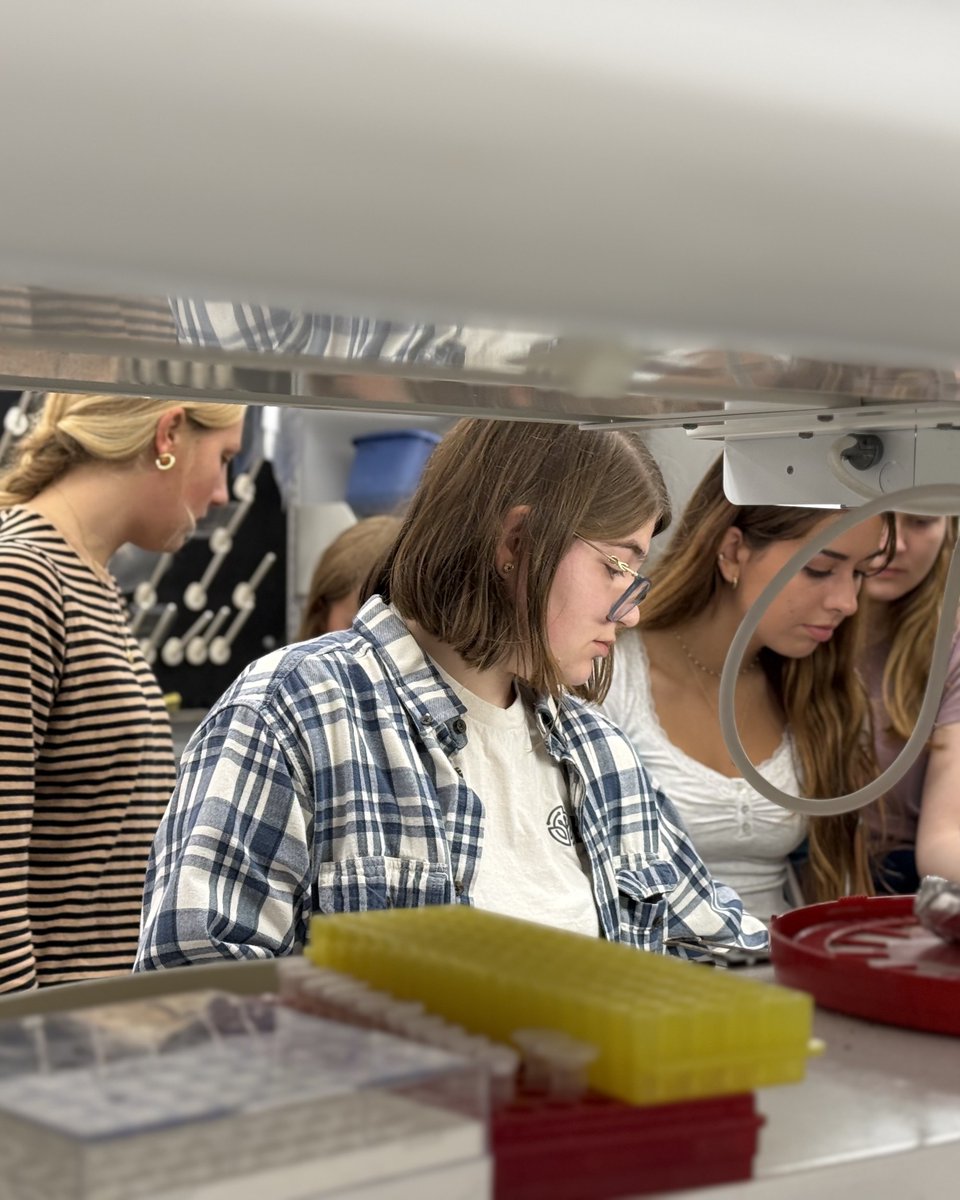
On September 29th, a group of students from BOCES New Vision Life Science program stopped by BTI to learn more about our groundbreaking plant science research and facilities. Dr. Magda Julkowska shared more about BTI’s Phenosight facility and how researchers use it within plant science research. They also learned from researchers in Dr. Silvia Restrepo and Dr. Maria Harrison’s lab to begin understanding the research taking place. The students will be able to participate in a hands-on internship experience next semester, and this field trip is one of many to help them understand life science research and potential research topics they are interested in.
Thank you to Alexis Davis for inviting your students to stop by, and to Dr. Julkowska, Dr. Cristina McGuire, and Lizzie Trost for taking the time to share your enthusiasm for plant science research!
On September 18, BTI dedicated its auditorium in honor of Dr. J. Alan Renwick, a pioneering chemical ecologist whose connection to the Institute began in 1960, when he arrived from Scotland with a single trunk and was offered a job after just one conversation. Throughout his career, he grew from research assistant to emeritus professor, publishing more than 140 papers and mentoring generations of scientists.
But the stories shared at the dedication made clear that Alan’s legacy was about much more than science. Colleagues remembered his patience, curiosity, humor, generosity, and his ability to make people feel welcome. His daughter, Katie, recalled how he continued coming to BTI for coffee long after retirement, in part because he valued the chance to run into people and hear about their lives and research.
The new Dr. J. Alan Renwick Auditorium is a fitting tribute to someone who believed deeply in both science and the community that makes it possible.
Read Alan’s story, watch the full dedication ceremony and tribute slideshow in the article, and hear more memories from friends and colleagues.
And if you knew Alan, please share a memory or story about him in the comments. We’d love to hear and preserve the stories that made Alan such a special part of BTI.
https://t.co/bYGeiUYDOc
The tomato on your plate is the product of generations of careful breeding – selected for size, firmness, yield, and shelf life. Flavor didn't always make the cut, and it has proven stubbornly hard to breed back in.
Wild tomato relatives still carry much of what was lost. Some pack their fruit with lycopene. Some hold more sucrose. Others never turn red at all.
A new BTI study in 𝘎𝘦𝘯𝘰𝘮𝘦 𝘉𝘪𝘰𝘭𝘰𝘨𝘺 maps the genetic "dimmer switches" behind color, sweetness, bitterness, and aroma – across three fruit tissues and up to four stages of development and ripening.
Led by Carmen Catala, Zhangjun Fei, and James Giovannoni, the team crossed cultivated tomato with three wild relatives. In the hybrids, both versions of every gene share the same cells and the same regulatory signals, letting researchers pinpoint differences written into the DNA right next to each gene.
What they found:
• Those built-in "dimmers" drove most differences, affecting up to 23.5% of active genes, versus no more than 4.6% for changes elsewhere in the genome
• Green-fruited species stay green because genetic changes steer pigment production away from lycopene
• A coordinated pair of sugar genes lets those fruits hold on to more sucrose
• Bitterness follows a "defense early, edibility at maturity" pattern as fruit ripens
The result: specific gene targets, in specific tissues, at specific moments, for breeding tastier, more nutritious tomatoes. The full dataset, including two newly assembled wild tomato genomes, is freely available.
Read the full story: https://t.co/Ip0HKm3eeR
The Andes were supposed to stop this cacao killer. They didn't.
Black pod disease destroys up to a quarter of the world's cacao crop every year. In Colombia, researchers expected the country's three Andean mountain ranges to keep populations of the pathogen, 𝘗𝘩𝘺𝘵𝘰𝘱𝘩𝘵𝘩𝘰𝘳𝘢 𝘱𝘢𝘭𝘮𝘪𝘷𝘰𝘳𝘢, separated.
A new Phytopathology editor's choice study led by BTI president Silvia Restrepo found otherwise. The team genotyped 73 isolates from 48 locations and found seven genetic clusters, and none lined up with geography.
The clue: every isolate was the same mating type, so the pathogen is reproducing clonally. That much diversity had to come from outside, most likely carried across the mountains on cacao plant material moved through breeding and distribution programs.
The research team also found that a strain's DNA can't predict how aggressive it will be. Breeders need to test resistance against isolates that span the full range of virulence.
Read the full story: https://t.co/J00w6YoWyi
What does it take to turn a promising scientific discovery into something that can make a real-world difference?
Sometimes, the answer is more research. More data. Specialized technology. Industry partnerships. Or simply the flexibility to pursue an idea beyond the boundaries of a traditional grant.
That’s where the Cane-Bridge Foundation is making a difference at Boyce Thompson Institute.
Through its support of projects ranging from guayule research for domestic natural rubber to crop disease solutions, therapeutic discoveries, advanced microscopy and BTI’s PhenoSight phenotyping facility, Cane-Bridge is helping scientists bridge the gap between discovery and impact.
At the center of this approach is Project Vault!, a $1 million investment designed to strengthen BTI’s ability to move promising discoveries toward the field, the clinic and the marketplace.
It’s philanthropy with a long-term vision: invest not only in great science, but in what that science needs to go further.
Read the full story to learn how Cane-Bridge is helping build a cycle where philanthropy advances discovery, translation creates opportunity, and successful opportunities help support the science of tomorrow.
https://t.co/pMbST3HV6y
Meet Benicio “Benny” Sandoval, one of our 2026 BTI REU researchers!
Watch as Benny shares his journey in plant science, his research, and how this summer has shaped his plans for the future.
Meet Jua'nele Webb, one of our 2026 BTI REU summer researchers!
Jua'nele’s summer was all about learning, growing, and discovering new possibilities.
Watch as she shares what sparked her interest in plant science, the skills she developed this summer, and how her experience at BTI has shaped what comes next.
On September 18th, we're celebrating the life and legacy of Dr. J. Alan Renwick by dedicating the Boyce Thompson Institute’s Auditorium in his honor.
𝐈𝐟 𝐲𝐨𝐮 𝐤𝐧𝐞𝐰 𝐀𝐥𝐚𝐧 𝐚𝐧𝐝 𝐰𝐨𝐮𝐥𝐝 𝐥𝐢𝐤𝐞 𝐭𝐨 𝐣𝐨𝐢𝐧 𝐮𝐬, 𝐩𝐥𝐞𝐚𝐬𝐞 𝐫𝐞𝐚𝐜𝐡 𝐨𝐮𝐭 𝐭𝐨 𝐜𝐨𝐦𝐦𝐮𝐧𝐢𝐜𝐚𝐭𝐢𝐨𝐧𝐬@𝐛𝐭𝐢𝐬𝐜𝐢𝐞𝐧𝐜𝐞.𝐨𝐫𝐠 — 𝐰𝐞'𝐝 𝐥𝐨𝐯𝐞 𝐭𝐨 𝐢𝐧𝐜𝐥𝐮𝐝𝐞 𝐲𝐨𝐮.
Alan's association with BTI began in 1960, when he joined as a research assistant at our original campus in Yonkers. Over the next 44 years, he was continuously engaged with the Institute — as a graduate student, scientist, faculty member, and emeritus professor. He passed away in September 2024 at the age of 88.
A pioneer in chemical ecology, Alan published more than 140 papers on how chemical signals shape the relationships between plants and insects. His early work decoded how bark beetles use pheromones to coordinate mass attacks on pine trees, appearing in Nature��in 1969 and still cited today in forest-protection research. He later turned to crop pests, identifying the specific compounds that draw cabbage butterflies to a host plant and those that repel them; his 1994 review on insect egg-laying remains a standard reference more than thirty years on. Across both, he pursued something he believed in deeply: natural, chemistry-based solutions to problems in crop production and forestry.
Alan was a generous mentor; scientists trained in his lab now work at institutions around the world.
Naming our auditorium for Alan feels especially fitting: a space built for gathering, sharing ideas, and building community — the very things he valued about BTI.
How can better science help build a more sustainable food system? For Benicio “Benny” Sandoval, the answer lies in plant breeding, biotechnology, and research that tackles real-world agricultural challenges. Read about his BTI REU experience! https://t.co/TgPdCl3sup
One unexpected Instagram post sparked Jua’nele Webb’s interest in hydroponics—and set her on a path toward engineering and agriculture. This summer at BTI, she expanded her skills in programming, computational biology, and plant science while discovering just how many possibilities lie ahead.
Read Jua’nele���s story and learn about her BTI REU experience: https://t.co/9esv074Dhn
What if we could “vaccinate” plants against pathogens?
New BTI research shows that a natural nematode compound called ascaroside 18 can prime plant immune systems for faster, stronger responses—without sacrificing growth.
Field trials showed reduced fungal disease + improved yields in corn and soybean.
Read more:https://t.co/qdcQt6yr4w
Thomas Hawkins’ path to plant science wasn’t exactly a straight line. From a love of the outdoors to soil science, research, and new possibilities, his REU experience helped him discover where curiosity can lead.
Read Thomas’ story and learn more about his summer at BTI's REU program. https://t.co/cwJy8M4DpL
This summer, Jayna Burch discovered that becoming a scientist isn’t about having all the answers—it’s about staying curious, slowing down, and finding a community that helps you grow. Read Jayna’s story and learn more about her summer research experience at BTI. https://t.co/WyVTsimFyL