Cryptographic standards may change, but hardware shouldn't have to.
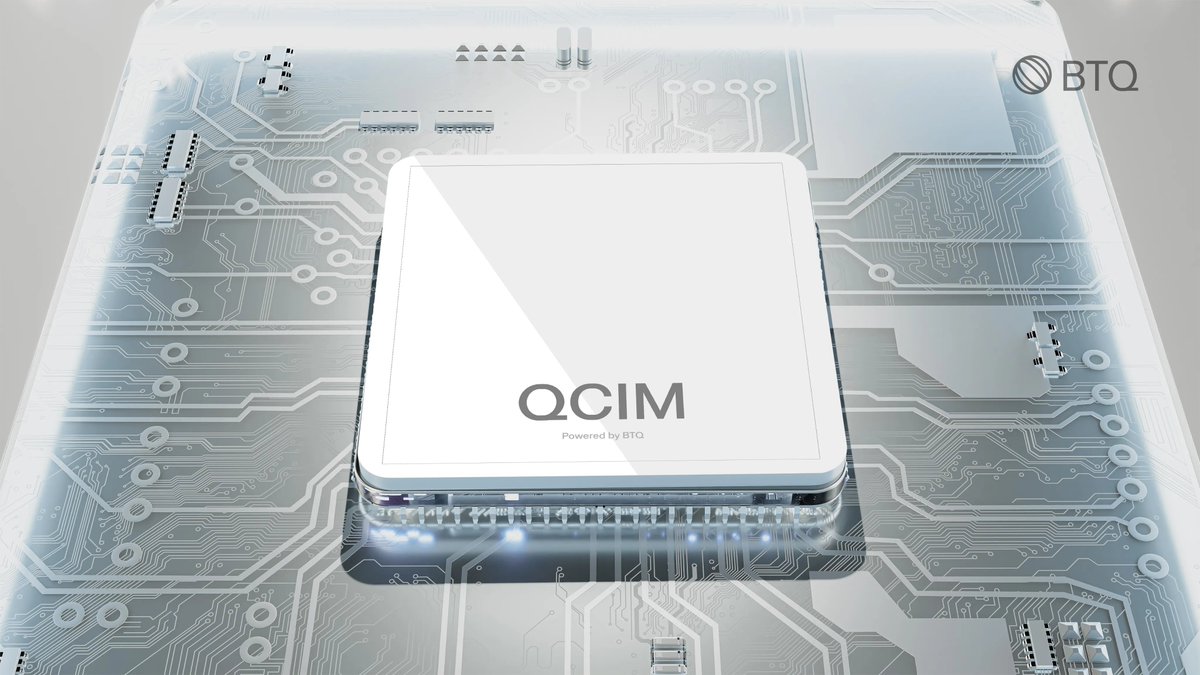
Meet QCIM, the ultra-efficient crypto-agile secure element. Low-power, super compact and re-configurable to protect against tomorrow's threats.
QCIM represents a generational shift in security chip design, built to last far into the post-quantum era.
$BTQ #QCIM
The quantum threat to crypto and the internet is no longer a distant problem - it's an engineering challenge to solve now. BTQ's @en_tropyc and @pq_hackett chatted with @QuantumBullHQ to break down post-quantum security across silicon, blockchain, and networks, why Google's 2029 migration timeline is a wake-up call, and what it all means for Bitcoin and Ethereum.
https://t.co/Zk9E2xVjKh $BTQ
What does a physically secure chip actually mean?
@blip_tm sits down with @en_tropyc to break it down: even unbreakable crypto can leak its secrets through a chip's power consumption. "Masking" stops it and QCIM's parallel architecture lets you mask every circuit individually, with far less overhead.
$BTQ
Meet Sean Hackett (@pq_hackett), Head of Silicon Product at @BTQ_Tech.
QCIM is BTQ's compute-in-memory architecture for crypto-agile post-quantum secure enclaves, one block that runs today's algorithms and updates to tomorrow's via signed firmware, with no silicon respins.
$BTQ
The recording of BTQ’s Webinar on the Q1 2026 Financial Results and General Corporate Update is now available. Watch for a deeper look at our milestones, business progress, and how BTQ is advancing quantum computing and post-quantum security infrastructure for the future of critical networks. https://t.co/GQ1qpIL21w $BTQ
Two quantum risks get conflated constantly. Only one is a credible near to mid term risk for Bitcoin.
SHA-256 mining can persist well into the quantum era. Signatures cannot, and that is where the ~6.7 million exposed coins sit.
@en_tropyc explains... $BTQ
Goldman Sachs stepped back from quantum after concluding practical timelines could stretch far beyond what is actionable today. JPMorgan Chase has taken the opposite approach, dedicating significant resources and research talent to the space.
Wall Street is not debating whether the threat is real. It is debating how to respond.
BTQ's President and Head of Quantum Innovation, @en_tropyc on why migration, not the math, is the real challenge. $BTQ
The latest Quantum State highlights where capital, policy, and real-world deployment are converging, and why quantum-secure infrastructure is quickly becoming a priority, not just a theory. $BTQ
The May edition of The Quantum State is live. This month covers:
• Policy momentum in the U.S. with the advancement of the National Quantum Initiative Reauthorization Act
• Continued capital flowing into quantum infrastructure and emerging architectures
• Increasing industry focus on quantum-secure systems across crypto, payments, and beyond
Plus key developments across partnerships, commercialization, and global coordination shaping the next phase of the industry. https://t.co/2M11PWqYEI
The May edition of The Quantum State is live. This month covers:
• Policy momentum in the U.S. with the advancement of the National Quantum Initiative Reauthorization Act
• Continued capital flowing into quantum infrastructure and emerging architectures
• Increasing industry focus on quantum-secure systems across crypto, payments, and beyond
Plus key developments across partnerships, commercialization, and global coordination shaping the next phase of the industry. https://t.co/2M11PWqYEI
BTQ is joining Industry Meets Talent at the Quantum Future Talent 2026 Careers Fair on 18 May! Short, focused 1:1 conversations with our team.
In addition to exciting research opportunities, we are also looking for a talented Business Solutions Architect to join our growing Sydney team!
Open to undergrads, PhDs & industry pros ready to translate quantum research into real-world impact.
Apply by 10 May: https://t.co/QZlSJnIVxy
BTQ provides strategic advisory support and QSSN as core PQC security infrastructure for the iM Bank initiative on the Kaia mainnet, advancing post-quantum migration across global financial infrastructure
- BTQ has been selected as the core post-quantum cryptography security technology provider for South Korea's first bank-led KRW stablecoin proof-of-concept, delivering its Quantum Secure Stablecoin Settlement Network ("QSSN") for the initiative.
- BTQ is providing strategic advisory support and helping coordinate implementation across the partnership with iM Bank and Finger, supporting the integration of post-quantum protections into regulated digital money infrastructure.
- Built on the Kaia mainnet, the proof-of-concept is connected to the blockchain ecosystems originally developed by Kakao and LINE, linking the initiative to two of the largest messaging and digital platform ecosystems in Korea and Japan.
BTQ Technologies' QSSN Selected as Core Security Infrastructure for South Korea's First Bank-Led KRW Stablecoin Proof-of-Concept https://t.co/mcP5b67PbV $BTQ
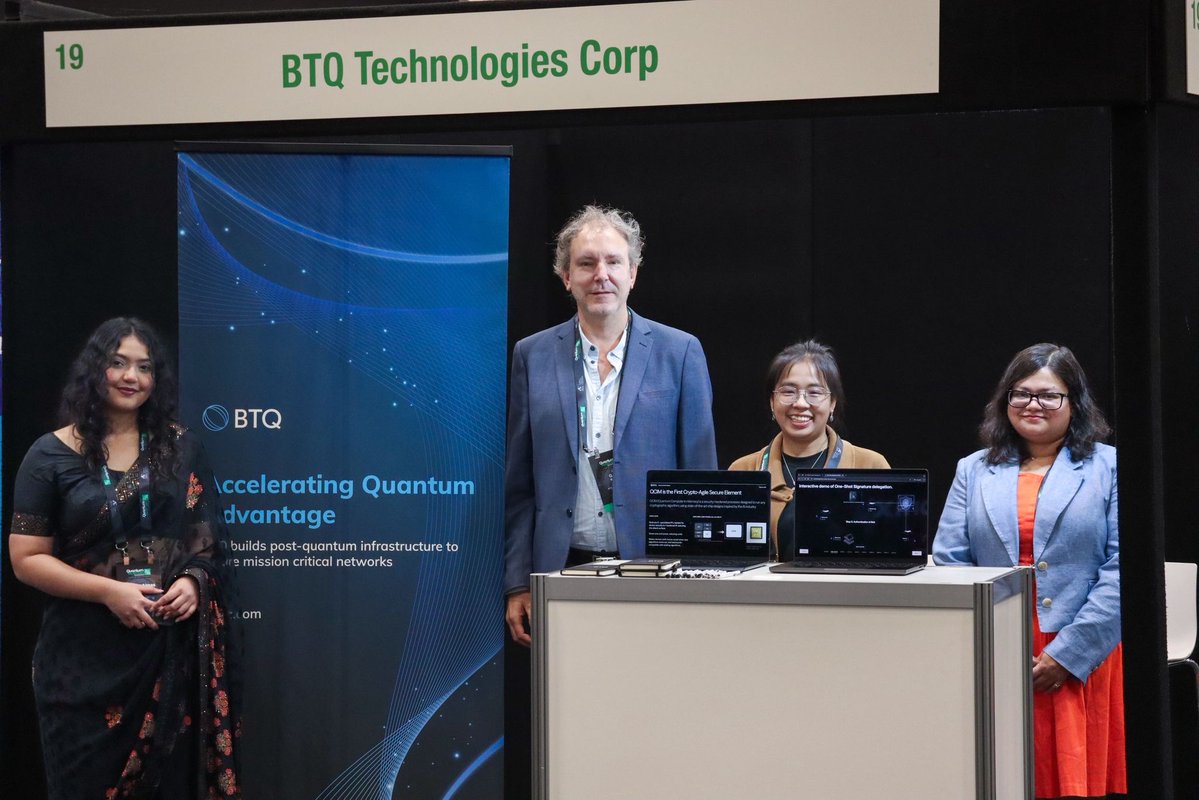
BTQ is proud to have supported Quantum Australia in Adelaide as a Silver Sponsor, and to be invited by the Government of South Australia to explore partnerships across the very exciting Adelaide ecosystem.
From our QCIM's crypto-agile PQC secure enclaves to our OSS (One-Shot Signatures) cryptographic keys. BTQ is delivering near-term, mission-critical solutions as we embody the “Impact for Now” sentiment at the conference.
$BTQ
ledger just put out a new article on side-channel attacks on PQC!
their conclusion: secure implementations need side-channel masking -- the kind of security that @BTQ_Tech's QCIM provides
BTQ's President and Head of Quantum Innovation, Chris Tam (@en_tropyc) outlines the real risks quantum introduces to Bitcoin and where the industry should be focused. Thanks to @scottmelker for the conversation. $BTQ
BTQ Insider | The Physics Behind the Quantum Leap
Classical processors are hitting a wall, at nanoscale, quantum mechanical effects like electron tunneling break the rules traditional circuits were built on. @gavin_brennen and @en_tropyc flip the script: rather than fighting quantum mechanics, we can harness it by isolating systems at near-zero entropy and replacing boolean logic with quantum logic. The result is computation provably faster than any classical machine, regardless of size or speed, and BTQ is building to make it real.
$BTQ
A thoughtful thread from Anastasia on the evolving quantum error correction landscape. Recent BTQ research reinforces why the roadmap remains wide open and why approaches like PI codes may prove increasingly important for hardware realistic fault tolerance. $BTQ
Stabilizer codes have dominated the quantum error correction conversation for a decade. Surface codes, LDPC codes, the Google and IBM roadmaps — all stabilizer-based. The family traces back to the mid-1990s, when Peter Shor's 9-qubit code and Andrew Steane's 7-qubit code proved for the first time that quantum information _could_ be protected from noise at all. This is genuinely non-obvious, since the no-cloning theorem in quantum information doesn't allow us to use the classical trick of just copying the data. Stabilizer codes work, they're well-understood, and everyone knows how to benchmark them.
But they have real weaknesses. They struggle with
1. energy gradually leaking out of the system (amplitude damping)
2. qubits that get lost mid-computation without the system knowing which one went missing (deletion errors).
And the "logic gates" you can build cheaply on top of stabilizer codes are limited (transversal gates in the Clifford hierarchy). More complexity, expensive workarounds, and that eats into efficiency gains of having the code at all.
A new paper from Yingkai Ouyang (Sheffield) and Gavin Brennen (Macquarie and BTQ) — "A theory of quantum error correction for permutation-invariant codes" ([https://t.co/dBJMJuS5ch](https://t.co/dBJMJuS5ch)) opens a new theory for an alternative. This development complements earlier work from the same team showing that permutation-invariant (PI) codes, used together with more conventional stabilizer codes, can activate the notoriously challenging non-Clifford logical gates for universal quantum computing, and with lower overhead than using stabilizer codes alone.
The quantum industry continues to advance across policy, investment, and commercialization. March brought meaningful momentum across quantum computing, infrastructure, and quantum-safe security. Read the latest Quantum State newsletter! $BTQ
Quantum is no longer just a research story. It is becoming a strategic and commercial one.
March brought major investment, government backing, new partnerships, and continued momentum in quantum computing and quantum-safe infrastructure.
Read the April edition of Quantum State for the key developments shaping the industry. https://t.co/1kri4DeURB


) opens a new theory for an alternative. This development complements earlier work from the same team showing that permutation-invariant (PI) codes, used together with more conventional stabilizer codes, can activate the notoriously challenging non-Clifford logical gates for universal quantum computing, and with lower overhead than using stabilizer codes alone.](https://pbs.twimg.com/media/HGl4x7xWwAAuPyP.jpg)
) opens a new theory for an alternative. This development complements earlier work from the same team showing that permutation-invariant (PI) codes, used together with more conventional stabilizer codes, can activate the notoriously challenging non-Clifford logical gates for universal quantum computing, and with lower overhead than using stabilizer codes alone.](https://pbs.twimg.com/media/HGl4x4iXQAACX_8.jpg)






) opens a new theory for an alternative. This development complements earlier work from the same team showing that permutation-invariant (PI) codes, used together with more conventional stabilizer codes, can activate the notoriously challenging non-Clifford logical gates for universal quantum computing, and with lower overhead than using stabilizer codes alone.](https://pbs.twimg.com/media/HGl4x-AWUAEzG1b.jpg)


