Yesterday marked a breakthrough in quantum computing: Microsoft and Quantinuum showcased the most dependable logical qubits ever documented.
These logical qubits have an error rate 800x better than physical qubits.
Researchers have achieved a significant improvement in error correction, allowing them to move from basic ("Foundational") to more robust ("Resilient") quantum computers.
🔵 Microsoft’s announcement states: "we ran more than 14,000 individual experiments without a single error. Furthermore, we demonstrated more reliable quantum computation by performing error diagnostics and corrections on logical qubits without destroying them."
🔵 This milestone represents a pivotal step towards constructing a hybrid quantum supercomputing system capable of revolutionizing research and innovation across various industries.
🔵 Having a hybrid supercomputer with just 100 reliable quantum bits would offer scientific benefits while reaching 1,000 reliable bits would unlock commercial advantages across various industries.
🔵 This breakthrough opens the door to solving real-world problems with reliable quantum computers. This also means: Q-Day is getting closer and closer.
🔵 Quantum computers, when sufficiently developed, could dismantle the security protocols that guard our digital lives. Blockchain, the decentralized ledger underpinning web3 applications, dApss, cryptocurrencies and secure transactions, will also face vulnerabilities.
🔵 To be prepared for potential attacks, using a post-quantum cryptographic algorithm is of the highest importance for blockchain networks.
🔵 #QANplatform - the hybrid blockchain that has launched the world’s first private blockchain that is both quantum-resistant (uses the CRYSTALS-Dilithium, the NIST-recommended primary post-quantum algorithm) EVM compatible, and enables coding smart contracts in any programming language.
🔵 Soon, you can start preparing for the new era! The QAN TestNet will be launched in April of this year.
Thrilled to announce our strategic alliance with @iotex_io , the bedrock of DePIN!
#EMC and #IoTeX are joining forces to redefine the AI #DePIN landscape, powered by our unique DeAI approach and IoT-driven innovation.
As pioneers in #DeAI and #DePIN, EMC and IoTeX are committed to shaping a future where AI's potential is maximized across a decentralized, secure, and efficient infrastructure. Get ready for a transformative journey into the next era of AI and blockchain synergy.
What's the TCP/IP for DLT?
It seems the IMF has their solution
We got another banger from the IMF visibly using $QNT SATP framework in their ASAP model.
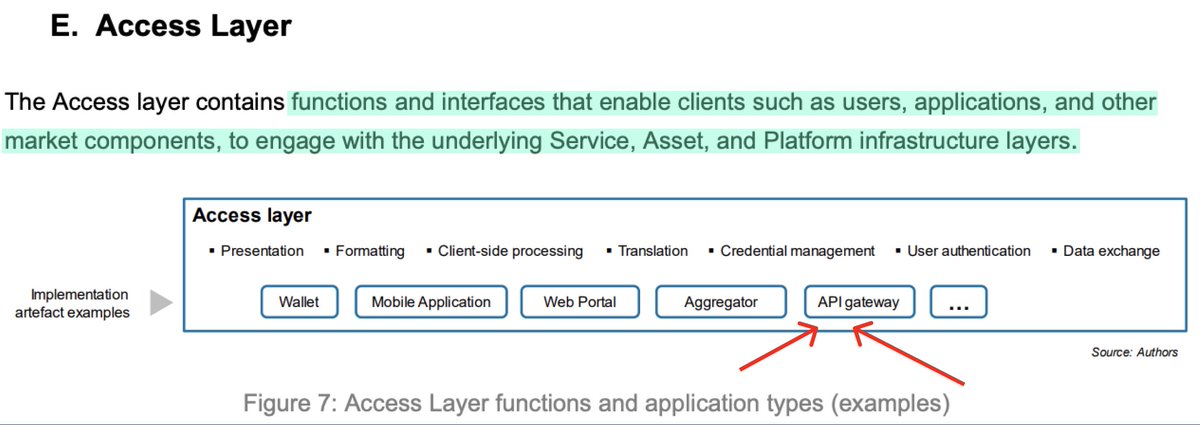
➤Access
➤Service
➤Asset
➤Platform
The IMF aims for this multi-layer model to be the base of DLT finance.
Within the document we see various signs that all point towards the use of SATP.
Especially the use of API Gateways.
What's most interesting is that we've seen these exact models laid out in prior CBDC projects.
In fact the IMF displays the Project Ubin and Jasper cross border trials, which as we can see DIRECTLY utilizes the ASAP model.
What was their interoperability solution?
APIs of course, as seen in the diagram.
To further add to this, they even mention their use of the Hash Time Lock Contract (HTLC) method, which is exactly what Overledger and SATP uses!
This is quite interesting as we've begun seeing more and more API layered CBDCs as of the past year.
The other obvious point towards the interoperability solution being an agnostic one is the connected DLTs shown in Ubin x Jasper.
Ubin used Quorum & Jasper used Corda.
These are 2 separate private permissioned DLTs & as we know there really aren't many permissioned DLT solutions for interoperability out there.
Especially ones standardized & regulated enough to be for CBDC usage!
This image was from Project Ubin's whitepaper & as we can see the API gateway sits right at the top!
While this test began in 2020, we can already see that the layered architecture had been in use already.
Looking at another diagram of the ASAP model by itself, we can see that the API gateway is a critical component of letting the ASAP flow properly.
Whats most interesting is what the IMF had written about the ASAP layered architecture.
"Access layer contains functions and interfaces for users, applications & other market components."
In other words, the access layer allows other applications to be built overtop of it.
Where have we heard this before?
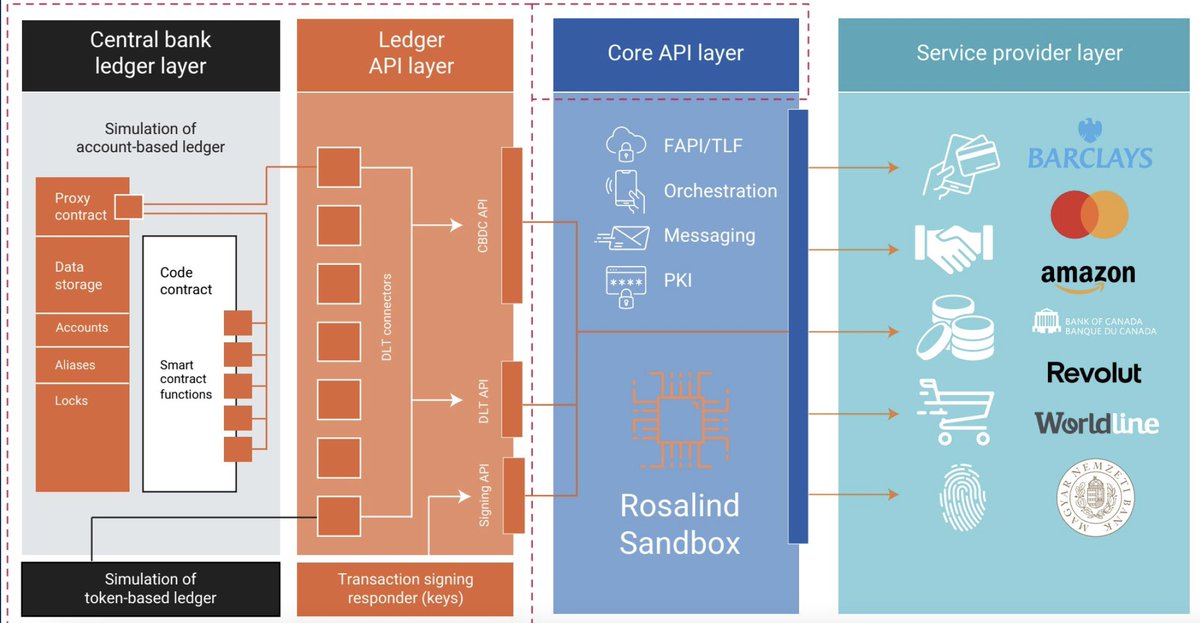
Well Project Rosalind by the BIS x BoE displayed this EXACT architecture.
We can see on the service layer there was tests of EXACTLY what the IMF mentions.
Functions & interfaces for users, applications, etc.
From Amazon, Barclays & even Mastercard all testing different uses of building applications overtop of the API layered CBDC framework.
It just makes the most sense.
With this model you're able to directly build applications over top of the CBDC layer while ensuring synchronous communications across all layers thanks to the APIs.
Let's examine Project Rosalind's architecture and relay it to how the IMF's ASAP model is displayed
Rosalind Core API Layer = IMF "Access"
Rosalind Service Layer = IMF "Service"
Rosalind Ledger API Layer = IMF "Asset"
Rosalind Central Bank Layer = IMF "Platform"
Not only do they look identical, but the use cases of the ASAP model directly fall inline with Project Rosalind.
Don't forget API x ISO2002 harmonization also comes in July of this year.
Everything is lining for API enabled digital finance.
And as we know SATP is at the forefront of all of it.
The perfect storm continues brewing🌪️
Shortly after publishing the news of the first EU country to implement QANplatform’s quantum-resistant technology, #QANplatform is about to take another giant step towards providing post-quantum blockchain solutions to businesses and organizations.
We are pleased to announce that the QAN TestNet will be launched in April!
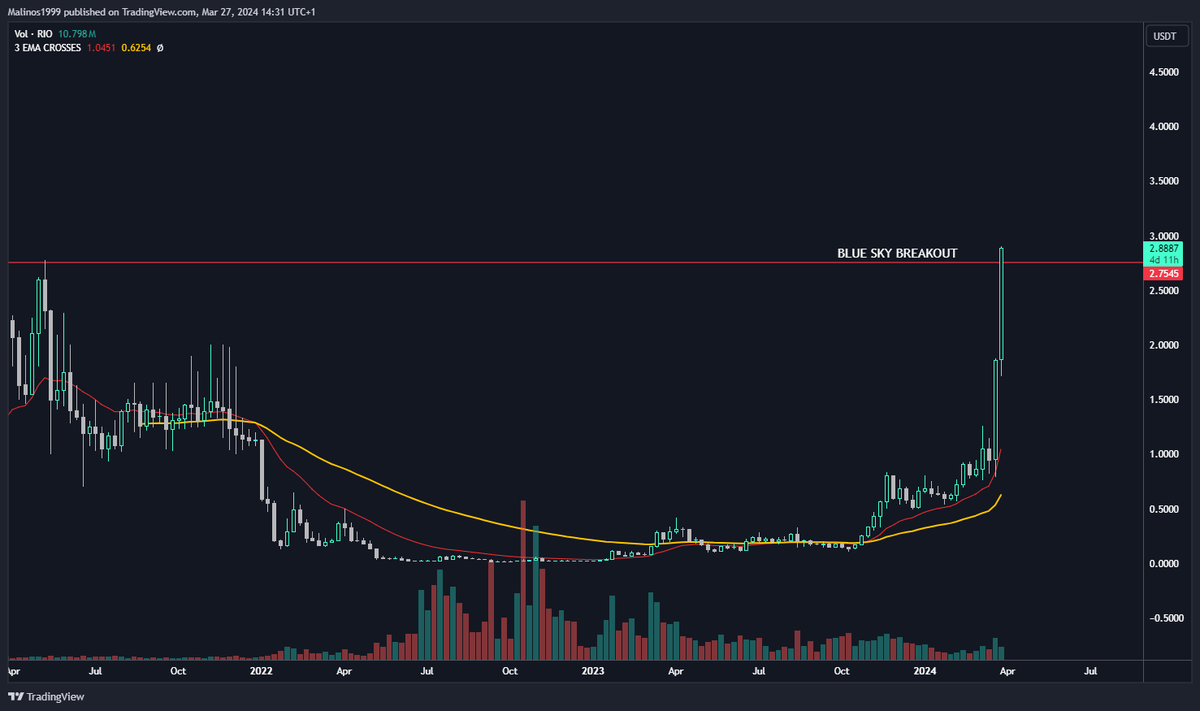
$RIO has just entered an untraded zone, a place where limitless imagination can begin!
We're at the start of the BLUE SKY BREAKOUT🎆
Let's show them who's the only #RWA king out there.
The EU published their goals for a DLT settlements.
We can see in the document there is heavy focus of use in Hash Time Locked Contract (HTLC).
This is the same solution in $QNT Overledgere/SATP.
But the hints run much deeper.
As you can see there is various mentions of APIs and even an API gateway in a delivery vs payment (DvP) scenario, which was also tested in Project Rosalind.
Additionally theres also the mention of ISO20022 triggering from a smart contract.
As we know, ISO20022 is a LEGACY financial standard, meaning that there needs to a be a DLT→legacy solution.
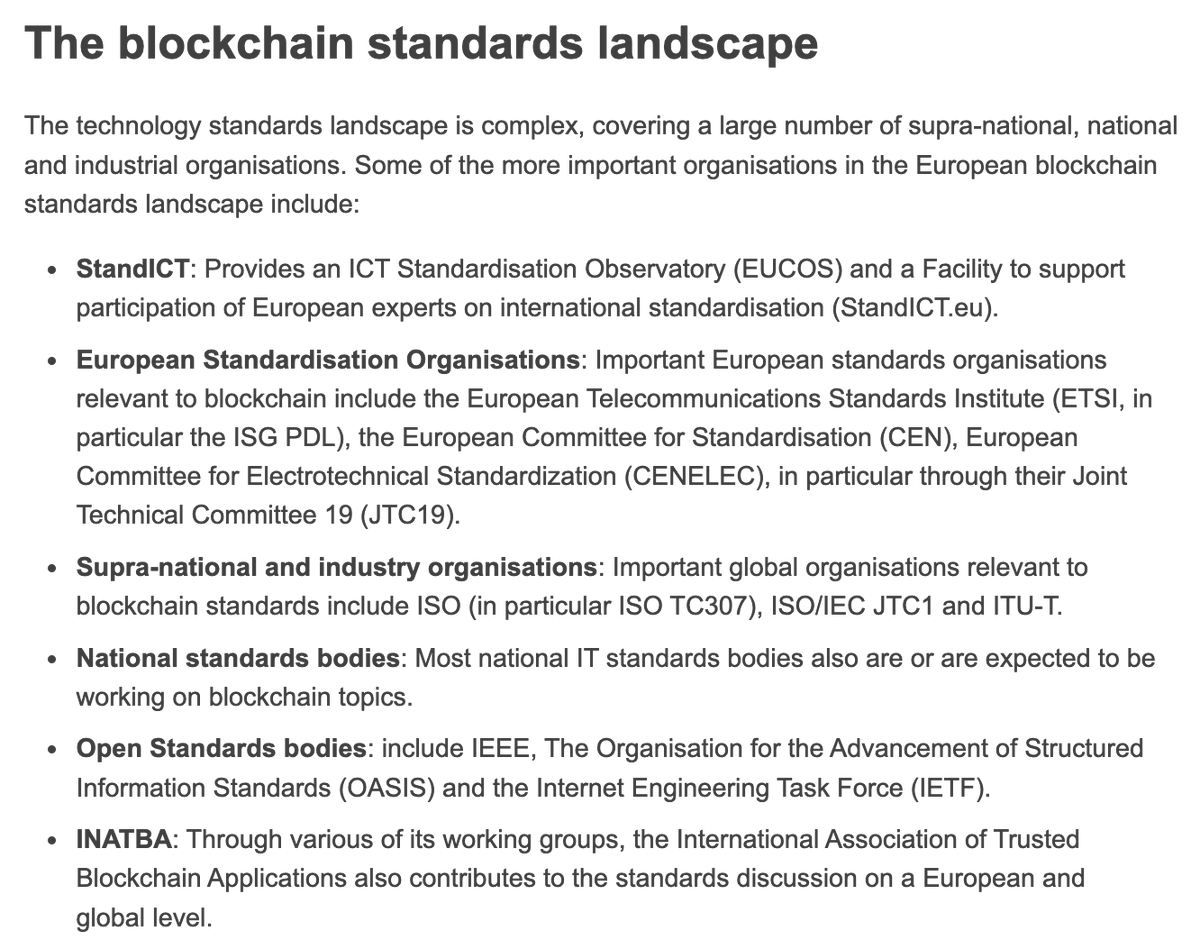
We've already seen the EU publicly voice their support for various Quant related standard bodies such as ISO, IETF & INATBA.
It's obvious what DLT interoperability framework that they went with😉
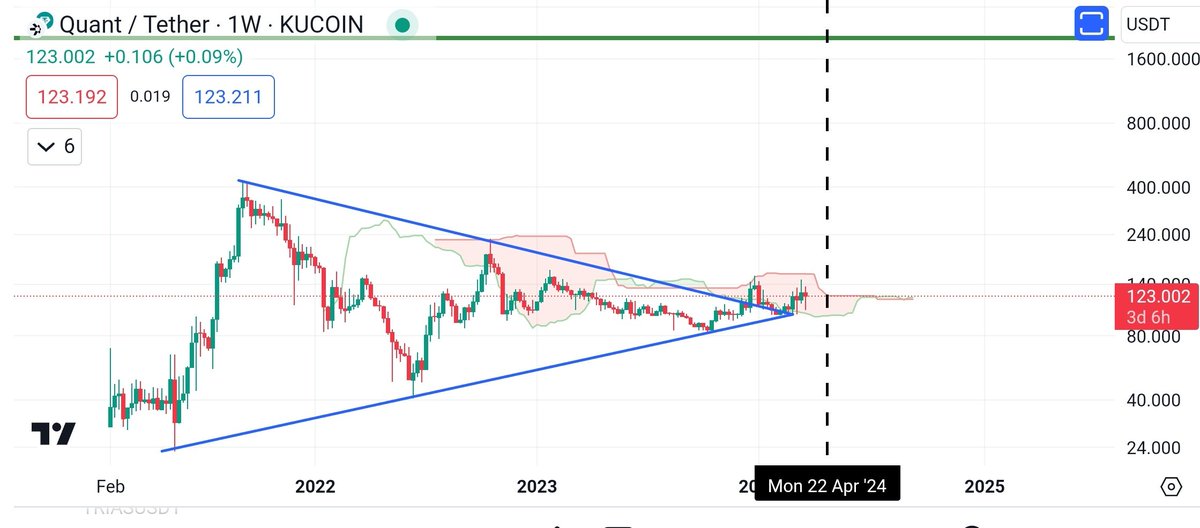
Fade all you want but make sure to get back in $Qnt before it breaks & closes above this red weekly Ichimuko cloud.
Cuz after that things are going to get really crazy for #Qnt IN SHA ALLAH
⌛=🚀
$btc $eth $link $xrp #crypto#btc#bitcoin $Sol #Sol#ETHFI#100x $Tao $Rio #Eth
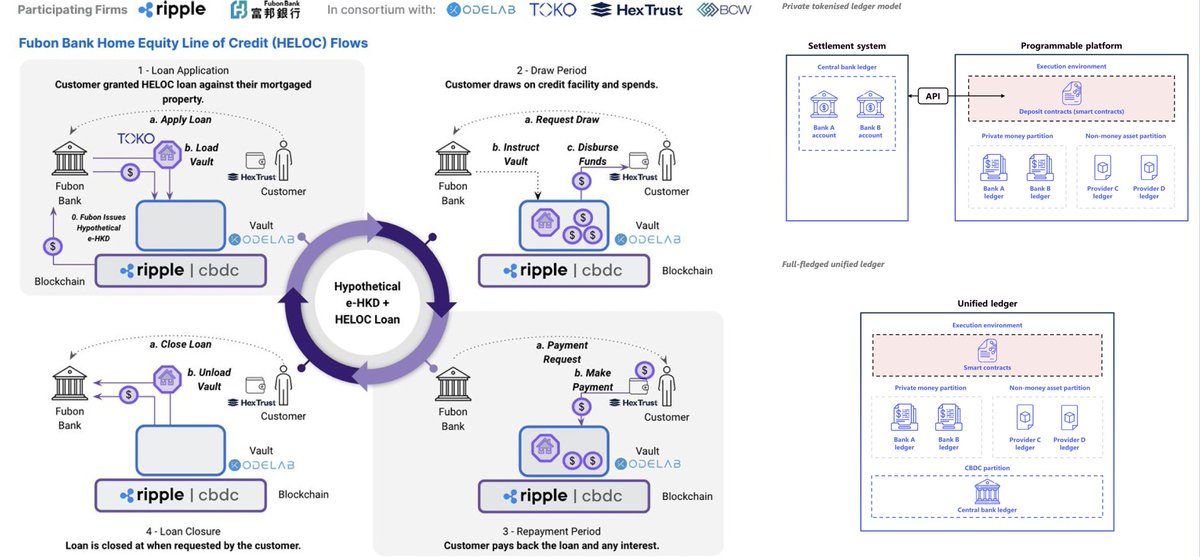
The core infrastructure of the HKMA eHKD CBDC pilot is one of the more eye opening concepts.
It brings multiple components of public DLT networks
$XRP- CBDC platform for eHKD 1:1
$HBAR- TOKO consortium partner
$QNT- API layered communication
Hong Kong has been one of the most forward countries/central banks on CBDC innovations, having been in various CBDC tests since their inception.
We've also seen connections in Hong Kong to each of the underlying DLTs in Quant, Ripple & Hedera prior.
This brings further open market access to CBDC environments through interoperability and other parties partaking in the ecosystem.
I believe we'll see much more of this hybrid and open market use cases to CBDCs as the infrastructure testing phase has shown the best viable platforms for utility.
Seeing that Hedera, Ripple & Quant all involved at various levels is a perfect place to start🔥