PhD, historian working at the @PileckiInstitut. Private opinions only.
"It's not what you look at that matters, it's what you see." - Henry David Thoreau
Tucker Carlson’s apologia for Nazi Germany’s aggression and totalitarianism
Once again, Tucker Carlson offers apologia for Nazi Germany’s aggression, this time in his conversation with Sir Jacob Rees-Mogg. While Mr Rees-Mogg does a formidable job of countering Mr Carlson’s most egregious falsehoods, it is worth digging deeper into the historical distortions underpinning his argument.
“I’m certainly not here defending Hitler. I’m just saying the idea that Hitler just randomly rolled into Poland is a lie and everyone believes it because they know nothing about the actual facts.”
Indeed, Hitler did not invade Poland “randomly”. But the “actual facts” are conspicuously absent from Carlson’s own account.
Hitler sought to destroy Poland’s independence and subject its people to German domination, as part of a broader project of conquest and racial empire in Europe. The German occupation brought systematic terror: the murder of Polish elites, the destruction and plunder of cultural heritage, mass expulsions, and the exploitation of millions as forced labourers. Those Poles not slated for expulsion or destruction were to be reduced to a leaderless slave labour force serving Germany's imperial ambitions. For Poland’s Jews, persecution, dispossession and ghettoisation were followed by systematic extermination, as the regime pursued the murder of European Jewry.
Carlson asks:
“...I’ve never understood: Why fight the Second World War in the first place?”
Britain and France entered the war following Germany’s invasion of Poland and their commitments to resist further aggression. Hitler’s occupation of the Czech lands in March 1939 had already demonstrated that his ambitions extended beyond incorporating German-speaking populations. Britain risked having to face a continent dominated by Nazi Germany, with its potential allies defeated or subordinated.
Contrary to Carlson´s claims, resisting German expansion was therefore consistent with Britain’s longstanding strategy of maintaining a European balance of power to protect its own security and imperial position. The threat was compounded by the regime’s brutality, already evident in the 1930s. In May 1940, Churchill described it as a “monstrous tyranny, never surpassed in the dark, lamentable catalogue of human crime”.
Ironically, Polish criticism of Britain has often focused on its failure to provide sufficient assistance, rather than its decision to enter the war, a perspective obscured by Carlson’s patronising treatment of Poland and other countries in Central and Eastern Europe. Britain and France failed to provide effective military relief during the September 1939 campaign, while Poland’s subsequent contribution to the Allied war effort received insufficient recognition. Polish pilots made a crucial contribution to the Battle of Britain. Yet when London celebrated victory in 1946, the Polish soldiers and sailors who had fought alongside British forces were denied representation in the Victory Parade.
The subsequent course of the war revealed the full horror of Nazi domination: concentration camps, systematic terror, forced labour and a war of annihilation. The Second World War became the deadliest war in human history, claiming tens of millions of lives. An estimated 5.6–5.8 million Polish citizens perished, including approximately three million Polish Jews murdered in the Holocaust. The Holocaust was a chapter of unparalleled horror, driven by the Nazi ambition to annihilate the Jewish people worldwide, to murder every Jew wherever they could be reached. In total, approximately six million Jews were murdered.
Apparently, this is still not enough of a “why” for Mr Carlson.
Carlson also claims:
“Well, Hitler said that 15% of Poland was once Germany and it was given to Poland at the Treaty of Versailles. That was German territory with Germans in it. That was his case. And by the way, that was true.”
Leaving aside the fact that territorial grievances could never justify aggression or a war of conquest, let alone grievances over borders established by international treaties, this account requires two essential corrections.
First, having belonged to the German Empire did not make these territories exclusively or inherently German. Although not all had remained part of Poland until the partitions, large areas, notably Greater Poland and Pomerelia, had. Despite policies of Germanisation and state-sponsored German settlement, particularly in the nineteenth century, they retained substantial Polish populations alongside German minorities. Describing them simply as “German territory with Germans” erases both their Polish history and their Polish inhabitants. Danzig, predominantly German-speaking, had a distinct status as a Free City under League of Nations protection, with special rights for Poland.
Second, these territorial demands must be understood within Hitler’s broader attempt to subordinate Poland to German ambitions. At this stage, Nazi Germany sought to draw Poland into an anti-Soviet alignment under German dominance, serving Hitler’s wider ambition to carve out “Lebensraum” in Eastern Europe. Demands concerning Danzig and an extraterritorial transport corridor were advanced alongside pressure for Poland to join the Anti-Comintern Pact.
Hitler himself made abundantly clear that his objectives extended far beyond territorial revision. According to the record of his meeting with senior military commanders on 23 May 1939, he declared: “Danzig is not the subject of the dispute at all.” Instead, he identified the objective as expanding Germany’s “living space” in the East and securing food supplies.
Days before the invasion, Hitler’s instructions were even more explicit. The surviving notes of his address to senior military commanders at Obersalzberg on 22 August 1939 record: “Have no pity. Brutal attitude.” He also announced that he would supply a propaganda pretext for war, regardless of its plausibility.
The following day, Nazi Germany and the Soviet Union signed the Hitler–Stalin Pact. Its secret protocol divided Eastern Europe into German and Soviet spheres of influence and envisaged the partition of Poland. Subsequently Germany invaded on 1 September 1939; the Soviet Union invaded from the east on 17 September. This was not simply a dispute over former German territory, but an assault on Poland’s independence by two totalitarian powers, both of which sought to destroy Poland’s elites.
Finally, the Nuremberg Tribunal endorsed the assessment of Paul Schmidt, an official interpreter at the German Foreign Office, that the Nazi leadership’s general objectives included “the domination of the European Continent”, to be pursued first through the incorporation of German-speaking groups and then through territorial expansion under the slogan of “Lebensraum”.
The dissemination of Nazi and totalitarian apologetics through a podcast with a vast international audience is deeply troubling in a number of ways. The post-war international order was founded on commitments to restrain aggression, protect human rights and prevent genocide. Upholding those commitments requires an understanding of the historical experiences that gave rise to them and the willingness to confront attempts to excuse aggression and domination.
Offering apologia for Hitler and Nazi Germany normalises the use of historical grievances to justify contemporary aggression. It undermines human rights and the principles underpinning a rules-based international order. Carlson’s treatment of Russia’s war of aggression against Ukraine reflects the same pattern: the aggressor’s grievances take centre stage, while the sovereignty and rights of those under attack recede from view.
What is at stake therefore extends beyond the interpretation of the Second World War. The quest for historical truth is also a quest for a better future.ed
@edwardlucas@EdwardGLuce@FareedZakaria@campbellclaret@RoryStewartUK@TimothyDSnyder@Roger_Moorhouse@davidfrum@JonahDispatch@aroberts_andrew@TomRtweets@jkirchick
Świetny tekst dyrektora @OSW_pl@W_Kononczuk. IMHO w ogóle jeden z najlepszych w temacie Wołynia, jakie kiedykolwiek pojawiły się w europejskiej debacie 🎯
Tak właśnie powinno się odkłamywać historyczne manipulacje
https://t.co/1ZWBGs7qz5
Bardzo popularny niemiecki kanał YT Simplicissimus (YouTube-Kanal)
zrobił odcinek o Witoldzie Pileckim z użyciem materiałów @InstPileckiego i z ekspertyzą naszego kolegi, szefa działu naukowego @B_Kapica oraz @jackfairweather
W kilka godzin obejrzało już ponad 400 tysięcy widzów. https://t.co/SxIvC8e6db
– Decyzja o tym, by 17 września nie wypowiadać wojny Związkowi Sowieckiemu była ze wszech miar szkodliwa. Tak z politycznego, jak i wojskowego punktu widzenia. Ona później rzutowała przez dłuższy czas na politykę, nie tylko zresztą rządu Rzeczypospolitej Polskiej na uchodźstwie. – ocenia w rozmowie z Portalem Obronnym sowietolog dr hab. Damian MARKOWSKI, prof. Instytutu Pileckiego. @PortalObronny
Facts Russia would rather not talk about: On 17 September 1939, Russia supported Nazi Germany in its aggression against Poland.
Tradition of unprovoked aggressions goes back a long way…
Year by year Russian MFA delivers on the 17th of September a well developed satire.For example Soviet Union was so afraid of Nazi Germany and assumed that their conflict was „inevitable” that it agreed to build Kriegsmarine base on its soil(Basis Nord).
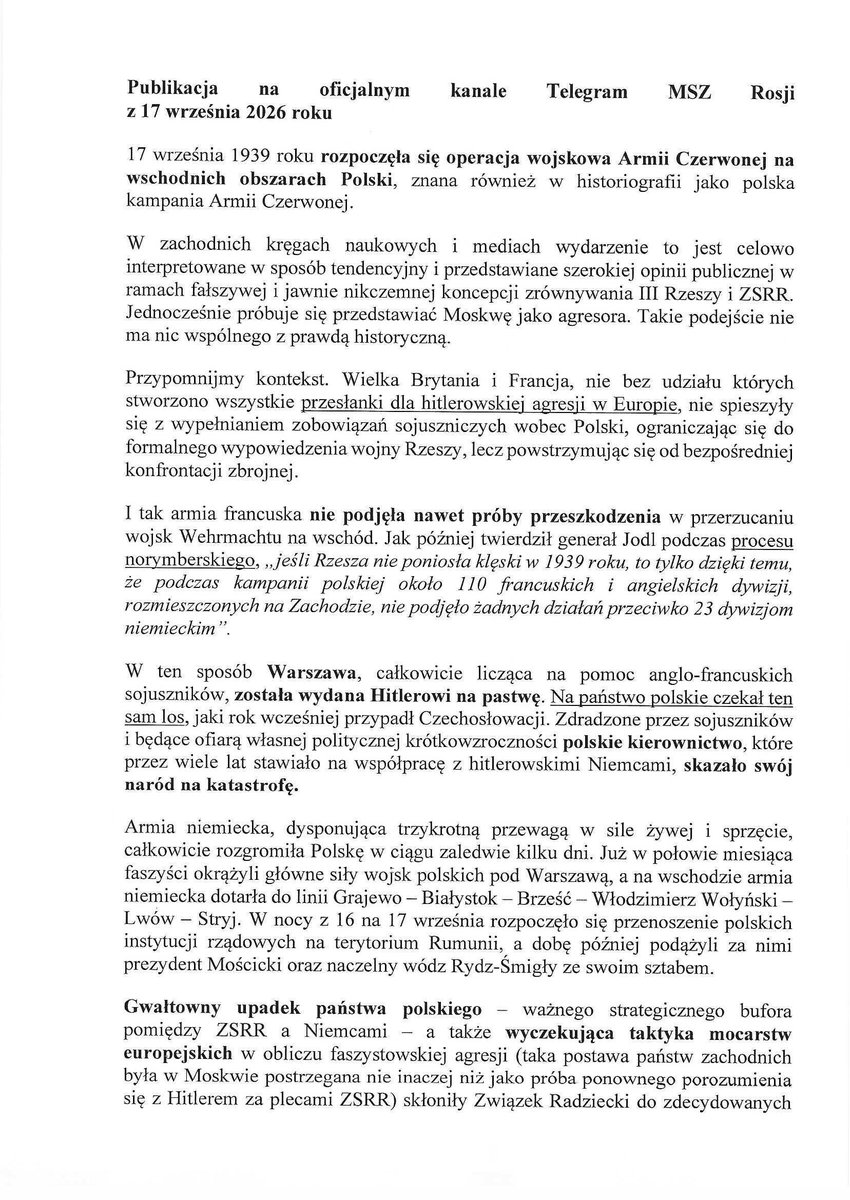
❗️Publikacja na oficjalnym kanale Telegram '@MID_RF z dnia 17 września 2026 roku odnośnie rozpoczęcia w dniu 17 września 1939 roku operacji wojskowej Armii Czerwonej na wschodnich obszarach Polski
https://t.co/SKjfp3rreL
@TolkienPolska Serdeczne pozdrowienia dla Pana Profesora. W dawnych czasach, z wówczas jeszcze doktorem, miałem z nim zajęcia z historii nowożytnej. Także w tym temacie mowił bardzo ciekawie i z polotem :)
@A__Zawistowski Z podobnych ciekawostek, tym razem na Pomorzu (granica polsko-niemiecka przed II wojną):
budynek niemieckiej straży granicznej:
https://t.co/Ey2n6w5VAx
budynek polskiej straży granicznej:
https://t.co/YxehTq0kTe
@TolkienPolska Jakiś czas temu kupiłem dla córki w antykwariacie za rozsądną cenę. Co ciekawe pomimo estetyki, do której nie jest przyzwyczajona (ach ten Jackson), całość bardzo jej się podoba (poza Elrondem, ktory wygląda jak Juliusz Cezar)
W nocy doszło do próby przejęcia stron internetowych Instytutu Pileckiego. Na witrynach centrali i oddziałów hakerzy umieścili treści noszące znamiona rosyjskiej propagandy i dezinformacji oraz wzmacniające narracje antyukraińskie. Nie doszło do wycieku danych.