This may be a long winded reponse, but I have some free time this pm. I like to use the AC/DC analogy, bcs I am an electrical engineer this clicks for me more I suppose. But consider this. In the late 19th and early 20th centuries, Thomas Edison and Nikola Tesla significantly shaped the development of electrical technology. Edison developed an architecture to move electricity- direct current (DC), which flows continuously in a single direction, like in a battery or fuel cell. During the early years of electricity, DC was the standard in the U.S., giving Edison a significant first-mover advantage (more than a decade) with a strong foothold in the market, but DC was expensive, inefficient, and unable to scale to the masses (it required power stations every mile or so).
Tesla briefly worked for Edison as a junior engineer, improving these DC generators at these power stations- while also attempting to interest Edison in an alternating current (AC) motor idea he wqs working on- a new architecture he had developed to move electricity. Unlike DC, AC reverses direction several times per second and can be easily transformed to higher or lower voltages using a transformer. This made AC far more practical for long-distance power transmission (scalable). Tesla tried to help the "DC-maxis". Edison, however, rejected Tesla's ideas, calling them "splendid" but "utterly impractical." Tesla viewed DC as inefficient for the masses due to its inability to easily adapt to different voltage requirements and its high energy losses over long distances. Edison, heavily invested in DC technology and infrastructure through his Edison Electric Light Company, sought to protect his business interests. Transitioning to AC threatened to undermine his established systems, Edison was a DC maximalist and famously declared, “Fooling around with alternating current is just a waste of time. Nobody will ever use it.”
Tesla left Edison's employment to pursue his vision of alternating current, which he believed was superior to Edison's direct current for long-distance power transmission and for a fraction of the cost. With the financial and industrial support of George Westinghouse, Tesla's AC system gained traction. Together, they challenged Edison's DC monopoly, engaging in what became known as the War of Currents. Ultimately, Tesla and Westinghouse emerged victorious, as AC architecture proved far more efficient and cost-effective for transmitting electricity over long distances. This breakthrough made electricity accessible and 'scalable' to the masses and established AC as the global standard for power distribution.
Fast forward to BTC early days- Sompolinsky was deeply integrated into the early BTC community. He surfaced on social media the same month and year(dec 2010) that satoshi left more "more complex ideas". He coauthored many papers tryingbto comvince the community of a new architecture to move value. One that could make BTC scalable. Here are his papers...
https://t.co/3pfyyV4rlT
Here is Sompolinsky and Zohar on the BTCtalk foeum in 2013 presenting the new architecture...
https://t.co/rBsL7YLyoI
Here is a video of him presenting a new architecture to move value to the BTC community in 2015 (notice Adam Back in the back row).
👉 https://t.co/ISG1p1SmRV
Despite these contributions, Bitcoin’s core developers rejected his proposals, arguing that solving scalability on layer 1 was impractical. Prominent Bitcoin developer Adam Back later dismissed DAGs, stating, “The DAG is over-complex; I had a similar idea in 2013 and discarded it.”
After countless efforts to help the Batac community he created Kaspa.
You can see eerily similar comparisons to the analogy above.
Hope that helps.
@realDonaldTrump I do agree that we as EU should spend more and the USA spend less in this ongoing war. But being buddies with Putin and being his little puppet is the most disgusting thing I've heard throughout this whole ordeal.
You should wash your mouth with soap, clown.
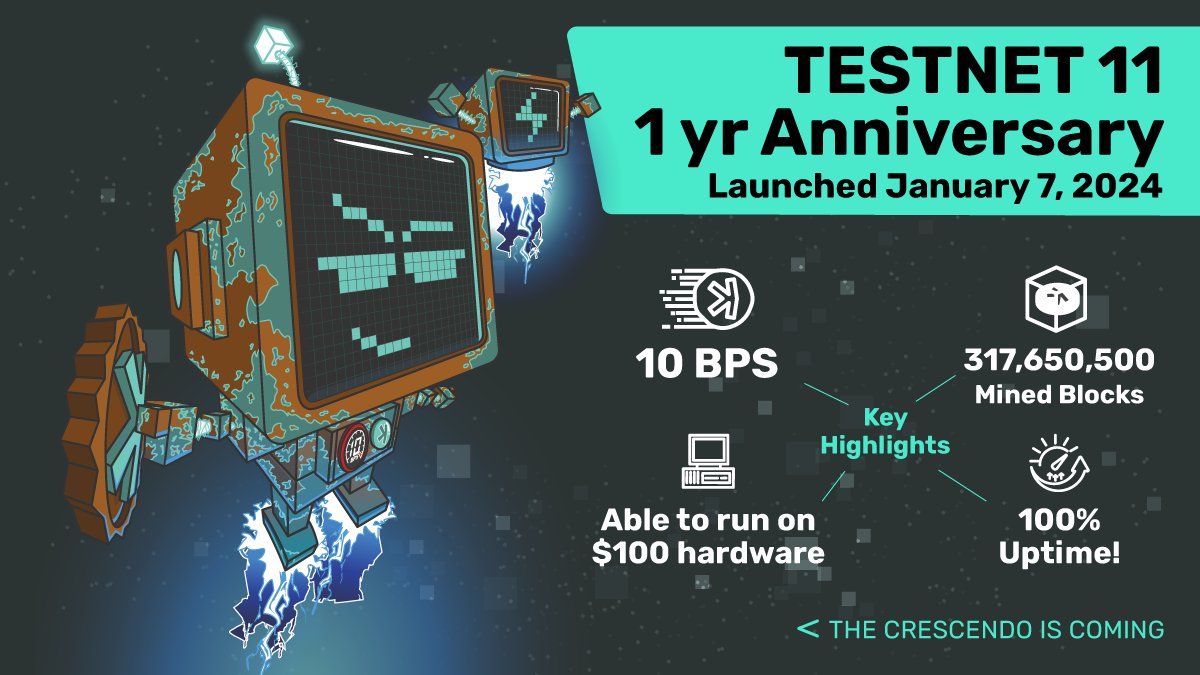
While we eagerly anticipate Crescendo and 10 BPS on the Mainnet, let’s celebrate 365 days of 100% uptime for TN11, launched on January 7, 2024.
⛏️317,650,500 mined blocks (as of this post)
Kudos to the Kaspa developers for taking the time to code it right the first time. :)
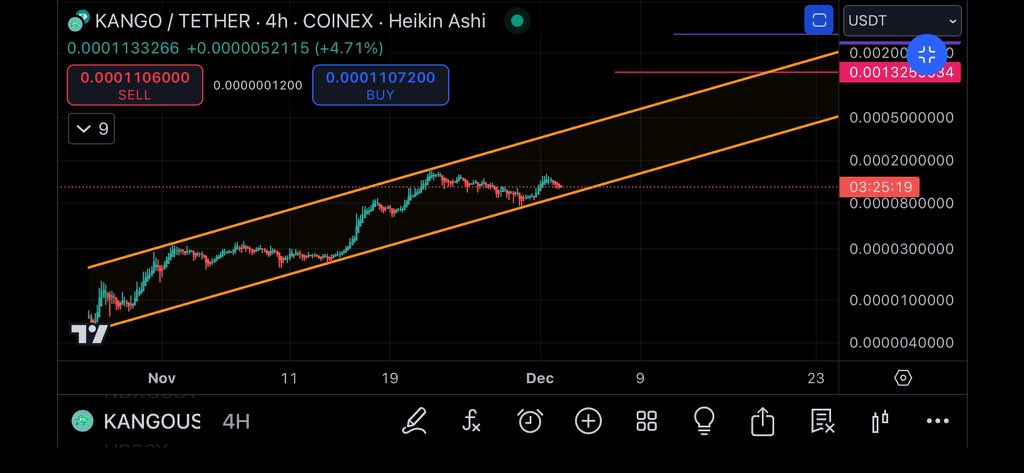
@_CoffeeNCrypto_ $KANGO HAS DONE 300 X
- 12 CEX in 45 days
- COMMUNITY. RAISED 1 Million USDT for Tier 1 Market maket
- #1 KRC20 from 1500
- MOST VOLUME
Check yourself 🤝 https://t.co/2MXzsOKJEV
LETS FKANGOO🚀 check DM
The speed in the #Kaspa Testnet-11 is simply incredible!
Below you can see the $KAS Testnet-11 in real speed🔥
The testnet hard fork was a complete success. The hard fork of the mainnet will make #crypto history 🚀