The President signing #CAB3 is NOT the end of the road! Here's why the President can't just take away our rights. The Constitution says it MUST go to a referendum. Please share this video and together let's demand that they #LetThePeopleDecide!
Dear Zimbabweans, the smartest people aren’t information collectors. They are pattern recognisers! You are not a victim if you’re made to do the same thing over and over while expecting a different result. You are a FOOL and deserve everything that’s happening. Spare us the fake outrage over common sense
The corrupt @FIFAcom president, Gianni Infantino, and the corrupt American president, Donald Trump, have dragged the World Cup and the game of football into disrepute.
Their political interference has tarnished the integrity of the tournament and undermined the principles of fair play. It is shameful, but then again, shame is something neither of them appears to possess.
The way the state has failed to deal with madness that has been taking place in SA for the past few months is so scary because the belief is that they must not be touched because they are a majority, absolute nonsense, even if we were to say they are a majority, what must happen if the majority is fighting for the right to commit injustices? kill others? Must that be ignored because they claim to be a majority? Where is the state? The is is worrying because this might happen to other people who are regarded as the minority
I have just read a tweet of @Laque_davis where he writes that, given all the shenanigans we have recently witnessed around the #CAB3 vote (with vehicles and money being brazenly handed out to MPs & others in return for support for CAB3), in future Presidential Elections will be replaced by Presidential Auctions!
He is absolutely correct. If CAB3 ever becomes law Presidents of Zimbabwe will in future be determined by who can pay the highest bribe to MPs.
#Zimbabwe we can do so much better than this. #onemanonevote
“It was relentless. It was a constant push.”
Hillary Clinton said Netanyahu and the Israeli government constantly tried to bully her during her time as Secretary of State.
"We're Nigerians, but today we are Mexicans."
For 90 minutes, borders dissolve. Flags get borrowed. Strangers become your people.
The World Cup is finally here 🔥
Writer: Val
🏆 Referee announced for 2026 #SuperCup!
We're pleased to share that Somali referee Omar Artan will officiate the highly anticipated match between PSG and Aston Villa in Salzburg.
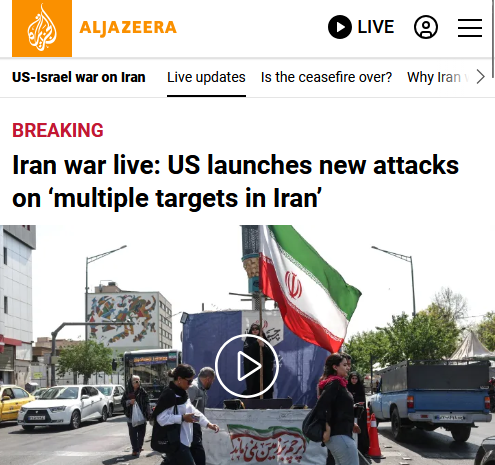
🚨BREAKING: Another U.S. strike on Iran. If Russia had launched attacks like this ahead of the 2018 World Cup, FIFA, sponsors, politicians, and every major media outlet would have demanded immediate cancellation. But when Washington does it, suddenly everyone discovers nuance.
Israel responds to Iran's retaliatory strikes by cutting off all aid to Gaza.
This is a state which routinely collectively punishes civilians as a tactic of war.
This is monstrous, and it is also a grave war crime.
Israel targeting senior U.S. officials cannot be accepted by our government.
This is not standard practice, especially considering the fact that Israel survives on our defense funding & diplomatic top cover.
Until we actually take away the support we give Israel they will keep playing us as fools.
A group of retired Zimbabwean military generals and former senior civil servants has publicly accused President Emmerson Mnangagwa of being the principal architect and beneficiary of Constitutional Amendment Bill No. 3 (CAB3), warning that the proposed changes serve narrow political interests rather than the national interest.
In a statement issued on today in Harare and signed by retired Air Marshal Henry Muchena on behalf of the group, the former military and civil service officials said recent meetings they held with President Mnangagwa had failed to address their concerns over the Bill.
They claimed the President dismissed their objections by saying, “whoever wins, wins,” a response they said reflected contempt for constitutional concerns raised by citizens and party members.
The group reiterated its call for a national referendum on the proposed amendments and added that the parliamentary consultation process was manipulated and did not reflect the will of the people. They also expressed concern over ongoing court challenges to the Bill and urged the judiciary to uphold its constitutional responsibilities.
In some of the most explosive claims contained in the statement, the retired officials alleged that financial incentives, including vehicle allocations and cash payments, had been used to secure support for CAB3.
They further claimed that a US$31 million fund had been set aside to influence parliamentary votes in favour of the Bill.
The retired officials warned Members of Parliament against supporting the proposed amendments, arguing that extending presidential and parliamentary terms without voter approval would constitute a violation of the Constitution.
They pledged to continue opposing CAB3 through legal, constitutional, and civic means.
I have posted the full PDF statement on my Telegram channel at the link below;
👇🏿👇🏿
https://t.co/f3TcNRwoAl
I remember studying psychology, sociology, and behavioural economics at university and learning about what is often described as the “scarcity mindset” and the phenomenon of “proximate competition”.
People living under conditions of chronic economic insecurity and abject poverty tend to focus on immediate and visible competitors rather than distant and powerful centres of economic power.
The foreign-owned spaza shop on the corner becomes a symbol of economic exclusion because it is tangible, visible, and accessible, whereas banks, mining conglomerates, retail giants, and financial institutions are abstract, complex, and seemingly untouchable.
Sociologists have long observed that when people feel powerless to change their economic circumstances, frustration is often redirected towards those closest to them on the social and economic ladder rather than towards those at the top who exercise the greatest economic influence.
That is why many engage those they perceive as powerful with caution and respect, while directing anger, hostility, and sometimes violence towards those who are no more powerful than themselves. It is psychologically easier to confront the vulnerable than to challenge entrenched centres of power.
This creates a cycle in which communities fight over small pockets of relatively inconsequential wealth while leaving larger structures of capital accumulation untouched.
The tragedy is that energy which could be channelled into education, organisation, entrepreneurship, skills development, or demands for structural economic reform is instead expended on battles over the lowest rungs of the economy.
They fight over spaza shops, which are often little more than survival businesses, rather than focusing on the institutions and structures that have a far greater influence on wealth creation and economic opportunity. Their circumstances, shaped by decades and even centuries of structural economic inequality, remain largely unchanged.
In this sense, persistent poverty is often sustained not merely by a lack of resources, but by a failure to recognise where economic power actually resides, how it is accumulated, and how it is reproduced across generations.
This is also reflected in political leadership at the highest levels, in the battles they choose to prioritise and the issues they focus on when engaging the proletariat and the lumpen elements of society.
They focus on T-shirts, they focus on chicken and chips, and they focus on trivial giveaways that do little to transform anyone’s life.
A T-shirt is worn today and discarded a year later, only to be replaced with another one at the next election cycle, whether five years later or perhaps two and a half years later during local government elections.
Meanwhile, the structural problems of education, industrialisation, job creation, healthcare, and economic empowerment remain unresolved. That, in many ways, is the tragedy of Africa.