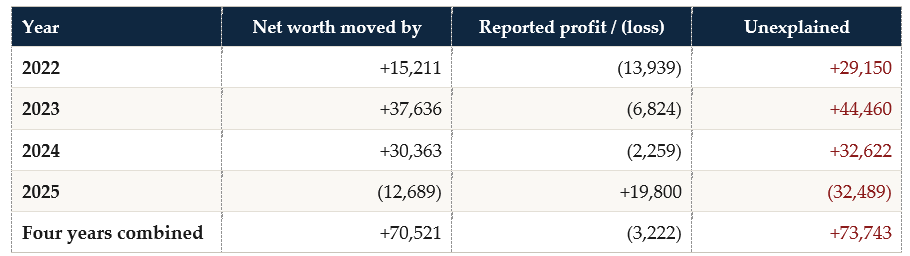
1. We were all there when SIGA, an agency that regulates state-owned or controlled businesses and parastatals, came and told us that state-controlled businesses have made incredible profits in 2025.
2. This was presented as a massive turnaround after years of losses.
3. Someone seemed to have forgotten that Ghana still has nerdy policy analysts who spend their lunch time poring over figures.
4. With the help of Tabula and Excel Power Query, we have taken the SIGA report to task.
5. Unfortunately, it simply doesn't hold up.
6. In fact, some of the findings are pretty bizarre.
7. The report as currently presented does not paint an accurate picture of affairs at state-controlled businesses in Ghana. It is replete with bizarre errors, misstatements, confusions, and flawed inferences. Especially when read against previous SIGA reports.
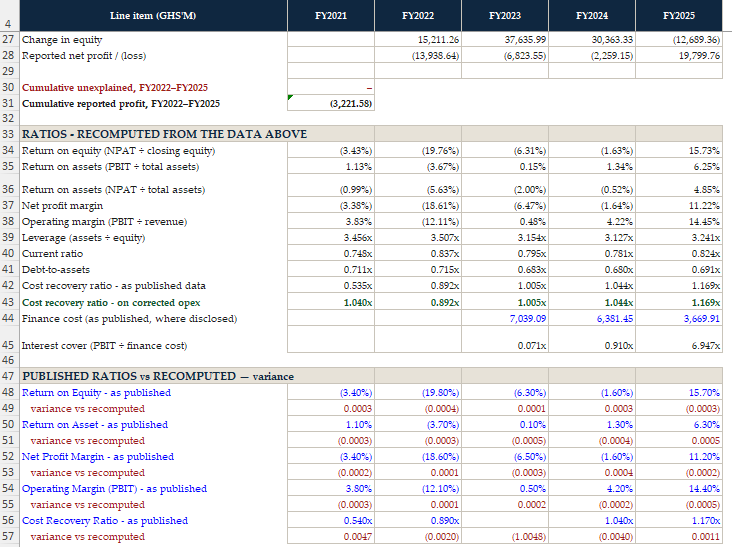
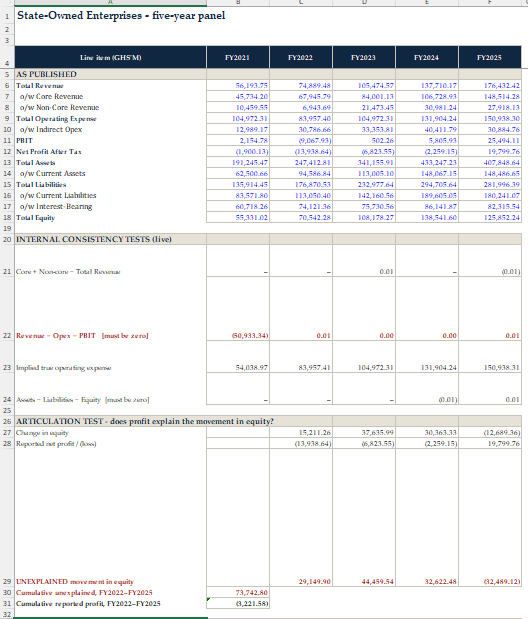
8. For example, the net loss for 2023 has been published in 3 different ways: GHS 2,573.2 million in the 2023 report, GHS 7,143.5 million in the 2024 report, and GHS 6,823.55 million in the 2025 report.
9. The net loss for 2022 has been published in 4 different ways. Revenue for 2021 has been published in 5 different five ways.
10. Total liabilities for 2021 appear as GHS135,883 million in the 2021 report, GHS172,043 million in the 2023 report, and GHS135,914 million in the 2025 report, a GHS36 billion excursion that appears and then vanishes.
11. These confusions make it really hard to make the comparisons across years that SIGA is trying to push us to do.
12. But when we do, we are forced to different, highly unflattering, conclusions. As follows.
13. State-owned businesses' underlying profitability declined in 2025. You heard that right. Contrary to what SIGA says, when you remove the currency effects (which as analyst @CallmeAlfredo stresses must be done for safe comparisons), net profit fell 17.1 per cent, operating profit fell 22.7 per cent, and the operating margin narrowed by three and a half percentage points between 2024 and 2025.
14. Basically, ECG went from exchange rate losses of GHS 8,837.71 million in 2024 to a gain of GHS 12,157.79 million in 2025. That swing: GHS20,995.50 million, is 95.2 per cent of the entire profit swing of GHS22,058.91 million that SIGA is celebrating.
15. Take exchange rate revaluations out and ECG’s operating result goes from a profit of GHS1.84 billion to a loss of GHS14.25 billion. Its operating cash flow moved from an inflow of GHS6.51 billion to an outflow of GHS12.54 billion, a swing of GHS19.05 billion in the wrong direction, while the company took in GHS20.44 billion of new financing to stay afloat.
16. Only $1.4 million in dividends were realised from the 53 fully state-owned enterprises in 2025. The dividend tally actually fell by 45.5% in 2025, compared to 2024. Celebrating "profits" when dividends are crashing?
17. Moreover, the celebrated turnaround is being measured against a baseline that was reduced by three-quarters between editions, using a ratio whose definition changed at the same time. Neither adjustment was disclosed.
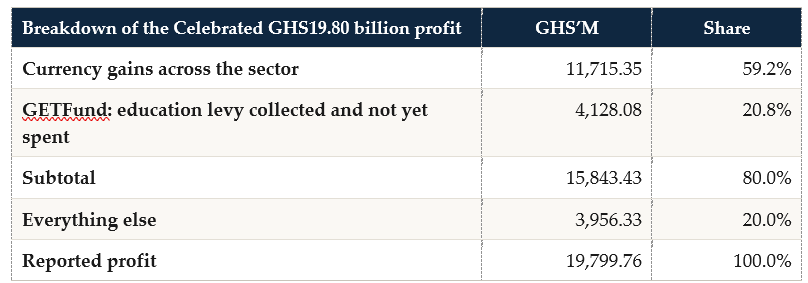
18. In simple terms: SIGA told us that a loss of GHS 2.26 billion in 2024 switched into a profit of GHS19.80 billion in 2025. But as everyone now knows, if you ignore the currency revaluations, profit actually fell from GHS9.75 billion to GHS8.08 billion, a decline of 17.1 per cent.
19. (By the way, the "976%" improvement from 2024 to 2025 that has been reported is totally meaningless. One can't use a percentage incremental when swinging from below zero - negative - to positive).
20. SIGA’s published cost figure for 2021 is wrong by GHS 50.9 billion. Instead of GHS 54.04 billion, GHS 104.97 billion is used. The wrong number is replicated from the 2023 figure. This crazy error is presented as evidence that State companies are becoming more efficient at covering their costs. The published series thus climbs from 0.54 in 2021 to 1.17 in 2025 to underline the success story. If corrected, 2021 was already 1.04. Most of the "improvement" is from a pure mistake.
21. (The craziest thing is that this is not a one-off. In all five SIGA reports from 2021 to 2025, the earliest year's cost figure is an exact copy of the figure two years later in the same table. And it is not confined to that table: the 2025 report duplicates cells in its mining chapter and its joint-venture chapter too, at different intervals. These are not typos. Something messed up seems to be going on.)
22. The other strange thing is how SIGA fails to explain how equity dropped by a whopping GHS 12.69 billion in 2025 creating an inexplicable GHS 32.49 billion gap from the profit line. Even as net worth has been reported as rising for the three previous years of losses. So somehow the net worth of the businesses that has been rising during the years of losses suddenly drops when humongous profits show up?
23. Another bizarre issue is that the 2024 report says State businesses lost GHS 9,675.43 million that year and reported a return on equity of minus 8.5 per cent. The 2025 report says the loss in 2024 was GHS 2,259.15 million. GHS 7.42 billion of losses disappeared like smoke. With zero explanation.
24. Apart from the currency revaluations, SIGA also booked GHS 4,128.08 million as profits from GETFund. That money is simply the portion of the levy (a kind of tax) Ghanaians pay that GETFund hadn't got around to spending yet by the end of the year (more likely, it wasn't released to them.)
25. As for the entities in which Ghana owns a tiny stake (like 0.04% in Anglogold), it is comical how their total profits were reported as if they can be attributed to Ghana.
In short, SIGA should withdraw, not just the confusing the 2025 one, but all its reports from 2020, fix the errors, and submit a more reliable series.
The EV regulation chat on the TL is interesting. Ghanaians don’t like to be regulated, it’s part of our “anyhowness”. Decades later, when things get out of control and start causing issues, same Ghanaians will be making noise about how things are “basaaa”. What do we want?
To the average Ghanaian, this is an avenue to criticize the govt for trying to ‘regulate’ everything.
To an ELECTRICAL/POWER SYSTEMS ENGINEER, this’s a great move by the government to ensure our grid (as a developing nation) doesn’t collapse.
Kudos!
After reading the IMF Report,this is what I have to say.
The GoldBod/BoG debate is being framed as if one side must be lying.I don’t think that’s the right way to understand it.GoldBod is correct on the accounting point,the $1.7bn loss is on the Bank of Ghana’s balance sheet,
I wasn’t familiar with Ebi Bright’s game. It’s rare to see a political appointee write so critically and honestly about the office they still hold.
She has written honestly about the constraints assemblies face. The Coordinating Director who runs the assembly is not the assembly’s employee. The finance officer answers to the Controller and Accountant-General. Roads wait on the Ministry. Education and health staff belong to GES and GHS.
It got me thinking. Electing MMDCEs is only a starting point.
We are about to spend a referendum and a whole election cycle on how the political head is chosen, and almost nothing on what that person will be able to do the morning after they win.
It also makes the government’s plan for electing assembly heads sound even more ridiculous. The president nominates five. A vetting committee cuts it to three. The people then vote among the three. We are designing an election where the ballot is filtered before it reaches the voter, for an office that cannot query its own finance officer. It is a longer route to the same appointment, and it leaves every structural problem intact.
The government also rejected several of the CRC’s key recommendations on local government and decentralisation, including the recommendation that central government stop spending a district’s common fund allocation on its behalf. It wants to keep the ability to run programmes like DRIP off the top, and to keep deducting sanitation payments at source to Zoomlion.
And consider what we are electing them to control. For instance, the DACF “guidelines” from the finance ministry direct assemblies to spend 25% of their allocation on 24-hour economy model markets. Every assembly. Whether or not a market is what that district needs most. An assembly drowning in refuse, or watching its shoreline collapse, still commits a quarter of its development money to a nationally chosen project. That is the whole paradox in one line item. The money is transferred to the assembly but the decision is not.
The structures are the thing.
Assemblies should be autonomous. They should prepare their own budgets and execute them. They should make their own resource allocation decisions and answer for them at the ballot box and to the Auditor-General, not to a queue of approvals in Accra.
Central government keeps what only the centre can do. Transfers, on a statutory calendar. Education, health, national security, standards, cross country highways etc.
Assemblies take full control of sanitation, water, inner roads, drains, markets, local planning and enforcement. The things residents actually judge them on.
Until then we will only elect mayors and DCEs but accountability at the local levels won’t change much.
🎉 As we celebrate our anniversary, we're celebrating the power of climate knowledge.
📚 SSPs show how societies may evolve.
🌍 RCPs reveal possible climate futures.
Together, they help us understand risks, inspire solutions, and shape a sustainable future.
#ClimateAction#SSPs
Parliament passes Community Service Bill, seeking to introduce non-custodial sentences for first offenders and other lesser crimes...
#GHOneNews#EIBNetwork#GHOneTV#NewsAlert
Stonebwoy shock me paa that tweet was very unnecessary. Even if Shatta Wale and Sarkodie dey hate each other but always find the right time to be friends cos of business, what’s wrong with that? Business is business