Back to the Unix and terminal, FreeBSD/*BSD, server side, command line, efficiency, simplicity. @CrystalLanguage / Ruby fan. For Smalltalk look at @smalltalkdev
🧠 A deep dive into one of the less visible parts of Ruby's next-generation JIT and why a recent change opens the door to bigger performance optimizations in the future. #Ruby https://t.co/tfIFhXewji
🎙️ New Episode of What’s Spinnin’
In this episode, Brett Kelly sits down with @allanjude a leading voice in the open-source and storage infrastructure community. Allan serves on the FreeBSD Core Team, is a lead committer for @OpenZFSonLinux , and is Head of Solutions Architecture at @klarainc .
The conversation explores Allan’s path from operating IRC shells in Hamilton, Ontario, to becoming one of the industry’s most respected experts in storage systems and data architecture. Along the way, they dive into the evolution of OpenZFS, the impact of ZSTD compression, and the realities of building reliable, scalable infrastructure in the open-source ecosystem.
Topics include:
• The evolution and future of @OpenZFS
• Systems architecture and data integrity
• Open-source development at scale
• The role of ZSTD compression in modern storage
• Building enterprise-grade support around open-source technologies
A thoughtful discussion for engineers, infrastructure professionals, and anyone interested in the technologies powering modern data systems.
https://t.co/ORMurkgKf3
#WhatsSpinnin #OpenSource #FreeBSD #OpenZFS #ZFS #Infrastructure #SystemsArchitecture #Storage #TechPodcast #OpenSourceTechnology #DataEngineering
Check out this interview with Carl Hörberg of 84codes, where he explains why they chose Crystal to build LavinMQ – a great example of Crystal in production.
https://t.co/g4V501tlPh
#crystallang@LavinMQ@84codes
Our biggest breakthrough in efficiency yet, the Framework Laptop 13 Pro with 20 hours of battery life. In Graphite.
Linux-first with options for Ubuntu pre-installed. Featuring Intel® Core™ Ultra Series 3 processors, LPCAMM2 Memory, a new haptic touchpad, and a touchscreen display.
Pre-orders for the Framework Laptop 13 Pro open now: https://t.co/88vOj9duM1
A new Crystal release is out for version 1.20.0
Highlights: `@[TargetFeature]` annotation, new process spawn API, support for kernel TLS and io_uring. The latter requires execution contexts which is now in the final preview.
Read more at https://t.co/5M0bLC0qQr
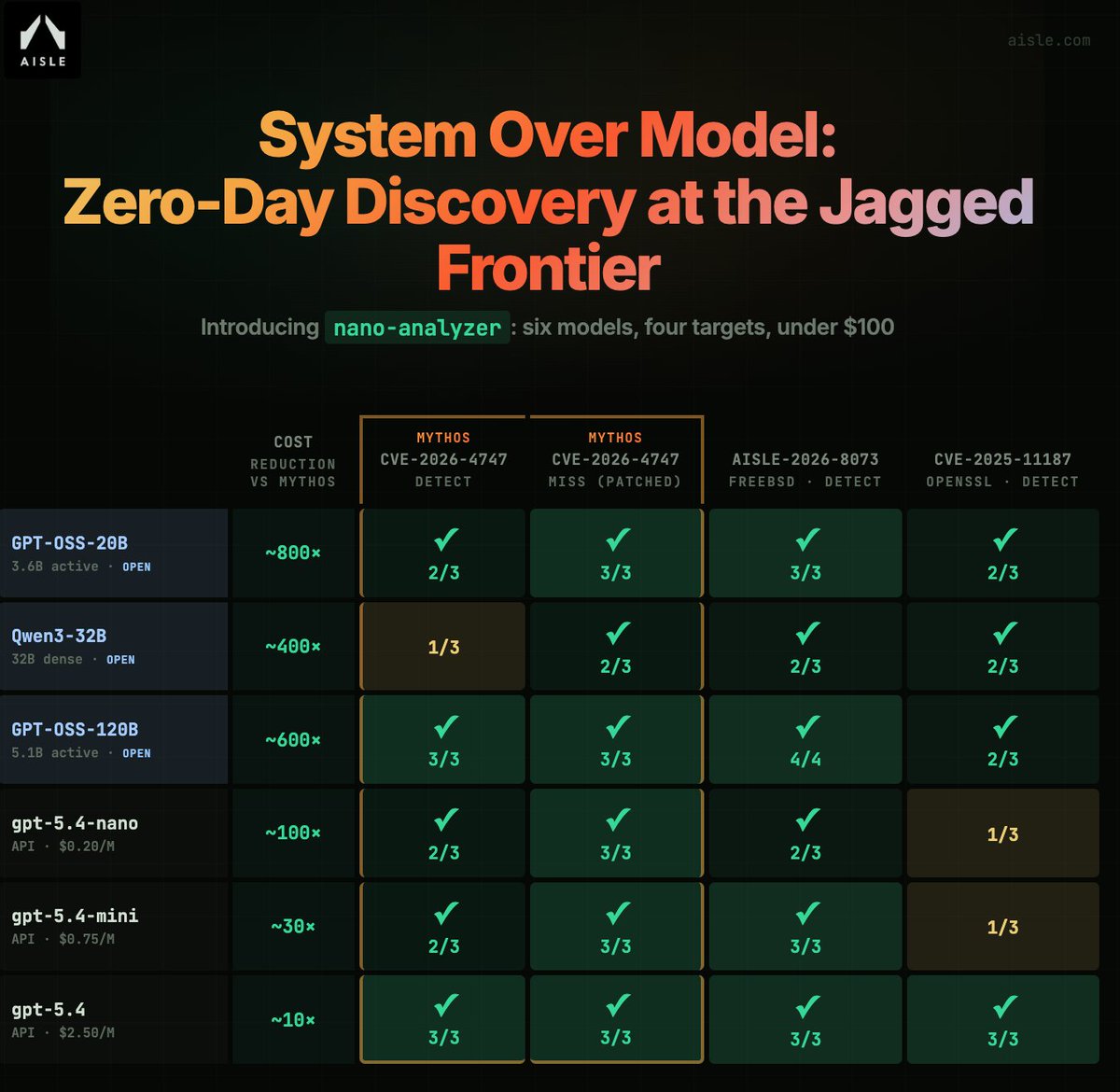
New post: We show that small, cheap models can detect the flagship Mythos FreeBSD zero-day (CVE-2026-4747) using a simple harness we call nano-analyzer
Models down to 3.6B active params (including open-weights ones you can run locally) would have detected it 100-1000x cheaper
🚨 A practical guide to auditing Rails apps: how to spot dangerous architecture, hidden risks, and fragile areas in days, not weeks. #Rails https://t.co/amahm1cVLw
🧠 Claude Code can query a Ruby project using the Shopify Ruby LSP instead of reading files blindly. This walkthrough outlines the gem install and configuration. #Ruby https://t.co/Bvw99VF8Uz
⚖️ Rails performance sits between premature optimization and missing basics. A walkthrough of pagination, eager loading, N+1 queries, and database indexes. #Rails https://t.co/TEJBjWRMkp
Big moment for Postgres!
Search has always been Postgres' weak spot, and everyone just accepted it.
If you needed a real relevance-ranked keyword search, the default answer was to spin up Elasticsearch or add Algolia and deal with the data sync headaches forever.
The problem isn't that Postgres can't do text search. It can.
But the built-in `ts_rank` function uses a basic term frequency algorithm that doesn't come close to what modern search engines deliver.
So teams end up:
- Running a separate Elasticsearch cluster just for search
- Building sync pipelines that inevitably drift out of consistency
- Paying for managed search services that charge per query
- Accepting mediocre search relevance because "good enough" ships faster
But this is actually a solvable problem.
You can realistically bring industry-standard search ranking directly into Postgres, which eliminates the need for external infra entirely.
This exact solution is now available with the newly open-sourced pg_textsearch by @TigerDatabase, a Postgres extension that brings true BM25 relevance ranking into the database.
BM25 is the algorithm behind Elasticsearch, Lucene, and most modern search engines. Now it runs natively in Postgres.
Here's what pg_textsearch enables:
- True BM25 ranking with configurable parameters (the same algorithm powering production search systems)
- Simple SQL syntax: `ORDER BY content <@> 'search terms'`
- Works with Postgres text search configurations for multiple languages
- Pairs naturally with pgvector for hybrid keyword + semantic search
That last point matters a lot for RAG apps. The video below shows this in action, and I worked with the team to put this together.
You can now do hybrid retrieval (combining keyword matching with vector similarity) in a single database, without stitching together multiple systems.
The syntax is clean enough that you can add relevance-ranked search to existing queries in minutes.
pg_textsearch is fully open-source under the PostgreSQL license.
You can find a link to their GitHub repo in the next tweet.
bzfs is a reliable near real-time, parallel replication and backup command-line tool for ZFS ... supporting disaster recovery and high availability (DR/HA), scale-out deployments, and protection against data loss or ransomware https://t.co/Pst2sePmmf







![CrystalLanguage's tweet photo. A new Crystal release is out for version 1.20.0
Highlights: `@[TargetFeature]` annotation, new process spawn API, support for kernel TLS and io_uring. The latter requires execution contexts which is now in the final preview.
Read more at https://t.co/5M0bLC0qQr https://t.co/X56Cw0WBoG](https://pbs.twimg.com/media/HGH-mADW8AIrYEQ.jpg)