In the 1990s, Canadian ecologist Suzanne Simard made a groundbreaking discovery that challenged everything we thought we knew about how forests work. While studying managed forests in British Columbia, she noticed something puzzling: when birch trees were removed to promote the growth of valuable Douglas firs, the firs did not flourish as expected, they actually struggled and grew more slowly.
Determined to understand why, Simard traced the movement of nutrients using radioactive carbon isotopes. What she found was astonishing. Trees were actively sharing resources through vast underground fungal networks known as mycorrhizae. These delicate, thread-like fungi connect the roots of different trees across the forest floor, forming a complex web that allows the exchange of carbon, water, nutrients, and even chemical signals, sometimes between entirely different species.
She discovered that older, larger trees often serve as central "hubs" or "mother trees," supporting younger saplings by redistributing vital resources and helping the entire ecosystem remain resilient. When these key trees are removed, the underground network weakens, and the health of the remaining forest declines.
Simard’s research overturned the traditional Darwinian view of forests as battlegrounds of ruthless competition. Instead, she revealed a far more sophisticated reality: forests operate as highly cooperative systems where trees communicate, support one another, and even warn neighboring trees about threats like drought, disease, or insect attacks.
What appears to the human eye as a silent, still forest is, in truth, a vibrant, interconnected living network, built not on isolation and rivalry, but on deep connection and mutual aid.
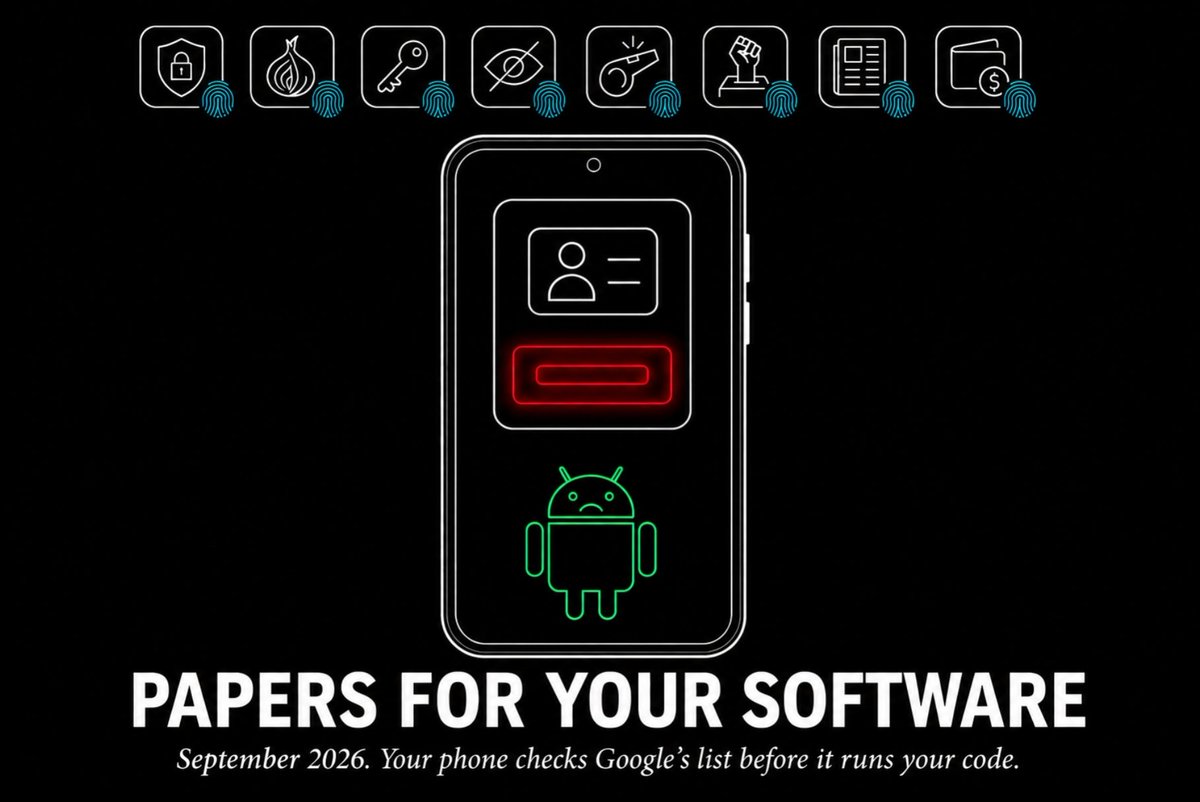
Google is building a registry that ties every piece of Android software to a government ID, and your phone will soon refuse to run anything that is not on it.
Starting September 2026, an app will not install on a certified Android phone unless its maker has handed Google a government photo ID, paid a fee, registered a payment profile, and signed over the keys to their own code. And not just apps from the Play Store. Every app. The one a friend builds you. The one a stranger across the world wrote and gave away. The one you wrote yourself, for your own phone, in your own home.
Your hardware will check it against Google's list, and if the name is not on file, the door stays shut.
Android was the open one. For fifteen years that was the entire pitch, the one phone where you owned the device and chose the software and no one stood at the gate. That is what is ending.
The phone goes from a thing that runs what you tell it to a thing that runs what Google has approved, and approval now means a legal name in a database.
A malware author will buy a stolen identity for $40 and ship his poison the same as ever. He always has. The registry does not touch him. What it touches is the developer who cannot put his real name on his work. The one building a secure messenger for people a government wants dead. The one shipping a tool that embarrasses the powerful. The one who writes under a handle because the alternative is a knock at the door.
The purpose, in Google's own words, is to "remove the cover of anonymity."
The mask is the oldest tool the free press ever held. The pamphlet with no printer's name. The essay signed with a fake one. Every government that ever feared what its people might read started by demanding to know who set the type. Google has volunteered to be the one who keeps the list.
If you want to install software from a maker who refused the registry, you can, after you enable developer mode, swear to your phone that no one is forcing you to do this, restart the device, wait a full twenty-four hours, and authenticate again. A day-long cooling-off period and a coercion check, to put a program you chose on a phone you own.
It is the permission slip with enough friction that most people stop trying, which was always the point.
F-Droid, the free software catalogue that has handed out unsigned, unregistered, no-name software for over fifteen years, called it existential and refused to comply.
67 organizations told Google to kill the plan. Google moved the date for no one.
So learn the way out now, while the door is still open. The stores that answer to no registry. The phones that were never on Google's list. The skill of putting what you choose onto the machine you own, before that skill becomes a thing you have to wait a day and swear an oath to use.
A phone that asks permission before it runs your software was never your phone. It was theirs, parked in your pocket, billed to your name.
Take it back while taking it back is still allowed.
Apple and Google are gradually expanding their use of hardware-based attestation. They're convincing a growing number of services to adopt it. Google's Play Integrity API and Apple's App Attest API are very similar. Apple brought it to the web via Privacy Pass, which Google intends on doing too.
Google's Play Integrity API requires hardware attestation for the strong integrity level and is gradually phasing in requiring it for the more commonly used device integrity level. Apple already has it as a requirement. Over the long term, this will increasingly lock out hardware and OS competition.
The purpose of these systems is disallowing people from using hardware and software not approved by Apple or Google. This is wrongly presented as being a security feature. Banks and government services are the main ones adopting it but Apple and Google are encouraging every service to use it.
Apple's Privacy Pass brought hardware attestation to the web to help with passing captchas on their own hardware. Many people saw that as harmless since few sites would be willing to lock out non-Apple-hardware users. Apple and Google are both likely to bring broader hardware attestation to the web.
Google's reCAPTCHA is planning an approach where they use Privacy Pass on Apple hardware, their own approach on Google Mobile Services Android devices and a QR code scanning system to require an iOS or Google certified Android device for Windows and other systems:
https://t.co/7rQnioRa8A
Banking and government services increasingly require using a mobile app where they can use attestation to force using an Apple or Google approved device and OS. Apple's privacy pass, Google's 'cancelled' Web Environment Integrity and now reCAPTCHA Mobile Verification are bringing this to the web.
Current media coverage for reCAPTCHA Mobile Verification misunderstands it and the impact of it. They're bringing a hardware attestation requirement to Windows, desktop Linux, OpenBSD, etc. by requiring a QR scan from a certified smartphone to pass reCAPTCHA in some cases. They could expand it more.
Control over reCAPTCHA puts Google in a position where they can require having either iOS or a certified Android device to use an enormous amount of the web. Google defines certification requirements for Android which includes forcing bundling Google Chrome, etc. It's enormously anti-competitive.
Google's Play Integrity API bans using GrapheneOS despite it being far more secure than anything they permit. It also bans using any other alternative. This isn't somehow specific to an AOSP-based OS. You can't avoid this by using a mobile OS based on FreeBSD instead. You'll just be more locked out.
Google's Play Integrity API permits devices with no security patches for 10 years. The device integrity level can be bypassed via spoofing but they can detect it quite well and block it once it starts being done at scale. The strong integrity level requires leaked keys from TEEs/SEs to bypass it.
It doesn't provide a useful security feature, but it does lock out competition very well. Services requiring Apple App Attest or Google Play Integrity are primarily helping to lock in Apple and Google having a duopoly for mobile devices. Play Integrity is more relevant due to AOSP being open source.
Governments are increasingly mandating using Apple's App Attest and Google's Play Integrity for not only their own services but also commercial services. The EU is leading the charge of making these requirements for digital payments, ID, age verification, etc. Many EU government apps require them.
Instead of governments stopping Apple and Google from engaging in egregiously anti-competitive behavior, they're directly participating in locking out competition via their own services. Requiring people to have an Apple device or Google-certified Android device is anti-competition, not security.
reCAPTCHA Mobile Verification will currently work with sandboxed Google Play on GrapheneOS but it clearly exists to provide a way for them to start using hardware attestation on systems without it. People without an iOS or Android device will be locked out when this is required even without that.
This isn't about security or any missing functionality. GrapheneOS can be verified via hardware attestation. Google bans using GrapheneOS for Play Integrity because we don't license Google Mobile Services and conform to anti-competitive rules already found to be illegal in South Korea and elsewhere.
Services shouldn't ban people from using arbitrary hardware and operating systems in the first place. Google's security excuse is clearly bogus when they permit devices with no patches for 10 years but not a much more secure OS. It's for enforcing their monopolies via GMS licensing, that's all.
‼️🚨 ALARMING: Google now treats privacy as suspicious behavior by default. Users of GrapheneOS, CalyxOS, /e/OS, and other deGoogled Android phones are being locked out of millions of websites unless they install the exact Google Play Services software they deliberately removed.
GrapheneOS is recommended by the EFF and used by journalists, lawyers, and activists in high-risk environments. The audience most likely to read Google's data practices and refuse its terms is now flagged as fraudulent for that exact decision.
What happened?:
▪️ Google announced "Cloud Fraud Defense" at Cloud Next on April 22-23, 2026, branding it "the next evolution of reCAPTCHA." Existing reCAPTCHA customers were auto-migrated.
▪️ When the system flags traffic as suspicious, the old click-the-bus puzzle is gone. Users get a QR code instead.
▪️ Scanning the QR code requires Google Play Services running on the device. Internet Archive snapshots show this requirement has been live since at least October 2025, silently rolled out for 7 months before anyone noticed.
▪️ No Play Services = no QR scan = locked out.
The bigger picture:
▪️ Google already tried this in 2023. It was called Web Environment Integrity (WEI), and it would have let Google decide which devices were "real enough" to access the web. Standards bodies and the public pushed back hard, and Google killed it. Three years later, the same idea is back, just hidden behind a QR code instead of a browser feature.
▪️ reCAPTCHA runs on millions of websites. Every developer who keeps using it is now, by default, telling deGoogled Android users they're not welcome...
@Whooperjr88@MetalsBrah@EagleOneWhiskey The data is from 2005-2018, I'm willing to bet the vast majority of cannabis that was consumed was black market untested.
@paulsaladinomd@paulsaladinomd recommended Segura's butcher shop in Uvita a few years back and that was one of the best steaks I've ever had in my life 10/10
These come from our Limetta Marmalade lines made by our good friend in VA Jolly Pond Farms. he has been killing it with our strains since day one many years ago. It’s really cool to see these project end up in places like this.
🎥 yellowskunkfarms ig
Follow us on IG @LandraceBureau
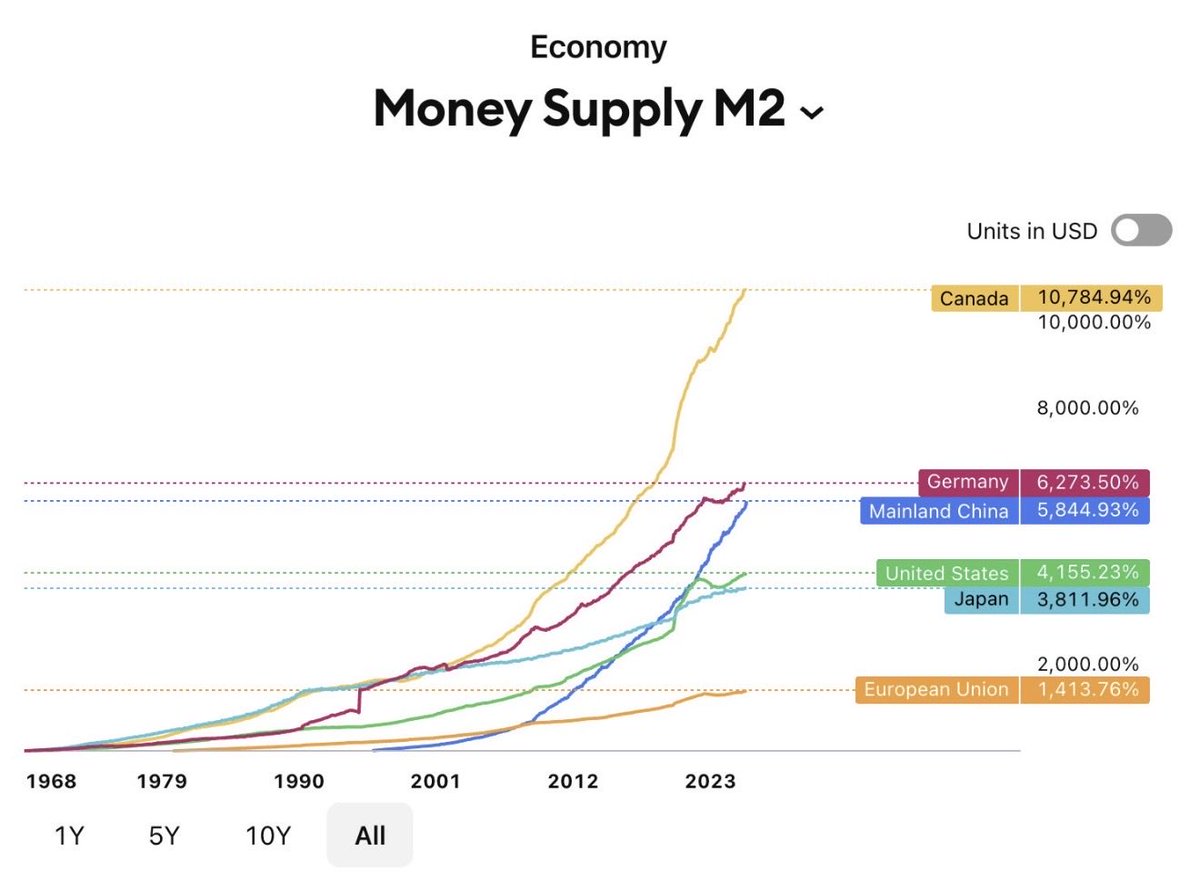
🚨 LOOK AT THIS CHART
Money supply (M2) growth since 1968:
🇨🇦 Canada: 10,784%
🇩🇪 Germany: 6,273%
🇨🇳 China: 5,844%
🇺🇸 United States: 4,155%
🇯🇵 Japan: 3,811%
Canada printed more money than every major economy on earth.
Every other country started levelling off.
Canada’s line goes VERTICAL.
This is why your dollar is worthless.
This is why homes cost $1 million.
This is why groceries doubled.
This is why food bank visits hit 2.2 million.
This is why your savings buy less every single year.
It’s not “global inflation.”
It’s a printing press that never stopped.
IT’S THE CANADIAN PESO.
The government devalued YOUR MONEY to fund spending it couldn’t afford.
⚡️ This is what pilots sometimes see above thunderstorms.
They’re called Red Sprites — massive electrical discharges that appear 30–50 miles above storms near the edge of space.
They last only milliseconds… which is why capturing them on camera is extremely rare. Nature still has secrets above the clouds.