Pages of the Glorious Qur’ān today
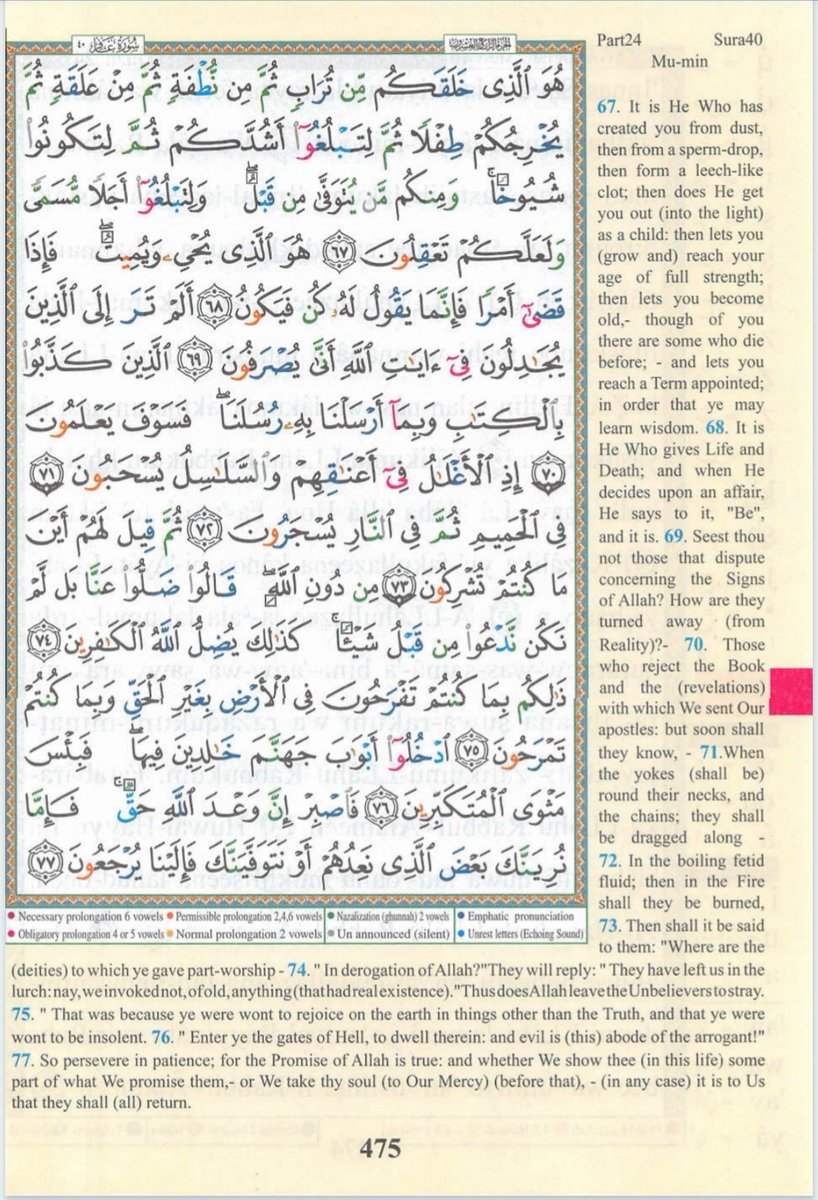
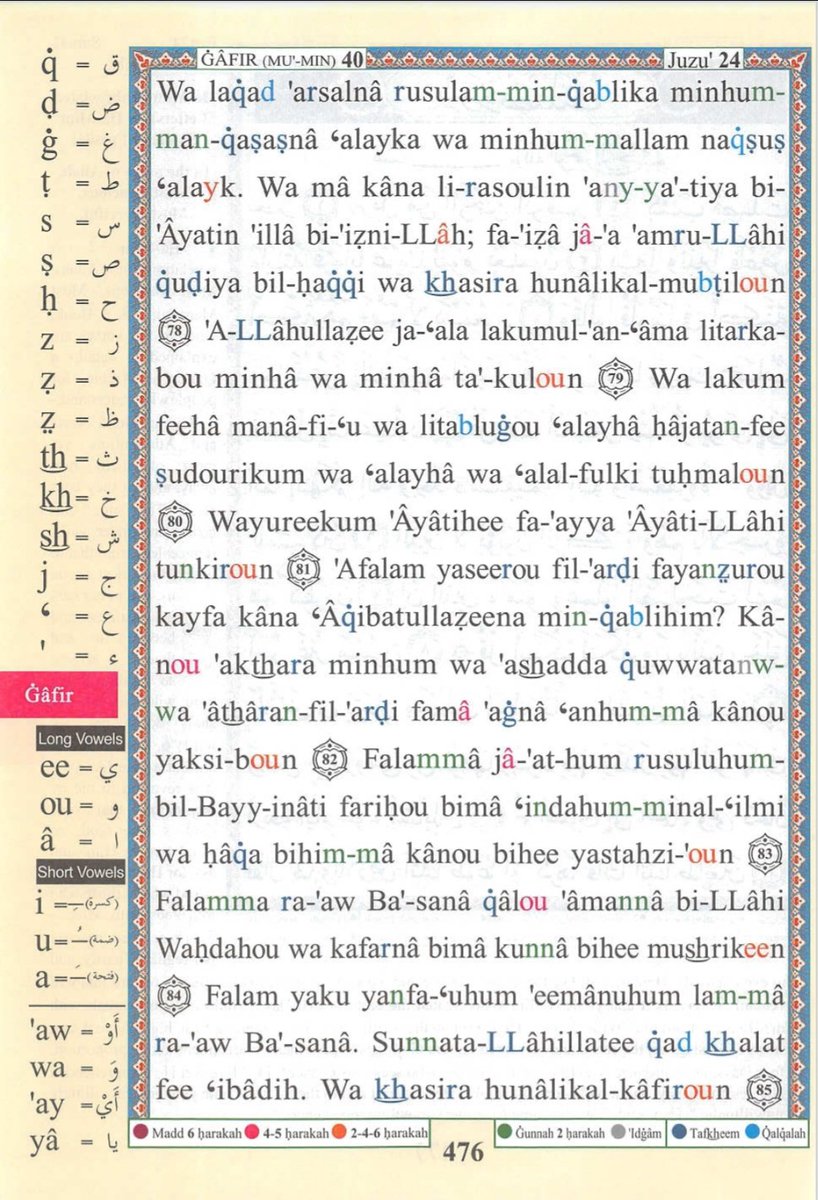
Monday 16/11/26, Sūrah Ghāfir (40): 67-85, tafakkur verse 40: 65
Theme: Remember your humble beginning and your final return to Allah
هُوَ ٱلَّذِی خَلَقَكُم مِّن تُرَابࣲ ثُمَّ مِن نُّطۡفَةࣲ ثُمَّ مِنۡ عَلَقَةࣲ ثُمَّ یُخۡرِجُكُمۡ طِفۡلࣰا ثُمَّ لِتَبۡلُغُوۤا۟ أَشُدَّكُمۡ ثُمَّ لِتَكُونُوا۟ شُیُوخࣰاۚ وَمِنكُم مَّن یُتَوَفَّىٰ مِن قَبۡلُۖ وَلِتَبۡلُغُوۤا۟ أَجَلࣰا مُّسَمࣰّى وَلَعَلَّكُمۡ تَعۡقِلُونَ
"It is He who created you from dust, then from a sperm-drop, then from a clinging clot; then He brings you out as a child; then [He develops you] that you reach your [time of] maturity, then [further] that you become elders. And among you is he who is taken in death before [that], so that you reach a specified term; and perhaps you will use reason."
LESSONS:
1. Remember your origin, and humility follows: Allah begins with *turāb*, dust: the same ground we walk on and will return to. Whoever remembers that he was once dust has no room for arrogance towards Allah or towards people. Pride forgets its beginning, while piety never does.
2. Every stage is His work, not ours:
Nuṭfah, then ʿalaqah, then ṭifl: at none of these stages did we contribute anything, and none of them did we even witness. We were carried from stage to stage by a Will that was not ours. The heart that grasps this learns *tawakkul*, because the One who fashioned us when we were helpless does not abandon us now that we are able.
3. Strength is a trust, not a possession:
Li-tablughū ashuddakum, "that you may reach your full strength." Our youth and vigour are a station on the journey, not its destination. The Prophet ﷺ said that on the Day of Judgement a person will be asked about his youth and how he spent it (Tirmidhī 2417). Strength used in obedience becomes provision; strength wasted becomes a regret.
4. Not everyone reaches old age:
Wa minkum man yutawaffā min qabl, "and among you is he who is taken before." The verse breaks its own sequence to remind us that death does not wait for its turn. The aware heart does not postpone repentance until old age, because old age was never promised. Ibn ʿUmar's counsel applies: "When evening comes, do not wait for the morning" (Bukhārī 6416).
5. A fixed term invites reflection:
Ajalan musammā, an appointed term, then laʿallakum taʿqilūn, "so that you may reason." Allah does not end the verse with fear but with intellect. Life has a beginning, a course and a known end, and the intelligent person is the one who prepares for that end. The Prophet ﷺ called the wise person the one who holds himself to account and works for what comes after death (Tirmidhī 2459).
May Allah make our final stage our best and our last deed our finest. Àmín.
One of the historical realities that deserves greater recognition in the study of Yorùbá civilisation is the contribution of Islam to the preservation, documentation, intellectual development and advancement of Yorùbá culture and heritage.
It is historically inaccurate to present Islam merely as a foreign religious influence that displaced Yorùbá identity, weakened indigenous civilisation or disconnected the Yorùbá people from their ancestry. Such a position overlooks centuries of interaction, intellectual exchange, cultural adaptation and the contributions of indigenous Yorùbá Muslims to the development of their society.
Islam did not arrive in an empty cultural space. It encountered an established civilisation with its own language, political institutions, philosophical traditions, systems of education, artistic expressions, social structures and historical consciousness. Over the centuries, Yorùbá Muslims became active participants in the development of both Islamic civilisation and Yorùbá cultural identity.
Let us examine some important dimensions of this relationship.
1. Islam contributed to the documentation of Yorùbá history.
One of the most significant contributions of Islam to Yorùbá heritage was the introduction and development of Arabic literacy and the Ajami tradition (Anjemi).
Before the widespread adoption of Roman writing, Arabic script had already become an important instrument of literacy among Muslim communities in Yorùbáland.
Yorùbá scholars employed Arabic characters to write in the Yorùbá language, document religious teachings, preserve historical accounts, compose poetry and record aspects of social life.
These manuscripts constitute important historical resources for understanding the evolution of Yorùbá society.
The Ajami tradition is particularly important because it demonstrates that the intellectual history of Yorùbá people cannot be adequately understood through Western-style documentation alone.
2. Islam strengthened the intellectual development of the Yorùbá language.
Islamic scholarship encouraged the use of indigenous languages in communicating knowledge.
Yorùbá Muslim scholars developed ways of explaining the Qur'an, Hadith, Islamic jurisprudence, theology and moral philosophy through the Yorùbá language.
This produced a rich tradition of Islamic literature, preaching, poetry and religious instruction.
The development of Yorùbá Islamic vocabulary also enriched the language through the adoption and adaptation of Arabic-derived expressions.
Terms such as Àlùfáà, Àmín, Àlùbáríkà, Àṣàlẹ̀ and Àdúrà illustrate aspects of the long interaction between Islamic religious vocabulary and Yorùbá linguistic expression.
The important point is that Yorùbá did not cease to be Yorùbá because it accommodated new vocabulary. Like every living language, it continued to grow through cultural contact.
3. Islam preserved and developed Yorùbá oral literature.
Yorùbá civilisation has always possessed a rich oral literary heritage.
Islamic engagement with this tradition produced distinctive literary expressions, particularly:
* Wákà – Islamic religious poetry and chanting.
* Dàdàkúàdá – a distinctive performance and chanting tradition.
* Islamic panegyrics and poetic compositions.
* Yorùbá religious proverbs and moral instruction.
* Islamic storytelling and historical narration.
These traditions demonstrate that Islamic religious expression never required the abandonment of indigenous artistic creativity.
Rather, Yorùbá Muslims developed creative ways of communicating Islamic teachings through familiar cultural forms.
The scholarly documentation of Wákà and Dàdàkúàdá provides important evidence of this interaction.
🚨🇺🇸 BREAKING: Manchester United appoint Mauricio Pochettino as new head coach, here we go!
Deal done and green light from US Federation as Poch has agreed all terms on Wednesday.
New era at #MUFC. 🆕🇦🇷
Apepepepe tu, omo, ma pa mi na
Șe ka ma lọ s'Oniru? Oșe Sophie o
Sometimes, I look at you, gadem, you na woman
My fine, fine, fine, fine lady o, my superwoman
High me, high me, high me, you dey high me
Wo bo șe dun bi bi ti maggi, jọo, ma pa mi
Atutu poyoyo, she's not from ghetto, speaking Spanish And my baby stylish
Jẹ ka ma lọ ka lọ lavi
Let me be in your arms
Lost me within your eyes
Let me be in your arms
Lost me within your eyes