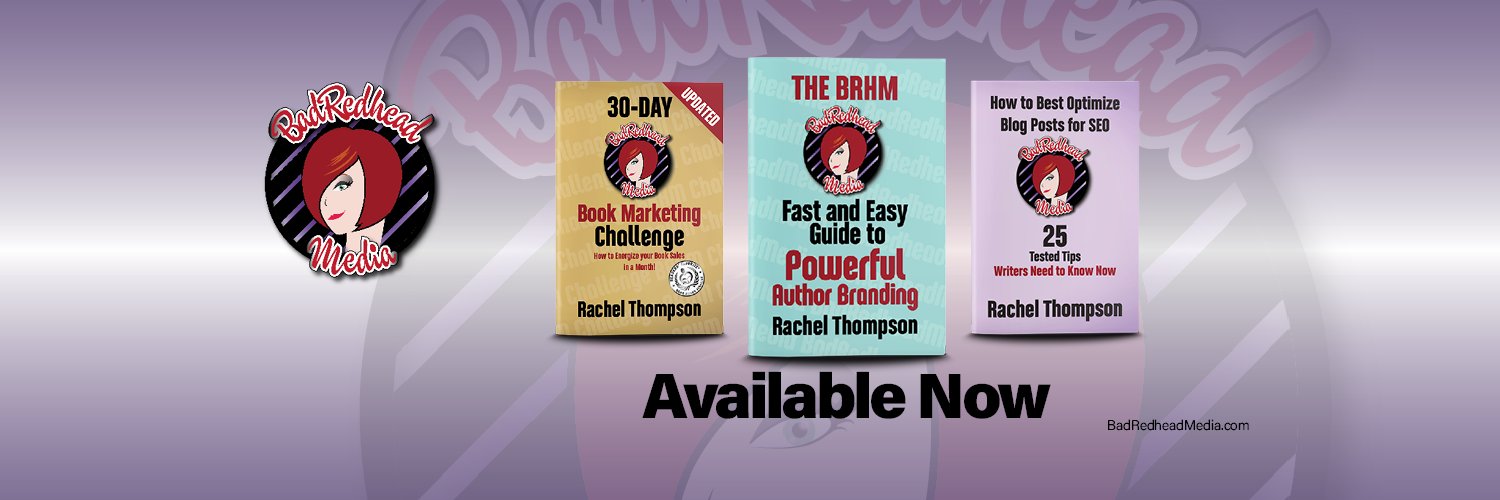
☀️ It's LIVE!
My newly-updated @BadRedheadMedia 30-Day Book Marketing Challenge is available now https://t.co/RazfyQyXSX
#ebook and #print#WritingCommunity - learn how to set up your author platform for success! ☀️
Twitter, FB, IG, blogging, marketing, promo, social...
🚀 Of all the futures science fiction has imagined, the one I still want to live in is 𝙎𝙩𝙖𝙧 𝙏𝙧𝙚𝙠’s.
In 𝘼 𝙁𝙪𝙩𝙪𝙧𝙚 𝘼𝙨𝙠𝙚𝙬: 𝙐𝙧𝙜𝙚𝙣𝙩 𝙀𝙨𝙨𝙖𝙮𝙨 𝙄𝙣𝙨𝙥𝙞𝙧𝙚𝙙 𝙗𝙮 𝙩𝙝𝙚 𝟲𝟬𝙩𝙝 𝘼𝙣𝙣𝙞𝙫𝙚𝙧𝙨𝙖𝙧𝙮 𝙤𝙛 𝙎𝙩𝙖𝙧 𝙏𝙧𝙚𝙠, each essay opens with a piece of original science fiction, then turns to a question we’re facing today. Who gets to shape the future of space exploration? What would we do if we found out we weren’t alone?
Here’s the trailer for my new book, out November 24. What part of 𝙎𝙩𝙖𝙧 𝙏𝙧𝙚𝙠’s future would you most want to see come true?
Order the book now: https://t.co/D6P5vmsT5r https://t.co/PV1g0ydxAW
by Jeffrey Morris (Published by Rational Future Books)
#AFutureAskew #StarTrek #StarTrek60 #ScienceFiction #BookTrailer
✍️ Reading More Every Day: Why Great Writers Never Stop Doing It by @lauriehollmanph (free) https://t.co/OYps6bD70s
The proprioceptive writer and how reading helps you write by using all your senses...
Reading is the center of the creative mind of the writer.
You can spot an author on line (a queue, not online!) at the grocery store, on a treadmill in a gym, while she’s brushing her teeth, while her nails and hair are being done, before she goes to sleep, and every time she’s with a child sitting side by side with a book.
Waiting rooms aren’t meant for waiting. They are meant for reading.
How do you know she’s an author? She is always reading. She can’t leave home without a book in her hand for that moment, otherwise lost to some mindless activity that often fills our days but keeps us with food in the refrigerator and clothes on our backs.
Did you ever read while you were standing, putting your pants on? Now that’s a book you can’t put down. That’s the book you want to write...
🧡 "We never
questioned
where to begin,
we simply stayed,
and stayed again."
𝙋𝙖𝙞𝙣𝙩𝙞𝙣𝙜 𝙔𝙤𝙪 𝙒𝙞𝙩𝙝 𝙒𝙤𝙧𝙙𝙨: 𝘼 𝘾𝙤𝙡𝙡𝙚𝙘𝙩𝙞𝙤𝙣 𝙤𝙛 𝙇𝙤𝙫𝙚 𝙋𝙤𝙚𝙢𝙨 by @ChrisWoodWrites
https://t.co/LcaLKTZA8i is perfect for the loves in your life!
🇺🇸 I was in Reykjavik in October 1986 as President Ronald Reagan’s arms control director. Forty years later, it’s good to see that remarkable weekend on the cover of American Heritage - via @KenAdelmanAuthor
In my book, 𝙏𝙃𝙀 𝘽𝙍𝙄𝙉𝙆 𝙊𝙁 𝙒𝘼𝙍, I tell the inside story of what happened when Reagan and Gorbachev sat down to talk about nuclear weapons...
https://t.co/XdB16GLnHR
📕 https://t.co/NLjxpY97zp #1 on @Amazon!
💥 NEW: Why Do We Assume Silence on Social Media Means Someone Doesn’t Care? by @BadRedheadMedia (free): https://t.co/fIv4wDLheB
When does speaking up help, and what do we miss when someone steps away?
I jokingly posted one sentence on my personal Facebook a few weeks ago. “So, I guess people still argue about politics here?” I posted it in reaction to seeing novel-length posts where people argued and shouted ad hominem attacks in shouty caps.
Who has time?
Welp. Got my answer. A lot of folks, apparently.
A few people replied that my silence is complicity, to think about my privilege and how I use my platform. I took the post down. I try to lead with kindness, but I got checked.
💥 Shout-out to my exclusive advertising sponsor, the always-free @Booklinker (universal book links—so helpful!), and the paid tool, @geniuslink.
Reading it back, I hear my eyeroll in 'still'. If you’ve been trying to get people to take an issue affecting your family seriously, I can see how my joke might sound like I was making fun of you. I also felt defensive, cause ya know, human. But what was I defending?
I absolutely recognize my own privilege in being able to make a crack like that, or in most situations. My intent was to be funny, but it was careless, and I accept that. That’s why I took the post down.
This is the kernel I’m struggling with: how my decision not to argue about politics online on my personal (e.g., ‘friends’) Facebook account (or anywhere) can lead to assumptions that may or may not be true...
Click or see bio for the rest! Always free.
⁉️ Narcissist vs. Sociopath vs. Psychopath: What’s the Difference? by @lauriehollmanph https://t.co/A8kTHefkK5
In long- and short-term relationships, in the workplace, and in society at large today, there is increasing concern about the terms narcissist, sociopath, and psychopath. Each is a distinctive disorder, significant not only to parents raising children who do not want their kids to grow up to have these personality disorders as adults but also to neuroscientists who are studying variations in the brain based on findings from MRI’s.
These terms and conditions are too often used interchangeably, which is incorrect, as the specific characteristics described below show. Furthermore, the psychotherapeutic treatment of these disorders is controversial.
The treatment for the narcissistic personality is the most well-defined because it has been studied for decades by prominent psychoanalysts who believe change is possible. Most likely, this personality disorder has been the most frequently addressed clinically because this group is the most likely, though not necessarily able, to seek treatment...
Start with the basics: your [Substack] publication name, description, About page, your two allowed categories, and your first post. You can add fancy stuff later.
~ @BadRedheadMedia "21 Substack Tips for Writers: What I’ve Learned About Growth, SEO, and Connecting with Readers"
#Writing
💥 NEW: Why Do We Assume Silence on Social Media Means Someone Doesn’t Care? by @BadRedheadMedia (free): https://t.co/Oral8ahGkH
When does speaking up help, and what do we miss when someone steps away?
I jokingly posted one sentence on my personal Facebook a few weeks ago. “So, I guess people still argue about politics here?” I posted it in reaction to seeing novel-length posts where people argued and shouted ad hominem attacks in shouty caps.
Who has time?
Welp. Got my answer. A lot of folks, apparently.
A few people replied that my silence is complicity, to think about my privilege and how I use my platform. I took the post down. I try to lead with kindness, but I got checked.
💥 Shout-out to my exclusive advertising sponsor, the always-free @Booklinker (universal book links—so helpful!), and the paid tool, @geniuslink.
Reading it back, I hear my eyeroll in 'still'. If you’ve been trying to get people to take an issue affecting your family seriously, I can see how my joke might sound like I was making fun of you. I also felt defensive, cause ya know, human. But what was I defending?
I absolutely recognize my own privilege in being able to make a crack like that, or in most situations. My intent was to be funny, but it was careless, and I accept that. That’s why I took the post down.
This is the kernel I’m struggling with: how my decision not to argue about politics online on my personal (e.g., ‘friends’) Facebook account (or anywhere) can lead to assumptions that may or may not be true...
Click or see bio for the rest! Always free.
Start with the basics: your [Substack] publication name, description, About page, your two allowed categories, and your first post. You can add fancy stuff later.
~ @BadRedheadMedia "21 Substack Tips for Writers: What I’ve Learned About Growth, SEO, and Connecting with Readers"
#Writing
#MondayBlogs
🔵 Why Words Matter: How Calling Himself a “Scholar” Changed His Life | Dr. @AndrewDKaufman https://t.co/iU0109BriA
One of the questions that animates moments like graduation is not just what we’ve accomplished, but who we are becoming. I was reminded of that in a place far removed from any graduation stage.
Let me take you there.
A few years ago, a sixteen-year-old at a juvenile correctional center asked me a question I’ve never forgotten.
Please click to read the rest.
To alter the past and fix the future, Domerin needs to solve a temporal riddle. He sent Crescent as many clues as he could. Now Crescent needs to find the answer in the future and carry it back to the past... https://t.co/db99quA4c7 #MondayBlogs
#MondayBlogs
I wrote Grammar Errors Part One. Hundreds of you had THOUGHTS.
Here’s Part 2 (and yes, I know it should be ‘Grammatical’ errors, but that sounds like little green Mike Wazowski in Monsters). Bring your red pen! | Rachel Thompson @BadRedheadMedia https://t.co/EfNkNrPHt7
1. Your vs. You’re
Your shows possession: Your book is on the table. You’re means you are: You’re pretending not to refresh your sales dashboard.
If you can replace the word with you are, use you’re. “Your welcome” can’t sit with us.
2. Irregardless
The standard word is regardless. Yes, irregardless appears in dictionaries because people have used it for a long time, but that doesn’t mean we agree. Dictionaries record language; they don't come to your house to approve every grammar decision you make because that would be weirdly intrusive.
Irregardless is generally labeled nonstandard. In edited writing, please use regardless and save everyone an argument.
3. Conscious vs. Conscience
We’re conscious when we’re awake and aware. Your conscience is the inner voice that tells you not to correct a stranger’s typo in the middle of their highly emotional post about blue bunnies in space.
Being conscious gives us opportunity. Our conscience tells us, "Stop scrolling already, Rachel. You should be writing.” So bossy...
Click or see bio for the rest! Always free!
#MondayBlogs
Why Writers Should Watch "Station Eleven:" Storytelling, World-Building, & the Star Trek Motto That Defines It | @RachelintheOC aka @BadRedheadMedia
https://t.co/EYshlsSdo4
When you hear the words “pandemic dystopia,” you might expect chaos, violence, and endless bleakness, or just think back a few years to our global pandemic. We lived that.
And yes, Station Eleven (HBO’s adaptation of Emily St. John Mandel’s multi-award-winning novel) gives us all that, available now on Prime Video and elsewhere.
What makes it unforgettable, and why every writer should watch, is how it insists on beauty, art, and human connection even as the world crumbles.
This isn’t a survival story in the usual sense. It’s a story about what endures when everything else is stripped away.
It’s a woven tapestry of detail that, upon repeated watchings, becomes even more and more meaningful (okay, okay, I’ve already watched it five times and am going for my sixth. Let me live.)
💥 Shout-out to my exclusive advertising sponsor, the always-free Booklinker (universal book links—so helpful!), and the paid tool, GeniusLink. I love both💥 (affiliate link).
📕 Station Eleven: Book vs. Show
Emily St. John Mandel’s novel and HBO’s series tell the same story in different ways.
The book is quiet and interior, built from fragments, memory, and subtle world-building. It asks the reader to piece things together slowly.
The show is expansive and emotional, lingering on visuals, silence, and character arcs that were only hinted at in the novel.
Some minor characters in the book become central on screen, shifting the story’s balance, and of course, there’s artistic license, with some characters written out completely, and others taking on different characteristics.
For writers, the lesson is this: a story isn’t fixed.
The same core idea can take on powerful forms, each revealing different truths. The show is adapted from the book, so there are clear differences.
Read more: https://t.co/EYshlsSdo4
Always free to read and subscribe!
#MondayBlogs
Badass & Broken, or Formidable Survivor? | by James Herman Kleiger, PsyD https://t.co/Y74jAQJOvL
"My new novel, Pareidolia: Illusions, Deceptions and Murder, is the latest installment in the Nicola Kitts psychological thriller series, featuring my protagonist, who, like the characters Lisbeth Salander from The Girl with the Dragon Tattoo and Sethe from Toni Morrison’s Beloved, embodies both brokenness and badassery.
The list of such memorable female characters – often described as “badass” and broken – is extensive, spanning classic figures like Jane Eyre and contemporary ones like Katniss Everdeen (The Hunger Games trilogy). Each, like Kitts, has been wounded by trauma and loss yet has emerged with fierce determination, strength, and perseverance."
Read more 👉 Free to read and subscribe. https://t.co/Y74jAQJOvL
#MondayBlogs
🍂 10 Practical Ways to Save Your Book From Failing Sales | by Rachel Thompson of @BadRedheadMedia https://t.co/334dP32qMv
Your book isn’t selling. Before you decide you need to spend $2,000 on ads, redesign your entire website, dance on TikTok, start a podcast, make seventeen Reels, or fire your cover designer, stop.
Poor sales are data. Something isn’t connecting between your book and the people who might want to read it. The question is where.
You’ve worked in book marketing for 15+ years, and one of the biggest mistakes I see authors make is assuming poor sales automatically mean their book sucks, they don't have enough marketing, or they haven’t spent enough on ads (it could be any, or none, of those).
Maybe people aren’t seeing the book, or they’re seeing it but not clicking; they’re clicking but not buying; or they’re buying Book One and never touching Book Two.
Those are completely different problems, and spending more money on promo won’t necessarily fix any of them. What helps is strategy.
💥 Shout-out to my exclusive advertising sponsor, the always-free @Booklinker (universal book links—so helpful!), and the paid tool, @geniuslink. I love both💥
I’ve written before about why book marketing has no easy button, because no single tactic, ad, social platform, viral post, or launch will do all the work for us. So, before you decide your book is DOA, here are five free and five reasonably priced ways to kick your sales in the pants.👖
See bio for the rest!
Here are some other collective names for animals:
a murder of crows
a tuxedo of penguins
a bask of crocodiles
a destruction of cats
a tower of giraffes
a parliament of owls
a cackle of hyenas
a smack of jellyfish
an ambush of tigers
a wisdom of wombats
🧡 Painting You with Words: From a Poetry Blog to a Book of Love Poems by @ChrisWoodWrites
https://t.co/QzLaS5RxJi
My first book, 𝙋𝙖𝙞𝙣𝙩𝙞𝙣𝙜 𝙔𝙤𝙪 𝙬𝙞𝙩𝙝 𝙒𝙤𝙧𝙙𝙨: 𝘼 𝘾𝙤𝙡𝙡𝙚𝙘𝙩𝙞𝙤𝙣 𝙤𝙛 𝙇𝙤𝙫𝙚 𝙋𝙤𝙚𝙢𝙨, is now available: https://t.co/Ex2hwYBC1p
📕 NEW: Why Conspiracy Theories and Political Influence Are Hiding in Plain Sight by J.T. Kuendig https://t.co/VoFMxgwbM3
According to a YouGov survey, 41% of respondents believed a single group of people secretly controls events and rules the world. Another fascinating rumor: 20% thought it’s likely true that the government is using COVID-19 vaccines to microchip Americans.
(Recognize those rumors? They were central to the development of my book, The Good Club.
Conspiracy theories like the ones above are prevalent in the United States. In fact, according to Psychology Today, about a third of people globally believe in at least one conspiracy theory.
Some are more outrageous than others. For example, 25% of Americans believed the government, media, and financial world were controlled by Satan-worshipping pedophiles...
Click for the rest!