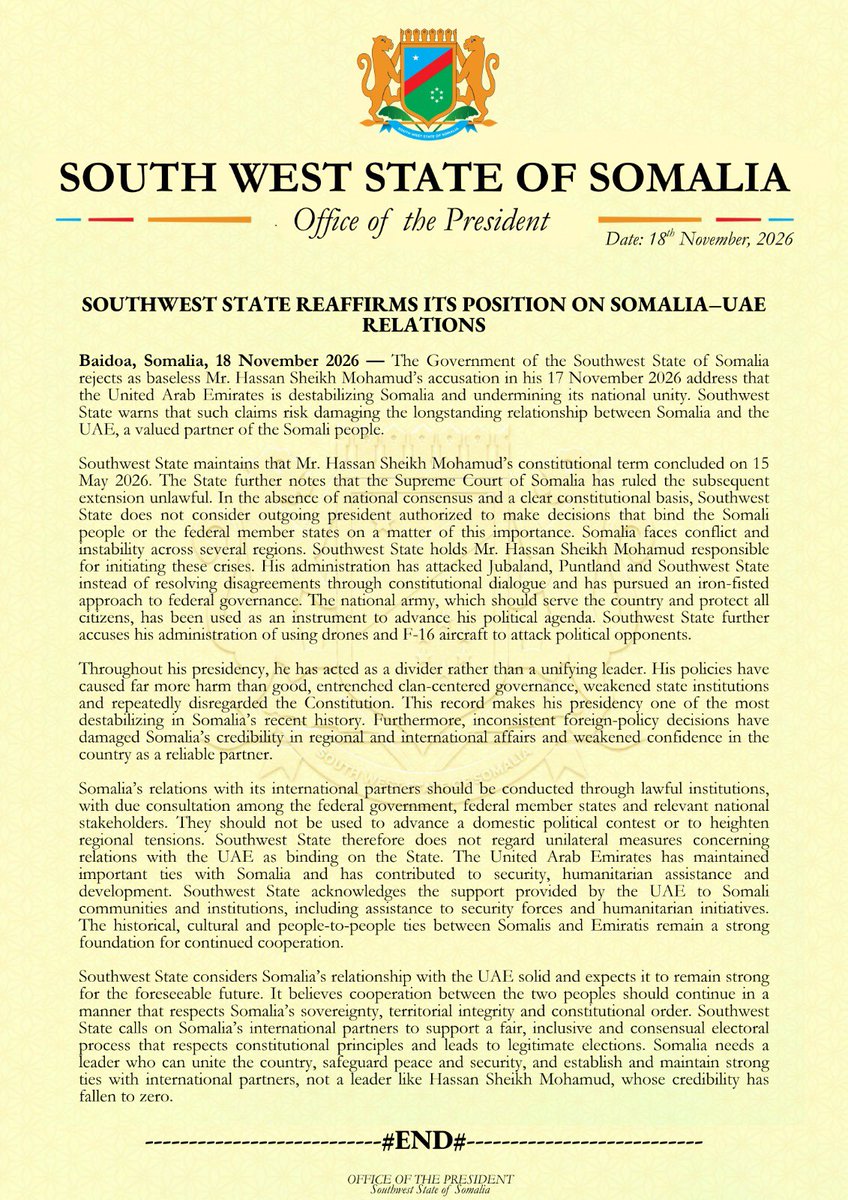
So Somalia is expelling UAE's Ambassador to Mogadishu for "interference in the country's internal affairs." I bet it ends up as another self-inflicted wound. Why doesn't Abu Dhabi reassign the Ambassador and open up an Embassy in Hargeisa? Much better!
https://t.co/cMKR6GMSGA
A failed and illegitimate president presiding over a failing state has no authority to lecture Somaliland on its relations with the UAE.
The UAE has invested in Somaliland’s development, including Berbera Port, roads, schools and vital infrastructure. We are grateful for this brotherly partnership and continued support.
Hassan Sheikh Mohamud should focus on putting his own house in order rather than commenting on Somaliland’s international partnerships.
The Mastermind Behind the Anti-Oromo Campaign Exposes Itself
Over the past several weeks, I have repeatedly warned that the clashes between two clans in Moyale were being exploited to transform a localized conflict into a broader Oromo–Somali, and potentially even an Ethiopia–Somalia, confrontation. I argued that the Eritrean regime, with the backing of its Egyptian allies, was seeking to open an eastern front against Abiy Ahmed by exploiting Ethiopia’s internal divisions.
One striking feature of this campaign has been that some of the most inflammatory rhetoric surrounding Moyale has come not from politicians and media personalities in Ethiopia, but from their counterparts based in Kenya. I have never considered this pattern coincidental.
My assessment was informed by several months of monitoring open-source information and clandestine political activities in Nairobi involving operatives linked to Isaias Afwerki’s regime. Now, Eritrea’s own ambassador to Kenya, Beyene Russom, has brought together some of the very politicians who have been working to inflame tensions surrounding Moyale. At this meeting, the ambassador reportedly brought the Moyale clashes, Ethiopia’s internal political divisions, and the dispute over Assab into the same discussion, even invoking the narrative of an alleged “Oromo supremacy” agenda. His own social media post confirms this.
The ambassador’s use of the term “Oromo supremacy” follows an established pattern of ethnic framing. It echoes Isaias Afwerki’s reference to the so-called “ideology of Orommuma” in his May 2025 speech, in which he linked it to Ethiopia’s political crises and Abiy Ahmed’s quest for maritime access. At the time, I warned, both publicly and in private discussions with Eritrean officials, that introducing this kind of ethnic framing into an already volatile political environment was setting the region on a dangerous path. Unfortunately, those warnings went unheeded. Instead, Asmara intensified its support for media outlets spewing hateful propaganda against the Oromo people.
What began as rhetoric from Isaias himself is now being amplified by his diplomatic representative in Kenya. The same ethnic framing is being extended to tensions surrounding Moyale—a localized clan dispute that should never have been allowed to escalate into an Oromo–Somali confrontation.
There should now be little doubt about the origins of the increasingly familiar narratives of “Oromo expansionism” and “Oromo supremacy,” peddled by a handful of opportunistic politicians and media personalities, or about who is sponsoring and amplifying them. The fingerprints of the Asmara regime are becoming increasingly difficult to conceal.
The ambassador’s intervention has brought into the open the very political agenda we have been tracking for months. Criticism of Abiy Ahmed’s government is entirely legitimate. But a blatant, coordinated anti-Oromo campaign designed to foment communal tensions and engineer a regional confrontation is an entirely different matter.
I once again issue a strong warning to the Eritrean regime and Ambassador Beyene Russom against abusing diplomatic positions and platforms to inflame ethnic tensions within Ethiopia. This strategy will not achieve what they hope. On the contrary, it risks backfiring by helping Abiy Ahmed rally support around a narrative of external threats and national sovereignty. Those seeking to weaken him may end up strengthening him instead.
As for the Oromo people, they have endured and overcome degrading campaigns waged against them from multiple corners for more than a century. They have survived far more organized and sustained attempts to undermine their identity and dignity. This latest hate campaign will be no different. It will not make a dent.