"The Treatment of Iran’s World Cup Team Exposed the West's and FIFA's Double Standards"
Iran’s captain was asked about LGBT rights. So, why then wasn’t the U.S. team captain asked about the U.S. bombing of the girls' school in Minab, asks @fbhutto ?
https://t.co/68qnQgYoTI
Iranian President Pezeshkian receives a hero's welcome in Pakistan
▪️Escorted into Islamabad by six Pakistani fighter jets
▪️ Honored with a 21-gun salute
▪️ Welcomed by ceremonial troops marching with flags held high
▪️ Received by PM Shehbaz Sharif and President Zardari
📍 BREAKING NEWS 🚨
Afghanistan Airforce has Decided to Buy HAL Tejas Aircraft from India. 🇮🇳🇦🇫⚡🇵🇰
According to some Reports, PAF Pilots are Extremely Happy about Afghan Decision, Hoping they'll Finally get a Chance to Face the "Hanger Queen" inside Afghan Territory...
وزیراعظم پاکستان محمد شہباز شریف نے اسلام آباد مفاہمتی یاداشت (Islamabad Memorandum of Understanding) پر بطور ثالث دستخط کردئے۔
اسلام آباد مفاہمتی یاداشت پر امریکی صدر ڈونلڈ ٹرمپ اور ایران کے صدر مسعود پزشکیان کے دستخط موجود ہیں۔
این یک سند تاریخی و پیامی از ایران مقتدر است: صلح در سایه احترام متقابل تحقق خواهد یافت.
جمهوری اسلامی ایران به صلح جهانی با حفظ عزت و استقلال، پیشرفت و همکاری منطقهای همواره متعهد و پایبند است.
I am honoured to announce that the historic ‘Islamabad Memorandum of Understanding’ has been electronically signed today between the United States of America and the Islamic Republic of Iran. The Memorandum has been signed by honourable Presidents of both the countries and also endorsed by me as the mediator. The signing of this agreement at the highest level of the respective governments demonstrates the commitment of both sides to a diplomatic resolution of the conflict. Islamabad MoU shall enter into force with immediate effect and as a first step, Islamic Republic of Iran will instantly reopen the Strait of Hormuz and the United States of America will immediately lift the naval blockade.
I offer my heartfelt congratulations and sincere appreciation to the President of the United States, Donald J. Trump whose steadfast commitment to diplomacy and preference for peaceful resolution have once again helped end a conflict that could have led to devastating consequences for the region and beyond. I also commend the dedication and tireless efforts of the United States negotiating team, including J.D. Vance, Steve Witkoff and Jared Kushner, for their invaluable contributions to this achievement.
I express my profound respect and appreciation to His Eminence Ayatollah Seyyed Mojtaba Hosseini Khamenei, the Supreme Leader of Islamic Republic of Iran and President Masoud Pezeshkian for their wisdom, foresight and statesmanship in embracing the cause of peace. I also wish to recognize the efforts of the Iranian negotiating team, including Mohammad Bagher Ghalibaf, Abbas Araghchi and Eskandar Momeni, whose patience, perseverance and commitment to constructive engagement were instrumental in bringing this agreement to fruition.
I would especially like to acknowledge the sincere efforts and constructive engagement of the leadership of the State of Qatar in helping reach this point. I also highly commend the leadership of the Kingdom of Saudi Arabia, the Republic of Türkiye and the Arab Republic of Egypt for their indispensable role and invaluable contributions in this regard.
I would also like to make special mention of Field Marshal Syed Asim Munir, whose tireless efforts, selfless dedication and instrumental role were critical in facilitating this breakthrough and advancing the cause of peace and regional stability.
May this Memorandum of Understanding serve as an enduring foundation for greater understanding, mutual respect and shared prosperity for the complete region.
@realDonaldTrump@JDVance@SecRubio@SteveWitkoff@SEPeaceMissions@drpezeshkian@mb_ghalibaf@araghchi
İran Devrim Muhafızları, Ürdün'deki Muvaffak Salti Askerî Üssü'nü hedef aldığını açıkladı.
Söz konusu üs, bölgede konuşlu ABD unsurlarına ve F-35 savaş uçaklarına ev sahipliği yapmasıyla biliniyor.
Doğruysa büyük iş...
Congratulations on the marriage anniversary of lady Fatima (sa) and Imam Ali (as)
A few days after the marriage of Imam Ali (as) and Lady Fatima (sa), the Apostle of God (pbuh) called on his daughter, and asked her how she had found her husband:
"She said that she found him the best companion in giving devotion and obedience to Allah (swt)."
Later, he asked Ali (as) how he had found his wife, and he said that "he found her the best companion in obedience to Allah (swt)."
📚 Bihar al-Anwar, Vol. 43, P. 117
When Imam #Ali ibn Abi Talib (as) married #Fatimah al-Zahra (sa), he owned very little wealth. One of the few valuable possessions he had was his armor.
The Prophet Muhammad (pbuh) advised Imam Ali (as) to sell his armor so preparations could be made for the blessed marriage. The money was used to buy simple household items, showing that the marriage of the greatest personalities in Islam was built upon faith, humility, love, and piety not luxury or material wealth.
It is narrated that the Prophet (pbuh) said:
“The best marriage of my nation is the simplest one.”
📚 Bihar al-Anwar, vol. 43
The story of the armor remains a timeless lesson: true value in marriage comes from character, faith, and sincerity not riches.
India's new strategic defence partnership with the UAE reflects a shift toward Netanyahu's "Hexagon of Alliances" comprising Israel, India, Greece, Cyprus, and the UAE. The stated aim is countering the "radical Shia axis" and emerging "radical Sunni axis," which is another way of saying encircling the Muslim world.
India has come a long way. After the Nehruvian era of alignment with Nasser's Arab nationalism and anti-imperialism, India developed a bilateral approach. It maintained ties with each state - it established Joint Working Groups on Defence with Israel in 2000 and also showed interest in Iran through the Tehran Declaration (2001) and Delhi Declaration (2003). During King Abdullah's 2006 visit to India, the Delhi Declaration (2006) and later Riyadh Declaration (2016) laid the framework for broader strategic ties with Saudi Arabia.
That is no longer the case. India has ended bilateralism for new alliance. This is driven by two factors.
▪️First, great power competition in the Middle East after China's increasing role in forging understanding between Iran and Saudi Arabia.
▪️Second, the growing anti-Muslim ideological underpinnings of Indian foreign policy, leading it to align with the UAE and Israel.
India is already Israel's biggest defence partner. Now it has signed a strategic defence partnership with the UAE for deeper defence industrial collaboration, training, exercises, and maritime security.
In an even bolder move, India will sign an energy deal where the UAE places 30 million barrels of oil in India's Strategic Petroleum Reserves and establishes a reserve for India in Fujairah, away from Hormuz. This means India will double down on UAE oil imports at the direct expense of Saudi Arabia, its second largest supplier after Iraq.
Beyond regional dynamics, this alliance is coordinating in multilateral forums. India and the UAE recently blocked condemnation of Israel at the BRICS foreign ministers summit in New Delhi. Given the strong ideological and material convergences among India, Israel, and the UAE, this relationship will only strengthen.
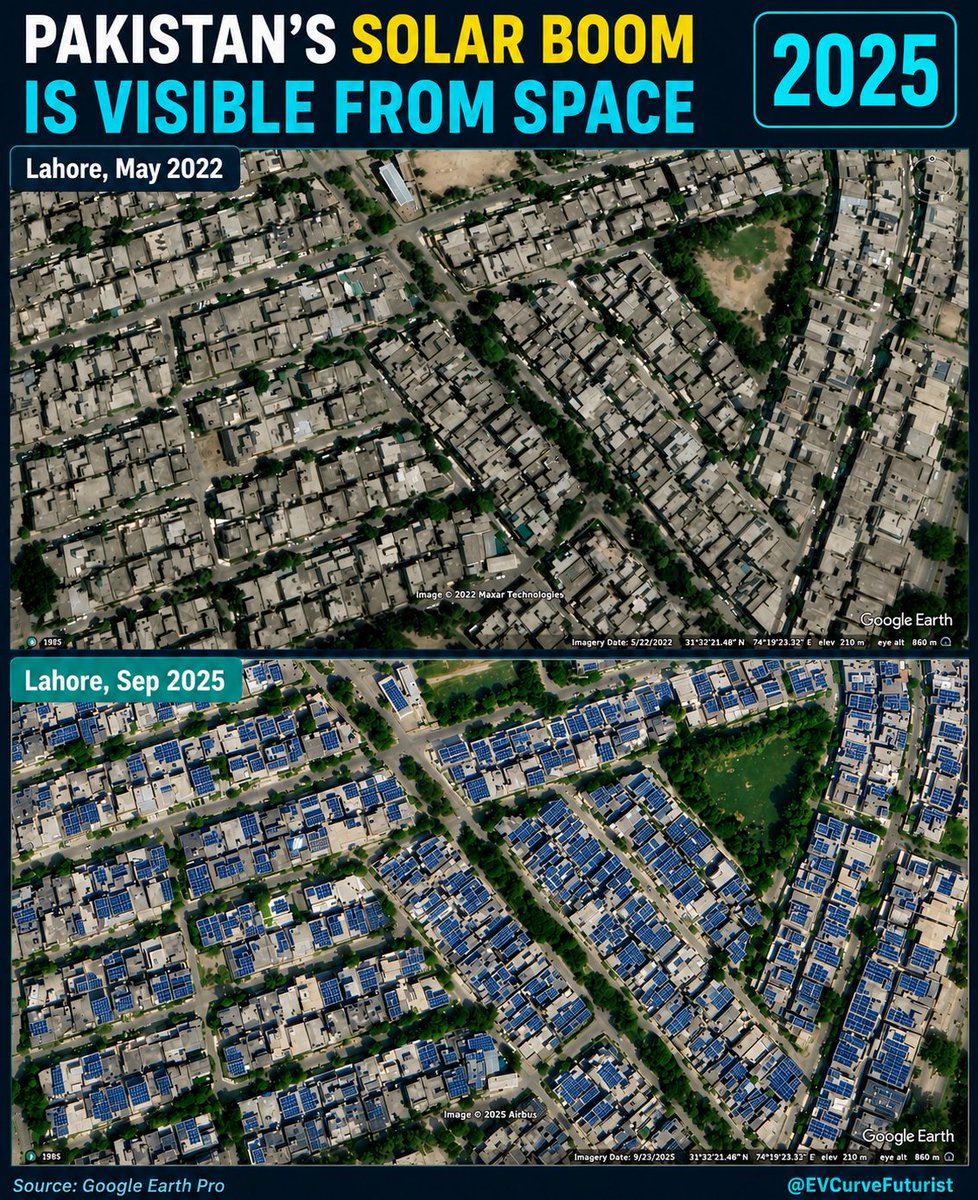
Pakistan may be accidentally building one of the world’s first decentralised #solar economies. The craziest part? Real scale barely shows in official stats. Imported 51.5 GW solar panels by late 2025—nearly = entire grid. Yet registered net-metered rooftop solar just 5.3–6.8 GW.
What makes this story so extraordinary is the speed.
In only a few years, Pakistan appears to have gone from a relatively minor solar market to potentially sourcing around a quarter of its electricity from solar once distributed generation is included.
👉 ~16.6–17 GW solar imports in 2024
👉 ~18 GW solar imports in 2025
👉 ~51.5 GW cumulative imports by late 2025
👉 Rooftop solar: ~1.3 GW → 4.1 GW in 2024
👉 ~5.3–6.8 GW registered rooftop solar in 2025
👉 24+ GW estimated behind-the-meter/off-grid
👉 Solar potentially ~25% of actual electricity use
The massive gap between imported panels and officially registered systems strongly suggests tens of gigawatts are now operating quietly on homes, farms, factories and businesses across the country.
This increasingly looks less like a normal energy transition and more like large-scale consumer-led grid defection.
And economics is driving nearly all of it.
Electricity tariffs surged. Diesel prices climbed. Blackouts remained common. Meanwhile ultra-cheap Chinese solar panels and falling battery prices made self-generation economically irresistible.
So millions effectively made the same calculation:
Generate your own power, or remain trapped inside an expensive and unstable system.
Once solar becomes cheaper than the grid itself, adoption can move faster than governments, utilities and even official statistics can keep up with.
This isn’t gradual transition by any stretch. It may ultimately become a blueprint for how energy-poor nations break free from legacy old-world energy systems dominated by fossil fuels and increasingly expensive centralised power.
It’s decentralisation at escape velocity.
This is #Bettrification.