Following up on yesterday’s $ETH call.
Yesterday, I said $2,750 and $2,800 were the key checkpoints before the higher targets could open up.
→ $ETH pushed to $2,788 before rejection and closed at $2,684.67, down roughly 2.5%.
→ Today, ETH has traded between roughly $2,630 and $2,700, with leveraged longs being flushed as the market digests last week’s rally.
This is the bear case from yesterday playing out, but the broader breakout structure has not been invalidated yet.
→ $2,626 to $2,672: immediate support zone
→ $2,550: deeper structural support
→ $2,800: major resistance
A clean daily close above $2,800 would strengthen the case for a move toward the $2,900 to $3,000 area.
But if $2,626 breaks decisively, the next downside zones become much more important.
So I’m not changing the thesis. The market is testing it.
$2,800 above.
$2,626 below.
Yesterday was the breakout.
Today is the test.
Watch the video for more
@pots_market@pots_money
https://t.co/V5pwVDh7cZ
ULTRA WALLET JUST OPENED ITS AMBASSADOR PROGRAM
If you’re already creating content on X, this one caught my attention.
Ultra Wallet is offering $10 USDT for every approved piece of content.
And this isn’t a one post and done campaign.
You can continue creating content, submitting it for approval, and earning $10 USDT per approved post.
How it works
→ Create quality content about Ultra Wallet
→ Publish it on X
→ Submit your post through the Ambassador Program
→ Get approved
→ Receive $10 USDT
→ Keep creating and submit more
But the ambassador program isn’t the only thing happening around Ultra Wallet.
The team says it has allocated approximately $100,000 USDT across rewards, user activities, fees and liquidity.
The current allocation
→ $5,000 for the Top 10 referrers
→ $1,000 for the Top 10 task participants
→ $40,000 for tickets and user rewards
→ $4,000 toward fees
→ $50,000 reserved for LT P2P liquidity
The team has also announced October 1 as the planned global launch date, with LT P2P trading planned to begin around the same time.
The idea is that users will eventually be able to trade LT against USDT through the P2P system. Public ecosystem posts also describe the P2P launch as planned for October 1.
So there are really two things happening here:
For users:
Mine LT → complete tasks → earn tickets and rewards → participate in the upcoming P2P ecosystem.
For creators:
Create → publish → submit → get approved → earn $10 USDT.
And because the ambassador program is not limited to a single submission, creators can keep producing content as long as their submissions meet the requirements.
If you’re already building an audience on X and creating Web3 content consistently, this is an interesting way to monetize content you’re already making.
$10 per approved post.
And with the October 1 launch approaching, there is more happening around Ultra Wallet than just the ambassador program.
Check cs for link
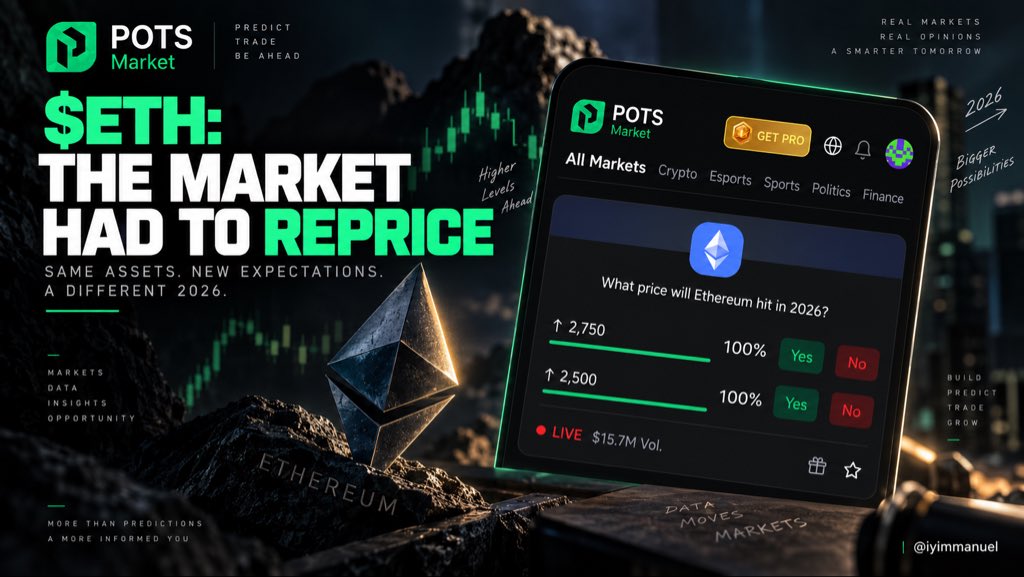
$ETH: THE MARKET HAD TO REPRICE
Market: “What price will Ethereum hit in 2026?” on POTS Market
Ethereum has had quite a journey this year.
ETH opened June around $1,988 before falling to roughly $1,512. For a while, the market was cautious around Ethereum, with price struggling to establish any meaningful upside momentum.
Then August changed the picture.
ETH started recovering, momentum accelerated, and the market began repricing Ethereum at significantly higher levels.
That is what caught my attention about this POTS Market.
Current POTS Market levels:
→ $2,500: 100% YES
→ $2,750: 100% YES
→ Volume: ~$15.7M
But there is an important detail here.
ETH has already traded above both levels.
So the interesting question is no longer simply whether ETH can touch $2,500 or $2,750.
The real question is:
→ Can ETH establish these higher levels as accepted prices?
→ Can the repricing continue beyond them?
That is where the chart gets interesting.
@pots_market@pots_money
The ride is only getting started. 🐓🏇
Horcecock is here to run with the community and take $RIDE where it belongs.
Don’t just watch the ride from the sidelines. Get your bag and ride with us. 🚀
@HorseCockcrypto
CA: 3S2MgR7v529qDCbB7ep5bk9YRCK13F5ASTjaFHTYpump
The Garden metaphor gets clearer when you look at the pieces together.
🌱 Seeds → Ideas
🌍 Soil → Community
🧠 Intelligence → AI
🤝 Connections → People and collaboration
🚀 Growth → Turning an idea into something real
MYCEL brings these together around an ecosystem built for creators. The site currently presents the Garden, Creators, AI and $MYCEL as parts of that ecosystem.
But here’s an important distinction.
@mycelgarden describes itself as an ecosystem in development. Some parts are already live, while Access, Rewards and Creator Economy are explicitly described as planned, not active yet.
So I wouldn’t look at this as a finished product with every piece already in place.
I see it more as an early framework for a different way of thinking about creation:
What if the tools, people, intelligence and community around an idea could exist in the same environment?
That’s the experiment.
One thing I particularly like about MYCEL’s positioning: it doesn’t frame AI as a replacement for creativity.
The project describes AI as something that can help creators:
→ Explore ideas
→ Structure their thinking
→ Develop concepts
→ Move toward execution
That distinction matters.
There’s a big difference between:
“AI, create something for me.”
and:
“I have an idea. Help me understand it better.”
The second approach keeps the human at the centre.
You still decide what matters. You still decide what you want to build. You still bring the taste, perspective and creative direction.
AI simply becomes another part of the process.
And when that process is connected to a network of creators and communities, it gets even more interesting. Because sometimes the thing missing from an idea isn’t another prompt.
It’s the right person, the right resource, or the right connection.
That’s the gap MYCEL is trying to explore.
Then there’s the Garden itself.
The name actually explains the philosophy pretty well.
MYCEL frames it around a simple idea:
Ideas are seeds.
Communities are soil.
Intelligence helps them grow.
Think about how most things actually get created.
Someone has an idea.
Someone else knows how to build it.
Another person understands community.
Someone else knows distribution.
Then you need feedback, collaboration, tools, and sometimes a completely different perspective.
Creation is rarely just one person sitting alone with an idea.
That’s why MYCEL’s AI × Creation × Network approach is interesting.
The creator brings the idea. AI helps explore and structure it. Other people contribute skills, feedback and connections. The Garden is meant to be the environment where those pieces meet.
So the network isn’t just sitting around the creation.
It becomes part of the creation process.
Here’s a simple example of what that looks like.
Imagine saying:
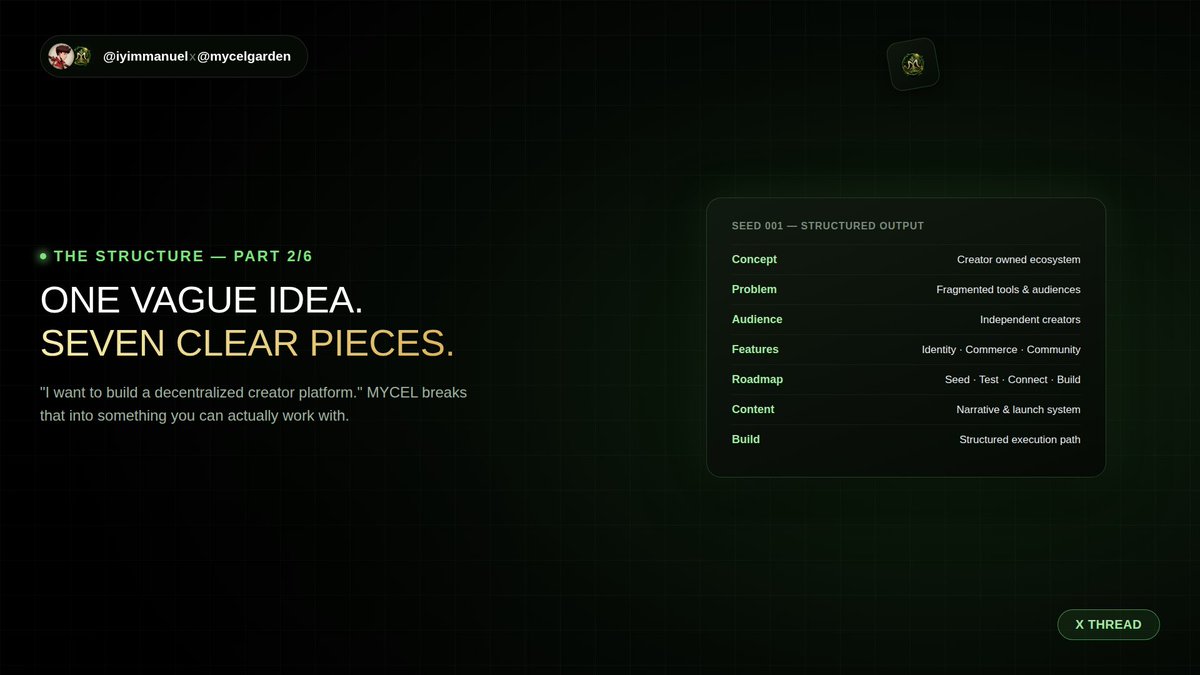
“I want to build a decentralized creator platform.”
That sounds like an idea.
But it’s still pretty broad.
MYCEL breaks that kind of thought into something easier to work with:
→ Concept: Creator owned digital ecosystem
→ Problem: Fragmented tools and audiences
→ Audience: Independent digital creators
→ Features: Identity, Commerce, Community
→ Roadmap: Seed, Test, Connect, Build
→ Content: Narrative and launch system
→ Build: Structured execution path
That’s the interesting part.
The original idea doesn’t disappear.
It becomes easier to look at from different angles. You can see what the concept is, who it serves, what needs to be built and how the pieces fit together.
So the value isn’t just AI generating something for you.
It’s AI helping you make sense of what you’re trying to create.
Most people have ideas.
The harder part is figuring out what to do with them.
You can have a clear vision in your head and still get stuck on the next questions:
→ What exactly am I building?
→ Who is it for?
→ What problem am I solving?
→ What should I build first?
→ Who do I need around me?
That’s the part of @mycelgarden that caught my attention.
MYCEL is built around AI × Creation × Network.
The idea isn’t to give creators another AI chatbot.
It’s about using AI to help people explore, structure and develop their ideas, while the creator stays at the centre of the process.
So instead of taking an unfinished thought and immediately asking AI to “make something,” the process starts with understanding the idea itself.
An idea first.
Structure next.
Creation after that.
That’s where the Garden comes in. 🌱
Making On Chain Money Make Sense
Your wallet knows everything you did.
But that doesn’t mean you actually understand where your money went.
A typical blockchain explorer gives you transaction hashes, contract methods, wallet addresses, logs and raw inputs.
Technically, the information is there.
Practically, it can look like this:
0x9f2c…c41a
method 0x38ed1739
logs 4
Now imagine trying to answer a simple question:
“How much did I actually spend this month?”
That is the gap @TSERAfinance is trying to solve.
TSERA describes itself as an on chain financial intelligence tool that reads wallet activity across seven chains and turns it into a financial statement you can actually understand.
Instead of making you decode the blockchain, it asks a much more useful question:
Where did your money actually go?
Steve, I had to cook something different for the #gamdom100k challenge 😂🎬
I honestly struggled with this one. From putting the concept together to getting the scenes right and especially the editing, this took me over 5 hours 😭
But I really wanted to put something together and get it out there.
Steve, I’d genuinely appreciate it if you could check this one out. ❤️
@stevewilldoit@gamdom@gamdom_beekay@kingadukes
Gamdom ID: 48211545
Username: Iyimmanuel
Hope this one catches your eye 👀
If you’re getting on Gamdom, use code “STEVE”.
Ever wondered why you can send money privately in the real world, but a blockchain transaction can leave a permanent public trail?
That’s where Zcash comes in. 🦓
Zcash is a cryptocurrency built with financial privacy in mind. It gives users a way to transact while having more control over what financial information is revealed publicly.
→ Why does financial privacy matter?
Think about your salary, the money you send to family, your donations, or simply what you spend every day. You probably wouldn’t want strangers knowing your balance, who you paid, and how much you spent.
So why should digital money automatically work that way?
→ What is a shielded transaction?
Think of it like putting your transaction inside a sealed envelope. The network can still verify that everything is valid, but the details can remain private instead of being exposed on a public blockchain.
That’s the simple idea behind @Zcash
Your transaction can be verified without making all your financial details public.
I put this into a simple visual story in the video below 👇
@ZcashIND
Creative is becoming a much bigger part of distribution than people realize.
• A good launch video grabs attention
• A strong concept makes people remember the product
• Great storytelling gives people a reason to share it
That’s what I like about what @unfair_so is building. The creative actually feels native to the internet instead of another polished startup ad.
And that last video 😂
The industrial revolution aesthetic, the bedtime story angle, the dialogue and the whole execution were so unexpected.
That’s the kind of creative that sticks.
Worth checking out: https://t.co/zpgG3ujXIB
Markets can make you think you understand price when you are really only seeing the result of a much larger process.
For a long time, I treated the price on my screen as the complete picture. If an asset was trading at $1, I assumed $1 was simply the price.
It is not that simple.
Underneath the price, there is a continuous auction happening between buyers and sellers.
Buyers place bids showing the highest price they are currently willing to pay.
Sellers place asks showing the lowest price they are currently willing to accept.
The difference between those two prices is the spread.
That small gap can tell you a lot about what it may take to actually execute a trade.
Here is the part that changed how I look at markets:
• Tight spread
A tight spread means the best bid and best ask are relatively close together. It can be a sign of an active market, but it should not be confused with order book depth.
• Wide spread
A wide spread means there is a larger gap between the best bid and best ask. If you want immediate execution, crossing that gap can increase the cost of the trade.
But spread is only one part of the picture.
Depth tells you how much liquidity is actually available at different price levels.
This distinction matters.
Imagine an asset is showing $1 on your chart. That does not automatically mean you can buy a large amount at $1.
If the available sell orders around $1 are limited, a larger market order may consume several price levels. Your average execution can then end up noticeably higher than the price you saw before placing the order.
That is where the difference between headline price and execution price becomes important.
And there is another detail traders often overlook:
The spread is not static.
It can change as market activity changes, as liquidity moves, around major news, or at different times of the day.
You have probably experienced the effect without thinking about the terminology.
You see a low cap trading at a certain price, hit market buy, and suddenly the average execution is nowhere near what you expected.
That does not automatically mean something went wrong.
It can be the result of the spread, limited depth and slippage interacting with the size of your order.
The practical takeaway is straightforward:
Before sizing a position, look beyond the chart.
Check the spread, check the available depth, and think about your expected execution.
The chart tells you where trades have taken place.
The order book gives you a view of what buyers and sellers are currently offering around that price.
The larger your order becomes relative to available liquidity, the more important that distinction becomes.
This is also why I like what @MEXC is doing with Opportunity Compass.
It is a five season, thirty episode global markets education initiative built around a simple idea:
“Know the Market, Know Your Opportunities.”
Episode 2, “How Global Markets Actually Work,” looks at the mechanics behind buyers, sellers, bids and asks.
If you are trying to become better at reading markets rather than simply watching prices move, this is the kind of concept worth understanding.
Explore the full Opportunity Compass here:
https://t.co/dUfXYwgO0M
Which market signal do you think traders most often mistake for liquidity, and what does that misunderstanding cost them in execution?
Educational content only…Not financial advice. DYOR.
I saw @treg_ai introduce Enrich Arena and had to test it myself.
I used Patrick Collison from https://t.co/X9wdMCp1Mx and Dharmesh Shah from https://t.co/tCX8sBf88r as my test entries, looking for their work emails with verification enabled.
What caught my attention was how the different providers handled the exact same requests.
Instead of choosing one enrichment provider and simply trusting that it will give you the best result, Enrich Arena puts 60+ vendors into the same arena and lets them compete on the request.
You can compare:
• Quality of the result
• Hit rate
• Speed
• Cost
In my test, Kitt returned results for both entries. One was marked valid, while the other was flagged for review. You can also see the cost and time associated with the results, while other providers can be used for entries that still need to be resolved.
That changes the way I think about enrichment.
The question isn’t necessarily:
“Which provider is the best?”
It becomes:
“Which provider is giving me the best result for this particular request?”
And that distinction becomes even more important when agents are doing this work at scale.
Why lock an agent into one provider when you have 60+ vendors with different prices, coverage and performance?
Give them the options.
Let the vendors compete.
Compare the outcome.
That’s what makes Enrich Arena interesting to me.
And this fits neatly into the bigger @treg_ai vision of giving agents access to a huge catalog of tools and providers through one interface, instead of having to manage a separate integration for every service.
I actually ran the test myself, and seeing the providers compete on the same data makes the concept much easier to appreciate.
Try it yourself:
https://t.co/kTGAd3dL3h
@treg_ai
BEFORE THE CATASTROPHE 🔥
$BTC with an absolutely insane PFP 😂
Pure Bitcoin meme culture with an apocalyptic twist. Let’s see what the community does with this one 👀
CA: 5tGZy2MaAc6szQNCLoy8cyZjnVpfbjHBm5n8SSsFpump
TG: https://t.co/52pdr1CMnz
You are super early 🚀🚀
I’ve been following @navaecosystem for a while now, and it’s good to see the product getting closer to the hands of more users.
Nava is building a social layer for Solana traders, bringing the social experience closer to the trading side of the ecosystem.
The Android version is now in closed testing, with the public launch expected after the 14 day testing period.
If you’re on Android, you can actually join the test, install Nava and try it out here:
https://t.co/ghhpOOlsAD
And the part I’m personally looking forward to most… iOS is also in active development. 👀
Can’t wait to finally get my hands on that version.
$NAVA | @navaecosystem
Just wrapped up another deep dive, this time breaking down @selectfdn & @tokenselect , how it works, and what makes the projects interesting.
I put together a detailed breakdown covering the key points and sharing my own perspective.
This is my entry:
[https://t.co/woXMIHSRvo]
Big thanks to @Kinguchee_e for creating the opportunity and putting this together for the community.
Now we wait for the results. Looking forward to seeing how it goes. 🫡
The Launch Is Only Half the Design.
What if supporting a token early didn’t mean your relationship with it ended when you sold?
Most token launches are built around one moment:
.Launch
.Buy
.Trade
But what happens to the people who helped get that project off the ground?
That question led me to @selectfdn and https://t.co/YTPzIKyvtq.
Select is building a launch system where early contributors can earn a share of trading fees for the life of a project.
But the fee sharing is only one part of the design.
The deeper idea is changing the incentives around how a community forms, launches and stays aligned.
Here’s how it works.🧵
Fuel Has a Risk Problem.
What happens when the price of something you literally cannot stop using suddenly jumps?
For most people, the answer is simple.
You pay more.
Fuel is one of those costs that can quietly reshape an entire budget.
A household has to spend more on commuting.
A delivery driver sees their margins get squeezed.
A business that depends on transportation suddenly has a much larger operating bill.
You cannot control global fuel markets.
You can, however, ask whether there should be better ways to manage the risk that comes with them.
That is where @HedgeEnerguq ($HED) enters the conversation.
They are building a decentralized fuel insurance solution on Solana.
Let’s break down what that actually means and why it matters.🧵