@tdkarnataka multiple 2 wheeler dealers are refusing BH registration for private employees in Bangalore. As per Karnataka HC directive private employees can also have BH registration for the vehicles.
₹19,000 crore.
That is what Banks collected in last 3 years just for not maintaining ‘Minimum Account Balance.’
Not from the rich. Not from big borrowers.
From the poorest accounts in the system.
Their crime? They didn’t have enough money.
A farmer misses the minimum balance - Penalty.
A pensioner withdraws money for medicine - Penalty.
A daily wage worker falls short by a few hundred rupees - Penalty.
The poor keep money in banks for safety. Not to be quietly fined for being poor.
Financial inclusion should protect small savings, not punish small balances.
In Parliament today I proposed ending minimum balance penalties so the banking system stops charging people for their poverty.
AI can replace everything except government jobs in India.
Govt jobs are not going anywhere in India. You have to wait at least several decades before it happens.
And it is going to be more lucrative after the implementation of the 8th Pay Commission.
Indian government offices are still apathetic towards technology.
Technology will eliminate or reduce the chances of corruption. ANd they cannot let it happen.
They will start lobbying against any changes. They want the status quo so that they can build their empires and loot common people.
It is safer to say that the integration of technology in Indian govt departments is not in sight in the near future.
In Parliament, I explained why India must put land & property records on BLOCKCHAIN.
Land records in India are in utter chaos. Ordinary citizens are made to run from pillar to post at registrar offices, while dalals and middlemen capture the system. Circle rates are exploited to fuel cash deals, property tax leakages continue, fake documents and encroachments multiply, and disputes over title never end.
The numbers tell the story:
• 66% of all India’s civil disputes are land disputes.
• 45% of properties lack a clear title.
• 48% are already under dispute.
• India ranks 133 out of 190 in property registration efficiency.
• Even a simple property sale can take 2 to 6 months. When disputes arise, civil courts take 7 years on average to resolve them.
• And 6.2 crore property documents are still pending digitisation.
That is why I argued in Parliament for a National Blockchain Property Register. Time stamped, tamper proof, fully transparent. It can make title verification instant, and ensure every sale, mutation and inheritance is recorded cleanly and traceably in realtime.
Countries like Sweden, Georgia and the UAE have shown what is possible. Transactions can finish in minutes, and dispute rates fall sharply.
India must move from chaos to clarity. From a land record system that creates obstacles to one that prevents them.
𝗣𝗮𝘁𝗶𝗲𝗻𝘁 𝗗𝗼𝗺𝗲𝘀𝘁𝗶𝗰 𝗖𝗮𝗽𝗶𝘁𝗮𝗹 must be 𝗥𝗲𝘄𝗮𝗿𝗱𝗲𝗱, 𝗻𝗼𝘁 𝗣𝗲𝗻𝗮𝗹𝗶𝘀𝗲𝗱.
I explained in Parliament how Investment in India remains heavily taxed, and why it needs to change.
In India, firms are being built JUST to IPO!
Example:-
If you had invested 400Rs in Nyakaa 4 years back, it would be 200Rs now.
Now that's not the bad part: the bad part is-- that along these 4 years, you would have NEVER been able to exit the stock profitably, if you bought at 400 levels.
So who was buying these stocks at crazy levels? Hard to exactly pin that data. But, a lot of it was bought by DIIs (domestic institutional investors).
Right now DIIs (mostly Indian mutual funds) have close to 25% ownership in Nykaa.
The game in India seems to be: Build a firm. Expand the valuation. And, sell it to Indian retail folks via Mutual Funds.
Nykaa is not the standout story: check Ola Electric, PayTM, Delhivery, PB FinTech, CarTrade -- I can go on and on.
Natural question: How are they buying these firms? well through your SIPs.
It is quite rich for us to call Bitcoin a "speculative" investment (it has delivered 78% returns in 1 year, 900% returns in 5 years).
But, tag such IPOs as sound investments-- and put public money (via SIP) onto it.
Everyone today is cribbing about Indian IT's lack of innovation. And, how they are glorified labour contractors.
But, innovation is not built in isolation.
You need an ecosystem to innovate.
- If someone today starts a Crypto or an AI firm,
there is no guarantee of a 24*7 power supply.
- Some state goons will raise their heads, gang up on you & make you close your office, due to your inability to speak the local language.
- IT survived in such an environment. And, exported to the world.
It is a story of resilience, which ended up powering many cities/houses in India. And, in a way contributed dramatically to the new "middle class".
It would find its place somewhere in the new tech ecosystem.
And, maybe with time: India might innovate on something else. But, the "wait" period is going to be painful. Not just for IT. But for India's economy.
Taxes are collected with a specific goal.
1) "Too much" taxes on roadways/highways should give you better roads
2) "Too much" taxes collected via stock markets should give you lower cost of trading/investing
3) "Too much" taxes collected via Swachh Bharat should make Bharat Swachh.
When these things do not happen, it is a breakdown. And, people should be held accountable.
But sadly: we as citizens shoot the messengers, who bring such facts to light.
And, therefore, we remain a "growing" economy, despite having extremely intelligent people.
Our people go and build other countries.
But, fail to build our own.
Is Thailand/Vietnam cheaper than India?
The answer is yes & no.
It depends on which "segment" you are comparing.
If you compare rural areas like Isan in Thailand to Villages in India, yes India is cheaper.
If you are looking to have roadside meals like Kachori/Samosa, again India would be cheaper.
But, the moment you go a level up: India becomes a lot more expensive.
Bangkok would be (on an average) 20% cheaper for a Middle class compared to Mumbai/Delhi.
Right from stays/eating out at mid-range restaurants, education etc.
Why? The reason is corruption.
If you run a homestay in India: you have to pay everyone right from panchayat to police. Same applies: if you run a restaurant or any small business.
Ultimately, this cost needs to be passed on to the end user.
This is the reason why: despite having 1/4th the per capita income of Thailand, the cost of surviving is almost the same (I'd argue even more!)
What is critical for the success of a startup - founders' skills or the macros?
I think it's a bit of both. You could be a great founder with excellent execution skills but still struggle in an unfavorable macro environment. Or, you could be an average founder benefiting from the economic momentum of your country and sector.
Every time I think about this, I realize how fortunate we have been in terms of macros, both as a country and through government initiatives. We've benefited from everything that the Government has done—starting with Aadhaar, increasing mobile penetration, Startup India initiatives, and the overall supportive startup ecosystem.
@AirIndiaX Flight I5 2992 delayed for over 2 hours from Bombay. Ground staff had no idea of the current status of the flight, they couldn't even confirm ETD. A very pathetic service.
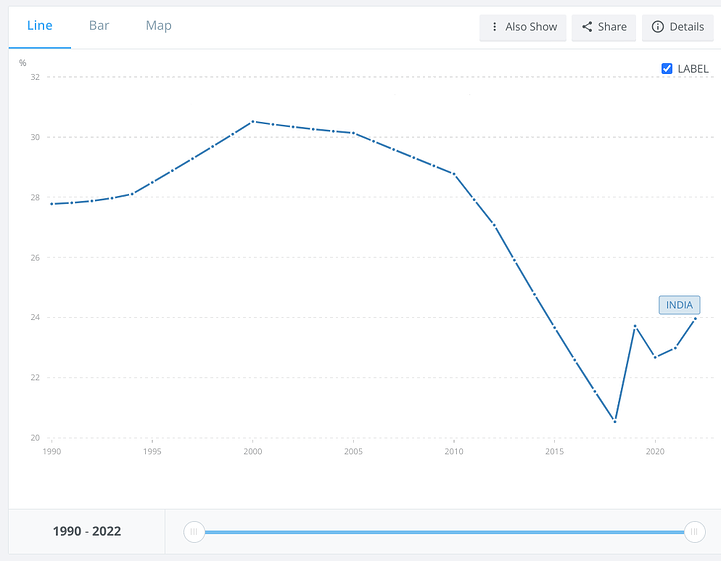
Empowering women to join the workforce is an obvious way to increase our economic growth. Our female labor force participation rate is among the lowest in the world.
One thing I couldn't make sense of is why our female labor force participation (FLFP), which was in the ~30% range in the 90s, fell to 20% and rose to 24%.
We have been discussing this topic on the @RainmatterOrg forum (Link in the next tweet), and Ashutosh from @IndiaDataHub shared something interesting.
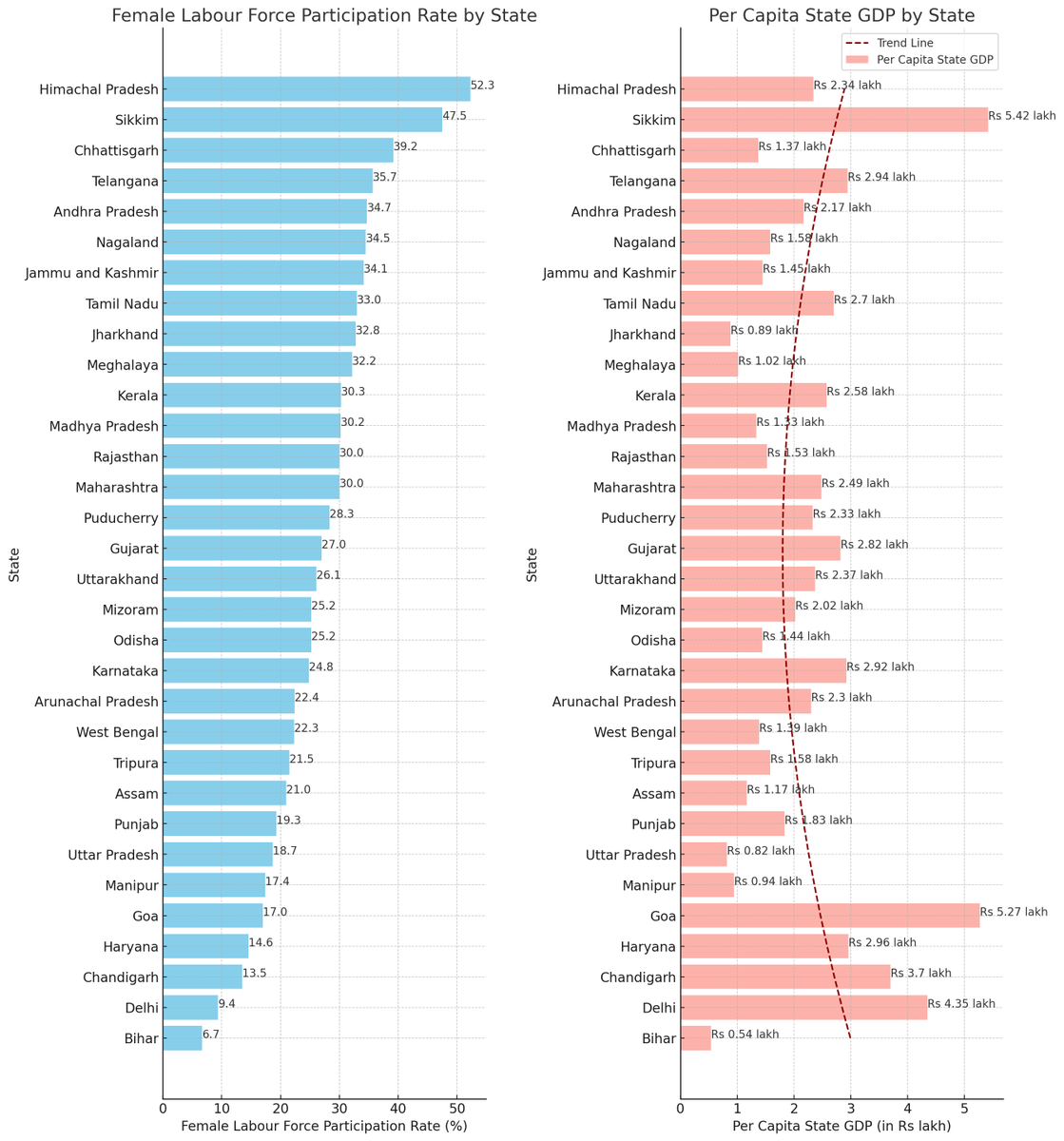
The relationship between female labour participation and per capita GDP tends to be U-shaped. This is because at lower income levels, a large part of female employment (and the same holds for children) tends to be distress or need-driven. As income levels rise, this distress employment reduces, and thus female labour participation declines. And then it rises as women enter the labour force again, not due to distress, but voluntarily.
Check the images, the U shape (of course, with exceptions) & the FLFP % dip from the 90's.