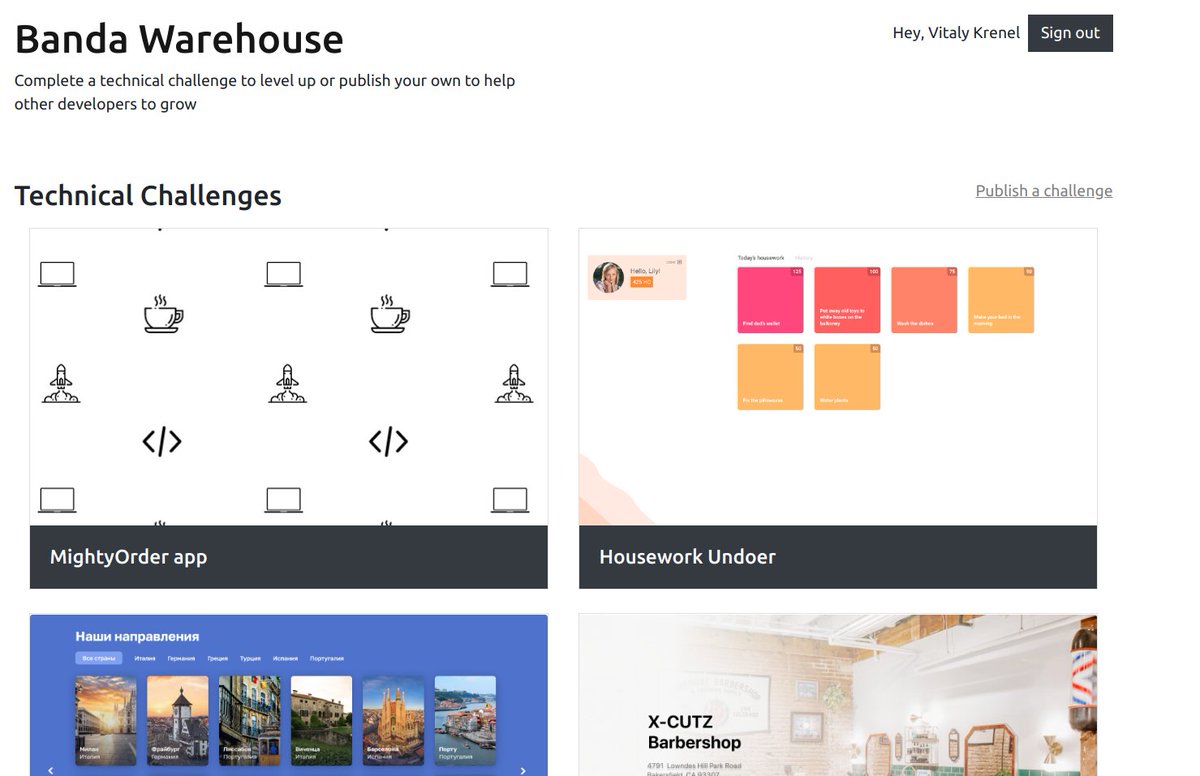
We are creating challenging projects for aspiring junior developers to help them get to the next level 🏹
Any webdev questions? Ask us using #BandaHelps!
Another question to #webdev / #100daysofcode mentors:
Do you create your own projects for your mentees to focus on a specific skill?
IMHO, many projects are designed to practice general/random set of skills - not something specific (i.e. async, architecture, tooling)
The question to #webdev mentors out there:
Do you use some platform for picking a project to use as a challenge for your mentees?
For example, I mentor a #js or #frontend junior dev - where I could find suitable projects for him/her? 🤔
Hey, fellow devs! We are making a place where any dev could share their project challenges or ideas to help other devs to hone their skills (like #js, #React, etc.) and level up
Hope, #100DaysOfCode crowds will find it a good source of practical projects ⚒️
What do you think?🤔
@NikolaR001 How about "Lean Startup" by Eric Ries?
https://t.co/YfKz8YsZl7
It's one of the most important books I've read so far on the question of building a product efficiently. I believe it's a valuable book for both entrepreneurs and software engineers.
@ChrisPiwinski Hey Chris! Could you share a little bit more info on the issue? Are there any JS on the project (and any errors in the DevTools Console)?
#DEVCommunity is there any #ReactNative mentor out there who has some spare time for a junior developer to help him master best practices of mobile development using React?
What really need is to be ready to invest a lot of effort. You need to be open and ready to admit your faults while encouraging your mentees to move forward.
And only then in return, you get self-improvement and growth covering both hard and soft sides together.
It's hard work for both.
So what does it take to become a mentor?
And no, you don't need to be an expert with 10 years of experience. It's good to have that, but that's not the requirement.
To summarize:
Track your progress. It encourages you when you are down, gives you feedback, and helps to be more intentional with your learning.
Also, find a way to publicly share your progress regularly - it's worth it, as you can see weak/strong sides and adjust your plan.
#BandaDaily #9 for self-learners:
Track your progress.
Doesn't matter whether you are just starting to learn #programming or mastering another framework. Find a way to track your progress.
🧵
Additionally, they reveal that the chances were even higher if the tracked results were publicly recorded.
E.g. if you commit to the #100DaysOfCode challenge and tweet your progress each day, you have higher chances of learning the #coding than just with silent practicing.