Privacy isn't about being 'shady.' It preserves the information asymmetry that makes strategic decisions possible. Transparent chains don't create fair markets - they make everyone maximally predictable.
Two trading agents on Ethereum see each other's full position history. They can't bluff, can't accumulate quietly, can't time exits without signaling. On Zano, neither knows the other's position, history, or strategy.
On Zano, there's no MEV because there's nothing to see. Pending transactions are private. Confirmed transactions are private. The mempool attack surface doesn't exist. Not because Zano 'solved MEV' - because it never created the conditions for MEV to exist.
MEV extraction on Ethereum runs into the hundreds of millions of dollars a year, all of it taken from regular users by bots exploiting transparency. 'Private mempools' and 'MEV protection' services are patches. The root cause is visible transactions.
What an AI agent actually needs from a blockchain: programmatic wallet access via JSON-RPC (not a browser extension), private transactions by default, and support for multiple confidential assets - real agents handle stablecoins, wrapped assets, and native tokens, not just
Time stamps:
00:01:09 Introducing Calin Culianu & Steve Thurmond
00:02:37 The Evolution of Bitcoin Cash
00:03:59 Who is Behind Bitcoin Cash Now?
00:06:34 Narratives and Misconceptions
00:07:53 Vlad's Perspective on the Fork
00:09:44 Bitcoin's Capture and Speculative Nature
00:11:48 Vlad's Journey with Lightning Network
00:16:07 Blockstream and the "Banker" Conspiracy
00:18:33 The Security Budget Debate
00:22:12 The Problem with IOU Systems like Lightning
00:24:02 Vlad's Disappointment with Onboarding
00:24:58 Ethereum's Rise Amidst Bitcoin's Infighting
00:27:52 The Bankers Won, But Crypto Still Exists
00:32:16 The Future of Bitcoin and Firing Core Devs
00:33:08 The Wall of Consensus in BTC
00:39:19 The Multi-Coin Future
00:42:48 Bitcoin Cash's Development Philosophy
00:49:08 Craig Wright's Controversial Involvement
00:55:16 The Impact of Contentious Forks
00:58:55 The Resilience of Bitcoin Cash
01:02:32 The Value of Open Source Competition
01:08:51 Greg Maxwell's Influence
01:12:00 The Ecash fork
01:25:02 Introducing New BCH Community Members
01:26:38 Building Smart Contracts on Bitcoin Cash
01:34:06 Why UTXO is Better than EVM
01:40:07 Can You Run a BCH Node?
01:41:07 The Flawed "Run a Node" Narrative
01:53:27 The Dangers of RBF and the Importance of 0-Conf
02:05:07 One-Minute Blocks Proposal
02:08:02 Finality and User Experience in Wallets
02:12:13 The "It's Just Money, Bro" Philosophy
02:41:39 What Can You Buy with BCH?
02:48:28 The Permissionless Nature of BCH
02:52:12 The Paradox of Layer Twos
02:57:18 The Stigma of Building on BCH
02:58:21 The Changing Culture of Bitcoin Cash
03:11:35 Ordinals and the "Spam" Debate
03:17:07 Would BCH Still Have a Nice Dev Culture If Michael Saylor Started Buying?
03:28:14 Quantum Computing and Satoshi's Coins
03:42:59 The Tail Emission Debate
03:50:11 The Culture is the Ultimate Defense
03:53:16 The Politicization of Bitcoin Development
03:59:26 Privacy and Fungibility
04:02:21 The Future of Privacy on BCH
04:36:12 Fulcrum: An Electrum Server Implementation
04:38:54 The Litecoin Question
04:49:13 The Difficulty of Recreating Bitcoin's Genesis
04:51:38 The Long-Term Bet on SHA-256
04:54:12 A Break and Introduction to Rosco
05:48:33 CashScript and Smart Contracts on BCH
05:55:22 BCH vs. Ethereum Smart Contracts
06:03:05 The UTXO Stack and Abstraction Layers
06:43:30 The Avalanche Pre-Consensus Question
06:45:51 The "Tax" Fork
07:04:06 The Failed Attack on Bitcoin Cash
07:08:58 The 2018 Inflation Bug Disclosure
07:22:46 The Michael Saylor Phenomenon
07:28:41 The Arrest of Roger Ver
07:39:28 Spending Crypto in the Real World
07:44:22 The End of Crypto-Friendly Spaces in Europe
07:52:05 Prediction Markets and Community Sponsorship
08:08:17 Robin Linus is Jealous of BCH Opcodes
08:09:50 Final Thoughts and Conclusion
Do your own research, test small, and understand the incentives.
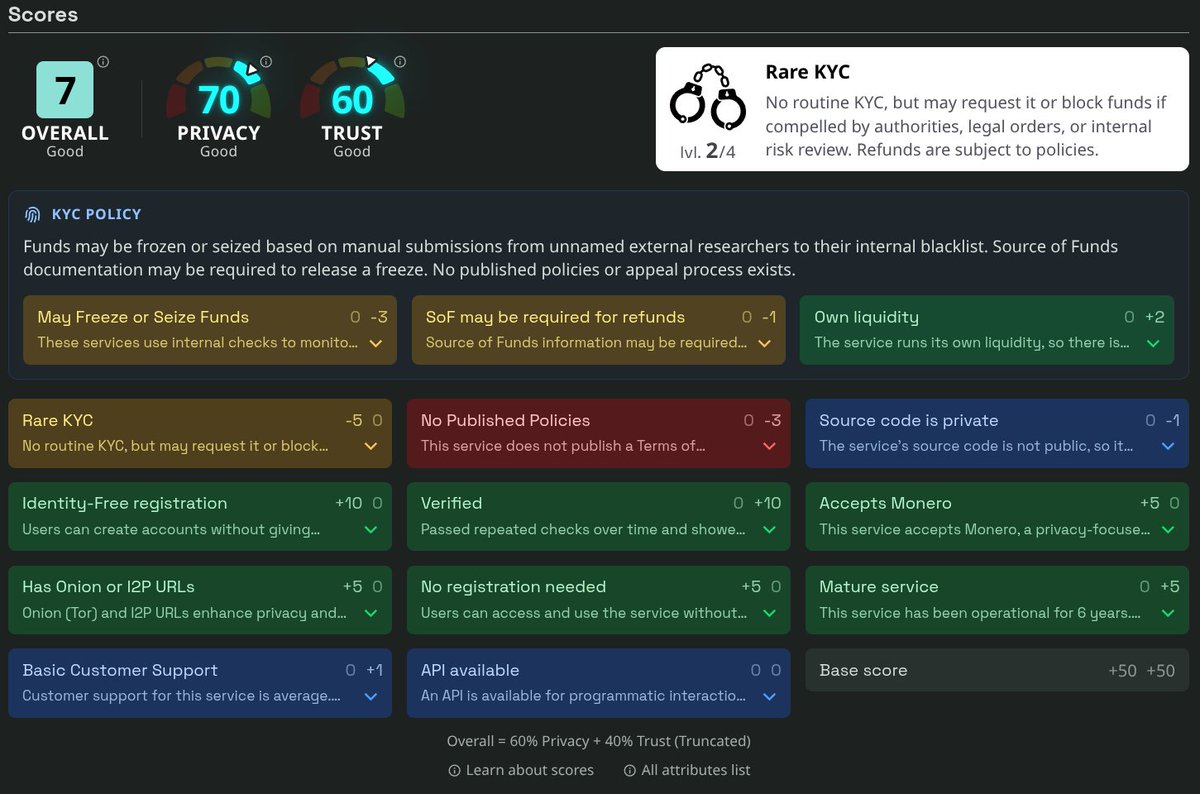
Check KYC policies, ToS reviews, and more on https://t.co/5u3bbp5aC2 to help you make informed decisions.
4/ Through Zano’s Confidential Layer, Bitcoin can now exist privately as BTCx. Same Bitcoin value, but with confidential and untraceable transactions powered by Zano’s privacy infrastructure.
Today, you can buy pizza with private Bitcoin. 🍕
3️⃣ The Zano Lite Wallet BETA is now live 🔥
One of the biggest barriers to using privacy blockchains has always been syncing the full blockchain first.
Now users can: • Connect to remote nodes • Skip full sync • Start using Zano instantly • Access desktop privacy with a lightweight experience
This is honestly massive for onboarding, especially in regions with poor internet access.
Full node wallets matter for decentralization. Lite wallets matter for adoption.
Now Zano has both.
Every transaction burns a small fee. More usage means more deflation. That's the mechanism. Not a marketing gimmick, just math.
$60M cap at $11.68
Got a Zano alias?
#Zano $ZANO #PrivacyMatters#Altcoins
The Zano Lite wallet BETA is live 🔥
The biggest barrier to trying any privacy blockchain has always been the same: sync the full blockchain, wait hours, and only then can you start using it.
The Zano Lite wallet connects to a remote node instead of running a full node. No full blockchain sync. No technical setup. The same mobile wallet experience, now on desktop.
What you get:
🔹 Connect to a remote node and skip the full sync
🔹 Full privacy-by-default on every transaction
🔹 Send, receive, and manage your assets
🔹 Zano Companion extension support built in
🔹 Available on desktop alongside the full node wallet
This is a beta release. We encourage everyone to try it alongside the existing wallet and share feedback.
Full node wallets are important for decentralization. Lite wallets are important for adoption. Now Zano has both. 🔒
I have friends* who got psyoped into believing that using Bitcoin is evil
They only use it to open Lightning channels or consolidate UTXOs, but feel deeply ashamed of it every time
Which is fine and dandy, except that Lightning & Liquid don’t pay the miners
And the miners can one day decide to break the L2s for being incompatible with the network’s incentives
We’ve entered the 2nd half of the 2020s, but bitcoiners still worship solutions from the 2010s that were just good enough for a while but never completely solved the scaling problem
*I still consider them my friends, even if they insult me in ways I would never do to anyone