@Shirink_13 “August 2017 Kha Maung Seik Massacre: According to an investigation by Amnesty International, fighters from the Arakan Rohingya Salvation Army killed up to 99 Hindu men, women, and children across the villages of Ah Nauk Kha Maung Seik and Ye Bauk Kyar.” Do you know ARSA?
ICJ Judgment on the Rohingya case.
I had myself concluded provisionally in the context of the ICJ Judgment that the 9 in favour were right and the 6 were wrong, But now that I have had a chance to study the texts, I am no longer so sure. Indeed, I find myself sitting firmly on the fence, supporting a "not proven" notional verdict available in Scottish law until 1 January 2026.
Even so, the ICJ Judgment will send the strongest possible message to Myanmar that the repression and victimisation of the Rohingya community is not acceptable. To that extent, the ICJ Judgment is to be welcomed, if it can achieve a creative and positive response both in Myanmar and internationally.
What has persuaded me to change my provisional view is that there is something not quite right about the judgment, evident in the manifest bias in elements in the section "Historical treatment of the Rohingyas in Myanmar", notably Paragraphs 134-142 on citizenship. I have the strong impression that the narrative has been politicised. Here are some examples taken from the section on citizenship:
134. "The Rohingyas have been present.... for generations".
Not true. Two or three generations, but no more. The term "Rohingya" was only concocted around 1960. Before that date, Rohingyas were known by other names. The old settlers (only) called themselves either Rooinga (Buchanan 1799) or Rwangya (post 1945), or Kaman, or Myedu. The bulk of today’s Rohingya (80%) are descended from Chittagonian and other Bengali migrants during British rule, mostly after 1870, and called themselves Chittagonians, or Bengalis if they came from further afield. Other designations were also used such as “Zerbaidi” for descendants of mixed Muslim-Buddhist marriages in Arakan and elsewhere.
135. “In the nineteenth and twentieth centuries, during the British colonial period, a large number of Muslims from present-day Bangladesh also immigrated to modern Rakhine State.”
With respect, “a large number” is not good enough when you can be very precise about actual numbers from the 1921 and 1931 Censuses and the 1941 Baxter Report on Indian Immigration. The extent of migration into Arakan during British rule is examined in detail in Chapter VII of Baxter. According to Baxter, immigrant Chittagonians and their descendants numbered 186,327 at the 1931 Census, and other immigrant Bengalis and their descendants 15,585, making a total of 201,912. Indigenous Muslims and their descendants, according to the 1931 Census - there are no details in Baxter which was concerned only with Indian immigration, not indigenous and long-settled migrants - had risen from 25,955 in 1921 to 56,963 in 1931 [51,612 “Arakan Muslim”, 2,670 “Kaman” and 2,681 “Myedu”].
That is, of 258,875 Muslims enumerated in the census in Arakan in 1931, no fewer than 77.99% (nearly 80%) came from Bengal during the latter part of British rule.
136. “The record shows that in the period after independence in 1948, Rohingya were treated as part of the polity of the Union of Burma…..”
Not true. The statement is anachronistic. The term “Rohingya” did not emerge until around 1960, a concoction dreamt up by Muslim ideologues. The main, isolated source quoted by the ICJ is a 1961 speech made by Brigadier-General Aung Gyi during a ceremony marking the surrender of Mujahadin insurgents. Yet you will search in vain in the archives of Burmese legislation from 1948 to 2026 for any reference to “Rohingya”. In the Civil Code and Penal Code, in primary and secondary legislation, in censuses, regulations, protocols and all other legal instruments, you will not find a single reference to any ethnic minority known as “Rohingya”.
137. “In 1982, Burma adopted a new citizenship law which established three types of citizenship, namely “citizen”, “associate citizen” and “naturalized citizen”…..
This statement omits a very important provision of the legislation, which is that the division into three categories of citizenship was only a transitional arrangement, and that by the third generation (grandchildren) there would be only one type of citizenship, namely full citizenship. General Ne Win made this point repeatedly in his 8 October 1982 speech setting out the government’s intentions in the new law.
https://t.co/DdBb9c9Ici
Clearly, naturalized citizens were most unlikely to belong to any of the 135 individual ethnicities, while Article 6 of the 1982 Law stated that anyone who was previously a citizen (that is, the vast majority of Arakan Muslims) retained their citizenship.
141. “Officially and unofficially, ‘Bengalis’ in Myanmar have been characterized as illegal immigrants or foreigners.”
Not true, The Judgment quotes not a single source for the assertion that “Bengalis” have been officially characterized as illegals. On the other hand, on 11 July 2012, President Thein Sein made it crystal clear that “third” generation Bengalis who migrated to Arakan during British rule were entitled to Burmese citizenship, the implication clearly being that they migrated legally.
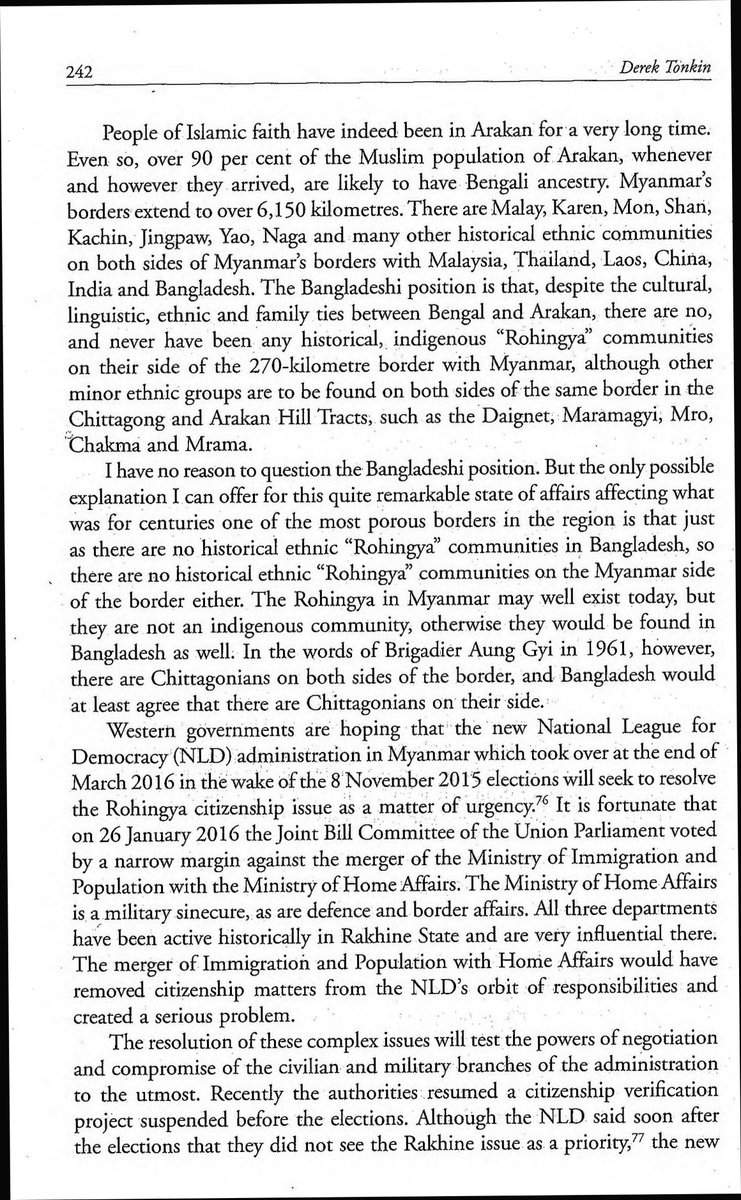
Attached are extracts from an article I wrote in the 2018 publication “Citizenship in Myanmar” (which was, I only recently discovered, one of the documents submitted to the ICJ by the Myanmar side). A later very slightly revised version of the article (not affecting the pages attached) is at:
https://t.co/EjuQfP6ViV
With respect, a public statement by a Head of State carries more weight than an unsupported statement by even such a distinguished body as the ICJ.
*******
We might well ask ourselves how in the future the ICJ can protect itself from being seduced by activist bias and misinformation. As it is, the Judgment is politically contaminated.
@DerekTonkinUK Nowadays, with enough money and lobbying, the truth can easily be buried. I’m not saying the judges took bribes, but they certainly set up the exact political game that certain politicians wanted to play.
@chawchimchim Nobody cares about Myanmar's innocent civilians; they only care about the Rohingya. just remember this case is from 2017, so if punishment is enforced, both the civilian President and her will be implicated. If they cared about you, they would have helped before anything happened