The political economy of sugar-sweetened beverage taxation in Latin America: lessons from Mexico, Chile and Colombia | Globalization and Health. Our paper is out! @AdamKoon @helenwalls @profplum8 @ProfRichSmith https://t.co/7rgrkCz7NR
NEW PAPER OUT!! 🔥 First-food systems transformations & the ultra-processing of infant & young child diets. A key driver of the global rise in milk formula consumption, among others, is the globalization of #BigFormula & its marketing practices #CDOH#IYCF
https://t.co/3bRHE8CtjL
If we want healthy and environmentally sustainable food systems, we need to recalibrate corporate power. How to do it? Lessons from Access to medicines, Tobacco control and the Divestment movements. New paper here https://t.co/s37HasskGB @ncdalliance@PHMglobal
Great new research on #commercialdeterminants#foodsystems
Ultra‐processed foods and the nutrition transition: Global, regional and national trends, food systems transformations and political economy drivers https://t.co/6cseg93zaF
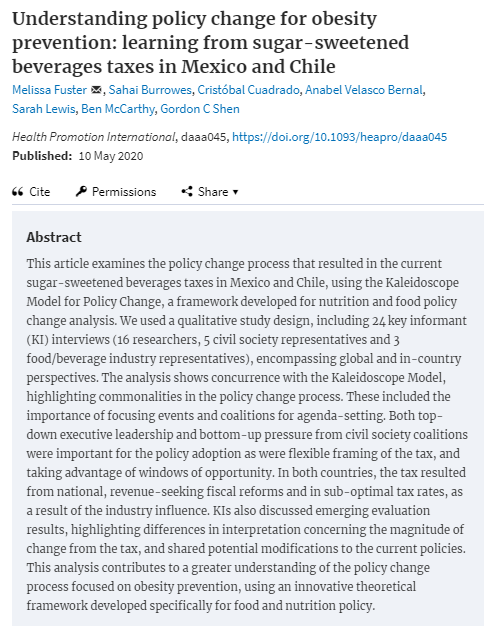
What enabled Mexico & Chile's #SSB taxes? Excellent analysis by @MelissaFuster et al finds: top-down leadership + bottom-up pressure from civil society; flexible framing; focusing events & policy windows during fiscal reform; evaluation evidence; overcoming industry resistance 👏
New study shows strong dose-response association between intake of ultra-processed foods and obesity in a representative sample of the UK adult population. Refutes findings of earlier study used by the food industry to deny link between UPFs and obesity https://t.co/I4mJEgg8yW
Chile was the first country to mandate front-of-package warning labels, restrict child-directed marketing & ban the sale in schools of all “high-in” food and beverages. The result? @lindseypsmith & colleagues found that sugary beverage purchases ⬇️ by 24%. https://t.co/9p5nAVyuV9