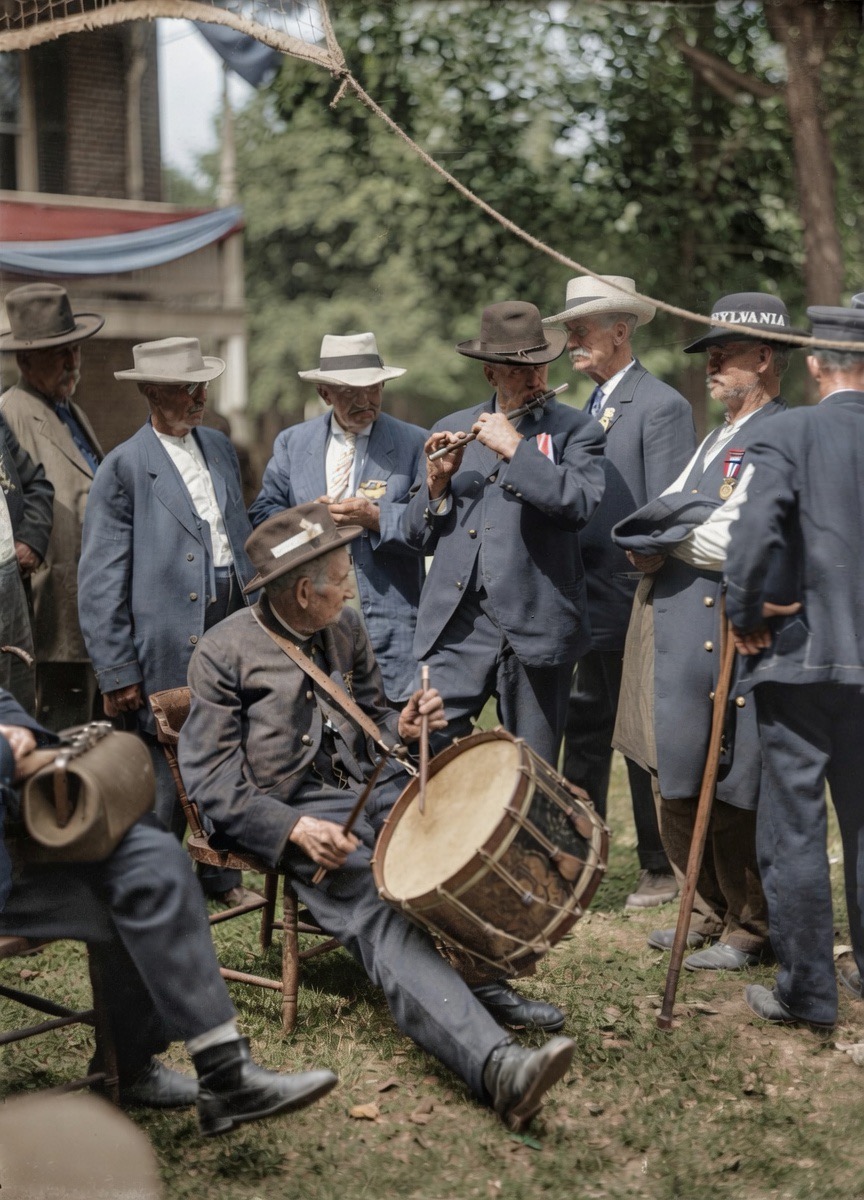
🇺🇸 1913 Gettysburg 50th Grand Reunion
Pickett's Charge once more! Members of the Pickett's Division Association walk across the field.
Approximately 120 of their members made it to the reunion.
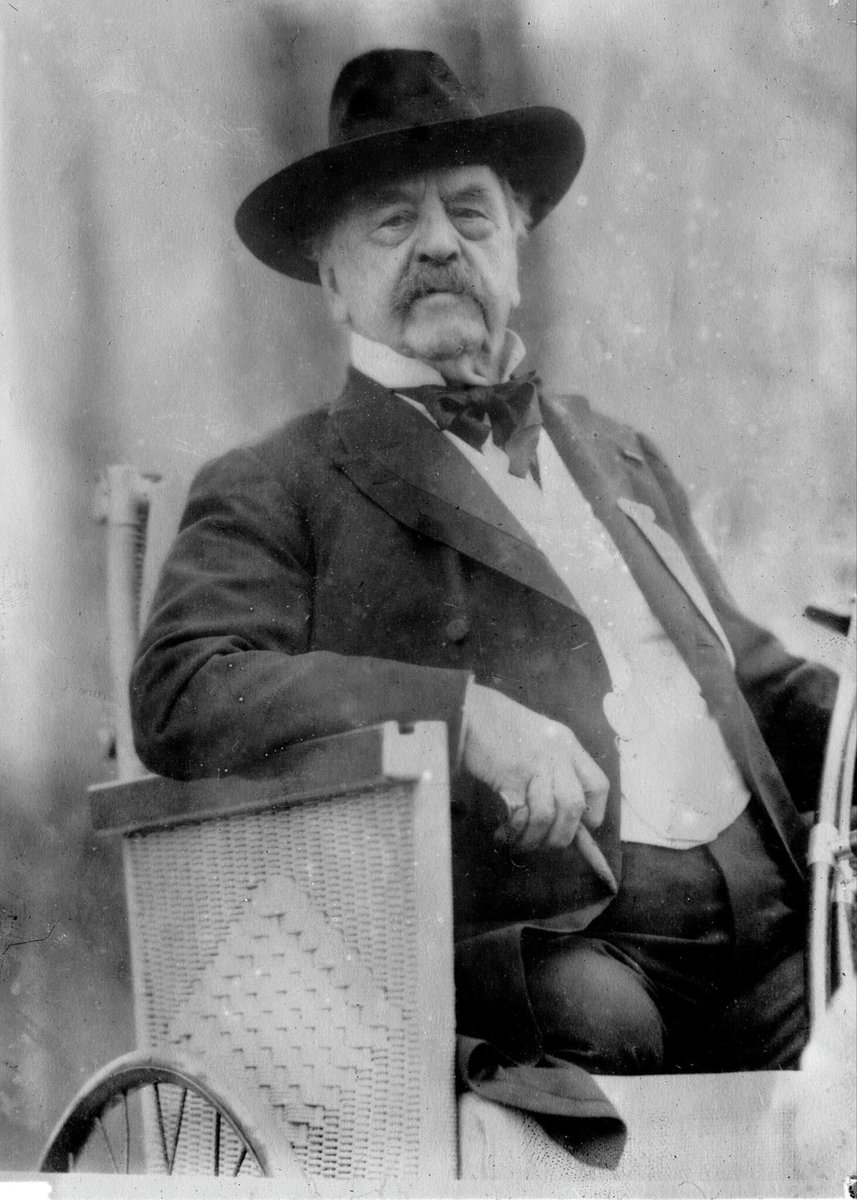
I think I decided I’m done posting about Sickles. He creeps me out and I don’t want him on my page anymore. I had more on him but I just can’t. Look him up if you want to learn more about his ways. Sorry to everyone
🇺🇸 Daniel Sickles seduced Queen Isabella II of Spain.
It earned him the nickname “The Yankee King of Spain."
President Grant appointed him ambassador to Spain in 1869. His core objective from the State Department was to negotiate the American acquisition or annexation of Cuba.
Sickles had other plans and did his own thing. Kinda like at Gettysburg.
He ended the affair by marrying one of the Queen's personal assistants, 23 year old Caroline de Creagh, in 1871.
They lived together in Paris and had two children, Eda and George Stanton.
In 1879, Sickles decided to return alone to the United States, leaving Caroline and the children behind in Europe.
They remained ‘married’ until Sickles' death in 1914.
🇺🇸 Feb. 27, 1859, New York Congressman Daniel Sickles shoots his wife’s lover dead in Lafayette Square, in broad daylight, steps from the White House.
The victim: Philip Barton Key II, son of Francis Scott Key, author of the Star-Spangled Banner, and U.S. Attorney for Washington.
Sickles told Key before he shot him "Key, you scoundrel, you have dishonored my home; you must die"
Then, at his trial, Sickles becomes the first person in U.S. history to be acquitted of murder using a temporary insanity plea.
He walked completely free!
One of his defense lawyers? Lincoln’s future Secretary of War, Edwin Stanton.
🇺🇸 1913 Gettysburg 50th Grand Reunion.
A Confederate and Union veteran shake hands across the stone wall at the site of Pickett’s Charge.
Old soldiers who had once tried to kill each other.
This was a popular spot as it sat right next to the tent city.
That is the Bryan Farm in the background, which would put this just north of the Copse of Trees/Angle on current Hancock Ave.
🇺🇸 General Joshua Chamberlain returned to combat after his Petersburg injury.
He got shot, again.
It was at the Battle of Lewis's Farm on March 29, 1865. A bullet tore through the neck of his horse, Charlemagne, and hit a pocket mirror (containing a picture of his wife Fanny) and a Bible in his chest pocket. The impact flattened the bullet, deflecting it entirely around his ribcage and out his back under his skin.
The blow knocked the horse to the ground and threw Chamberlain from the saddle.
He lay in the mud, soaked in blood and momentarily unconscious. Seeing their leader down, his troops began to break and retreat.
When he woke up, he was surrounded by Confederates who couldn't recognize his shredded, bloody, and muddy uniform.
Thinking quickly, he bluffed them by pretending to be a Confederate officer and ordering them forward against the Union lines. The ruse worked just long enough for him to escape back to his own men.
He remounted his wounded horse and helped rally his men for a counterattack.
Just two weeks later, Grant selected him to receive the formal surrender of Confederate arms at Appomattox.
🇺🇸 Joshua Chamberlain experienced the ultimate surreal moment: reading his own death notices.
Because his Petersburg wound was assumed mortal, word quickly spread to the home front. The military leaked his "death," and outlets, including newspapers in Maine, rushed the news into print.
Weeks after surviving surgery, a recovering Chamberlain sat up in bed and read the printed accounts of his own passing.
The papers had to run clarifying updates later to correct the mistake.
George Patton’s grandfather, George S. Patton Sr., was also killed in the Civil War.
George Sr. is buried in the exact same grave as his brother, Waller. Their shared monument reads:
"Here lie asleep in one grave. THE PATTON BROTHERS."
As commander of the 22nd Virginia Infantry, he was shot in the leg and mortally wounded on September 19, 1864, at the Third Battle of Winchester.
George Patton’s great Uncle was killed at Gettysburg.
Colonel Waller T. Patton commanded the 7th Virginia Infantry which was in Kemper’s Brigade, Pickett’s Division.
During Pickett’s Charge, part of his jaw was blown off by an artillery shell fragment. He died on July 21 at a makeshift hospital at Pennsylvania College (now Gettysburg College).
Waller’s first cousin, Lewis B. Williams Jr., was also killed at Pickett’s Charge. He was thrown from his horse by an artillery shell and landed directly on his own sword, mortally wounding him. He died that day.
🇺🇸 Most Badass Celebrities: Combat Veterans Edition #2 James ‘Jimmy’ Stewart
Jimmy Stewart, famous for starring in It’s a Wonderful Life, was a World War II combat veteran and retired U.S. Air Force Brigadier General.
He was already a major Hollywood star and recent Academy Award winner when he enlisted in the U.S. Army on March 22, 1941, months before the United States entered World War II.
Stewart was determined to serve in combat rather than accept safe stateside or promotional assignments.
With over 400 hours of civilian flying experience, he earned his pilot wings and quickly rose through the ranks.
He went from private to full colonel in roughly four years.
In the fall of 1943, he deployed to England as commanding officer of the 703rd Bomb Squadron, 445th Bomb Group, flying B-24 Liberator heavy bombers.
He flew 20 combat missions over Nazi-occupied Europe, often serving as a lead pilot.
He was known for volunteering for tough missions and for his calm leadership under fire.
On one mission in February 1944, his B-24 was struck by flak, which blew a large hole in the fuselage directly beneath the flight deck. Despite the damage, he and his crew brought the heavily damaged aircraft back to base.
When the plane landed, it essentially broke in half like an eggshell.
Stewart and the entire crew climbed out of the wreckage without a single scratch.
As he stood on the tarmac looking back at his plane, a ground crew sergeant ran up to him. Stewart looked at the wreckage and remarked:
“Sergeant, somebody sure could get hurt in one of those damned things.”
Stewart was promoted to operations officer of the 453rd Bomb Group and later served as chief of staff of the 2nd Combat Wing.
On the morning of D-Day, June 6, 1944, Stewart personally briefed the bomber crews who would strike German positions right behind Omaha Beach.
He told his men they were about to look down and see the mightiest fleet ever set to water.
After the war, Stewart remained in the Air Force Reserve.
On February 20, 1966, as a Brigadier General, he flew a combat mission aboard a B-52 Stratofortress during Operation Arc Light over Vietnam.
He kept the flight low-profile and did not seek publicity.
Stewart rarely spoke publicly about his wartime experiences. He carried the heavy responsibility of leadership and the loss of men under his command.
For his service, he was awarded the Distinguished Flying Cross with oak leaf cluster, the Air Medal with multiple oak leaf clusters, and the French Croix de Guerre with Palm.
Thank you, Brigadier General! 🫡🇺🇸
🇺🇸 Most Badass Celebrities: Combat Veterans Edition #3 Oliver Stone
Oliver Stone, famous for directing Platoon, Born on the Fourth of July, and JFK, is a Vietnam combat veteran, two time Purple Heart recipient, and earned the Bronze Star with “V.”
He grew up in New York and was attending Yale when he decided to drop out and enlist in the Army in April 1967.
He specifically requested combat duty in Vietnam because he wanted to see it for himself.
Stone arrived in Vietnam on September 16, 1967, and was assigned to the 25th Infantry Division operating near the Cambodian border.
He started out as a rifleman in a regular line platoon.
The area was extremely active. His unit ran constant patrols through thick jungle and rice paddies and took enemy contact on a regular basis.
During one particularly bad ambush, things went completely sideways.
Stone’s lieutenant and an NCO were both killed, along with the unit’s German Shepherd scout dog.
In the middle of the chaos and heavy enemy fire, Stone pushed forward on his own toward an enemy spider hole that was still pouring out fire.
From about 15 yards away he threw a grenade that flew perfectly into the small opening.
He later described it as a “perfect pitch,” like an outfielder throwing straight to the catcher’s mitt.
The grenade detonated inside the hole and silenced the position.
For his continuous extraordinary heroism under fire, he was awarded the Bronze Star with the Valor device.
Stone was wounded twice during his tour.
The first wound came when he was shot in the neck.
The bullet missed his carotid artery by only about a quarter of an inch. He was lucky to survive it.
He received a Purple Heart for that wound and was wounded again later in another engagement, earning a second Purple Heart.
He took part in over 25 helicopter combat assaults, often going into hot landing zones.
For his actions during those missions he also earned the Air Medal.
Stone volunteered for even more dangerous work.
He transferred to the 1st Cavalry Division and joined a Long Range Reconnaissance Patrol unit.
These small teams operated deep behind enemy lines, sometimes staying out for days with very little support. Their job was to find the enemy, gather intelligence, call in air strikes or artillery, and then try to get out. It was some of the highest-risk work in Vietnam at the time.
While serving in the 1st Cavalry Division, Stone became close with a soldier named Juan Angel Elias.
Elias was a tough, respected fighter who looked out for the younger guys. He became Stone’s mentor and friend in the field.
Years later, when Stone made Platoon, the character Sgt. Elias played by Willem Dafoe was directly based on Juan Angel Elias.
Stone spent more than a year in Vietnam. He came home with a Bronze Star with Valor, two Purple Hearts, the Air Medal, and the Combat Infantryman Badge (CIB).
Thank you, Specialist!
In 1855, Thomas ‘Stonewall’ Jackson founded a Sunday school class specifically for free and enslaved blacks.
Called the Lexington Colored Sabbath School, Jackson personally taught and awarded Bibles to those who showed faithfulness and progress. By 1861 the class had grown to roughly 100 regular attendees before he left for the war.
Jackson himself owned 6 slaves and accepted slavery as biblically sanctioned and part of God’s providential order.
He also took seriously what he saw as his Christian duty to provide religious instruction and care for the souls of those under his influence.
He required his own enslaved household members to attend the school and supported it even after he went to war.
The school would operate for over 30 years, closing in 1887.
Picture: Thomas Jackson as professor at VMI
🇺🇸 At this same battle of Chapultepec, a young Lt. Thomas Jackson, who later earned the nickname ‘Stonewall,’ spoke the only deliberate lie he ever told in his life.
Jackson commanded a section of light artillery. His guns were pushed forward along a narrow causeway directly under the castle’s heavy fire.
When the Mexican guns opened up, his horses were killed and most of his men fled for cover in a ditch. Jackson was left almost alone on the exposed road with his remaining guns.
Instead of retreating, the 23 year old lieutenant stood his ground. He paced back and forth in the open, personally serving the pieces alongside a sergeant while under fire.
A cannonball reportedly passed right between his legs. Jackson told his men:
“There is no danger! See? I am not hit!”
When withdrawal was suggested, he argued it would be more dangerous than holding the position.
For his conduct, Jackson earned a brevet promotion to major. Not bad for someone just 15 months out of West Point.
His faith that he was in God’s hands was clearly evident.
It was no surprise he would one day stand like a stone wall at Manassas.