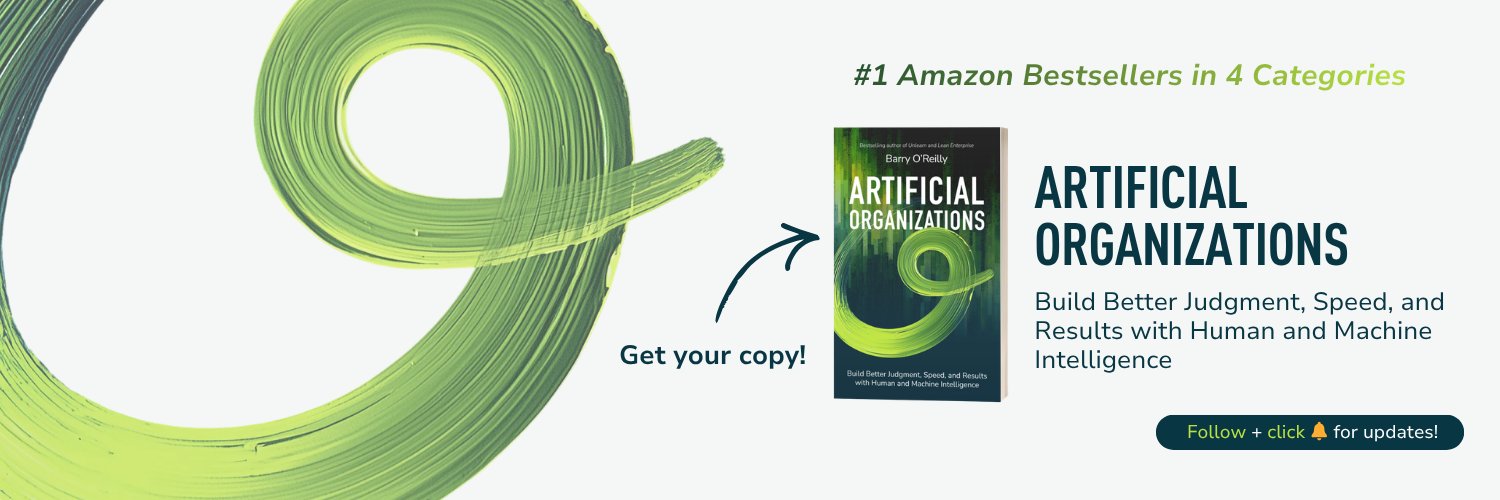
I’m excited to share that my new book, Artificial Organizations, is coming out in mid-March!
I’ve been working on this over the past number of months, driven by a simple question I keep hearing from executives:
How do we pair human intuition with machine insight to actually get better outcomes, not just more activity?
This book is for leaders navigating that shift in how we work in high-paced environments.
Not AI as a tool. Not AI as automation.
But AI as a thinking partner that helps you make better decisions, faster without losing judgment, context, or humanity.
Sign up at https://t.co/hCIS4rshG8 to be notified of the official book release!
The biggest mistake I’m seeing right now is that organizations are treating AI adoption the same way they treated innovation for the last decade: as something to bolt onto business over redesigning the core.
Launch pilots, buying tools, creating AI task forces, telling people “to experiment” then celebrate activity. It’s waste.
Over the last six weeks, in conversations with senior executives across large organizations, the pattern has been remarkably consistent. Leaders are not short on interest. They’re not short on tools. They’re not even short on use cases.
They’re short on BEHAVIOR CHANGE!
AI is being added on top of outdated workflows, fragmented decision-making, slow governance, unclear ownership, and meeting-heavy cultures. So instead of creating leverage, it creates more work.
These are the mistakes to avoid. But be honest with yourself if you’re making one, and shift.
1️⃣ Leaders delegate AI adoption before they practice it themselves.
They ask the organization to change, while their own routines, meetings, decision forums, and management habits stay untouched.
2️⃣ Companies chase use cases instead of redesigning workflows.
They ask, “Where can we use AI?” when the better question is, “Where is judgment slow, overloaded, or poorly supported?”
3️⃣ AI gets measured by activity, not outcomes.
Usage, pilots, licenses, and prompt counts become the scorecard. But few leaders can say whether decisions are faster, trade-offs are clearer, or execution has improved.
4️⃣ Old decision systems get automated.
If your approval process is slow, your governance unclear, or your priorities constantly shifting, AI won’t fix that. It will simply make the dysfunction move faster.
5️⃣ Senior leaders underestimate how personal this shift is.
AI adoption does not start with enterprise transformation. It starts with leaders changing how they prepare, think, decide, follow up, and learn.
The uncomfortable truth is this: many organizations don’t have an AI adoption problem. They have a leadership operating model problem.
AI exposes that.
The companies that will pull ahead won’t be the ones with the most tools. They’ll be the ones whose leaders redesign the way judgment flows through the organization.
Because if AI doesn’t change behavior, it’s decoration.
What AI adoption mistake are you seeing most often inside organizations right now?
Over the years, I've had the opportunity to work with startups, Fortune 500 companies, government organizations, and entrepreneurs navigating periods of significant change.
Those experiences have shaped much of my thinking on innovation, leadership, experimentation, and, more recently, AI.
@TechShakeAsia recently featured me in an article exploring that journey, along with some of the ideas behind Artificial Organizations, Unlearn, and Lean Enterprise.
👉 You can read it here: https://t.co/WMHJBBVrtp
People have asked me what it's like recording the audiobook for #ArtificialOrganizations.
Before doing it, I assumed it was pretty straightforward.
You sit in a recording booth, read your book into a microphone, and a few hours later you're done.
The reality is very different.
Every sentence gets fine-tuned.
"Read that slower."
"More energy."
"Less energy."
"Pause there."
"Don't pause there."
"More emphasis."
"Try it again."
By the end of the process, I started feeling a bit like Bill Murray in Lost in Translation.
If you've seen the famous Suntory whiskey scene, you'll know exactly what I mean.
A line that sounds perfectly fine suddenly becomes:
"Again."
"A little more intensity."
"Again."
"A little less intensity."
"Again."
After a few days in the booth, I developed a whole new appreciation for professional narrators.
That said, there was something valuable about revisiting every chapter this way.
When you're forced to read every word out loud, you quickly discover which ideas are clear, which sentences flow naturally, and which parts need a second take.
Today is my final recording session. Looking forward to sharing the audiobook! 🎧
A surprising amount of executive work has become context reconstruction.
Before making a decision, leaders sit through meetings, review dashboards, search Slack threads, revisit emails, and ask people to repeat information they have already shared.
The decision itself may take five minutes.
Rebuilding the context can take days.
As AI reduces the cost of information, the bottleneck is shifting somewhere else.
The leaders creating leverage are finding ways to preserve context, not continuously recreate it.
I explore why this matters, and why human judgment is becoming the scarcest resource inside organizations, in this month's newsletter.
👉 https://t.co/qViDURrQB8
How much of your week is spent making decisions versus rebuilding the context needed to make them?
How do you turn one person's AI workflow into a capability the organization can actually benefit from?
Across organizations, people are discovering better ways to work with AI.
They use it to prepare for meetings, accelerate research, synthesize information, and improve communication.
The challenge is that those gains often stay with the person who discovered them.
- A leader becomes more effective.
- A team member saves time.
- One department develops a better way of working.
The bigger question is how those improvements spread.
How do you take something that works for one person and make it repeatable across teams? How do you capture what works, share it, and help others build on it?
The organizations seeing the greatest impact from AI are improving how information flows, how decisions are made, and how work moves through the business.
They identify areas of friction, run focused experiments, measure results, and scale what works.
This idea sits at the core of #ArtificialOrganizations.
When successful AI practices become shared capabilities, the impact extends beyond personal productivity.
Teams learn from one another more effectively, decisions improve, and better ways of working become embedded in the organization.
What's one AI workflow you've developed that others in your organization could benefit from?
People can only perform within the constraints of the system they're operating in.
Organizations often respond to performance challenges by focusing on talent, accountability, or execution. Yet many of the issues leaders face, including slow decisions, competing priorities, misalignment, and inconsistent results, are symptoms of something deeper.
Performance is shaped by the quality of decisions, the flow of information, and an organization's ability to learn and adapt as conditions change.
The strongest organizations don't depend on a few exceptional people to keep everything moving. They create environments where knowledge is accessible, decisions are made with context, and teams can execute with clarity.
Over time, that advantage compounds.
Sustainable performance is rarely accidental. It emerges from systems intentionally designed to support better thinking, better decisions, and better outcomes.
📖 Explore more ideas from Artificial Organizations: https://t.co/YrOTtI1L09
💬 Or comment AO BOOK and we'll send you free sample chapters.
Jim Highsmith breaks decision-making into knowledge, experience, and judgment.
AI can help with knowledge. It can surface patterns, summarize inputs, and move faster through the data.
But Jim’s distinction between fast and slow decisions matters.
Some decisions are rule-based and data-heavy. Others require orientation: context, tradeoffs, and judgment about what kind of situation you are actually in.
Conflating the two is how leaders end up automating the wrong work.
The question is not just, “Can AI do this faster?”
It is, “What capability do we still need people to build by doing the work?”
Listen on Unlearn podcast:
- YouTube: https://t.co/PfDv6lBhAq
- Website: https://t.co/1wYRXlI58l
The future of the firm won’t be decided by who has access to the best model. That access will keep moving, and over time it will become easier to switch, replace, or upgrade the underlying intelligence.
The harder question is whether the organization is building a learning system around it.
To me, this starts with Judgment Systems and scales through Judgment Infrastructure.
A Judgment System is the repeatable way a leader captures, synthesizes, decides, and acts with AI as a thinking partner. It helps individuals improve the quality and speed of their own decisions under pressure.
Judgment Infrastructure is how that capability scales across the organization. It is the operating architecture that captures context, preserves institutional memory, surfaces signals, pressure tests options, and helps teams make better decisions faster.
That is where human capital and token capital start to compound.
The risk is that companies treat AI as another productivity layer while their actual decision-making system stays the same. Faster output will not create advantage if the organization still senses slowly, thinks in silos, decides through hierarchy, and acts with fragmented context.
Human agency matters more in this world, not less. People still decide what matters, what is worth pursuing, what trade-offs are acceptable, and where trust must be protected. AI can amplify that judgment, but it cannot own it.
This is why I believe the most important IP of the firm will be its ability to compound learning across people and AI. The organizations that build that capability early will not simply work faster. They will decide better, learn faster, and adapt with more confidence.
That is the promise of the artificial organization: human and machine intelligence designed together for better judgment, speed, and results.
Most companies bolt AI onto the edges of existing thinking, systems and workflows. Artificial Organizations redesign the core.
AI should take work off our plate.
There are plenty of administrative tasks where automation is the right move.
The risk Jim Highsmith points out is more subtle: if we let the machine do all the thinking, we may not notice capability fading until a crisis hits.
And by then, confidence is hard to rebuild on demand.
That is the leadership tradeoff with AI. Use it to remove drag, but keep people practicing the judgment they will need when the system fails, the answer is unclear, or the stakes suddenly change.
Full conversation with Jim on Unlearn:
- YouTube: https://t.co/PfDv6lAJKS
- Website: https://t.co/1wYRXlHxiN
Yesterday we wrapped up the final session of the Artificial Organizations: Executive Leadership Series.
Over the past few months, we've worked through every chapter of the book together, discussing how AI is changing the way we think, make decisions, and lead.
A big thank you to everyone who joined the livestreams, asked questions, shared experiences, and contributed to the conversations along the way.
If you missed any of the sessions, or would like to revisit them, all 11 livestreams are now available here:
🎥 https://t.co/2Hhz2ESkxv
One thing I've enjoyed most since the book launched has been hearing which ideas resonate most with readers.
Artificial Organizations currently has 46 global reviews on Amazon with a 4.9-star average rating.
If you've read the book and found it valuable, I'd really appreciate you taking a few minutes to leave a review. It helps other leaders decide whether the book is relevant for them.
📚 Scan the QR image or leave a review here: https://t.co/yw1pULBYnT
And if you've finished the book, I'm curious: What's the one idea, framework, or chapter that has stayed with you the most?
Working with executives across different industries, I've noticed that many leadership challenges eventually trace back to the same issue: decision latency.
Most organizations have access to plenty of data, analysis, and expertise.
Yet important decisions still spend weeks moving through meetings, approvals, and alignment cycles before action is taken.
The cost rarely appears on a balance sheet, but it shows up in missed opportunities, slower execution, and lost momentum.
Over time, small delays compound. Decisions take longer. Learning slows. Progress becomes harder to sustain.
That's why I've become increasingly interested in how leaders can reduce decision latency without sacrificing judgment.
👉 Want to read Artificial Organizations? Comment AO BOOK, and we will send you the FREE chapters!
People often talk about the OODA loop (Observe, Orient, Decide, and Act) as a speed advantage.
Jim Highsmith points to the more useful part: orientation.
John Boyd’s edge was his ability to change mental models quickly enough to match the situation. That is what let him reverse position on challengers in the air, again and again.
That lesson matters for leaders dealing with uncertainty.
The delay often happens before the decision, in the moment where we need to admit that our old frame no longer fits what is actually happening.
Full conversation with Jim on Unlearn.
- YouTube: https://t.co/PfDv6lBhAq
- Website: https://t.co/1wYRXlI58l
One of the biggest risks of AI isn't that machines get smarter.
It's that leaders stop practicing judgment.
Over time, automation can quietly remove the very experiences that help us build intuition, pattern recognition, and decision-making capability.
In this week's Unlearn episode, I sat down with Jim Highsmith, co-author of the Agile Manifesto, to explore what happens when organizations become process-optimized but judgment-constrained, and why developing better decision-makers may be the most important work leaders have ahead of them.
A thoughtful discussion on executive judgment, AI, uncertainty, and the leadership capabilities that still can't be automated.
Read the latest Unlearn newsletter 👇
Or listen here: https://t.co/1wYRXlHxiN
@SpaceX may be one of the most important companies of the next decade. That still does not mean every price is a good price.
Ahead of the IPO, the comparison that caught my attention is not the rocket launches, @Starlink headlines, or the Elon factor. It is the gap between valuation and current revenue.
The reported IPO valuation is around $1.75 trillion.
The working revenue target in this comparison is $15 billion.
That is the judgment question.
Are investors buying what SpaceX is today, or what they hope it becomes?
Compare that with:
@Walmart: $713B in revenue, around $950B market cap.
@aramco: $329B revenue in 2019, $25B IPO raise.
Vodafone: 360M customers, around $25B market cap.
Starlink appears to be carrying much of the SpaceX story. Reports suggest Starlink is the profitable engine inside the business (it’s a great product too!), with recent IPO coverage highlighting its central role in the company’s revenue and valuation case.
Could SpaceX be worth that valuation in the future? Absolutely. Is it worth that today? That is a different question.
This is where investors can get hurt, especially retail investors, if they don’t have a good judgment system in place.
Big IPOs create excitement. Early demand spikes. Institutions and insiders know how to manage their exposure. Retail investors often arrive late, buy the story, and end up holding the risk when the price resets.
The answer is not cynicism. The answer is judgment. Before buying into any major IPO, ask:
1. What do the numbers say today?
2. What future has already been priced in?
3. What would have to go right for this valuation to make sense?
4. What would have to go wrong for me to be left holding the bag?
The best investors do not just chase big stories. They build judgment systems, as I defined in #ArtificialOrganizations.
What is yours telling you?
The more leaders I speak with about AI, the more one question keeps coming to mind:
If we were building our companies today, knowing what AI can do, would they look anything like they do now?
Most conversations still sound like:
"How can AI make us more efficient?"
How can it help us write reports faster, automate tasks, reduce costs, or improve productivity?
Those are reasonable questions.
But they assume the organization itself is already designed correctly.
What if it isn't?
What if the bigger opportunity isn't improving the current operating model, but questioning whether we'd build it this way at all if AI existed from the start?
Many of the management practices we take for granted were designed for a different set of constraints:
- Information was scarce.
- Expertise was concentrated.
- Coordination was expensive.
As a result:
- Meetings became the way context moved.
- Hierarchies became the way decisions scaled.
- Processes became the way knowledge was preserved.
AI changes those constraints.
Access to information is no longer the primary challenge for most organizations.
When information is abundant, knowledge is searchable, and analysis happens in seconds, the bottleneck shifts somewhere else.
The bottleneck becomes judgment.
The leaders creating the most value with AI aren't simply deploying more tools.
They're rethinking how decisions get made, how learning happens, where authority sits, and how people and machines work together.
AI adoption is quickly becoming table stakes.
Organizational redesign is where the advantage will come from.
Because once everyone has access to similar models, the differentiator won't be the technology.
It will be how effectively people and machines work together inside the organization.
The companies that pull ahead won't ask:
"Where should we add AI?"
They'll ask:
"If we were building this company today, knowing what AI can do, what would we design differently?"
That's a much harder question, but it's also a far more valuable one.
The knowledge that matters most in many organizations is rarely written down.
People learn it over time.
Who needs to be involved before a decision gets made. Which tradeoffs are acceptable. What success actually looks like when priorities collide.
Most companies don't notice how much they depend on this knowledge until they try to scale it.
New leaders spend months learning how decisions actually get made. Teams revisit conversations that have already happened. Context gets rebuilt instead of transferred.
For years, that was simply accepted as part of organizational life.
Now something is changing.
As information becomes easier to access, a different challenge is becoming harder to ignore.
I explore that idea in my latest blog, which I co-authored with Melanie Steinbach, 4X CHRO at McDonald’s, Cameo, Miliken, and MasterClass.
Read the full blog here: https://t.co/uE0tIS52mj
Everyone is talking about AI, but what fewer people are talking about is what AI is actually exposing: the quality of our decisions.
Recently, I joined @ShawnFlynnSV on The Silicon Valley Podcast @PODCAST_SV to discuss what I call #ArtificialOrganizations—organizations that use AI not just to automate work, but to improve how decisions are made.
We explored:
→ Why leadership today is less about gathering data and more about synthesizing it
→ How to accelerate AI adoption without damaging trust or culture
→ Which decisions should remain human, and which are better delegated to machines
→ The 5–15–30 roadmap I use to help leaders navigate AI transformation
One question I often ask executives is:
"If you removed your entire AI stack tomorrow, what remains?"
The answer usually reveals whether AI is truly creating leverage—or simply adding complexity.
The future won't belong to organizations that deploy the most AI tools.
It will belong to leaders who learn how to think, decide, and adapt differently.
🎙️ Listen on:
- Apple Podcasts: https://t.co/lMIItmLsG3
- Spotify: https://t.co/fyXk8QYxvC
- Youtube: https://t.co/RSELzhfJKi
#ArtificialOrganizations #AILeadership #SiliconValleyPodcast