I’m excited to share that my new book, Artificial Organizations, is coming out in mid-March!
I’ve been working on this over the past number of months, driven by a simple question I keep hearing from executives:
How do we pair human intuition with machine insight to actually get better outcomes, not just more activity?
This book is for leaders navigating that shift in how we work in high-paced environments.
Not AI as a tool. Not AI as automation.
But AI as a thinking partner that helps you make better decisions, faster without losing judgment, context, or humanity.
Sign up at https://t.co/hCIS4rshG8 to be notified of the official book release!
Everyone is talking about AI, but what fewer people are talking about is what AI is actually exposing: the quality of our decisions.
Recently, I joined @ShawnFlynnSV on The Silicon Valley Podcast @PODCAST_SV to discuss what I call #ArtificialOrganizations—organizations that use AI not just to automate work, but to improve how decisions are made.
We explored:
→ Why leadership today is less about gathering data and more about synthesizing it
→ How to accelerate AI adoption without damaging trust or culture
→ Which decisions should remain human, and which are better delegated to machines
→ The 5–15–30 roadmap I use to help leaders navigate AI transformation
One question I often ask executives is:
"If you removed your entire AI stack tomorrow, what remains?"
The answer usually reveals whether AI is truly creating leverage—or simply adding complexity.
The future won't belong to organizations that deploy the most AI tools.
It will belong to leaders who learn how to think, decide, and adapt differently.
🎙️ Listen on:
- Apple Podcasts: https://t.co/lMIItmLsG3
- Spotify: https://t.co/fyXk8QYxvC
- Youtube: https://t.co/RSELzhfJKi
#ArtificialOrganizations #AILeadership #SiliconValleyPodcast
Visa is a great example of how too many companies are getting off on the wrong foot with AI.
They spent 18 months giving employees access to AI tools. Leaders talked about it. They encouraged people to use them. They made the tools available across the organization. And still, they didn’t see the breakthrough they were looking for. Why?
Because tool access doesn’t change human behavior.
The turning point came when Visa brought its top 300 leaders together for two days of hands-on AI training.
They weren’t just shown tools. They practiced real workflows. They applied AI to real decisions. They explored how it could support the work they already do every day.
That distinction matters.
Most organizations start with tools. Buy the licenses. Open access. Publish policies. Build training catalogs. Then they wonder why people don’t suddenly change how they work.
The better starting point is the leader and their personal traits.
- How do you do your best work?
- Where does your judgment matter most?
- Which routines slow you down?
- Which decisions deserve better preparation, synthesis, or follow-through?
- What should be amplified, and what should never be automated?
That’s the shift I describe in Artificial Organizations as the 3T Model: Traits → Tasks → Tools.
Start with how leaders naturally do their best work. Then identify the tasks where their judgment matters most to create value. Only then choose the tools that help them improve the way they think, decide, and lead.
That’s why AI adoption has to be leader-led.
The first step isn’t giving 30,000 employees AI licenses and hoping transformation appears. It’s helping the top 100 to 300 leaders become confident practitioners first. Not experts. Practitioners.
Leaders need a safe space to try this work, compare what’s working, admit what isn’t, and build confidence together. That’s how new behavior spreads. Not through mandates, but through role modeling.
This is what we’ve learned building an AI venture studio and coaching Fortune 500 leadership teams through this shift.
The organizations moving fastest with AI aren’t waiting for the workforce to figure it out.
Their leaders are going first, and learning in public.
My latest book, #ArtificialOrganizations, shows the way. Our programs help leaders get there.
Years ago, success inside many organizations depended on learning things that were never formally documented.
You figured out who to ask.
You learned which meetings mattered.
You picked up the unwritten rules through observation and experience.
Much of that knowledge lived in people rather than systems.
AI is changing the economics of information. Finding answers is becoming easier. Accessing expertise is becoming easier.
Yet one challenge remains surprisingly persistent.
→ Context
Understanding how decisions get made. Recognizing what matters in a particular situation. Knowing which signals deserve attention and which do not.
That capability increasingly separates organizations that move with clarity from those that create more activity without better outcomes.
Melanie Steinbach and I recently explored why Work Charters matter and why context may become one of the most valuable assets an organization can build in the age of AI.
Read it now: https://t.co/uE0tIS52mj
💬 A question for leaders: If a talented new executive joined your company tomorrow, how much of what they need to succeed is documented, and how much still depends on finding the right person to explain it? Share your thoughts in the comments!
A CEO asked me this question today: What practical frameworks or strategies do you recommend for leaders who want to build more adaptable and resilient organizations?
It peaked my interest, and reminded me I always come back to a few practical principles.
The first is unlearning. Leaders have to identify the behaviors, beliefs, and systems that once made them successful but now limit them. Adaptability starts by letting go.
The second is evidence-based decision-making. Don’t ask, “Do we like this idea?” Ask, “What would we need to learn to know if this idea is worth pursuing?” That shift changes everything.
The third is small bets before big bets. Create portfolios of experiments. Test assumptions early. Make learning cheap. Scale only when the evidence is strong enough.
The fourth is empowered teams with clear intent. Adaptable organizations don’t centralize every decision at the top. Leaders set direction, constraints, and outcomes, then give teams the space to discover the best path.
The fifth is human and machine intelligence by design. Don’t randomly sprinkle AI tools across the organization. Map where human judgment matters most, where AI can augment capability, and where new workflows, roles, and guardrails are needed.
Resilience is not about predicting the future perfectly. It’s about building the capacity to sense, learn, and respond faster when reality changes.
All these points and more are captured in my new book, Artificial Organizations: Build Better Judgment, Speed, and Results with Human and Machine Intelligence
“A great articulation of how leaders need to move from meetings overload to intelligent decision-making.”
That's how @gobrienau described #ArtificialOrganizations while reading it from the beaches of Bali.
Many leaders spend their days moving from meeting to meeting, processing information, and reacting to requests. The challenge isn't a lack of activity. It's creating enough space for better decisions.
One of the opportunities AI creates is helping leaders spend less time managing information and more time thinking, deciding, and applying judgment where it matters most.
💬 Comment AO BOOK, and we'll send you free sample chapters from Artificial Organizations.
📚 Or check Artificial Organizations on Amazon: https://t.co/YrOTtI2iPH
One challenge came up repeatedly in conversations with CFOs at @Gartner_inc Finance Symposium:
How do you invest in AI today while still being confident it will create value tomorrow?
During the event, I had the chance to chat with Ilana Estrich, CFO of @PPFA Planned Parenthood Federation of America.
What stood out was her balanced perspective.
She uses AI every day for research, communication, and making complex topics easier to explain. At the same time, she's focused on ensuring her organization adopts AI for the right reasons, at the right time, and in the right places.
That mirrors a challenge many finance leaders are facing right now.
AI experimentation is accelerating, but connecting spend to measurable outcomes remains difficult. Leaders are being asked to make investment decisions before many organizations have clear frameworks for evaluating what success should look like.
This is one of the core ideas and frameworks in #ArtificialOrganizations: how leaders can move beyond AI activity and build systems that improve decision-making, performance, and outcomes over time.
Ilana was one of the finance leaders who picked up a copy from the 400 books we gave out at the event following my keynote.
Where does your organization sit today: experimenting, scaling, or still figuring out how to measure AI is creating value?
Decision quality is heavily influenced by the internal state of the person making the decision.
Two leaders can have access to the same information and arrive at very different outcomes.
One operates from urgency and pressure.
The other operates from clarity and calm.
The difference may seem small in a single moment.
Last week on Unlearn, Chris Walker shared an idea: your internal state influences how you interpret risk, communicate with others, and respond when uncertainty increases.
It's one of the reasons I explored decision-making so deeply in #ArtificialOrganizations. As AI gives leaders access to more information and faster execution, the quality of decisions increasingly depends on the person making them.
The best leaders I’ve worked with aren't defined by how they perform when conditions are easy. They're defined by their ability to create clarity when the pressure is highest.
What helps you maintain clarity when making decisions under pressure?
🎧 Listen now on the #UnlearnPodcast:
- YouTube: https://t.co/7RABcvQ5wo
- Spotify: https://t.co/7daSZkZ21h
One of my guiding principles and favorite activities is spending time with Interesting People, Doing Hard Things (I wrote a blog about it a few years ago below)
Last week I was in Washington, D.C. to keynote at the Gartner CFO Conference. Whenever I’m in town, I try to catch up with people who are doing outstanding work in tough environments.
Justin Fanelli (LinkedIn: https://t.co/QxkCxKCUU5) is always one of the first people who comes to mind when I’m in Washington
He’s one of those rare people who combines technology, innovation, storytelling, experimentation, and service in a way that feels deeply practical and deeply human.
As CTO of the @USNavy, he operates in one of the highest-stakes environments on the planet. The kind where technology is not a toy. It has to work. It has to matter. It has to create better outcomes.
What I appreciate most about Justin is how hard he works to bring new ways of working into environments where change is difficult, stakes are high, and the cost of getting it wrong is real.
Breakfast with people like this is always energizing.
Not because they make the work sound easy.
Because they remind you that meaningful work rarely is.
If you’re interested in what it takes to do something genuinely different, apply technology for positive outcomes, and keep experimenting in high-stakes environments, Justin is someone worth following.
Hard things are hard for a reason, but the right people make you want to keep doing them.
🔗 Blog ‘Interesting People, Doing Hard Things’: https://t.co/VcgQLUh6S1
#ArtificialOrganizations just reached 42 global reviews on Amazon with a 4.9-star average rating! ⭐️
Thank you to everyone who has taken the time to read the book, share it with colleagues, recommend it to friends, or leave a review. I’m genuinely grateful for the support.
One of the most interesting parts of this journey has been hearing which ideas resonate most with leaders. Some tell me it’s the concept of judgment systems. Others point to AI as a thinking partner, decision velocity, or the 3T Model.
If you’ve read the book, I’d love to know:
What’s the one idea, framework, or chapter that has stayed with you the most?
And if you’ve finished the book but haven’t left a review yet, I’d really appreciate it. Reviews help other leaders decide whether the book is worth their time and attention.
📚 Leave a review here: https://t.co/yw1pULCwdr
Thank you for being part of the conversation!
AI spend is everywhere. AI impact? Still harder to find. That was the theme I kept hearing at the @Gartner_inc CFO conference in Washington DC this week where I keynoted on Artificial Organizations.
CFOs are no longer asking, “Should we invest in AI?” They’re asking better questions: Where is the value showing up? How do we measure it? Which investments should we scale, stop, or redesign?
And most importantly: how do we turn AI spend into better decisions?
AI is not just a technology investment. It is an operating model challenge. If finance is becoming the enterprise decision engine, then CFOs have a critical role to play in designing how human and machine intelligence work together across the organization. Not more pilots. Not more dashboards. Not more tool sprawl.
Better judgment, faster decisions, cearer trade-offs creates stronger results.
The companies that win with AI won’t be the ones that spend the most. They’ll be the ones that learn fastest, measure what matters, and redesign how decisions flow through the business.
Great few days with the Gartner CFO community. Big thanks to everyone who joined the conversation, challenged the ideas, and is doing the real work of turning AI from activity into advantage.
Shout out to Ternary for inviting me to work with them on this event.
#ArtificialOrganizations #AI #CFO #FinanceLeadership #DecisionAdvantage #GartnerCFO
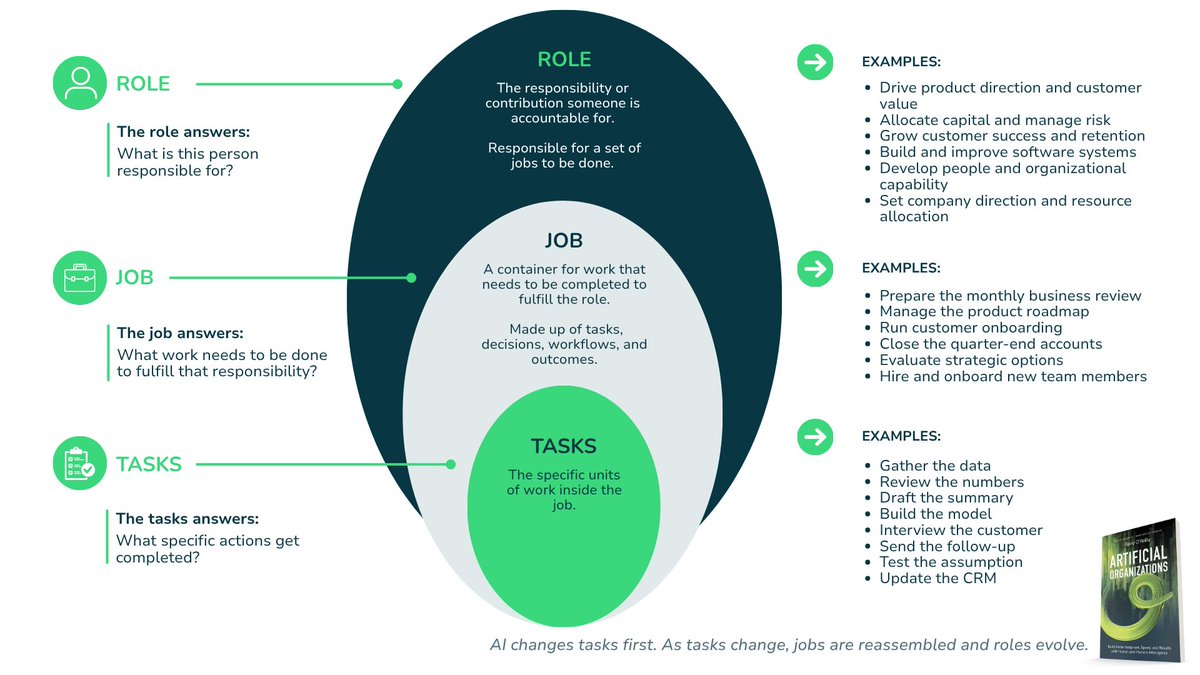
Organizations often approach AI through roles, org charts, and headcount planning.
But the more meaningful changes are happening inside the work itself.
A role may remain stable while the tasks inside it evolve quickly.
Some responsibilities become easier to automate.
Others require stronger judgment, better communication, and clearer decision-making.
That is why understanding the relationship between roles, jobs, and tasks matters so much right now.
If the tasks inside a role change significantly, is it still the same job?
I break this down further in my latest blog, “Your Job Is Not Being Taken Away. It’s Being Reassembled.”
👉 Read more here: https://t.co/oWnzGC8WCR
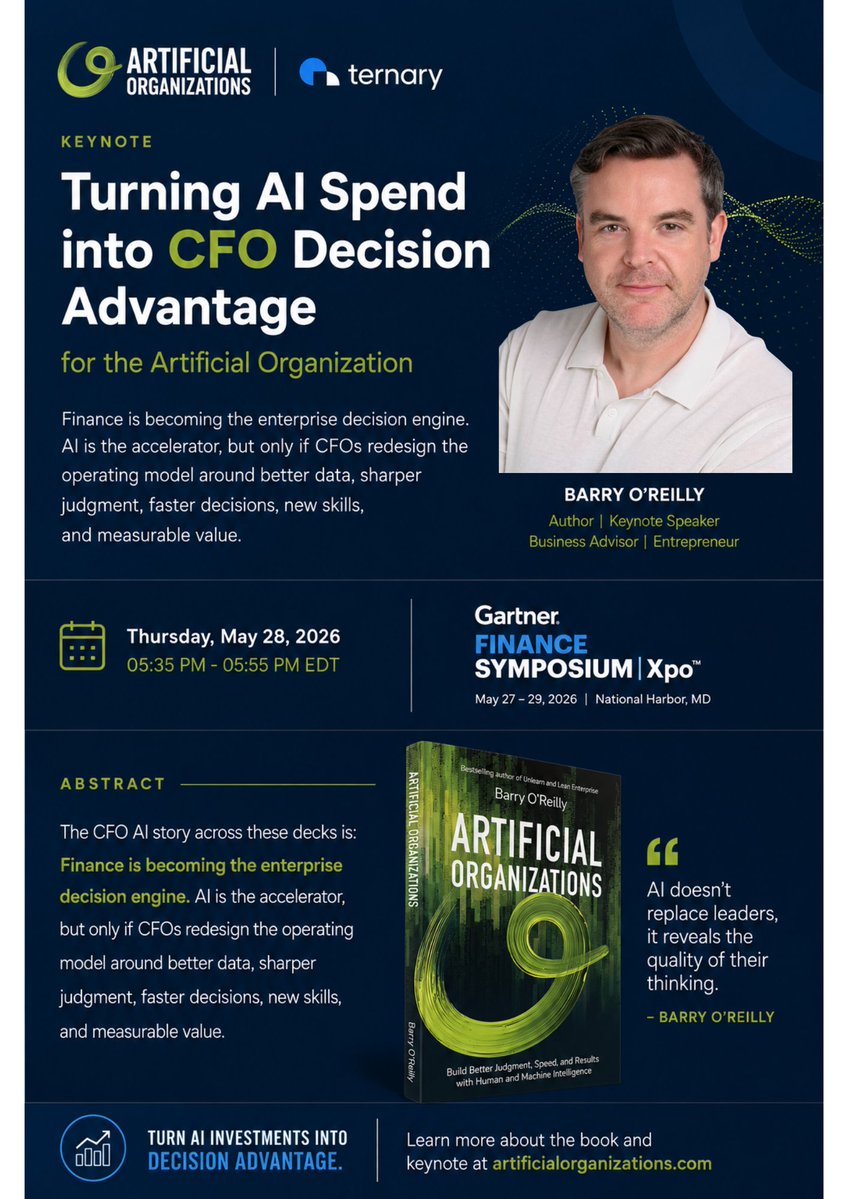
Looking forward to speaking at the @Gartner_inc Finance Symposium this week with Ternary.
One thing I keep hearing from CFOs right now:
AI adoption is moving fast, but many teams are still trying to figure out how to turn that momentum into better decisions and measurable business impact.
That’s what I’ll be exploring in the keynote tomorrow. If you’re at Gartner Finance Symposium/Xpo, feel free to come by and say hello 👋
📍 National Harbor, MD
🗓️ Thursday, May 28, 2026
⏰ 05:30 PM – 05:55 PM EDT
Event link: https://t.co/npfEoFmPJV
One of the most interesting parts of the AI Salon Philippines session in Manila wasn’t the keynote. It was the conversations afterward.
I asked a few leaders in the room two simple questions:
1/ What’s your biggest takeaway about AI right now?
And
2/ What’s one behavior that’s changed since you started using AI tools?
What stood out wasn’t hype around tools. It was how quickly people started talking about behavior change:
- testing ideas faster
- reducing admin work
- improving workflows
- creating more space for strategic and creative thinking
- becoming more open to experimentation
That’s the shift I’m seeing more and more.
AI adoption becomes meaningful when it changes how people think, decide, communicate, and operate, not just how fast they complete tasks.
Thanks again to @TechShakeAsia and everyone at #AISalonPhilippines for the great conversations. More of these perspectives from leaders and operators coming soon. 🚀
Curious to get a taste of what you missed in my keynote? Comment AOBOOK and we’ll send you free sample chapters of the book
When I released Unlearn, the audiobook ended up outselling the physical book almost 2 to 1 in the early months. The publisher was so shocked, they reached out asking what I’d done to sell so many audiobooks.
The ironic part?
They wouldn’t let me record the audiobook myself. They wanted an actor to narrate it instead.
Loads of people asked why they weren’t hearing my book without my voice? So this time, we’re doing it differently.
Excited to share that the audiobook version of #ArtificialOrganizations is now in production, and this time I’ll be recording it myself. 🎧
I’ll be in the studio throughout June, so you be able to listen to the book on the beach this summer 🏖️
Subscribe to my newsletter so you don’t miss the release https://t.co/x6vvRln3DL
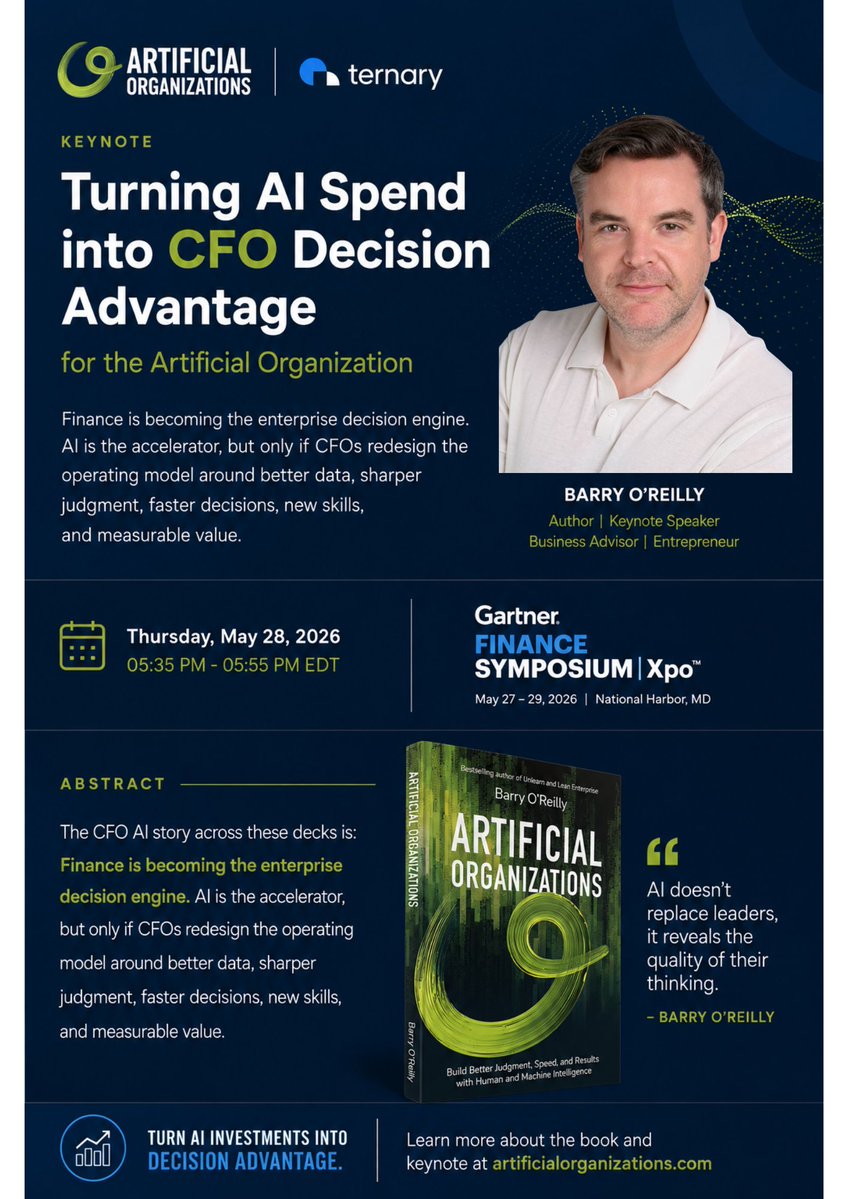
Don't miss out on my session on Artificial Organizations at Gartner Finance Symposium/Xpo™.
Learn more about the session here >> https://t.co/Qm8cL35Q8j via @Gartner_Inc
One of the biggest mistakes I see leaders make with AI is thinking about work only at the role level.
But roles are made up of jobs to be done.
And jobs are made up of tasks.
That distinction matters much more than most organizations realize.
Take a CFO.
The responsibility of the role may stay the same: allocate capital wisely, manage risk, and help the business make better decisions.
But the tasks inside the work are already changing.
Preparing a business review used to require hours of collecting data, cleaning spreadsheets, building slides, and chasing updates across the organization.
Now, some of that work can be automated or accelerated very quickly.
The judgment still matters.
What the numbers mean.
Which trade-offs matter.
What decision should actually get made.
Once leaders start looking at work through the lens of roles, jobs, and tasks, the AI conversation becomes much more practical.
The real redesign starts inside the work itself.
How are you seeing the task mix inside roles change in your organization?
____
I wrote about this in my latest blog, “Your Job Is Not Being Taken Away. It’s Being Reassembled.”
👉 More here: https://t.co/oWnzGC9usp
I’ll be at Gartner Finance Symposium next week with Ternary. My keynote, Turning AI Spend into CFO Decision Advantage.
Finance is becoming the enterprise decision engine. AI is the accelerator but only if CFOs help redesign the operating model around better data, sharper judgment, faster decisions, new skills, and measurable value.
CFOs now have to help (and need help) to answer harder questions:
> Where is AI actually improving business performance?
> Which investments are creating decision advantage?
> Where are we generating activity without outcomes?
> How do we increase speed without sacrificing judgment?
> How do we manage AI risk without slowing the organization down?
This is the world of Artificial Organizations, and how we make sure human and machine intelligence combine to produce better results
If you’re attending Gartner Finance Symposium/Xpo, come join the session.
Thursday, May 28, 2026
05:30 PM – 05:55 PM EDT
National Harbor, MD
Or DM me if you want to meet while we’re there.
#GartnerFinance #CFO #AI #ArtificialOrganizations #FinanceLeadership #DecisionAdvantage
A surprising amount of AI friction inside organizations comes from one assumption:
that the tool is the starting point.
So leaders keep adding platforms, assistants, dashboards, and workflows, hoping clarity will improve along the way.
Instead, many teams end up carrying more operational overhead than before.
The leaders who seem to be adapting well approach this differently.
They pay close attention to how they naturally think under pressure (traits), where they create the most leverage and focus their attention (tasks), and which systems actually support the way they work best (tools).
From there, the workflows become clearer.
The tools become easier to evaluate.
The signal-to-noise ratio improves.
That sequence became the foundation for the 3T Model:
→Traits. Tasks. (then) tools.
Do you think organizations are starting AI adoption in the right place?
I explore the framework further in my book #ArtificialOrganizations: https://t.co/YrOTtI2iPH