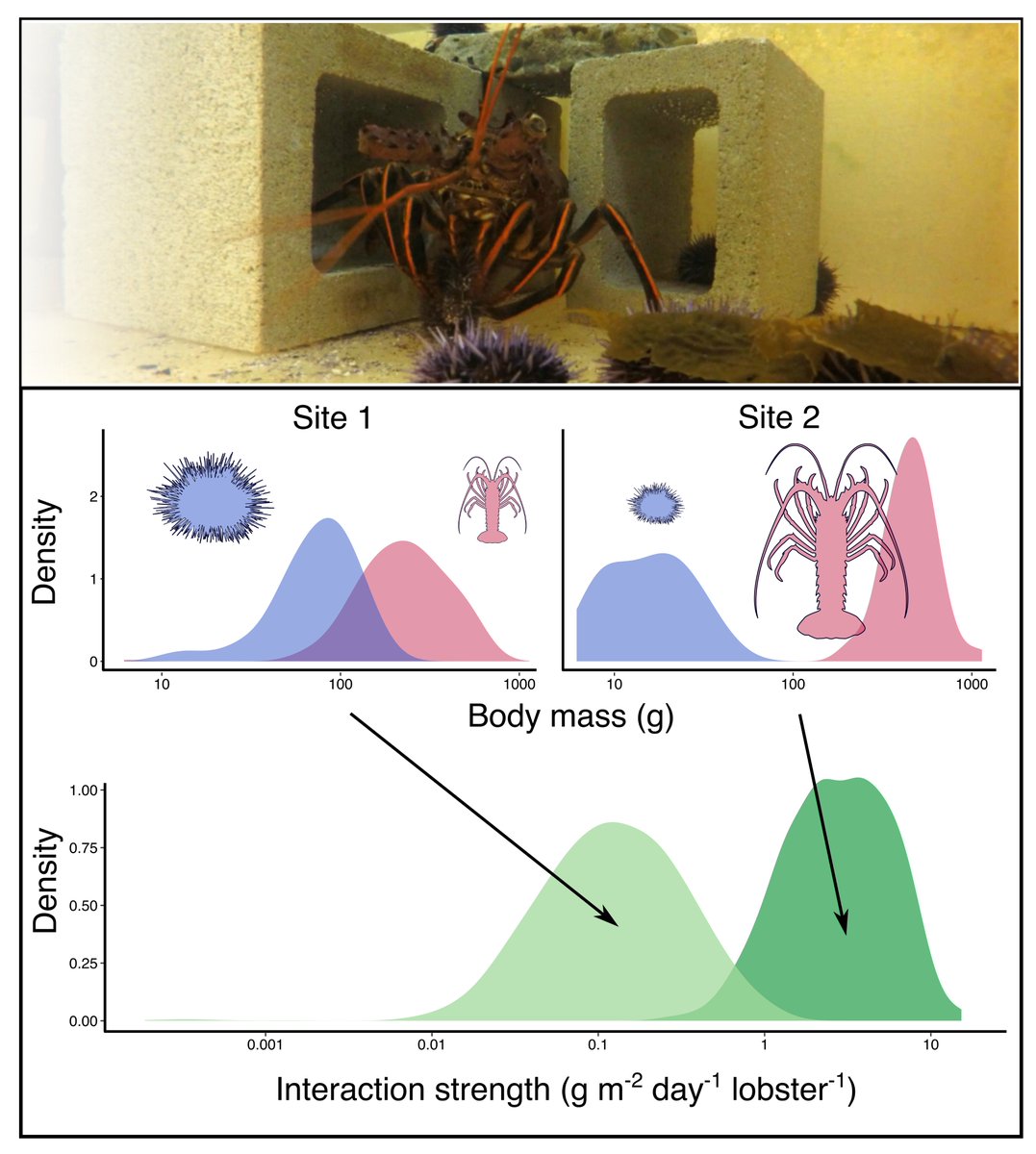
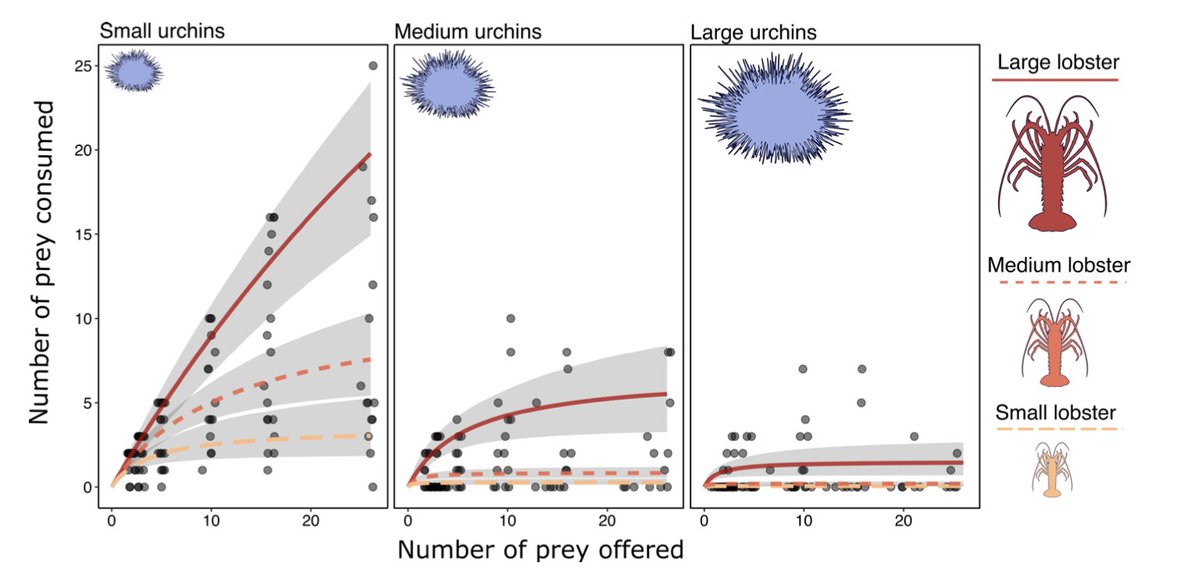
Predicting the ecological consequences of fishing can be challenging, but it may be possible the predict the effects using the body sizes of a predator and its prey. We explored this idea for in a new paper out in @AnimalEcology. @AdrianStier. See thread
https://t.co/BoBY2Utcmb
Using these relationships, we then estimated lobster-urchin interaction strength across space and time based on 9 years of observational data available through the @LterSbc@USLTER. Variation in body size accounted for up to 87% of the variation in interaction strength.
Finally, we compared our experimental predictions to estimates based on relationships from the literature. We found that general scaling relationships predicted when and where lobster interact strongly or weakly but failed to estimate the magnitude of these interactions.
Lots of previous work has explored how interaction strengths vary with predator and prey size across broad taxonomic and size ranges. But it’s unclear how much info we can borrow from cross-tax relationships to predict how strongly a particular predator interacts with its prey.
🌡️🦠📈 New Paper Alert! 🌡️🦠📈
How will mixotrophs evolve in response to warming temperatures? Pleased (& a little depressed) to share our lab's first foray into experimental evolution, out today & open access in Global Change Biology: https://t.co/vKNsFPDvgE
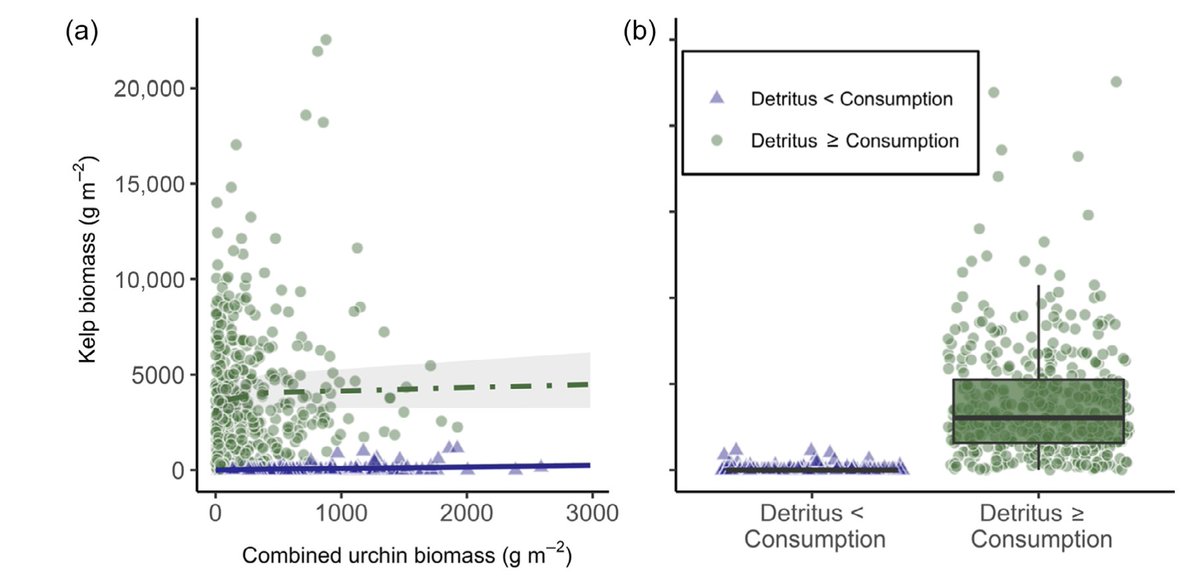
Our work highlights the importance of considering biological rates versus static proxies of rates such as species abundance/biomass. Understanding the critical role of detrital supply could help guide targeted kelp forest restoration.
Our team put together a video abstract for our paper published in @ESAEcology. Special thanks to Jacob Ogawa for compiling the video! @MaeRennick, @AdrianStier, @jocur512
Here is the link to the paper:
https://t.co/hLChkjiAmI
We found that when urchin foraging demands exceeded the availability of kelp detritus, the standing stock of kelp is ~50 times lower than when the supply of detritus exceeds urchin demand.
How might fishing-induced changes in body size alter how CA spiny lobsters prey on sea urchins?
pre-print out by @BartDifiore, feedback welcome! https://t.co/5zib9FvhZ6
When and where do urchins cause kelp forest collapse? Our new paper shows that the balance between urchin herbivory and detrital supply is key! Please share!
Congrats 2 leads @MaeRennick & @BartDifiore on a fantastic paper in @ESAEcology
https://t.co/zsjhreYoUZ