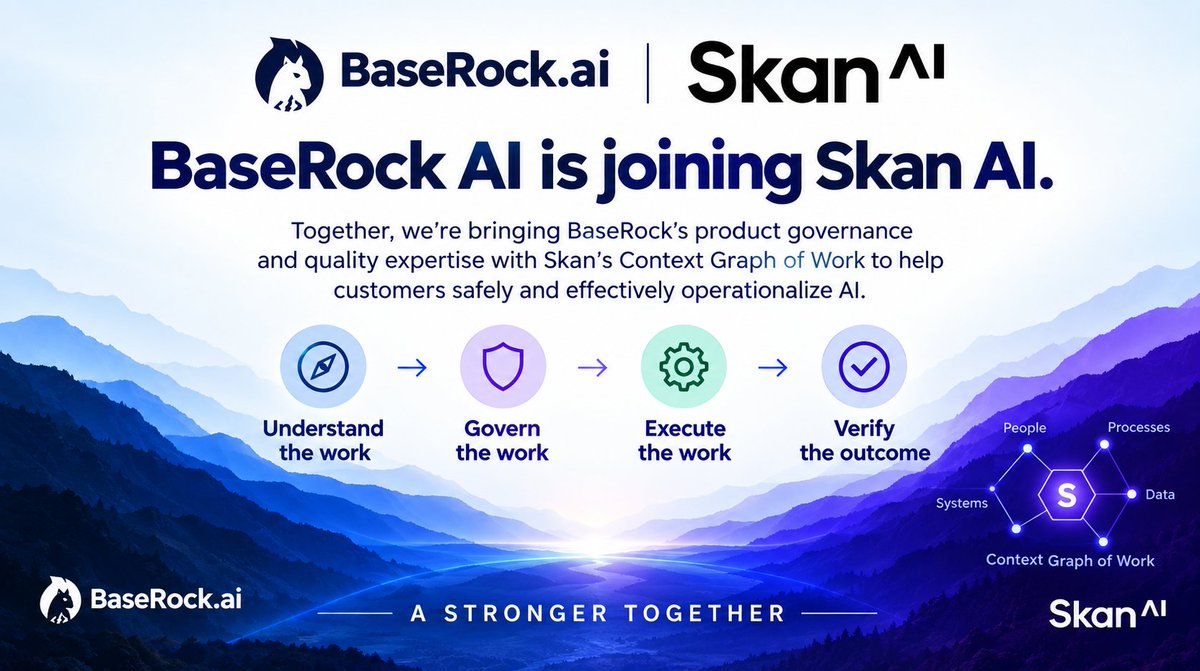
Excited to share that the BaseRock AI team is joining Skan AI. 🚀
After 15+ years in software delivery, I’m excited about what we can build together.
BaseRock started with a mission to rethink software quality. That mission evolved into connecting business intent with technology execution.
As AI moves from assisting people to doing work, the question becomes: how do we ensure AI acts correctly?
Together with Skan AI, we’re working toward a future where organizations can:
Understand the work.
Govern the work.
Execute the work.
Verify the outcome.
Incredibly proud of the BaseRock team and grateful to our customers, investors, advisors, and partners who supported our journey.
A new chapter begins. Onward. 🚀
#SkanAI #BaseRockAI #AgenticAI #AIGovernance
Every deployment carries a level of risk.
Traditional release checks tell you whether your application was built successfully, tests passed, and deployment completed.
But they don't always answer the most important question:
How confident are you that your business-critical workflows will still behave as expected in production?
A release can have:
• Successful builds
• Passing automated tests
• Healthy infrastructure
…and still introduce a logic regression that impacts your customers.
That's where Confidence Scoring becomes valuable.
Instead of relying solely on pass/fail results, Confidence Scoring evaluates the health of critical business workflows by considering signals such as:
• Workflow coverage
• Recent code changes
• Execution results
• Business impact
This gives engineering teams a clearer picture of release readiness before deployment.
As software delivery accelerates with AI-assisted development, confidence is becoming just as important as speed.
The goal isn't simply to deploy faster.
It's to deploy with greater certainty that your software will continue delivering the intended business outcomes.
What signals does your team rely on before approving a production release?
Share your thoughts in the comments.
#SoftwareTesting #QualityEngineering #ReleaseManagement #DevOps #AgenticQA #BusinessUseCaseTesting #AI #BaseRockAI
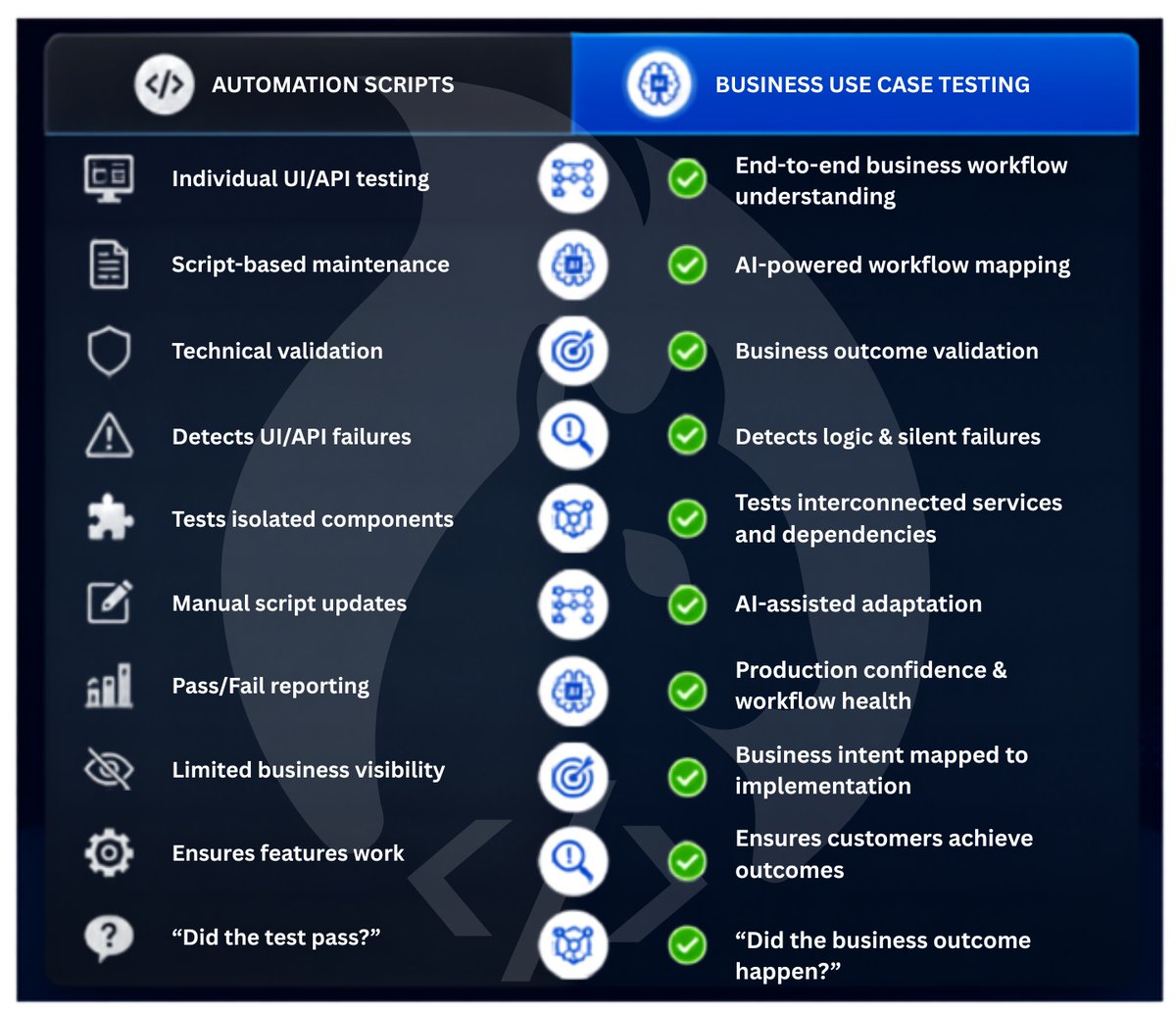
Your automation scripts can all pass...
...and your customers can still experience broken workflows.
Testing APIs and UI isn't enough for modern applications.
Business Use Case Testing validates the outcomes that matter most.
How is your team protecting business-critical workflows?
#SoftwareTesting #QualityEngineering #AI #DevOps #BaseRockAI
JavaScript applications are no longer just frontend applications.
A single user action can trigger APIs, state updates, business rules, third-party services, notifications, and authentication flows all within seconds.
Traditional testing often validates these components individually.
But users don't experience individual components.
They experience complete workflows.
At https://t.co/2EWZiJrrs5, our JavaScript Workflow Intelligence helps engineering teams understand how frontend interactions connect to backend services and business processes. By mapping these relationships, teams gain better visibility into the workflows that matter most and can identify issues before they impact customers.
As modern web applications become increasingly complex, understanding the entire workflow, not just the code, is becoming essential for building confidence.
Learn how BaseRock helps teams validate business outcomes, not just technical implementation.
Book a demo: https://t.co/9Kmt2mxGql
#JavaScript #SoftwareTesting #QualityEngineering #FrontendDevelopment #AgenticQA #BusinessUseCaseTesting #AI #BaseRockAI
AI has changed how fast we build software.
But speed without governance creates risk.
PR merged
Pipeline green
Deployment successful
Business outcome still wrong.
That's why Product Governance matters.
Read more:
https://t.co/HUXzdUBPCR
#AI#SoftwareTesting #ProductGovernance #QualityEngineering
Have you ever deployed software where every test passed—but production still failed?
That's the reality of silent failures.
The application works.
The APIs respond.
The deployment is green.
Yet customers experience broken workflows, incorrect pricing, or missing notifications.
Our latest blog explores why these failures are becoming more common as AI accelerates software development and why validating business outcomes is becoming just as important as validating code.
Read more: https://t.co/v7Ytd2Sjtm
#SoftwareEngineering #SoftwareTesting #AI #QualityEngineering #BusinessUseCaseTesting #AgenticQA #DevOps #BaseRockAI #baserockai
Your software can pass every test and still fail your business.
A green pipeline doesn't always mean a successful release.
Logic regressions happen when software works technically but no longer delivers the intended business outcome.
As AI accelerates development, protecting business intent becomes just as important as writing code faster.
In our latest blog, we explore the GUARD Framework and how it helps engineering teams detect silent failures before they reach production.
Read the full article: https://t.co/1OVZ9NmvdZ
#SoftwareTesting #QualityEngineering #AgenticQA #BusinessUseCaseTesting #DevOps #BaseRockAIYour software can pass every test and still fail your business.
250 years of independence.
250 years of bold ideas, relentless innovation, and people willing to build what comes next.
Today, we celebrate not only America's past, but the spirit that continues to shape its future: the freedom to think independently, challenge what exists, and create what's possible.
To the developers, engineers, founders, builders, customers, and communities moving technology forward every day, Happy Independence Day.
Here's to 250 years of freedom and countless possibilities ahead.
Happy Fourth of July from all of us at https://t.co/QgcvsH9USI.
#IndependenceDay #America250 #FourthOfJuly #Innovation #Engineering #Technology #BaseRockAI
Software testing has traditionally focused on one question:
Does the application work?
But modern software teams are starting to realize that's not enough.
A feature can pass every test.
A deployment can be successful.
Coverage can be high.
And yet the business outcome can still fail.
Why?
Because customers don't experience individual functions.
They experience complete workflows.
A customer doesn't care whether an API returned a 200 status code.
They care whether they successfully completed checkout.
They don't care whether a database transaction succeeded.
They care whether their order was processed correctly.
This is where Business Use Case Testing (BUCT) becomes important.
Instead of validating isolated technical components, BUCT validates whether critical business workflows continue to achieve the outcomes they were designed to deliver.
As software becomes increasingly complex and AI accelerates development velocity testing business outcomes may become just as important as testing code correctness.
In our latest guide, we explore:
• What Business Use Case Testing (BUCT) is
• How it differs from traditional testing
• Why modern engineering teams are adopting it
• How it improves production confidence
Read the full article:
https://t.co/oS4cUWOtDs
#SoftwareTesting #QualityAssurance #Engineering #DevOps #SoftwareQuality #BaserockAI #BUCT
"Great products don't fail because teams can't execute, they fail because decisions lack clarity."
In his latest article, our founder, Rishi Singh, explores why product governance is the missing layer between strategy and execution.
When ownership, prioritization, and success metrics aren't clearly defined, teams face:
❌ Conflicting priorities
❌ Slow decision-making
❌ Unclear accountability
Strong product governance creates alignment, accelerates execution, and helps teams build products that drive real outcomes.
Read Rishi's insights: https://t.co/ybFznJvSwp
#ProductManagement #ProductGovernance #ProductStrategy #Leadership #EngineeringLeadership #SaaS #DigitalTransformation
🚨 AI adoption is hitting a new reality check: token costs.
For the last two years, the goal was simple: get everyone using AI.
Now, enterprises are asking a different question:
👉 Are we getting enough business value for what we're spending?
The biggest surprise? It's not chatbots driving costs—it's AI agents.
Every time an agent scans repositories, reloads context, or loops through workflows, token consumption rises. Without the right architecture, AI costs can scale faster than business outcomes. 📈💸
The future of enterprise AI isn't about using the most tokens.
It's about maximizing outcomes per token.
Smart organizations are investing in:
✅ Semantic caching
✅ Context layers
✅ Model routing
✅ Token governance
Read more: https://t.co/ix8eXGTSN5
#ArtificialIntelligence #AgenticAI #LLM #SoftwareEngineering #AITesting #EnterpriseAI #GenerativeAI #MLOps #DevOps #BaseRockAI
Coverage measures execution.
Confidence measures survivability.
Want to see how BaseRock AI identifies workflow gaps that traditional testing misses?
📅 Book a demo: https://t.co/7FOWS9Zurf
92% Code Coverage.
Production still failed.
That's because code coverage measures execution.
It doesn't measure confidence.
Recently, we looked at a system with:
✅ 92% code coverage
✅ thousands of passing tests
✅ green CI/CD pipelines
Yet a critical business workflow still broke under real user behavior.
Why?
Because coverage answered:
"Did this line of code execute?"
But it never answered:
"Will this workflow survive in production?"
The failure wasn't in an individual function.
It emerged from a sequence of actions that traditional tests didn't validate:
→ Apply discount
→ Remove item
→ Navigate back
→ Continue checkout
A path that real users take every day.
This is the blind spot of traditional testing.
Teams optimize for:
→ coverage percentages
→ test counts
→ passing builds
But production failures happen in:
→ workflows
→ integrations
→ edge cases
→ user journeys
At BaseRock AI, we're focused on Business Use Case Testing (BUCT).
Because customers don't experience isolated functions.
They experience workflows.
Coverage measures execution.
BUCT measures production confidence.
How does your team measure confidence beyond code coverage?
#SoftwareTesting #QA #Engineering #DevOps #QualityEngineering #BaserockAI #BUCT
Most tests only verify if the code behaves the way developers expected.
But production environments don’t care about expectations.
Real users don’t follow your happy flow.
They:
Spam the Submit button 5 times in a second.
Refresh pages during payment processing.
Use unstable internet connections.
Trigger APIs that return null instead of valid objects.
Hit systems while database connections are failing mid-transaction.
And suddenly…
✅ Your unit tests pass.
❌ Your product still breaks.
That’s the gap between the Happy Path and the Edge Path.
Modern QA isn’t just about checking if features work in ideal conditions.
It’s about understanding how systems behave when reality gets chaotic.
Business Use Case Testing (BUCT) focuses on:
Real user behavior
Cross-service failures
Unexpected workflows
Production-like edge conditions
System resilience under pressure
Because software quality isn’t measured by how well it works when everything is perfect.
It’s measured by how gracefully it fails when everything isn’t.
Stop testing what you hope happens.
Start testing what actually happens.
#SoftwareTesting #EngineeringMindset #BaseRockAI #AgenticQA #BUCT
More tests ≠ better software.
AI tools like GitHub Copilot and ChatGPT can generate hundreds of tests in seconds.
But that doesn’t mean your code is safer.
🚫 Test bloat
🐢 Slow CI/CD
⚠️ Flaky pipelines
🎭 Over-mocking
After ~70% coverage, returns drop—while cost and complexity keep rising.
What actually works 👇
• Test critical user flows
• Prefer integration over excessive mocks
• Keep test suites fast & reliable
👉 Read more: https://t.co/l9IZGt7GrO
#SoftwareEngineering #Testing #DevOps #AI #CodeQuality
✅ Tests passed.
❌ Still failed in production.
That’s the gap most teams miss. 🧠
Traditional tests validate expected behavior. Real users rarely follow the expected path.
A user:
🛒 Adds an item to the cart
🏷️ Applies a legacy discount code
💱 Switches currency at the last second
↩️ Hits “Back” while payment is processing
Every individual step may pass.
The journey can still fail. ⚠️
That’s where hidden bugs live—not inside isolated functions, but inside business flows, timing, and real-world user behavior.
If you aren’t testing the actual journey, you aren’t fully testing the product.
At BaseRock, we’re building BUCT to uncover untested scenarios before your users do. 🔍
How does your team catch edge cases today? 👇
#BUCT #AgenticQA #SoftwareTesting #QualityEngineering #ProductDevelopment
Bugs = Untested Scenarios
The uncomfortable truth:
Bugs aren’t usually surprises. They’re scenarios nobody thought to test.
Teams are getting better at covering defined requirements, automating known test cases, and shipping faster than ever.
Yet bugs still slip through.
Where bugs hide:
• Unexpected user behavior
• Edge cases no one imagined
• Gaps between intent and implementation
Users don’t follow specs. They follow shortcuts, confusion, and real-world habits.
The real problem:
It’s not only a failure of execution. It’s often a failure of imagination.
Building resilient products requires:
• A skeptical mindset
• Deep understanding of business intent
• Challenging the specification
• Connecting the full lifecycle
Intent → Spec → Implementation → Real Usage
Great QA isn’t just testing what was built.
It’s uncovering what wasn’t even considered.
Rethink how you test. That’s where quality begins.
#BUCT #AgenticQA #SoftwareTesting #QualityEngineering #ProductQuality
AI is accelerating software development at an unprecedented pace.
What used to take weeks can now be built in hours.
But while development has evolved, testing hasn’t kept up—and that gap is becoming a serious risk.
Most teams still rely on scripts, selectors, and implementation-based validation. In an AI-driven world, where code changes rapidly and interfaces evolve constantly, this approach is increasingly fragile.
The real challenge isn’t speed.
It’s the absence of a clear, machine-readable understanding of intent.
What should the system guarantee—regardless of how it’s built?
This is where the idea of a “System of Intent” comes in:
A shift from validating steps to validating outcomes.
It’s not just a better way to test, it’s a necessary evolution for AI-driven development.
We explored what this means for QA, engineering teams, and the future of software quality 👇
👉 https://t.co/Sj3FkWj4uZ
Stop hiding behind 90% code coverage.
We’ve all been there. The dashboard is green. The PR is merged. The coverage report says you’re safe.
Then, a user does something *unexpected*… and production crashes.
Here’s the hard truth:
Code coverage tells you which lines ran — not whether your business logic actually works in the real world.
You can have 100% coverage and still ship a broken product.
At BaseRock AI, we believe in **Confidence over Coverage**.
It’s time to move beyond
“Did the line run?” → to → “Does the scenario actually work?”
#SoftwareTesting #BaserockAI #BUCT #EngineeringExcellence #QualityAssurance