BasicAI is a company that provides data labeling tools and services, aiming to speed up the evolution of the AI landscape and to build a more intelligent world.
#TechNews
CHE Lab at UB turns connected cars into road crack inspectors. Roadside units send GPS hints over C-V2X, the car crops its dashcam view to that spot, and a model finds and measures cracks. Precision jumped from 0.20 to 0.70, AP up 822%.
Paper: https://t.co/GvKCw5VKkk
#TechNews
SAM3-I extends SAM3 to follow complex natural language instructions without an external LLM. It uses cascaded adapters and alignment losses, trained on 840k plus instructions. It boosts gIoU and runs in one pass.
Open-sourced: https://t.co/HLurdAtwkH
Cross-view object correspondence breaks when Ego becomes Exo. V²-SAM, a CVPR 2026 Highlight, extends SAM2 across views without poses, labels, or 3D. It hits 48.0 IoU on Ego-Exo4D with only 15M parameters and 77.2 IoU zero-shot on HANDAL-X.
Paper: https://t.co/WAaM5sU7XX
#TechNews
MARIS (CVPR 2026) brings the first large-scale underwater open-vocabulary segmentation benchmark and a lightweight method that fuses geometric priors with domain-aware semantics to segment unseen categories in degraded underwater scenes.
Arxiv: https://t.co/XlcsYCxQC3
NTU's PixelArena tests if #multimodalAI can do #imagesegmentation .
Gemini 3 Pro Image did well on face masks, but performance on COCO was weak and unstable. Good sign for AI-assisted data labeling, not a replacement for human annotators yet.
Project: https://t.co/WM7TTFaLmN
Keypoint annotation marks meaningful landmarks on objects. Skeleton annotation connects them into a structure. They help AI models understand pose and movement. Our latest video walks through the full keypoint and skeleton annotation workflow.
Watch here: https://t.co/NAw4LZmbs9
AI vision can identify unlabeled, irregular items. Japan's BakeryScan uses #computervision to identify unwrapped bakery items in under a second. The same tech now powers scanless smart checkout, from smart carts to Just Walk Out stores.
Read more: https://t.co/opl1Wn4b3L
Ultralytics released #YOLO26 . It removes NMS for end-to-end detection via one-to-one heads, making latency more predictable on edge. It also cuts DFL, adds STAL/ProgLoss, and uses MuSGD. Up to 43% faster CPU inference on COCO.
Doc: https://t.co/ak54OjA4cG
#HappyNewYear#NewYear2026
You are the ones shaping what the world looks like tomorrow, and we are always here to build the data foundation for your next big idea.
At BasicAI, we hope you and your team solve the hard problems this year and build technology that truly matters.
#TechNews SPIRAL unifies #LiDAR data generation and segmentation in one range-view diffusion model, jointly producing depth, intensity, and semantic labels. It achieves SOTA on SemanticKITTI and nuScenes with only 61M parameters.
Project page: https://t.co/iXVEykRRBj
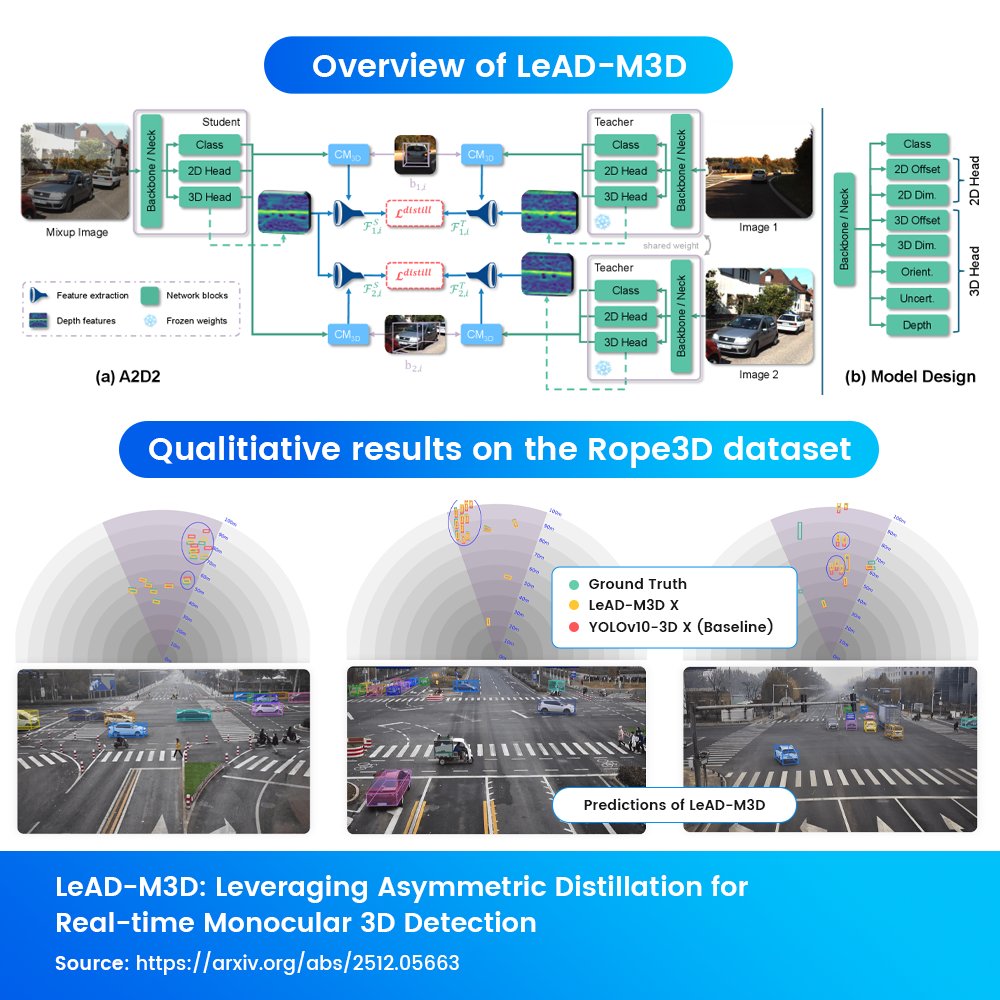
LiDAR gives great depth but is costly and power‑hungry. Recent research, LeAD‑M3D, hits SOTA monocular 3D detection using RGB camera only, with denoising‑style training and 3.6× faster inference, making deployable #3Dvision more realistic.
Project: https://t.co/Ei8JoRjysn
#EdgeAI runs vision models directly on devices under strict compute, memory, and latency limits. Our latest post shares practical data annotation strategies, so lightweight models stay robust, efficient, and truly optimized for edge deployment.
Read here: https://t.co/dnsgn0yNmc
RacketVision, an AAAI 2026 Oral, is a new racket-sport benchmark dataset with joint ball and racket pose labels from 942 pro matches. It improves tracking, pose, and trajectory prediction, and helps sports AI understand strokes + tactics.
Read: https://t.co/Y6DEYTu2cB
Building real-world training data is slow and expensive. Synthetic data is changing this. In our new blog, we show how to blend synthetic and real data, design annotation for virtual scenes, and build workflows that deliver better model performance
Read: https://t.co/HXPjuhOxe0
Great CV models start with great annotations. IoU & mAP measure model performance, but they don’t reflect label quality. True QA spans accuracy, agreement, coverage, efficiency and reliability. Our post maps 20 metrics across 4 categories to guide teams:
https://t.co/UNg91CeyaO
#TechNews We want to share the Med-Banana-50K dataset: a cross-modality, text-guided medical image editing dataset (50k edits) with bidirectional edits, structured reviews, and failure traces. It could advance reliable augmentation and counterfactuals.
https://t.co/uIQJJeHCmv
Clear 3D #LiDAR annotation guidelines drive consistent data and better models. Vague ones cause variance, rework, and noise. 3D adds geometry, occlusion, and sparsity challenges. We share an 8-part framework to build robust in-house guidelines.
Read: https://t.co/QmNw5g0obN
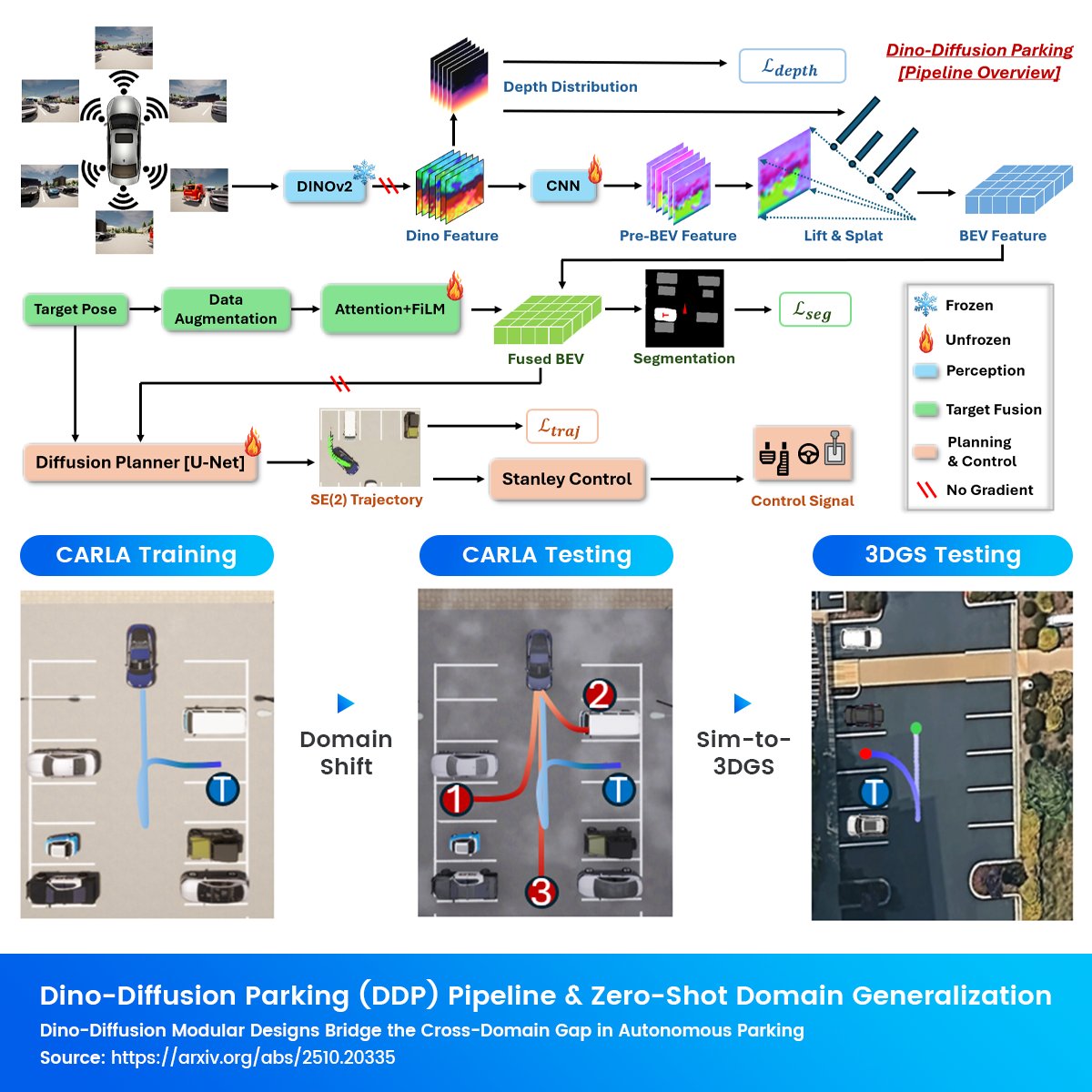
Today we want to share Dino‑Diffusion Parking: DINOv2 + diffusion planning + Stanley control. Trained in clear weather, it parks in storms and dusk, holding >90% success OOD in CARLA. A modular recipe for robust, scalable #autonomousparking.
Paper: https://t.co/0hOZAlhPTf
Wildlife causes $600M in US farm losses. Today we want to share a new study about real-time deer detection on edge devices. The work benchmarks YOLO on Raspberry Pi and Jetson using a realistic Cameratraps deer dataset with reproducible baselines.
Paper: https://t.co/7ixuAOhuNB
3D LiDAR data annotation is becoming core data infra for selfdriving, robotics, and smart cities. In our recent analysis, this market is expected to grow by 20% CAGR to $4.5B by 2030.
Learn more: https://t.co/JCJiXpESEq