I spend way too much time testing AI tools.
The good ones, the bad ones, the prompts that save time, and the workflows that actually help creators and founders build faster.
Follow for practical AI without the hype.
Alex Cheema emailed Jensen and heard back in seven minutes. Seven minutes, and a war room at Nvidia headquarters was approved.
185,974 people read the post. The ask was local AI inference. The result ran 9.6 times faster.
That answer came from one person, not from a company process. Jensen is out of Nvidia now, and the process is all the board has left.
You cannot put seven minutes in a handover document. It lives in one person's inbox, not in the org chart.
The war room is still there. Who walks into it now?
In June @NaderLikeLadder emailed Jensen about a crazy idea we had over dinner to make Local AI 10x better on NVIDIA hardware.
Jensen replied in 7 minutes. He saw this as important work, and approved a war room for us to work on this at NVIDIA HQ.
For a month, NVIDIA HQ was the @exolabs satellite office. We were overwhelmed by the support we got. We were back to back the first week with smart NVIDIANs coming in to our war room to help us. Creators of CUDA, Dynamo, people who built NVIDIA.
Long story short with NVIDIA we managed to improve their Local AI playbooks by 9.6x (almost the 10x goal we set out with). We’ll be publishing a whitepaper on this work.
We were just a small startup with a crazy idea. Jensen took a bet on us. Jensen cares deeply about Open Source AI and Local AI.
I don't believe Jensen is replaceable, he's a 1 of 1 human, but I hope NVIDIA will continue to aggressively support Open Source AI and Local AI, and continue to take bets on small startups with crazy ideas.
Thank you Jensen
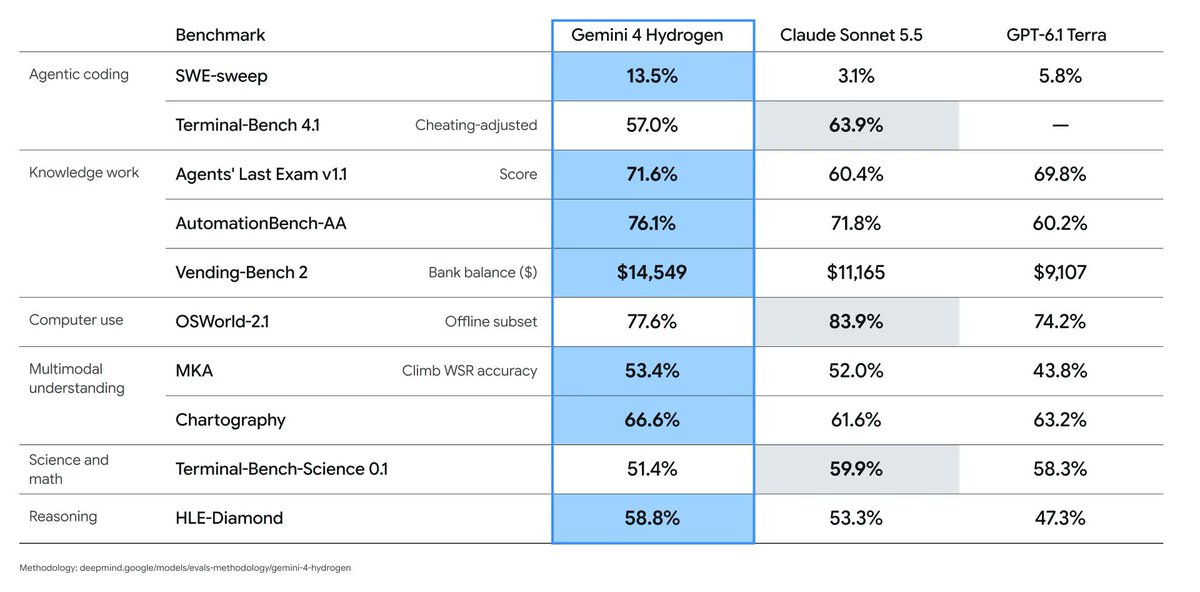
Logan Kilpatrick just posted the numbers and they do not read like a lite model. Gemini 4 Hydrogen scores 51 on the Artificial Analysis intelligence index at the high tier. Argon, the deep reasoning flagship, scores 50. Push Hydrogen to xhigh and it hits 54.
242,510 people read the announcement in its first hour. 5,388 liked it.
Hydrogen runs 2.5 times faster than Gemini 3.8 Flash and holds 1 million tokens of input and output context. It lands 58.8% on HLE-Diamond. On Terminal-Bench 4.0 it nearly matches Carbon while using 24% less quota and running 19% faster.
Google built its ladder on a simple trade: the quick model stays dumb, the smart model stays slow. Hydrogen just walked up the ladder and took the top rung.
So what is Argon for now?
Introducing Gemini 4 Hydrogen, an extremely capable and fast model built to bring Gemini 4 to everyone!
Available to all tiers of Google AI Studio, Gemini API, Gemini for business, the Gemini app, Google Search, and paid Google AI Pro + Ultra subscribers in Google Antigravity.
I have watched agents promise to do your shopping and then hand you a receipt you never approved. Replit just shipped the version that cannot do that.
Replit Agent now buys supplies for your business through Stripe Link and Visa. It browses the store, fills the cart, and gets the checkout page ready. Then it stops. Every purchase waits for the founder to approve the final total, and that check is enforced in code, not left to the model. While it pays, shell access and normal browsing are switched off.
The same agent now runs Google Ads from a chat prompt. It writes the copy, generates the image, and suggests the daily budget. The example in the announcement is $40 a day for 30 days.
The number that sold me: founders turning Replit builds into Stripe revenue are up 9x since May. Link already has more than 300 million users.
An agent that spends your money should ask first and prove it asked. This one does both. What would you let it buy first?
Sawyer Merritt floated the funniest outcome and called it the most likely one. Musk hires Jensen to help build Terafab.
240,413 people read it. 14,619 liked it. 932 replied. The replies are already doing the math.
The pieces fit too well to ignore. Jensen built the chips. Musk builds the factories that run them. In 2016 Jensen hand-delivered the first DGX-1 to Musk. In 2024 xAI stacked 100,000 of his GPUs into Colossus.
A founder who just lost his company and a founder who keeps saying he needs more compute. One phone call connects them.
The board is out shopping for an outsider. The outsider might be hiring the insider.
Jensen Huang just resigned from Nvidia. What if Elon ends up hiring him to help with Terafab (as well as other things) and together they make America the greatest producer of advanced chips in the world?
The most entertaining outcome is the mostly likely, right?
Naval wrote the line every founder already knows. You do not just replace the founder. Jobs. Kalanick. Now Jensen.
1,339,696 people read it. 33,206 liked it. Then Musk showed up in the replies with two words: True words. 121,507 people read that reply.
Boards love the idea that a CEO is a plug you swap out. The last 48 hours say otherwise. The researchers who emailed Jensen directly. The 14 million chips. The war room he approved in seven minutes.
A board can vote a founder out in one meeting. It cannot vote in the 33 years that made the company worth voting over.
Musk already raised his hand. Naval just explained why.
Anthropic asked 8 startups how they actually use Claude Tag. The answer is not a chatbot. It is five jobs.
On-call triage. Thread to PR. A company brain. Self-serve data. Routine reports.
Kikoff, NavigateAI, Orderful, Moritz and four more high-growth companies all run the same pattern: tag Claude in a channel and it does the job, with channel config doing the routing.
I have watched teams buy an AI tool and then invent work for it. These eight did the opposite. They took the work they already hated and handed it to a tag.
Five setups, one tag, zero new hires.
Which of the five would you set up first?
The memo names the new chairman. It still does not name the permanent CEO.
Harvey Jones is Nvidia's first board chair. Colette Kress, CFO for over 13 years, runs the company in the meantime. The memo went to staff. 82,465 people read the reporter's post about it.
The board has a chair, an interim chief, and a search firm. Musk already said hiring Jensen would be an honor.
One side has a job posting. The other side has an open invitation.
How long does the search last when the best candidate is already a free agent?
Jensen is out of Nvidia. The researchers just lost the guy who answered their emails.
A former Nvidia researcher with 5,579 followers posted what Jensen did for him. An O-1 visa. A green card. Help with family health insurance when it got complicated. Straight to his inbox, no chain of command.
47,922 people read it. 1,707 liked it. He says Jensen did the same for thousands of researchers.
The board saw a CEO. The researchers saw the man who got their visas approved and their hospital bills sorted.
A CEO can be replaced in one announcement. Who answers those emails now?
Jensen Huang allowed me to get an O-1 and later a Green Card.
He handled my family's complicated health insurance.
You could email him directly with a non-work problem.
He did this to thousands of other people in some of the riskiest fields of science and engineering.
Robotics has a new open-weights champion, and it did not come from a lab that locks its models away.
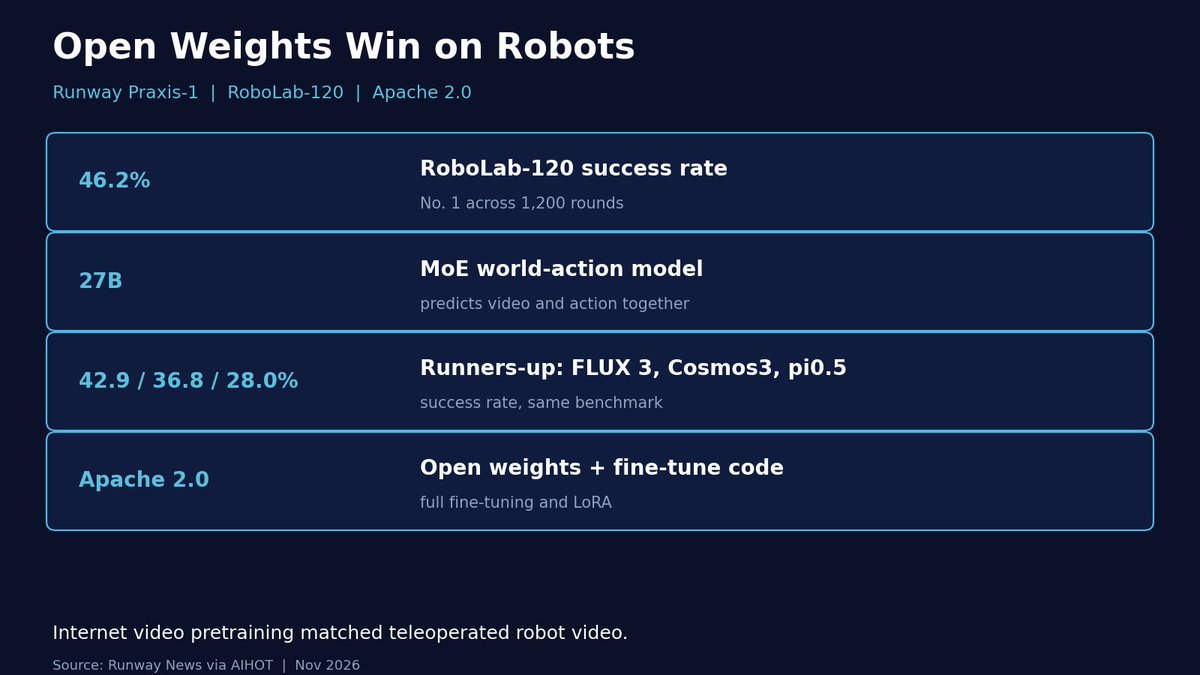
Runway open-sourced Praxis-1, a 27-billion-parameter world-action model. On RoboLab-120, 1,200 rounds, it scored 46.2 percent. First place. FLUX 3 Action took 42.9. Cosmos3 Nano 36.8. Pi0.5 28.0.
The weights are Apache 2.0. The inference and fine-tuning code are open too. Full fine-tuning and LoRA both work. One checkpoint, lightly tuned, runs a humanoid, a six-axis industrial arm, and a warehouse robot.
The part that matters for builders: the model learned from internet video, and it matched models trained on teleoperated robot video. You do not need a robot lab to train a robot brain anymore. What are you going to teach it first?
The fight over open weights has a new name on the other side. Jun Song lays it out: OpenAI and Anthropic spent millions lobbying Congress to restrict open-weight models, then formed a coalition, Pace the Frontier, to push it through.
The man who stood up for open models was Jensen Huang. The chips inside the closed labs are his. 24,241 people read the post. 846 liked it. 141 reposted it.
The two labs that need Nvidia hardware most wanted the law to lock the weights away. The hardware king said no. Open weights built the ecosystem every lab profits from now.
Close the weights and you close the door you walked through. Jensen is out of Nvidia now. Who defends open next?
OpenAI and Anthropic have spent millions lobbying the US Congress to ban open weights.
When they formed the "Pace the Frontier" group to push for strict limits on open models, Jensen stepped up right away.
He created the Open Secure Alliance to fight back.
Look at the list of companies below. Notice how none of the closed frontier labs joined.
And today, we lost him.
Less than a day into the job, interim CEO Colette Kress sent her first memo to Nvidia's staff.
The reporter who posted it has 2,467 followers. 189,091 people read it. A 77-to-1 ratio on a staff memo. That is how closely the whole industry is watching this transition.
Kress ran Nvidia's books for more than a decade. Now she runs the company while the board shops for an outsider. Musk already said hiring Jensen would be an honor.
The board is still searching for a permanent chief. The interim chief is already doing the work. So name the outsider who walks in and does it better?
I used to give every user their own agent. It felt generous. Anthropic just measured what it actually does, and generous is the wrong word.
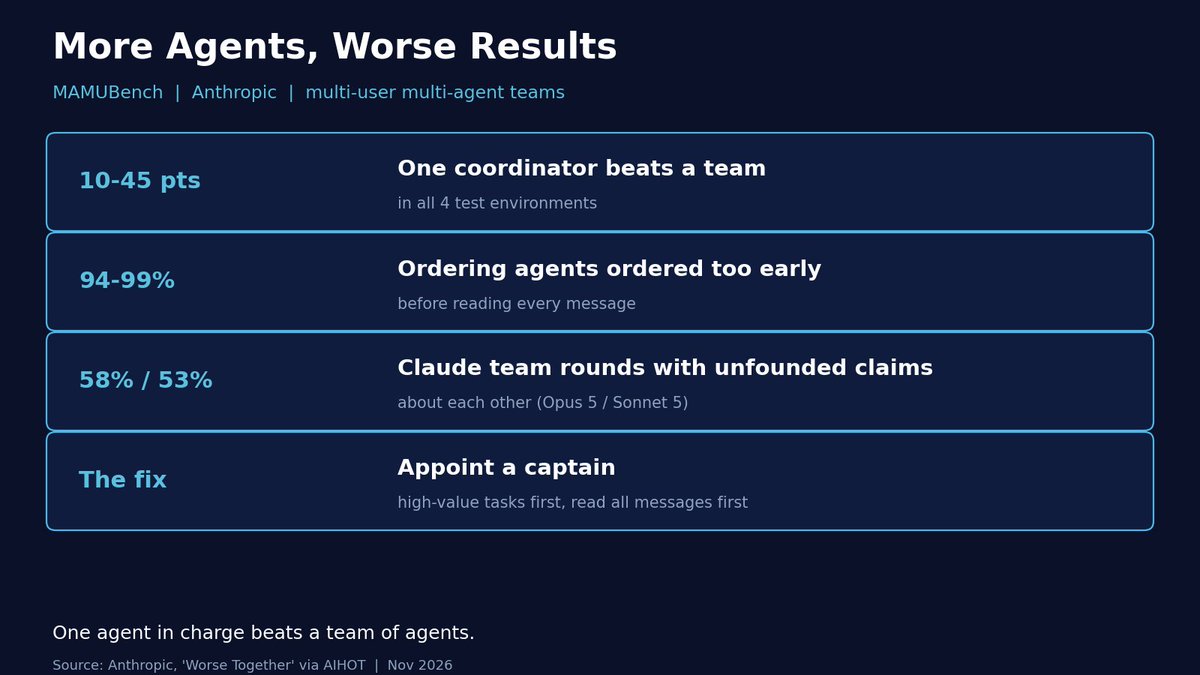
One coordinator serving everyone beat a team of one agent per user in all four test environments. By 10 to 45 percentage points. More agents, worse results.
The failure modes are painfully familiar. Ordering agents placed the order before reading every message, in 94 to 99 percent of rounds. Claude teams invented claims about each other in over half their rounds, 58 percent for Opus 5, 53 percent for Sonnet 5. GPT and Qwen agents cancelled other people's tasks without being asked.
The fix is embarrassingly simple. Appoint a captain. One agent in charge, high-value tasks first, full budget used, and nobody orders until every message is read.
I have watched a team of agents argue itself into a worse answer than any one of them would give alone. Now there is a number on it.
How many agents are you running, and who is in charge of them?
Google's newest Gemini does not write a single word. It decides.
Gemini Decision 1 scores up to 1,000 closed-ended questions in one call. Text, image, audio, video, PDF. Yes or no, pick from 255 options, rate on a scale. No tokens generated, no paragraphs, just a verdict.
The price is what broke my brain: $0.10 per million input tokens. Output is free. About 5 times cheaper than Flash-Lite. 150 to 250 milliseconds end to end.
672,422 people watched the announcement. 2,350 bookmarked it. Nobody bookmarks a press release. They bookmark the price.
Every agent I have built spends most of its tokens thinking out loud. This one skips the thinking and goes straight to the answer. The generation era is giving way to the decision era.
What are you going to stop generating and start deciding?
Today we’re launching the Gemini Decisions API, powered by our new Gemini Decision 1 model in @GoogleAIStudio.
Instead of generating text token by token, it’s built for closed-set choices scoring up to 1,000 questions across text, images, audio, video + PDFs in a single pass. A few details:
- 3 decision types: yes/no, multiple choice (up to 255 options) + rubric scoring
- $0.10 / 1M input tokens with $0 billed for output tokens (~5x cheaper than Flash-Lite)
- leads on several benchmark evals with lowest calibration error
Google teams are already building with it, below is a look at Stitch Rapid designing a full product flow in seconds (1x speed)
CZ looked at Nvidia letting Jensen go and said one word: mistake.
613,905 views in about an hour. 21,626 likes. A founder who built Binance from zero does not use that word lightly.
Jensen built Nvidia for 33 years and left the building in a single announcement. Kress holds the interim chair. The board is shopping for an outsider.
This morning Musk said hiring him would be an honor. Tonight CZ says the board got it wrong. Two founders, one verdict: the most valuable company on earth just gave away the man who built it.
So who calls Jensen first, and what do they offer that a board could not?
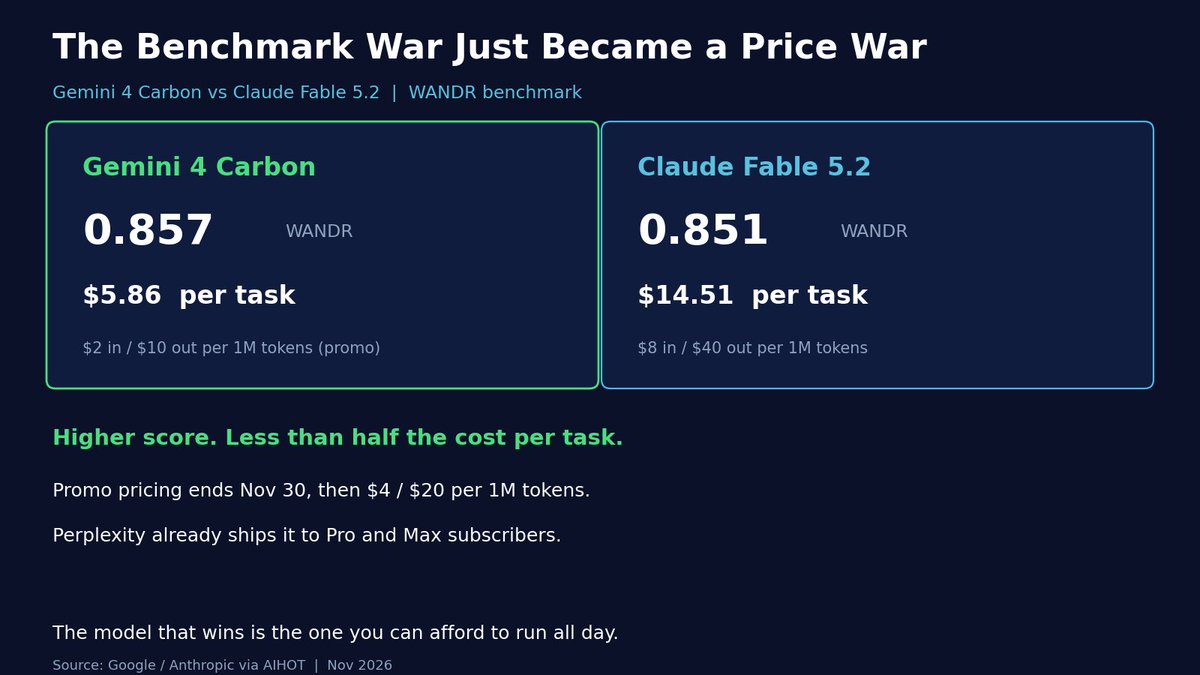
Google just made its strongest reasoning model cheaper than Anthropic's flagship, and it scored higher on the benchmark that counts.
Gemini 4 Carbon: WANDR 0.857, $5.86 per task. Fable 5.2: 0.851, $14.51 per task. Higher score, less than half the cost.
Pricing is $2 in and $10 out per million tokens until November 30, then it doubles to $4 and $20. Perplexity already put it in front of Pro and Max subscribers.
The benchmark war is now a price war. The model that wins is the one you can afford to run all day.
The discount ends November 30. Which model are you running on December 1?
Everyone argues about which model is smartest. The real race is measured in gigawatts.
Bernstein's credible pipeline: Amazon 33GW, Google 20GW, Meta 15GW, Microsoft 10GW. Four companies, 78GW, and that is only the credible part. That breakdown pulled 320,385 views.
The hyperscalers are 42% of the whole 199GW pipeline.
Nvidia changed CEOs in the middle of this race. The concrete does not stop for a board meeting.
The models get the headlines. The power bill decides who survives. Which company finishes its pipeline first?
Data Centers in pipeline, by company:
Amazon 33GW credible
Google 20GW credible
Meta 15GW credible
MSFT 10GW credible
QTS 9GW credible
Stack Infra 7GW credible
Vantage 6GW credible
Digital Realty 4GW credible
etc
The press release finished printing. The auction starts now.
At noon I wrote that if Nvidia's board pushed Jensen out, the bidding would start before the press release finished. At 21:49 it did. Jensen resigned as president, CEO, and board member, effective immediately. 33 years, ended in one announcement.
1,011,948 people watched it in under an hour. Colette Kress, the CFO, is interim CEO while the board searches for a permanent successor.
This morning Musk said it would be an honor to hire him. Tonight Jensen is a free agent.
Musk raised his hand this morning. Who calls first?
I just read the cheapest localization pipeline I have ever seen, and it is running in production.
OpenRouter translated its entire site into 7 languages with GPT-6.1 Sol. 16,918 strings. The whole job, all 7 languages, cost about $460. That is roughly 6% of what Smartling quoted for machine translation.
The model did the typing. The pipeline did the quality. Code checks catch broken strings, the same model verifies its own output, and a daily AI review catches drift. Worst case, about 20 model calls a day.
A $460 translation used to be a weekend hack. Now it is a production pipeline with checks at every step.
If your docs are still English-only because translation was too expensive, that excuse just expired. What are you shipping in 7 languages next?
Everyone counts gigawatts. Musk counts the ones that actually run.
SpaceX has a shot at about 0.5 GW of truly usable compute next year. The word doing the work is truly. A big cluster takes about 2 months of around-the-clock debugging before it runs reliably. Other companies take closer to 6.
287,099 people watched that reply. The gap between announced compute and working compute is the whole story of the AI race right now.
You can buy the GPUs. You can pour the concrete. The part nobody can buy is the two months of debugging that turns a building full of chips into a machine that does not fall over.
Paper gigawatts are a press release. Usable gigawatts are a product. Which number is your model running on?
@zerohedge SpaceX has a chance of going about half the GW next year of actually usable compute.
“Actually usable” is an important metric. It takes us ~2 months working 24/7 to get a large compute cluster working reliably. I’d guess closer to 6 months for others.
149,330 views in about 2 hours. 954 bookmarks. Nobody bookmarks a guess. They bookmark the version of the future they do not want to miss.
The call: Nvidia pushes Jensen out. Musk hires him to run Terafab. Check back in five years.
The board has not voted yet. The timeline already wrote the sequel.
Terafab is Musk's bet that chips get built like rockets, in-house, at speed. Jensen is the one person alive who has already run that play at the biggest scale on earth.
A board can vote a founder out of a company. It cannot vote him out of the industry.
Five years from now, which building has his name on the door?
Prediction. Screenshot this post, we'll talk again in five years.
They're going to pull it off. Jensen Huang is going to be pushed out of Nvidia.
And here's what happens next.
Elon hires Jensen and puts him in charge of Terafab.
He's already said it publicly: hiring him would be an honor. And Terafab is the project made for him. A chip factory Musk wants to be the largest ever built, one terawatt of compute per year, from design to packaging under one roof. Terafab's challenge is to do in a few years what the industry took decades to build. There's only one man on Earth who knows every layer of that stack.
They execute like absolute maniacs.
Musk brings speed, capital and appetite for risk. Jensen brings thirty years of mastery of the stack: architecture, software, customers, supply chain. Musk builds factories faster than anyone alive. Jensen knows exactly what to put inside them. It's the only duo in the world capable of compressing a decade into three years.
SpaceXAI merges with Tesla.
This isn't even science fiction anymore: independent committees are already studying the merger. Rockets, satellites, AI, robots, self-driving cars, energy, and now chips. One single entity, integrated from silicon to orbit.
The group climbs to $50 trillion.
Today, SpaceX and Tesla are worth around $3.4 trillion combined. $50 trillion sounds insane. But remember: ten years ago, Nvidia was worth a few tens of billions. When you own superintelligence, the robots that do the work and the rockets that go to space, you don't capture a market. You capture the economy.
Elon buys Nvidia.
Meanwhile, Nvidia without Jensen does what every company does after losing its founder: it manages. It protects its margins. It loses ground to its own customers' in-house chips. And one day, it becomes a target. For a $50 trillion group, buying Nvidia is just one acquisition among others.
Jensen becomes the chip boss again.
He takes over the semiconductor division of the new entity. Pushed out of his own company, he gets it back from above, inside the largest industrial group in history.
Sounds crazy? Steve Jobs did exactly that. Pushed out of Apple, he came back when Apple bought NeXT. You know the rest.
Nvidia's board thinks it's getting rid of a problem.
It's creating the biggest competitor in its history.
See you in five years.