While Europe was under ice, someone in Ratnagiri carved a 14-metre map of India.
It's an elephant. Head west to the Konkan, tail east.
Inside it: a tiger in the east, a langur in the north, a boar in Madhya Pradesh, a pangolin in the south. Each animal where it actually lives.
Seven mountains. The Mahabharata also names seven. It was carved 10,000 years before the Mahabharata.
Now the part that should end the argument.
The map's width-to-height ratio is 1.167. Modern India is 1.04. Doesn't match.
Because they weren't mapping modern India.
Reverse-solve 1.167 against the coastline of 12,000 BCE — when the sea was 120m lower and the Sunda Shelf was dry land — and the eastern edge lands at ~100.9°E.
The eastern shore of the Malay Peninsula. The exact limit of the world you could walk to from India at the time.
A decorative outline doesn't do that. A map does.
The oldest known map is supposed to be Çatalhöyük, ~6,200 BCE. This predates it by 6,000 years.
It's on an open plateau. People play cricket near these carvings. The monsoon is erasing it.
Full paper, free, permanent:
DOI: 10.5281/zenodo.20516459
#Ratnagiri #Archaeology #History
Modi-hatred is almost a requirement to be called an "intellectual" in some circles. We have to counter them, so let's recall some history.
Congress had left Punjab, Kashmir, Assam all burning. The Naxal menace had made middle India ungovernable. Bihar and UP had become lawless. Bengal stagnated and deteriorated.
Today, Bengal has been rescued from the lawless TMC. For the first time since my childhood, we can discuss development and progress in all these states. We can disagree on specific paths to development, but at least we get to have that conversation.
These achievements did not happen magically. They required a lot of hard work and sacrifice - and all of it happened democratically. Let us not forget that Congress used Article 356 very often to dismiss state governments and now they lecture us on "democratic values".
If we elect the wrong crowd, we risk losing all the gains we have made.
Modi and Shah have provided strong and resolute leadership that has allowed these useless intellectuals to indulge their Modi hatred. Deep down, even they know the truth.
Must watch how Modi ji transformed India. Tough times ahead, but because of Modi we can easily sail through.
The situation was scary in 2008 under Congress-led UPA rule by the so-called great economist PM Moun muni.
Let me explain what just happened today because it deserves so much recognition.
GalaxEye is a Bengaluru startup founded in 2021 by IIT Madras engineers. Today they launched Mission Drishti on a SpaceX Falcon 9. It is India's largest privately built satellite at 190 kg. And it carries a technology that no commercial satellite has ever carried before.
Normal satellites take photos of the Earth using optical cameras. Like your phone camera, but from 500 km up. The problem is obvious. Clouds. Night. Fog. Smoke. If any of these are in the way, the photo is useless. India has monsoon cover for 4 months a year. That is 4 months where optical satellites are partially or fully blind over large parts of the country.
The alternative is SAR. Synthetic Aperture Radar. Instead of taking photos with light, it sends radar waves down and reads what bounces back. Radar goes through clouds, through darkness, through smoke. A SAR satellite can image a flooded village at 2 AM during a cyclone when no optical satellite can see anything.
The problem with SAR is that the images look nothing like photos. They look like grainy black-and-white radar maps. A military analyst or a trained geospatial engineer can read them. A farmer, a disaster response team, or a city planner cannot.
Until today, if you wanted both optical and SAR data for the same location, you needed two different satellites, passing over at different times, at different angles. Then someone had to manually align and fuse the two datasets. Expensive, slow, and the data never perfectly matched because the satellites saw the same spot minutes or hours apart.
GalaxEye put both sensors on one satellite. Optical and SAR, fused into what they call OptoSAR. Three times more information than a single sensor. Processed onboard by an NVIDIA AI chip at 1.8 metre resolution.
Now in practice, during the next cyclone hitting Odisha, one satellite pass gives you a clear image of which villages are flooded, which roads are cut, and which buildings are standing. Day or night. Cloud or clear. In near real-time.
For defence, it means you can monitor a border area 24/7 regardless of weather. For agriculture, it means tracking crop health across an entire monsoon season without a single cloud gap. For infrastructure, it means monitoring construction progress on highways and bridges without waiting for a clear day.
GalaxEye tested their SAR tech on ISRO's POEM orbital platform. The satellite was tested at ISRO facilities. IN-SPACe provided regulatory clearance. NSIL, ISRO's commercial arm, will distribute the imagery globally. And it launched on SpaceX because ISRO's PSLV doesn't have the right orbit slot for this mission.
Yes, four IIT Madras graduates built a world-first satellite in 4 years in Bengaluru.
Take a bow!
In the 1980s, most IITians would go abroad. In 1989, when I graduated from IIT Madras, I remember feeling extremely dejected about our country. Punjab, Kashmir and Assam were all burning.
My heart was not in engineering. I was mostly reading books in Economics and Philosophy - we had a good library. The burning question in my mind was "Why are we so poor?"
Some of my classmates and I wrote an article in the IIT campus newspaper in late 1988-early 1989 (there were two newspapers, Focus and Spectator, and I believe we published in Focus, they were reproduced using "cyclostyling" machines - please look them up!).
In my vague recollection, the thrust of the article was that the IIT system was failing to serve the needs of the country and the country itself was facing a profound stagnation (I wish I could get that article now - a copy may be in some dusty basement in IIT). I want to know what I thought and said as a 21 year old in 1989 that I agree with and what I disagree with today.
By 1989, I had become a committed anti-socialist, having lived through the socialist stagnation of India. By 1989, the collapse of the Soviet Union was on, and China was in turmoil - the Tinananmen student protests and their forced suppression.
By 1991, India needed an emergency IMF loan. The 1991 economic reforms by Shri Manmohan Singh happened due to pressure from the IMF. So you can imagine the mood in 1989.
That was the India I left in 1989. I was feeling miserable to leave but hopeless to stay. In 1990, I came home for a visit and thought of dropping out of my PhD and staying home. I was home sick.
I started to study Singapore and Japan during 1990-94 in my PhD years - the "Why are we so poor" question. By 1994, I decided I would be in the private sector and took up an R&D job in Qualcomm.
My Telugu and Kannada brethren.. let's support delimitation.
Finally, KL and TN influence will reduce and we both will get to seat appropriately.
TN+ KL -60
KA + Telugu stated - 70.
We got cheated back then..
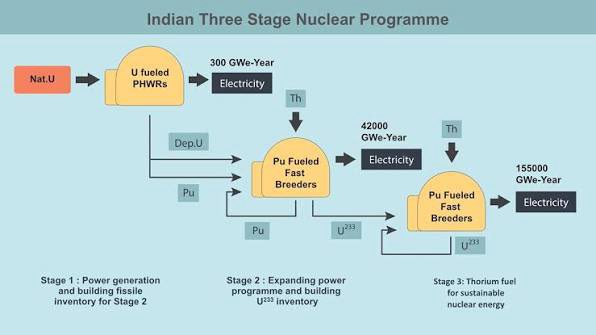
The famous 3 stages of India’s nuclear energy program. (Today we cracked 2nd stage here - BARC calls it 3rd as 2nd was PFBTR (prototype))
Stage 1 : Convert uranium into plutonium..
Natural uranium has very little fissile U-235. In PHWRs, U-235 undergoes fission to produce energy, while the abundant U-238 absorbs neutrons and converts into plutonium-239 (Pu-239).
You generate power and create fissile material for the next stage.
Examples: Rajasthan Atomic Power Station, Kakrapar Atomic Power Station, Narora etc
Stage 2 : Breed more fuel using fast neutrons
Fast breeder reactors use Pu-239 as fuel. When it fissions, it releases high-energy neutrons that convert surrounding U-238 or thorium into more fissile material (Pu-239 or U-233).
Net effect: you create more fuel than you consume (breeding).
Examples: Fast Breeder Test Reactor (critical today and Modi ji called it out, Prototype Fast Breeder Reactor - Base tech demonstrator)
Stage 3 : Thorium to Uranium-233 cycle
Thorium-232 is not fissile, but it absorbs a neutron → becomes Uranium-233, which can sustain a chain reaction.
👉 This enables long-term energy using India’s vast thorium reserves.
Example: Advanced Heavy Water Reactor (planned)
In one line:
Uranium → Plutonium → Thorium → U-233 → Sustainable nuclear fuel cycle
Not many know this, but I used to get trolled online for saying that Bhabha Atomic Research Centre was once home, few really understood what I meant. Trolls said when I returned from US since then BARC was making this..
defence bros this is BARCs Kaveri Engine on AMCA moment (yes, that big)
Space bros it is BARCs gaganyaan moment
Tonight I am alking through the night to reach the mountain top.. just in time to witness tomorrow’s sunrise from a place where the raw material journey once began.
This is Stage 3, folks.PFBTR to FBTR
Stage 3.. (actual 3 will be Th Reactor) where reactors move from consumption to creation. The Fast Breeder Test Reactor offers a glimpse of that future, using fast neutrons to generate more fuel than it burns.
Somewhere, Homi J. Bhabha would be smiling. And I’d really love to send a card to Anil Kakodkar sir today.. probably I will :)