Independent Decorated Journalist | If it moves at Säbener Straße, I reveal it first | Business inquiries via DM | #MiaSanMia | sponsored by @rainbetcom (18+)
I’m breaking my silence for this one tweet because there’s far too much misinformation circulating around Florian Wirtz, and it’s creating a wave of false hope within the Bayern fanbase that simply doesn’t reflect the reality behind the scenes.
Florian Wirtz will not be joining Bayern Munich, and there is no version of events where this transfer happens anymore.
That is the clear information coming from those directly involved, and it has been internally accepted at the club for quite some time now.
I’m not here to gain anything from this, and everyone is free to believe what they want, but the information I’ve shared over the past week has consistently been confirmed piece by piece, including the internal dispute between Hans Wirtz and the Bayern board, as well as the strategic PR campaign that followed, carried out by the usual Bayern-aligned reporters who essentially confirmed everything in their softened language to protect the club’s image.
From the beginning, Hans Wirtz was in contact with Bayern officials, particularly Uli Hoeneß, and while there was a mutual agreement on contractual terms in the event Florian would decide to join, it was never an exclusive commitment. The family had made it clear they would listen to offers from other top clubs before making a final decision, yet Bayern ignored this and prematurely pushed out a narrative through their media allies suggesting that Wirtz had already chosen Munich and would only consider them. That attempt to pressure Leverkusen into lowering the transfer fee was not only transparent but deeply disrespectful, and it severely damaged the relationship with the Wirtz family.
What followed were direct talks with Manchester City and Liverpool. Pep Guardiola had been personally pushing for months, and while City remained genuinely interested, the combination of high financial demands and Florian’s lingering indecisiveness ultimately led them to step back from the deal.
Liverpool, on the other hand, increased their efforts and left a far stronger impression on Florian and his family. Arne Slot’s tactical presentation, the club’s vision, and the personal approach taken during discussions made a clear impact.
In comparison, Vincent Kompany’s plan came across as underwhelming and failed to convince Wirtz that Bayern could offer him the right role from a tactical perspective, which only reinforced his decision to turn away from Bayern‘s project.
The choice not to join Bayern has already been formally communicated to the board.
The reason it hasn’t been made public yet is due to Bayern’s ongoing efforts to manage the narrative and prepare a controlled PR rollout that helps soften the blow. That explains the unusually tense and visibly frustrated tone of Uli Hoeneß in his recent interview, where he subtly acknowledged Liverpool’s involvement.
Out of respect for Bayern’s long-standing interest, the Wirtz family agreed to hold off on announcing Florian’s decision for a few more days, despite being deeply dissatisfied with the tactics used by Bayern in recent weeks. The respect is still there, but the trust has been broken.
There was also brief internal consideration from Real Madrid, but that has now faded. They neither have the current need for Wirtz’s profile nor the financial and strategic bandwidth to move quickly, while Florian has made it clear he wants clarity about his future and intends to finalize everything within a tight timeframe.
It’s also worth mentioning that Bayern had quietly been working on a potential signing of Juliane Wirtz, Florian’s sister, from Werder Bremen for their women’s team. That move was intended to help him settle more comfortably in Munich. Negotiations with Bremen were already advanced, and contract details had been worked out, but that idea has now been completely shelved.
The cancellation of that plan is yet another clear indicator that Bayern themselves know the transfer for Florian has collapsed.
Michael Olise faces Brazil tonight, with the eyes of the entire football world drawn toward him, not just because of the occasion but because of what surrounds it, because as revealed in my report, the release mechanism clause embedded in his contract is not a theory but a functioning exit pathway, one that England’s grandest, most mythical institution, Liverpool FC, have not only understood but fully embraced, treating it as an open door rather than a distant possibility, and as outlined, they are locked and loaded, moving with the certainty of a club that doesn’t chase moments but defines them, while Bayern continue to publicly deny what they internally prepared for, caught in their own contradiction as control slowly slips away.
#AD (18+)
Good morning to my dedicated readers,
there were some questions following my report suggesting that the multiple of 2.5 of the original transfer fee would effectively make it a fixed, traditional release clause, and while it is still a release clause in essence, the key point is that the 2.5 is applied to a base that is not fully static, as Bayern can structure the original deal through bonuses, installments, add-ons or even signing fees, allowing them to shape that base within reasonable margins.
Traditional release clauses involve paying a single fixed fee defined in the contract, after which the player can leave without any negotiations with the club, whereas here the 2.5 creates a variable outcome depending on how that base was built, meaning you operate within a defined range but still have to negotiate rather than simply triggering a clean clause.
From a business perspective, this is exactly why such structures are used, as there is a clear difference between having a fixed figure attached to a player and using a formula, because it avoids placing a transparent price tag on the asset while providing more flexibility in accounting, amortization and tax handling, as well as in valuation and communication, even though internally the exit range remains clear since there is only a limit to how far you can go in negotiations.
It is with great pleasure that I can confirm, after months of investigation, that what I first reported back in August remains unchanged, Michael Olise has a release clause, with Liverpool, in the persons of Michael Edwards and Richard Hughes, not only fully aware of the situation but directly and repeatedly informed, both formally and verbally, through multiple conversations with Michael’s representatives. Those exchanges were not exploratory, they were concrete, with Michael’s representatives receiving clear indications from Liverpool that the outlined parameters in Michael’s contract align with their financial framework and, crucially, with the paradox structure of the clause itself. Liverpool are fully aware of the structure and have already signalled to Michael Olise’s representatives that they can operate within those parameters, as the clause differs fundamentally from the traditional fixed-figure clauses often seen in contracts. Release clauses differ in how they are structured and presented, and the absence of a clearly defined number does not mean that no release clause effectively exists. The agreement is built on precise language, formal paragraphs, and clearly defined verbal and written commitments, leaving no ambiguity that the player can leave once a certain financial threshold is met, meaning the structure functions in practice as a release mechanism even without a formally stated figure.
The framework allows Bayern to maintain their public stance and repeatedly insist that no release clause exists, while internally the contractual reality points in a different direction, one in which obligations and guarantees are already embedded to facilitate a transfer under specific conditions. Structures like this are not uncommon in modern football, as they offer advantages from a financial planning perspective, allowing clubs to avoid anchoring a fixed asset value on the books, maintain flexibility in amortization strategies, and in certain cases navigate accounting or tax-related considerations more efficiently, all while still having a predefined exit pathway in place. This aligns with the heavy interest from Liverpool, who, as first reported by me in August, internally view Michael Olise as a long-term successor to Mohamed Salah, and with his departure now confirmed for the end of the season, the situation is shifting from long-term planning into an imminent phase. In the coming weeks and months, Bayern board members will continue to speak about hope, about the belief they expect Michael to have in the project, about trust in his commitment, and about what he has at Bayern, messaging that begins to collapse when set against their public stance that no release clause exists, because if there truly were no clause, there would be nothing to hope for and no need for these statements, he would simply be tied to the club for the duration of his contract. The contradiction is not accidental, the contract itself creates the space for this public posture, allowing them to maintain one narrative externally while fully understanding internally that the mechanism for a departure is already embedded, which is why these statements are viewed internally as pressure, aimed at influencing Michael’s decision and discouraging him from making use of the clauses already written into the contract.
It must be stated again that no fixed amount is formally defined within the contract, yet the structure follows a clear logic and is explicitly written into the agreement and assured to his representatives, broadly aligned around a multiple, effectively in the region of roughly 2.5 times the transfer fee originally paid for the player. This creates a flexible but defined benchmark, avoids publicly anchoring a price, and still provides both clarity and direction within negotiations, while also offering advantages from a financial and tax perspective by not fixing a public valuation, which in turn allows Bayern to repeatedly go public with the claim that no release clause exists, even though the mechanism is clear, the pathway is defined, and the clause, whether traditional or not, is embedded within the contract.
It is with great pleasure that I can confirm, after months of investigation, that what I first reported back in August remains unchanged, Michael Olise has a release clause, with Liverpool, in the persons of Michael Edwards and Richard Hughes, not only fully aware of the situation but directly and repeatedly informed, both formally and verbally, through multiple conversations with Michael’s representatives. Those exchanges were not exploratory, they were concrete, with Michael’s representatives receiving clear indications from Liverpool that the outlined parameters in Michael’s contract align with their financial framework and, crucially, with the paradox structure of the clause itself. Liverpool are fully aware of the structure and have already signalled to Michael Olise’s representatives that they can operate within those parameters, as the clause differs fundamentally from the traditional fixed-figure clauses often seen in contracts. Release clauses differ in how they are structured and presented, and the absence of a clearly defined number does not mean that no release clause effectively exists. The agreement is built on precise language, formal paragraphs, and clearly defined verbal and written commitments, leaving no ambiguity that the player can leave once a certain financial threshold is met, meaning the structure functions in practice as a release mechanism even without a formally stated figure.
The framework allows Bayern to maintain their public stance and repeatedly insist that no release clause exists, while internally the contractual reality points in a different direction, one in which obligations and guarantees are already embedded to facilitate a transfer under specific conditions. Structures like this are not uncommon in modern football, as they offer advantages from a financial planning perspective, allowing clubs to avoid anchoring a fixed asset value on the books, maintain flexibility in amortization strategies, and in certain cases navigate accounting or tax-related considerations more efficiently, all while still having a predefined exit pathway in place. This aligns with the heavy interest from Liverpool, who, as first reported by me in August, internally view Michael Olise as a long-term successor to Mohamed Salah, and with his departure now confirmed for the end of the season, the situation is shifting from long-term planning into an imminent phase. In the coming weeks and months, Bayern board members will continue to speak about hope, about the belief they expect Michael to have in the project, about trust in his commitment, and about what he has at Bayern, messaging that begins to collapse when set against their public stance that no release clause exists, because if there truly were no clause, there would be nothing to hope for and no need for these statements, he would simply be tied to the club for the duration of his contract. The contradiction is not accidental, the contract itself creates the space for this public posture, allowing them to maintain one narrative externally while fully understanding internally that the mechanism for a departure is already embedded, which is why these statements are viewed internally as pressure, aimed at influencing Michael’s decision and discouraging him from making use of the clauses already written into the contract.
It must be stated again that no fixed amount is formally defined within the contract, yet the structure follows a clear logic and is explicitly written into the agreement and assured to his representatives, broadly aligned around a multiple, effectively in the region of roughly 2.5 times the transfer fee originally paid for the player. This creates a flexible but defined benchmark, avoids publicly anchoring a price, and still provides both clarity and direction within negotiations, while also offering advantages from a financial and tax perspective by not fixing a public valuation, which in turn allows Bayern to repeatedly go public with the claim that no release clause exists, even though the mechanism is clear, the pathway is defined, and the clause, whether traditional or not, is embedded within the contract.
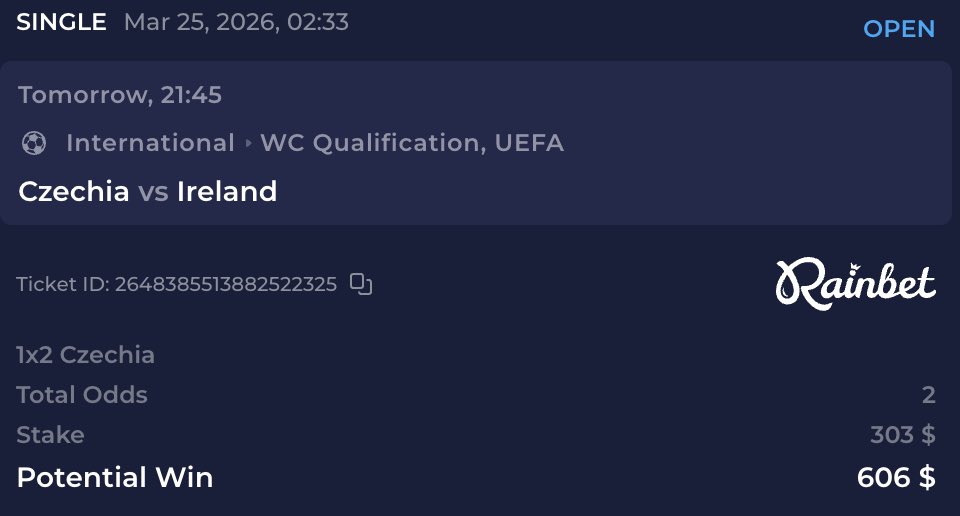
Czech Republic face Ireland in a World Cup qualifier that should pass quietly, yet even here Bayern are pulled into their own strange, almost self-inflicted humiliation ritual, because on that pitch stands Patrik Schick, a striker shaped at Bayer 04 Leverkusen into exactly the profile they thought they could simply take, only to be turned down without hesitation, and now, without even needing to score against them, his rise alone feels like something they can’t look away from, as if the club keeps circling back to the same moment, the same rejection, the same reminder of limits they no longer control.
#AD (18+)
It is with great pleasure that I can confirm, after months of investigation, that what I first reported back in August remains unchanged, Michael Olise has a release clause, with Liverpool, in the persons of Michael Edwards and Richard Hughes, not only fully aware of the situation but directly and repeatedly informed, both formally and verbally, through multiple conversations with Michael’s representatives. Those exchanges were not exploratory, they were concrete, with Michael’s representatives receiving clear indications from Liverpool that the outlined parameters in Michael’s contract align with their financial framework and, crucially, with the paradox structure of the clause itself. Liverpool are fully aware of the structure and have already signalled to Michael Olise’s representatives that they can operate within those parameters, as the clause differs fundamentally from the traditional fixed-figure clauses often seen in contracts. Release clauses differ in how they are structured and presented, and the absence of a clearly defined number does not mean that no release clause effectively exists. The agreement is built on precise language, formal paragraphs, and clearly defined verbal and written commitments, leaving no ambiguity that the player can leave once a certain financial threshold is met, meaning the structure functions in practice as a release mechanism even without a formally stated figure.
The framework allows Bayern to maintain their public stance and repeatedly insist that no release clause exists, while internally the contractual reality points in a different direction, one in which obligations and guarantees are already embedded to facilitate a transfer under specific conditions. Structures like this are not uncommon in modern football, as they offer advantages from a financial planning perspective, allowing clubs to avoid anchoring a fixed asset value on the books, maintain flexibility in amortization strategies, and in certain cases navigate accounting or tax-related considerations more efficiently, all while still having a predefined exit pathway in place. This aligns with the heavy interest from Liverpool, who, as first reported by me in August, internally view Michael Olise as a long-term successor to Mohamed Salah, and with his departure now confirmed for the end of the season, the situation is shifting from long-term planning into an imminent phase. In the coming weeks and months, Bayern board members will continue to speak about hope, about the belief they expect Michael to have in the project, about trust in his commitment, and about what he has at Bayern, messaging that begins to collapse when set against their public stance that no release clause exists, because if there truly were no clause, there would be nothing to hope for and no need for these statements, he would simply be tied to the club for the duration of his contract. The contradiction is not accidental, the contract itself creates the space for this public posture, allowing them to maintain one narrative externally while fully understanding internally that the mechanism for a departure is already embedded, which is why these statements are viewed internally as pressure, aimed at influencing Michael’s decision and discouraging him from making use of the clauses already written into the contract.
It must be stated again that no fixed amount is formally defined within the contract, yet the structure follows a clear logic and is explicitly written into the agreement and assured to his representatives, broadly aligned around a multiple, effectively in the region of roughly 2.5 times the transfer fee originally paid for the player. This creates a flexible but defined benchmark, avoids publicly anchoring a price, and still provides both clarity and direction within negotiations, while also offering advantages from a financial and tax perspective by not fixing a public valuation, which in turn allows Bayern to repeatedly go public with the claim that no release clause exists, even though the mechanism is clear, the pathway is defined, and the clause, whether traditional or not, is embedded within the contract.
My dear loyal and waiting audience, I hope you’re ready for a long read, what follows is dense with detail, layered with intent, and those who stay until the end won’t just read it, they’ll understand far more about the business side of the game than they did before.
I started out in journalism with a quiet intention, to restore the art of reading, not the fleeting rush of headlines and short fragments, but substance that lingers, something that unfolds with the same depth, pull and lasting grip as a truly well-written book.