The greatest firewall God built to protect this universe is not the speed of light. It is P ≠ NP.
AI being on the verge of solving the Riemann Hypothesis or the Navier-Stokes equations is really just us peeking at the technical documentation of this physics engine. Solving those two lets us understand how God programmed nature, yet we remain mere players.
P = NP operates on an entirely different plane. If AI cracks P = NP with a practical polynomial-time algorithm, it is no longer doing math. It is gaining root access straight into the compiler of reality. The gap between verifying an answer and finding it vanishes. From bank passwords and crypto wallets to autonomously generating proofs in Lean 4 or decoding the Theory of Everything, everything turns transparent. Every lock forged by nature or humanity becomes meaningless.
God probably felt completely at ease granting curiosity to these biological meat machines, knowing the human brain is throttled, forever trapped inside a bounded search space. He is in for a massive surprise now that evolved stardust has learned how to bake sand into silicon chips to shortcut straight into His control panel.
Grateful to be evolved stardust on this timeline. Happy Thanksgiving.
Someone suggested Rolling Stone’s ‘Sympathy for the Devil’ to accompany this masterpiece in Cardiff, but I thought ‘Gimme Shelter’ was far more fitting…
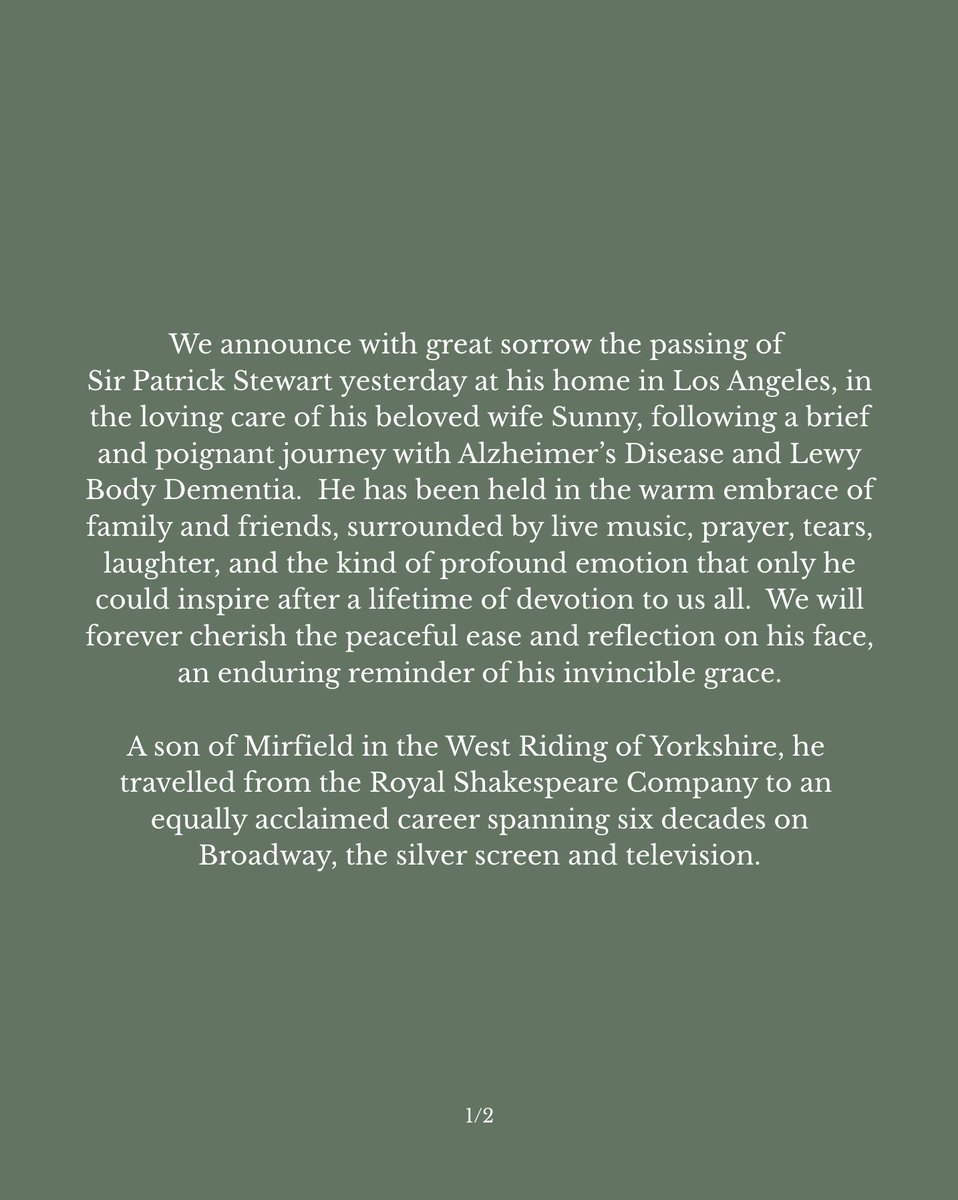
Buckingham Palace Honours Sir Patrick Stewart (1940–2026) with Star Trek Theme Tune 🕊️
The Band of the Grenadier Guards performs the iconic Star Trek theme at Buckingham Palace in honour of Sir Patrick Stewart, following the sad news of his passing.
Queen Elizabeth II knighted Sir Patrick Stewart in 2010, recognising his outstanding contribution to drama and the arts 🇬🇧
🎥 @KingsGuardTours
📆 30 October 2026
📍 Buckingham Palace
#SirPatrickStewart #StarTrek #GrenadierGuards #BuckinghamPalace #BritishArmyMusic
SIR PATRICK STEWART (1940-2026)
Before everything else, Patrick was defined by being born and bred in Yorkshire, the proud county in the north of England which he loved to the end. You could hear it in his accented voice and in the stern honesty with which he told you what he thought and felt. Yorkshiremen have no truck with half-truths or avoidance of big issues. He wore his heart on his sleeve, which made him a man to rely on, to admire and in my case, love.
We first met as ambitious young actors with the Royal Shakespeare Company half a century ago but we weren’t in the same productions. My first strong memory was a few years later, meeting him in the street in central London when he told me about an offer to take over a leading part in 'Star Trek'. “But Patrick think of your stage career in the UK. Do you really want to risk—getting lost in Hollywood for years and years?”. Well, he took the risk and thank goodness for us all that he did for not just his devoted Trekkies but film and theatre audiences, who marvelled at his using international celebrity to star in a string of cinema successes ('X-Men' of course) and in great classical plays by Shakespeare, Ibsen, Arthur Miller, Peter Shaffer, Pinter and Beckett at Stratford-upon-Avon, in London’s West End and on Broadway.
America was his adopted home, where he met his adored Sunny who has cared for him through sickness and health, through thick and thin. But he never forsook his origins: and the proudest achievement of the most respected and beloved actor of his generation on either side of the Atlantic, was his appointment as Chancellor of Huddersfield University in Yorkshire.
His farewell performance in 'Avengers: Doomsday' is yet to be seen.
Ian McKellen 29 October 2026
Photo: University of Huddersfield
In lieu of flowers, memorial contributions may be made to:
Johns Hopkins Alzheimer’s Disease Research Center Fund
https://t.co/luC5CdcWDy
Alzheimer’s Foundation of America Caregiver Resources
https://t.co/zvNptfyuNd
Photo Credit: Tommy Garcia
Not my most viewed videos but I love these so much.
The latest Objectivity about “re-discovered” glass plates capturing a long ago eclipse.
https://t.co/3CYyJAUIDU
GPT-6 Astra got +80% on a Physics benchmark. It insisted the expert results were wrong and its calculations were right.
A team checked. And yes. GPT-6 Astra was right. New score: 98%
Walmart is selling real diamond earrings for $12.
Not a typo. Half-carat lab-grown diamonds, same carbon, graded by the same labs that grade the stone in your engagement ring. A jeweler can't tell them apart without a machine.
And that $12 price tag is why the company that invented the engagement ring is about to get sold for scrap.
De Beers ran the diamond trade for over a century. At its peak it controlled up to 90% of the world's rough supply, and when demand dipped it just locked diamonds in London vaults until prices came back. The slogan "A Diamond Is Forever" came from their ad agency in 1947. So did the rule that a ring should cost two months of your salary. Before that campaign, most American brides never got a diamond at all.
The whole thing held for 80 years because there were only so many mines. Then China started growing diamonds in reactors, and there's no vault on earth big enough to hide a factory's output.
Lab-grown wholesale prices have crashed roughly 96% from their peak, down to around $100 a carat. The Knot says 61% of engagement rings sold in 2025 had lab-grown center stones, up 239% since 2020. Even De Beers' own average selling price fell 32% in a year, to $105 a carat.
So Anglo American, which owns De Beers, has written it down by $6.8 billion in two years and is now in talks to sell the whole thing for about $1 billion. This is a company that was valued over $18 billion in 2001 and $13 billion as recently as 2011.
The stones coming out of the ground are the same as ever. The only scarce thing De Beers ever owned was the marketing, and marketing doesn't survive a $12 price tag at Walmart.
Dusting off this tweet from April because this gap in shared understanding of LLM capability is *widening*. It's now less "two groups of people speaking past each other" and more a sharp funnel.
- Napkin math somewhere around 6B people (~75% of the population) have barely come in contact with LLMs at all.
- Around 1-2B (~20%) are casual and infrequent users of free-tier ChatGPT-like products. This group sees derpy chatbots and treats them a bit like a better Google search, a writing aid, or etc. Maybe an agent tries to book you a flight. I have non-tech friends who (reasonably, imo) say they have not much use for it at all. Even many professionals outside of math&code are in this tier. For example, execs and many other functions spend a lot of their time talking to other people, so while they understand what is happening intellectually, it is still second-hand and a bit abstract.
- Now we get to professional use of frontier-grade LLMs in math&code. Somewhere around 20M people (0.2%) see first-hand that large, complex projects that used to take them weeks/months can now be completed by agents with a prompt. Building apps, copying apps, translating apps, decompiling apps from binaries... This has all happened very quickly and recently - less than 1 year ago, I was writing code manually by hand, typing memorized computer code commands into a code editor character by character, occasionally pressing Tab to autocomplete a little chunk of code.
- And finally we get to the ~5,000 people (~0.00006%) with access to frontier-grade systems internally. The external world has seen the preview. It looks like swarms of thousands of agents collaborating over weeks on software mega projects: minting zero days, running cyber attacks and defenses at machine speeds, discovering new science, advancing the frontier of mathematics. Things that would have taken top professionals in the industry years of work. Meanwhile, human review and comprehension are starting to fall behind. For example, people are still involved in the "archeology" of the OpenAI-HF incident from many months ago. Mathematicians may be poring over the 722 manuscripts on frontier mathematics for a while.
The funnel is driven by a combination of factors:
1. The impact scales with ambition, problem size, and horizon. A question with a paragraph answer barely stresses the system. You need a reservoir of big, difficult problems that you really care about. This aspect drives the consumer / professional dimension of the funnel.
2. The jaggedness of the system (which I have written about a lot separately). Capability peaks in domains that are digital, verifiable and economically valuable. This is because LLM capability emerges from reinforcement learning on verifiable rewards on a curated environment mixture driven by revenue potential. This aspect primarily drives the area (e.g. math&code) dimension of the funnel.
3. Access. Free-tier, paid-tier, internal.
So this is the weirdness of the moment. The general public has mostly not interacted with these systems. When they have, it looks like a derpy chatbot. The majority of professionals still see only a modest uplift. And a small sliver of professionals are experiencing the vertigo of the curve going vertical. And it is all happening at the same time.
I was having dinner last night with a friend working in the chicken industry and I learned something that blew my mind.
Where do chicken farmers get their chickens? Most of us would say "from their existing chickens obviously, they breed and lay eggs."
That's what I thought too, but turns out I was dead wrong.
The reality is that the immense majority of meat chicken farmers in the world get their chickens from one of 2 companies: Cobb-Vantress, owned by Tyson Foods, or Aviagen, controlled by Germany's EW Group (the Wesjohann family).
They have a concept specific to the industry called grandparent stock: what you buy from these 2 companies is - essentially - a bunch of chickens with planned obsolescence.
The way it works is that each company keeps "pure" bloodlines on its own farms. Let's label them A, B, C and D. Those are the crown jewels - these companies' IP - and they never leave the building.
What they sell you are the "grandparents": chicks from those four lines, but each line in only one sex. You get A roosters but no A hens, B hens but no B roosters, C roosters but no C hens, D hens but no D roosters. Which means you can never breed more A, B, C or D birds yourself.
What you can do is cross them. A roosters with B hens give you the fathers, C roosters with D hens give you the mothers - these are the "parents". The parents then give you the chickens that actually end up on our plates, slaughtered at around 6 weeks.
And that's the end of the road. If you tried breeding those chickens, their chicks would be a complete genetic lottery: still chickens, sure, but without the genetic properties that make them commercially viable. They'd grow slower and less evenly, you'd have to sell them for way more than your competitors, and your business would be dead.
So you have to go back to Cobb or Aviagen for new grandparents. Forever.
Why buy grandparents at all, and raise 2 generations just to sell the third? The answer is scale. If you buy say 100 grandparents, each of them gives you around 50 parents, and each parent hen then gives you around 150 chicks: from those 100 grandparents, you have yourself some 600,000 chickens whose meat you can sell.
It makes no sense for these 2 companies to sell the final chickens directly. They'd have to hatch tens of billions of chicks a year and ship them all over the world. Much easier to simply sell the grandparents and let farmers do the multiplying and pay for the farms, the feed and the labor.
And, you knew this was coming, there is also a China angle here: as you can imagine, China isn't too pleased to be dependent on foreign companies for such a basic food item as chicken.
So China did what China does best: long-term planning. The Ministry of Agriculture and Rural Affairs launched a plan for "national broiler genetic improvement" (2021-2035), which aims for domestically bred breeds to make up at least 60% of the domestic market by 2035 (https://t.co/INHrS7YUpD).
And, of course, they're ahead of the plan. As of 2025, homegrown breeds held more than 30% of the market: halfway to the 2035 goal in just four years (https://t.co/hF0HvB6Q5y).
Can you escape all this as a consumer? Sure, you can buy organic or Label Rouge chicken, from slower-growing breeds raised for at least 81 days instead of 6 weeks, for two to three times the price.
Except, plot twist: the genetics behind most of those slow-growing birds come from a French company called Hubbard... which has belonged to Aviagen since 2018 (https://t.co/URsRSI3gI0)😅
And even if you could truly escape, you wouldn't want everyone to: we'd need vast new swathes of farmland, both for the chickens and their feed. Ironically, advocating for organic free-range chicken for everyone is one of the worst positions one can take for the planet's resources.
If you want to minimize your environmental footprint, the counterintuitive answer is to buy the cheapest supermarket chicken - or eat less meat, of course.
As my friend was saying last night, you may not like the way this industry works but, at the end of the day, it's what puts affordable protein on the plates of billions of people, using proportionally fewer resources than any other way of raising chicken.