Established in 2008, Bayside provides Change Management & Mission Critical professional services, broadband /telephone connectivity, and material support.
Never before have so many Americans been outside the labor force:
The number of Americans who are not in the labor force rose by +832,000 in June, to 105.8 million, an all-time high.
These are people who are neither employed nor actively looking for work.
This is now 2.2 million above the 2020 pandemic peak, when the global economy was shut down.
So far in 2026, 2.5 million Americans have exited the labor force.
By comparison, 68.7 million Americans were not in the labor force at the beginning of this century.
As a % of the population aged 16+, this figure is up to 38.5%, the highest since the 1970s, excluding the pandemic period.
The US job market is weak under the surface.
Container shipping rates are skyrocketing again:
The spot rate for a 40-foot container from Shanghai to Los Angeles rose to $6,482 last week, the highest since 2024.
This marks the 10th consecutive weekly increase.
Spot rates for this route have nearly TRIPLED since the Iran War began in February.
Still, the Port of Los Angeles processed more than 530,500 loaded inbound containers in June, up +13% YoY, the highest volume in any June on record.
The surge has been driven by importers rushing goods into the US ahead of the expiration of temporary tariffs on July 24th and expected new import taxes, while the Iran War continues to disrupt shipping patterns.
Supply chain stress is surging again.
My office is currently accepting U.S. Service Academy nomination applications.
Each year, it is my honor to nominate the best and brightest of South Carolina who will go on to serve our great nation. Good luck to all of this year's applicants!
US housing inventory growth is accelerating:
The monthly supply of new single-family homes rose +1.0 month in May, to 10.3 months, the highest since February 2009.
This indicator measures how many months it would take to sell all homes currently on the market at the current pace of sales.
The higher the reading, the weaker the demand relative to supply.
By comparison, the long-term median for this metric is ~6.0 months.
Since the 1970s, 6 of the 7 times this indicator surged to current levels, the US economy was already in a recession.
This comes as elevated mortgage rates and record homeownership costs are keeping buyers on the sidelines, leaving builders with growing inventories that they are struggling to clear.
The US housing market has rarely been this oversupplied.
US Treasuries are in a structural bear market:
Over the last 10 years, US Treasuries have delivered an average annual inflation-adjusted return of -3%, the worst performance since the 1980s.
By comparison, the S&P 500's average annual real return has been +12% over the same period.
This marks the widest return gap between stocks and bonds since the 1960s, when the S&P 500 returned +19% annually at the peak while Treasuries returned just +1%.
Sustained periods of negative real Treasury returns have only occurred 3 times in market history, in the 1910s, 1940s, and 1970s-1980s.
These were times when the US economy faced historic periods of inflation, in some years exceeding 10% annually.
Deficit spending and inflation are out of control.
BREAKING: Semiconductor stocks now account for a record 18.8% of the S&P 500’s market cap.
This percentage has more than TRIPLED since 2022.
Over this period, the semiconductor index, $SOX, has rallied a massive +546%.
To put this into perspective, semiconductors accounted for less than half of their current weight at the peak of the 2000 Dot-Com Bubble.
Meanwhile, the Magnificent 7 stocks now reflect a record ~33% of the S&P 500’s market value.
Tech is all that matters.
Case Western Reserve University continues to earn recognition on the global stage. 🎓
The university was one of only two Ohio institutions to place in the top 200 of U.S. News & World Report’s 2026 Best Global Universities rankings.
🔗 Learn More: https://t.co/IuYS1JYBkV
Technology CapEx spending is exploding:
The CapEx-to-Sales ratio of developed market tech firms is up to a record 11.5%.
Over the last 2 years, this percentage has risen +4 points, far outpacing any other 2-year increase in history.
To put this into perspective, the previous peaks seen in the 1990s and early 2000s were at 9.0% and 8.5%.
By comparison, the developed market excluding tech CapEx-to-Sales ratio stands at just 7.0%, below its own long-term average.
The AI buildout is also driving investment spending higher in other sectors, with utilities now leading at a CapEx-to-Sales ratio of ~23%, well above its long-term average of ~15%.
The AI investment boom is reshaping capital allocation across the entire economy.
Global capital markets are incredibly hot:
Companies have raised a record $4.7 trillion in equity, corporate debt, and bank loans so far this year.
This marks the 3rd consecutive annual increase for this point of the year.
Total capital raised is also running ~$500 billion above the 2021 post-pandemic financing boom.
The surge has been driven primarily by technology companies seeking to fund AI spending, alongside record debt issuance to finance AI infrastructure.
Furthermore, investment-grade private credit issuance is not included in these figures, despite playing an increasingly important role in financing data centers, semiconductors, and power plants supporting the AI buildout.
Investors are pouring money into AI an unprecedented pace.
@afcom Kansas City kicked off their annual KC Tech Trends yesterday morning. Kara Lowe walked us through Data Center industry news from a national and regional perspective. Over $7 trillion in new Data Center investment is forecast to take place in the next several years.
In partnership with the City of Annapolis, the Midshipman Action Group volunteered their time to shovel snow for residents in need. We support our neighbors in Annapolis and remain committed to service beyond the Yard.❄️
Inflation slowed over the course of 2025, but Americans remain frustrated that they haven’t seen more relief on prices, particularly at the grocery store https://t.co/SIOHZIECMo
The million dollar question: What happens to Silver?
This is your reminder that Silver just posted its best year since 1979 during the 2025 trade war, rising +148%.
Bonds have been getting crushed and crypto remains highly volatile, solidifying Gold and Silver as the global safe havens.
More uncertainty, less stability, and fragmented global trade are a safe haven trade's best friend.
Asset owners will keep on winning.
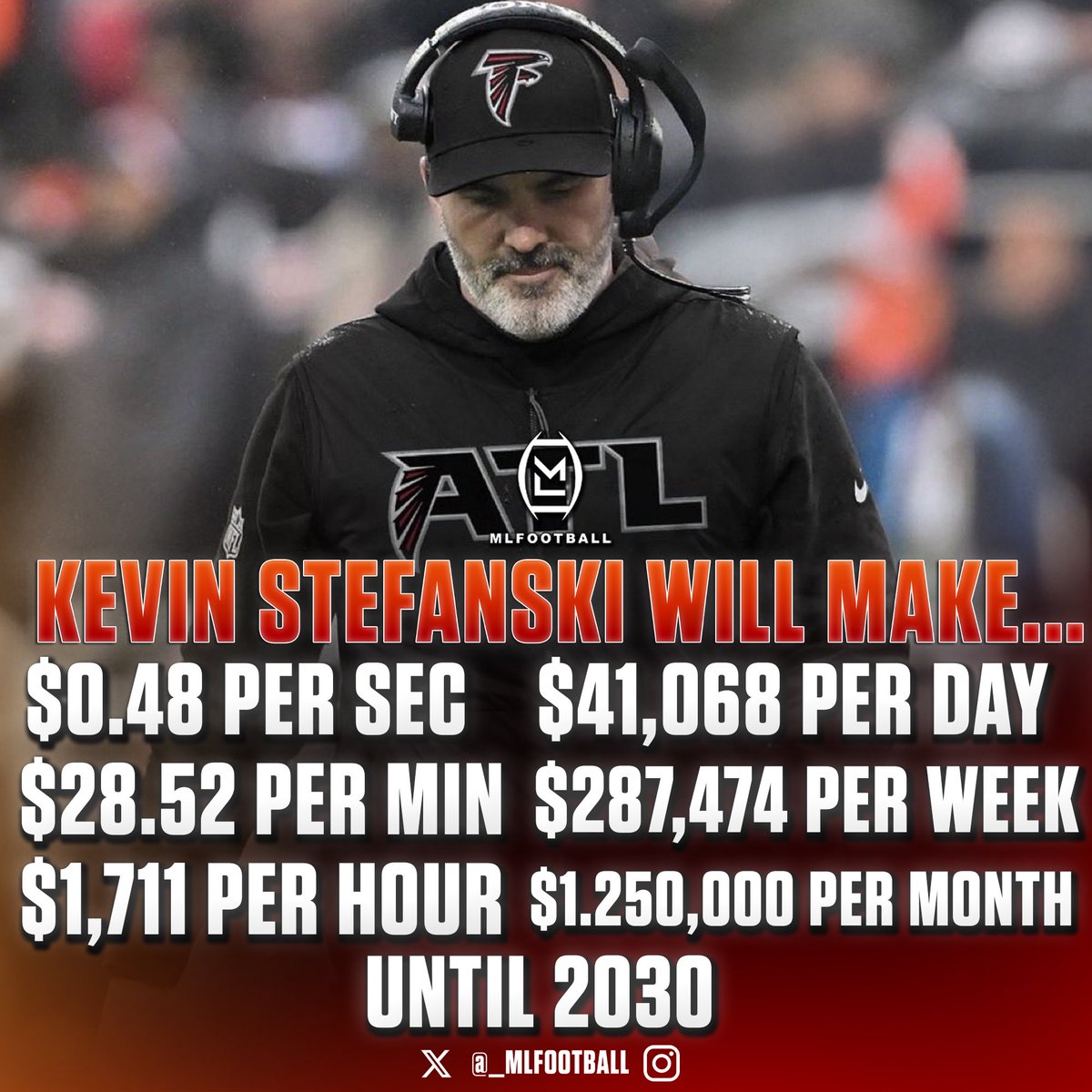
🚨BREAKING: Kevin Stefanski will make over 40 THOUSAND DOLLARS PER DAY from the #Falcons for the next 5 years.
Per second: $0.48
Per minute: $28
Per hour: $1,711
Per day: $41,068
Per week: $287,474
Per month: $1,250,000
Kevin is now one of the highest-paid coaches in the #NFL.
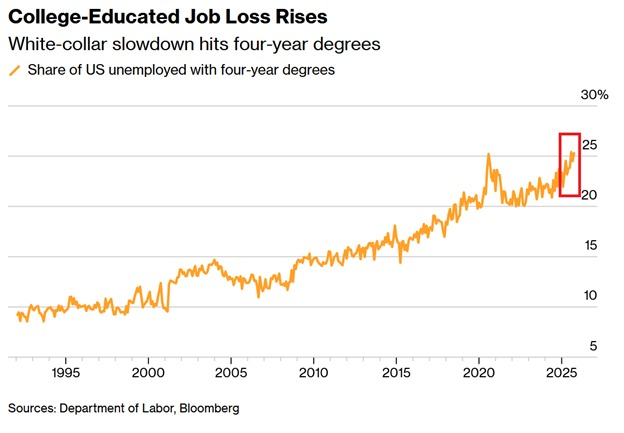
BREAKING: Americans with four-year college degrees now account for a record 25.3% of U.S. unemployment.
The percentage has doubled since 2008, leaving more than 1.9 million degree-holders age 25+ currently unemployed.
This is the highest level since data collection began in 1992.
BREAKING: Tomorrow is Warren Buffett's last day as CEO of Berkshire Hathaway.
Buffett took the stock from $19/share in 1965 to $750,000/share today, up +3,950,000%.
Congratulations to the best investor of all time.
🇨🇳 CHINA'S MAGLEV HITS 700 KM/H IN 2 SECONDS - PLANNING 1,000 KM/H - WHILE AMERICA ARGUES ABOUT FIXING POTHOLES
China just tested a maglev platform that accelerates to 700 km/h (435 mph) in 2 seconds. Target speed: 1,000 km/h (621 mph). That's faster than commercial aircraft. On the ground.
The acceleration alone is borderline violent - 0 to 435 mph in two seconds is 9.8g. Fighter jet territory. Passengers would need specialized seating just to survive the launch.
But let's address reality: This is a test platform. Prototype speeds don't mean operational trains. China announces ambitious projects constantly. Some materialize (their existing 430 km/h maglev in Shanghai works). Others disappear quietly.
The pattern though? They're attempting scale nobody else is. High-speed rail connecting every major city. Maglev research pushed to extremes. Infrastructure spending that makes Western investment look microscopic.
Meanwhile in America: Amtrak averages 105 km/h between cities. California's high-speed rail project started in 2008, burned $10+ billion, and hasn't moved a passenger. The fastest train in the U.S. hits 240 km/h for exactly one 54-mile stretch.
China's going for 1,000 km/h. Even if they only achieve 800 km/h operationally, that's still triple America's maximum.
Here's why this matters beyond trains: Infrastructure capacity signals industrial capability.
If China can build and operate 1,000 km/h trains, they can manufacture the precision components, power systems, and control mechanisms that transfer to aerospace, military, and manufacturing.
The U.S. won the 20th century partly because it built the Interstate Highway System when others couldn't.
China's betting the 21st century winner will be whoever builds impossible infrastructure first.
They might fail. Engineering challenges at 1,000 km/h are extreme - air resistance, track precision, emergency braking, passenger safety.
But they're trying while America argues whether to fix the L train in New York.
Even Chinese failure puts them ahead. You learn more from attempting the impossible than from successfully maintaining mediocrity.
Source: Xinhua, CGTN
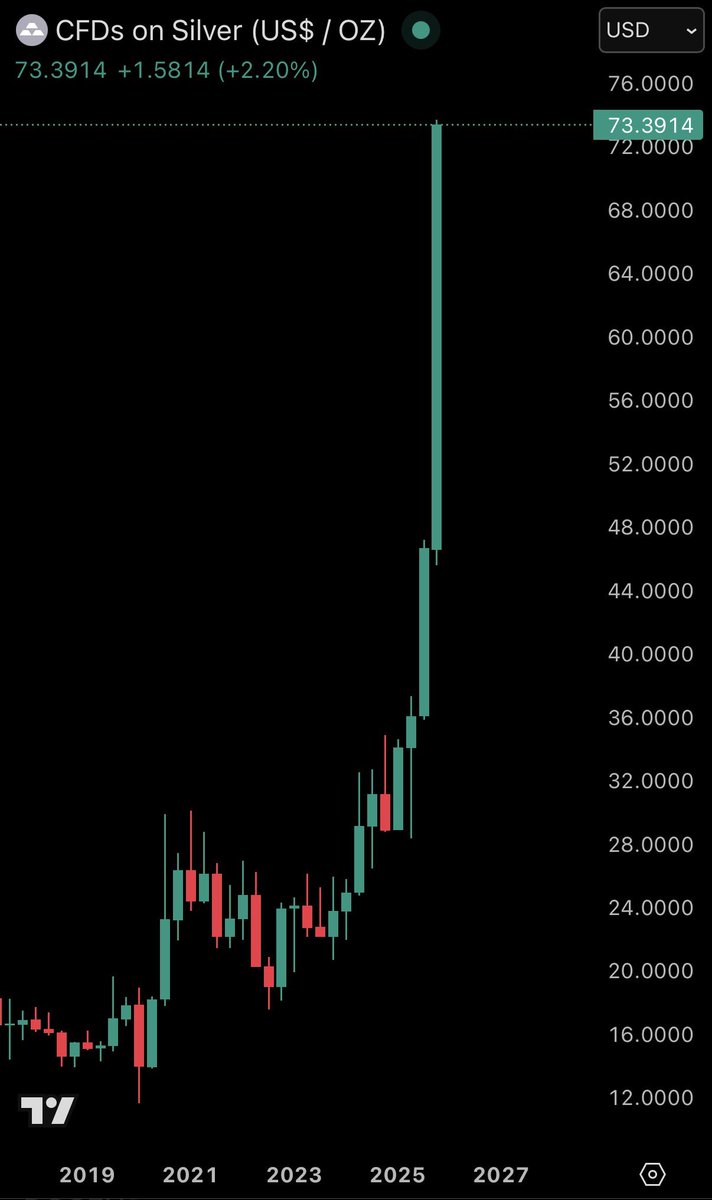
BREAKING: Spot silver prices surge nearly +$2/oz, to a record $73.67/oz, now up +154% YTD.
Silver prices are up more than +30% this month and set for an 8-month win streak.