The dirty secret of DevOps?
The best engineers aren't the ones who know the most tools.
They're the ones who've broken prod, fixed it under pressure, and built systems so the next person doesn't have to.
Scars > certifications.
Follow for more on building system reality. 🔁
Most junior DevOps engineers learn tools.
Senior DevOps engineers learn failure modes.
Kubernetes, Terraform, CI/CD — they're all just abstractions over the same question:
"What happens when this breaks at 2am?"
🧵 How to think like a senior engineer 👇
Here's what separates a good pipeline from a great one:
code deploys automatically, bad code never reaches prod
Add layers:
→ Lint + unit tests on each PR
→ Image scanning before push
→ Smoke test after deploy
→ Auto-rollback on health check failure
Ship fast. Break nothing.
3/
the actual work happens before volatility — written exit conditions tied to business performance, not price movement.
No condition met, no action taken. that's not patience. That's just having a framework when the market is loudly asking you to abandon it. #DalalStreet
1/
FIIs pulled out billions. markets went red. everyone around you was either panic selling or asking "bhai ab kya karein?"
the people who held — they didn't have more courage. they just had a decision already made before the chaos started. #FIIOutflows#Nifty
2/
FIIs exit India when the dollar strengthens, US rates move, global risk turns off. none of that touches why a good business is a good business.
their redemption pressure isn't your thesis breaking. knowing the difference is the whole game. #IndianStockMarket
1/
I never really had a "pure" role.
always somewhere in between, not fully dev, not fully ops, not fully anything.
turns out that in-between place has a name. targeting DevOps now and it actually makes sense. 🧵
Currently working on a few interesting projects for a hackathon #genaiacademy#googlecloud which includes the use of Cloud Run, MCP, BigQuery, Alloydb and lot more
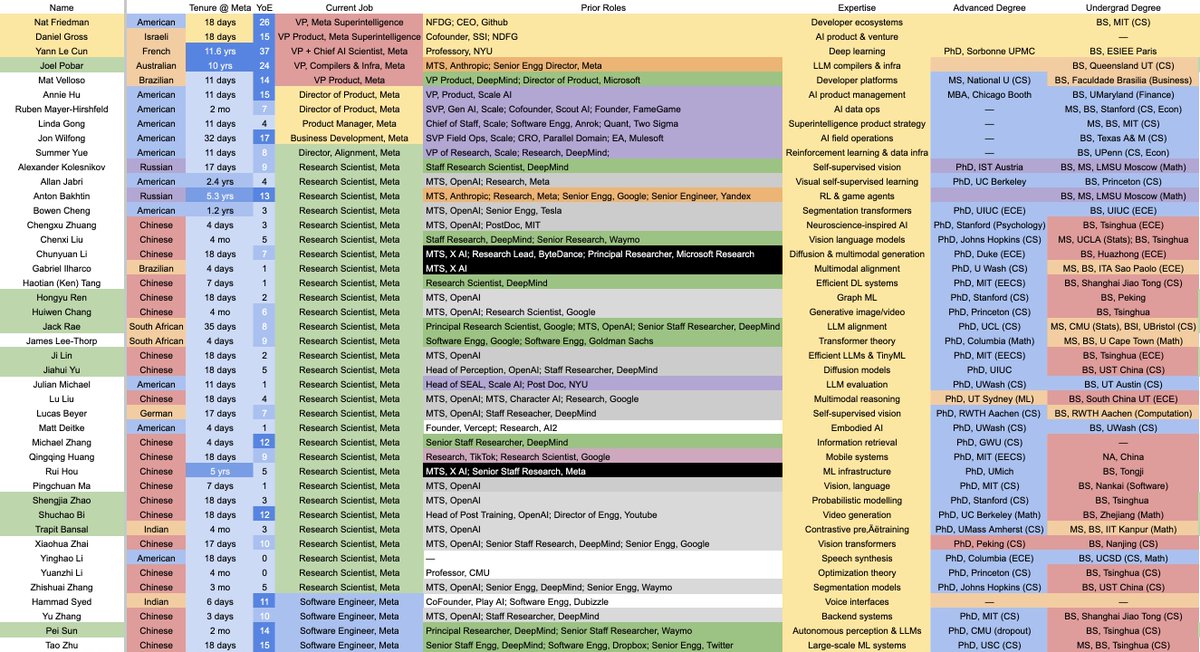
🚨 BREAKING: Detailed list of all 44 people in Meta's Superintelligence team.
— 50% from China
— 75% have PhDs, 70% Researchers
— 40% from OpenAI, 20% DeepMind, 15% Scale
— 20% L8+ level
— 75% 1st gen immigrants
Each of these people are likely getting paid $10-$100M/yr.
This weekend, I am reading a pretty chill paper on how YouTube categorizes channels :) Was really curious about what they are doing with mine :)
Google published a paper in 2013 that covered how they transitioned from manually curated channel lists to a fully algorithmic classification system, deployed across the entire YouTube corpus.
When they built this system in 2013, they shipped the most basic version possible - no audio and video understanding, no image models, no ASR. They did it with just metadata, entities, and smart aggregation.
The flow is simple - the pipeline annotates videos with semantic entities (via Freebase), classifies those into categories, and aggregates them up to the channel level. This approach is fast, scalable, and reliable :) ofc things would have changed today.
Apart from this, they analyze query logs, process co-watch sessions, and refer to the uploader history to refine entity disambiguation. This was their first attempt at channel classification with "no humans in the loop".
I skimmed it once, and it is a fun read because it is so relatable :) Give it a read, it is a pretty simple paper to read, and it almost reads like a story.
You can always find the papers I read and the notes (of some) on my paper shelf, and other write-ups in the comments.
I will cover some of these topics in future videos. But until then, you can watch detailed explainer videos I made around system design, databases, and concurrency, again, linked in the subsequent tweet.
We made a Guide on how to create Datasets for Fine-tuning!
Learn to:
• Curate high-quality datasets (with best practices & examples)
• Format datasets correctly for conversation, SFT, GRPO, Vision etc.
• Generate synthetic data with Llama & ChatGPT
🔗https://t.co/plpkUTOilS
In 2023, four engineers did what Microsoft couldn't.
They built an AI editor that makes coding feel like magic.
Now Cursor is valued at $10B - it's the fastest-growing SaaS startup in history.
Here's why this VS Code fork is outpacing Microsoft's $1T machine: