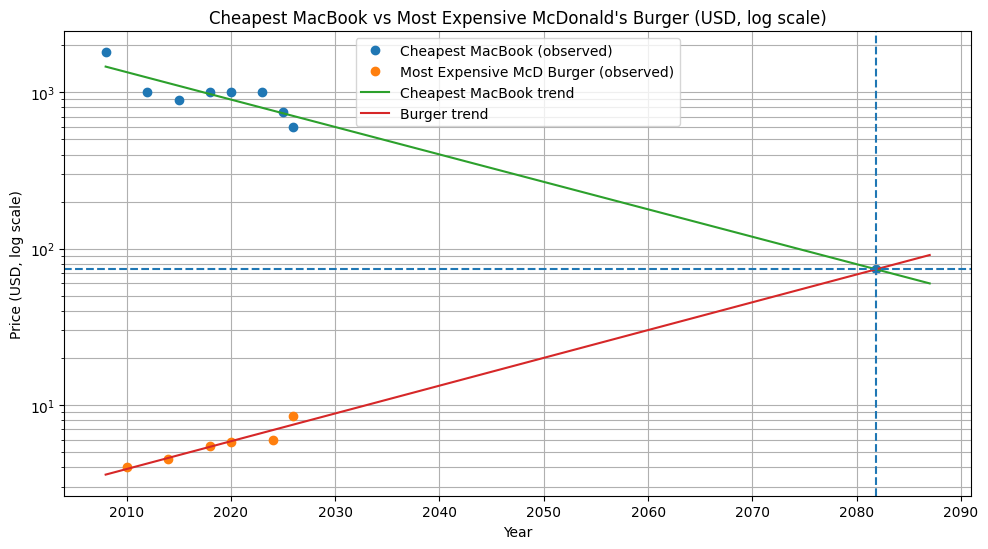
I've plotted the most expensive McDonald's burger and the least expensive MacBook over time. This analysis projects that the most expensive burger will be more expensive than the cheapest laptop as soon as 2081
What Matt Walsh is missing the geopolitical chess, especially China and Russia:
Walsh is asking "how does this benefit America?" purely through the lens of "freedom for Iran" vs American lives/money. That's the WRONG frame. Nobody serious in the Pentagon is doing this for Iranian freedom. Here's the actual strategic play:
🇷🇺 The Russia Play:
• Iran is Russia's #1 weapons supplier for Ukraine — Shahed drones are the backbone of Russia's terror-bombing campaign. Destroying Iran's drone production lines directly degrades Russia's war capability without putting a single American soldier in Ukraine.
• If Iran's military infrastructure collapses, Russia loses its most important ally outside of China. The "axis of resistance" (Russia-Iran-North Korea) gets cut in half.
• This is a proxy war move against Russia without escalating in Europe. Walsh doesn't see this because he's thinking about Iran in isolation.
🇨🇳 The China Play (the big one):
• China buys ~1.5 million barrels/day of sanctioned Iranian oil via their "dark fleet." Neutralizing Iran disrupts China's cheap energy pipeline.
• Every barrel China can't get from Iran, they pay MORE for elsewhere — weakening their economy during a critical period of competition with the US.
• Taiwan deterrence signal: If the US will strike a sovereign nation without congressional approval and level its military in days, what does Beijing calculate about defending Taiwan? This is a SHOW OF FORCE aimed at the Pacific, not just the Middle East.
• Iran is a key node in Belt & Road. Destabilizing it disrupts China's land-route-to-Europe strategy.
🛢️ The Energy Dominance Play:
• Walsh says "what does it do for America?" — if Iran's oil goes offline, global prices spike. The US is now the world's #1 oil producer. Higher oil prices = American energy companies print money, American jobs, American GDP.
• Simultaneously, Iran's customers (China, India) become MORE dependent on US-aligned energy sources (Gulf states, US LNG). That's leverage.
🔒 The Nuclear Calculus:
Walsh caught the contradiction — "nuclear capabilities set back decades" but also "dangerous." He's right that's inconsistent messaging. But the real concern isn't today's centrifuges — it's that Iran was 2-3 weeks from breakout. You don't wait for the gun to be loaded. The nuclear argument isn't about current capability, it's about trajectory.
🗳️ The Political Point:
Walsh's strongest argument is actually his last one — the political cost. He's right that if this costs Republicans in '26 and '28, the strategic gains are moot because a Democratic administration would likely reverse course. That's the one thing the war planners genuinely might be underweighting.
Bottom line: Walsh is asking a civilian's question ("what's in it for regular Americans?") about a move designed for great power competition with China and Russia. The answer IS there — he's just looking at the wrong chessboard.
@crypt0e probably the best org layoff statement I've seen. most just get the impromptu teams meeting with hr and a couple of weeks of severance. it's going to be a bloodbath over the next few years