Compression is essential for AV video data pipelines, yet many teams still train or run inference on raw data. The usual question would be: what do I lose if I use compressed footage?
But what if the missed question is: what do I lose by using raw data?
Our recent study on Depth Anything V2 tested what happens when you train a "student" model on Beamr-compressed footage, fine-tuning only 14% of model weights.
Depth error on pedestrians and motorcyclists (VRUs) dropped 30.7%, with 35.2% smaller training data than baseline compression. Mixing raw source frames during training was entirely successful: the "student" model’s AbsRel was 2x to 5x lower than its compressed error.
We propose a new approach: video data compression should be utilized as data augmentation during model training to effectively improve model learning and robustness.
Walking through the methodology and the rest of the benchmark series at AutoSens USA, June 9–11. Booth 315. Schedule a meeting: https://t.co/4d8h0P7lYv
Learn more about the Depth Anything research and the AV benchmarks on Beamr blog: https://t.co/gPgJJzgp6f
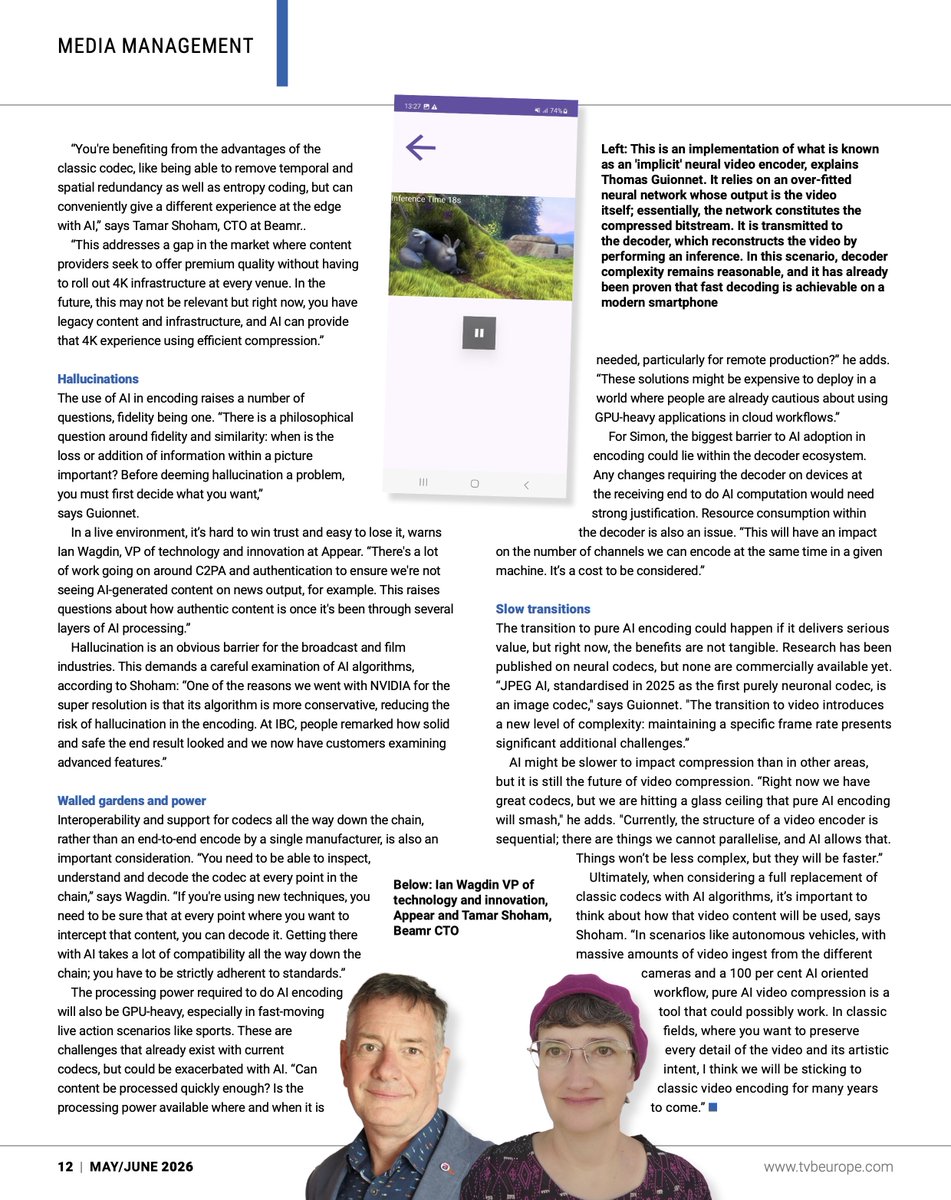
Take a look at Beamr CTO Tamar Shoham in @TVBEurope's latest issue on where AI actually fits in video.
Beamr's Live 4K AI quality enhancement powered by NVIDIA “addresses a gap in the market where content providers seek to offer premium quality without having to roll out 4K infrastructure at every venue,” she explains.
Thanks @TVBEurope and Monica Heck for the great piece about AI and video!
Read the full article here: https://t.co/C7PDI094Bd
Real-time, GPU-accelerated, 4K AI quality enhancement with NVIDIA RTX Video Super Resolution and Beamr's content-adaptive technology - Read the blog: https://t.co/BzbcNpjMuk
AV teams who stopped worrying about compression and started leveraging it are training faster on smaller datasets - and getting better results.
A recent example from our research: a depth estimation model trained on Beamr's CABR-compressed footage dropped depth error on pedestrians and motorcyclists by 30.7%, using 35% less training data than the baseline.
We'll be discussing our study and our latest ML-safe benchmarks at two events where AV and ADAS teams gather in June:
-> @AutoSens_ USA, Detroit, June 9-11, Booth 315. Schedule a meeting: https://t.co/4d8h0P7lYv
-> Vehicle Tech Week Europe, Stuttgart, June 23–25, 2026.
#Video #Perception #AutonomousVehicles #ADAS #PhysicalAI
Next month we'll be at @AutoSens_ USA in Detroit to discuss with perception, validation, and simulation engineers about what's slowing their ML pipelines, and how to clear those bottlenecks.
Beamr ML-safe AV stack, confirmed on real-world and synthetic video data:
-> Up to 50% smaller file size
-> Less than 2% difference in mean average precision vs. baseline
-> Localization differences - minimal; Confidence scores - demonstrating stable model behavior
-> Depth model trained on Beamr-compressed data: depth error dropped 30.7% on pedestrians and motorcyclists (VRUs)
Attending AutoSens USA? Meet us to discuss how to run Beamr technology on your own data. Schedule a meeting (booth 315): https://t.co/4d8h0P7lYv
Learn more: https://t.co/QDZ9GYhuq6
Smart Mobility Summit is driving a lot of traction and insightful conversations.
Our demo:
-> ML-safe AV video data stack across object detection, captioning, and world foundation models
-> Robust machine vision models on Beamr-compressed inputs
Though our shirts are causing their own traffic jam.
Are you here? See it yourself at booth VT24.
Can you train more resilient machine vision models on smaller datasets?
Our recent research shows it's possible. Compression becomes an enabler for AI models to perform better than models trained on uncompressed data. For vulnerable road users (VRUs), including pedestrians and motorcyclists - the depth model trained with Beamr-compressed data (35.2% smaller) delivered 30.7% reduced depth error.
Beamr's video data stack:
-> Preserving ML accuracy
-> Reducing storage, networking, and I/O time by up to 50%
-> AI training asset
Next week, we will demonstrate Beamr's stack across the AV pipeline at the Samson International Smart Mobility Summit, held in Expo Tel Aviv.
-> Ready to test Beamr’s content-adaptive technology on your own data? Schedule a meeting (booth VT24): https://t.co/Rf9GV7HDfg
Compressed video data made the AI model more robust, not less.
Beamr fine-tuned Depth Anything V2 on AV footage compressed with content-adaptive compression (patented CABR).
The result:
-> 35.2% smaller than baseline
-> 30.7% lower depth estimation error on safety-critical objects, like pedestrians and motorcyclists (VRUs)
-> 16.0% lower error, aggregated
The industry has treated compression as a tradeoff. CABR-compressed footage made the model more resilient to compression, while freeing storage, networking, and infrastructure capacity.
Compression became an asset.
Press release: https://t.co/rvxss4e49o
For full methodology and results: https://t.co/9DASZhr3KB
#Beamr #Video #Data #MLSafe #PhysicalAI
If you're managing petabyte-scale AV video data, compression is no longer optional. Without it, storage, egress, I/O time, and pipeline throughput all compound.
But compression introduces a critical question the industry hasn't systematically answered: how do you confirm ML model integrity across every pipeline stage?
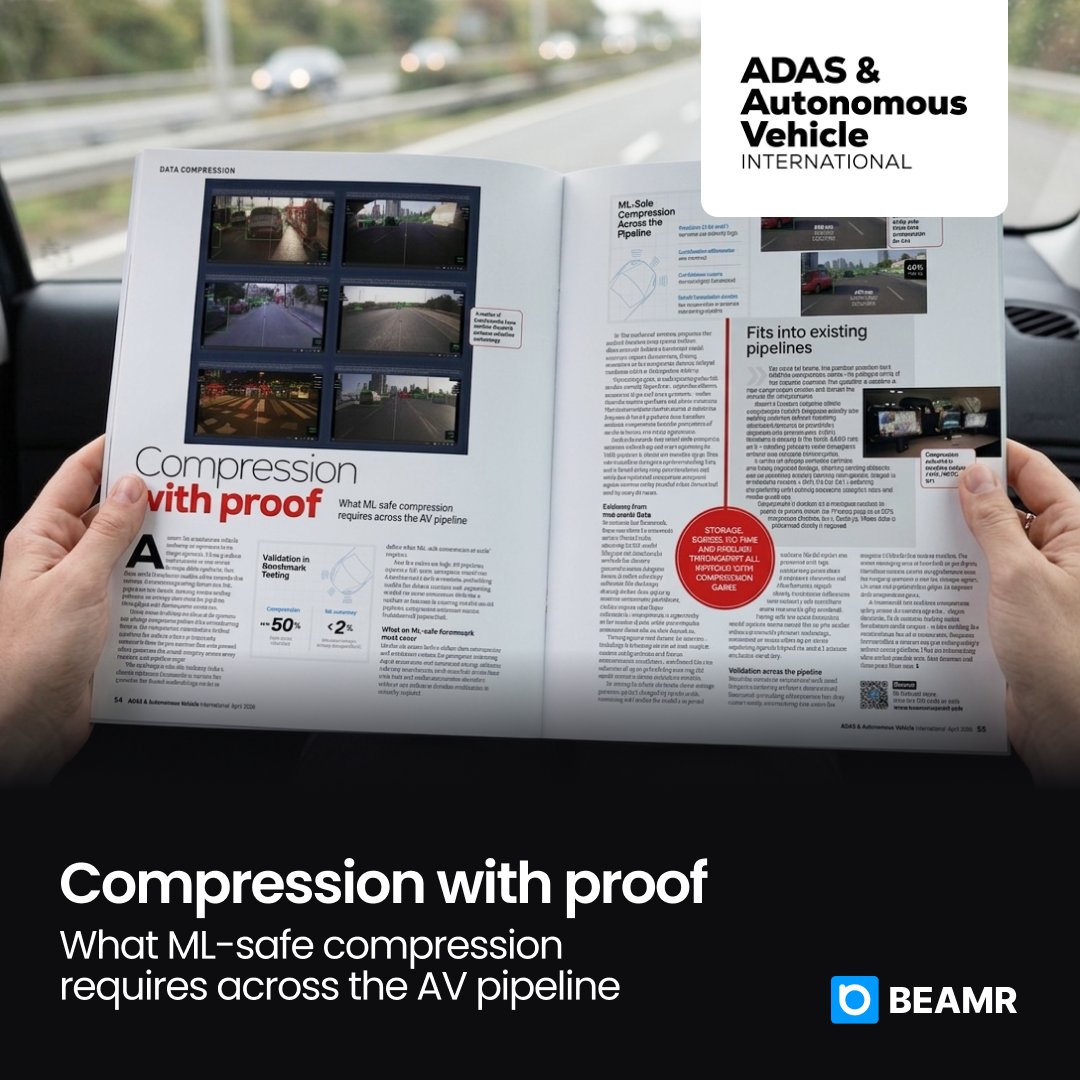
ADAS & Autonomous Vehicle International featured Beamr's ML-safe compression framework, benchmarked across the AV pipeline:
♢ Up to 50% file size reduction
♢ Precision (mAP) remains consistently high
♢ Localization differences minimal
♢ Confidence scores remain highly correlated
♢ Visual Realism Index (VRI): 93%–98% agreement
-> Read the full article in ADAS & Autonomous Vehicle International: https://t.co/crRZPc4ElG
-> Run Beamr's ML-safe compression on your own data: https://t.co/YqfDsPDNPY
#Beamr #AutonomousVehicles #MLSafe #Video #Data #PhysicalAI
Live at the dSPACE User Conference!
Together with dSPACE, we’re demonstrating ML-safe compression inside the RTMaps ecosystem for the first time. 31% smaller files vs. baseline. Zero impact on model accuracy ✨
Running on AUTERA, dSPACE’s in-vehicle data logger, it compresses multi-camera video the moment it’s captured. No post-processing. No offload bottlenecks. No accuracy trade-offs.
AV fleets produce terabytes per run. Compressing at the source means less storage, faster transfers, and shorter iteration cycles, without touching what the model sees.
Real-time. On GPU. Proven on the vehicle.
📍 Come see it live! Schedule a meeting: https://t.co/3wX4EmgpUj
Our NAB Show booth has been busy.
Hard to say if they're here to catch the difference in a VISTA test - or just trying to win the Ray-Ban Meta smart glasses.
We'll see 👀
Meet us at booth W3514, schedule here: https://t.co/429YhGPOVV
For the first time, Beamr and dSPACE demonstrate ML-safe compression in the dSPACE RTMaps ecosystem, with 31% file size reduction compared to baseline encodes while preserving model accuracy.
AV test fleets generate terabytes of footage per run, choking storage, slowing data transfer, and extending development iteration cycles. Applying compression at the data logging stage reduces the volume of video data entering downstream storage and processing pipelines, where infrastructure costs accumulate at scale.
-> See the results at dSPACE User Conference, held from April 21-22 in Novi, Michigan. Schedule a meeting: https://t.co/V17K0LoSxz
-> Read the full story: https://t.co/eCXGC1g58k
You're delivering AI upscaling, encoding developments, or video pipeline changes. How do you know if the change is safe to ship?
Until now you either trust the metrics and hope for the best, rely on internal experts’ opinion, or run an expensive lab test.
Beamr VISTA enables subjective video quality testing at scale, with clear go/no-go results based on statistical confidence, in days, and built for your production cycle.
Beamr VISTA validated NVIDIA RTX Video Super Resolution AI quality enhancement outperformed bicubic upscaling.
Attending NAB Show? Schedule a meeting here (booth W3514): https://t.co/p03EHtCShz
Visit https://t.co/OxwUXKsFHe
Every video change is risky, and when a video team wants to know if a quality change is safe to ship, they either trust the metrics and hope for the best, rely on internal experts’ opinion, or run an expensive lab test.
We built Beamr VISTA out of our own need: to ship video quality decisions with confidence, at scale, in days. Now, we are making VISTA available for any video team.
At @NABShow, we will demonstrate how VISTA validates NVIDIA RTX Video Super Resolution AI quality enhancement from 720p source to 4K, showing it has better perceptual quality than standard upscaling, with statistical confidence of 95%.
Attending NAB Show? Schedule a meeting here (booth W3514): https://t.co/p03EHtCShz
Visit https://t.co/OxwUXKsFHe
@NVIDIAAI
Can you compress video for NVIDIA Cosmos Curator by half and confirm the model still describes the scene the same way? We benchmarked CABR on Cosmos Curator's AV captioning workflow and got
>>
Metrics don’t watch video. People do.
Yet most video decisions today are still made by algorithms. Today, we’re changing that ✨
Introducing Beamr VISTA - a new way to test video quality with real viewers, at scale.
Already used by @nvidia
🔗 Learn more: https://t.co/YT1A2tODZy
>>
Any downstream task consuming these embeddings - search, filtering, deduplication, or curation - would produce identical results on compressed and uncompressed video.
>> Part 4 of ML-Safe AV Video Data Testing series. Read here: https://t.co/PCC2ZPjtjR
@NVIDIADRIVE
>>
-> 41%–57% file size reduction
-> Compression shift is well below the model’s own randomness: Signal-to-Noise Ratio (SNR) <1.0
-> Within each video, the pipeline simply cannot tell compressed from uncompressed: Agreement rates with Beamr-optimized are 93%–98%
>>