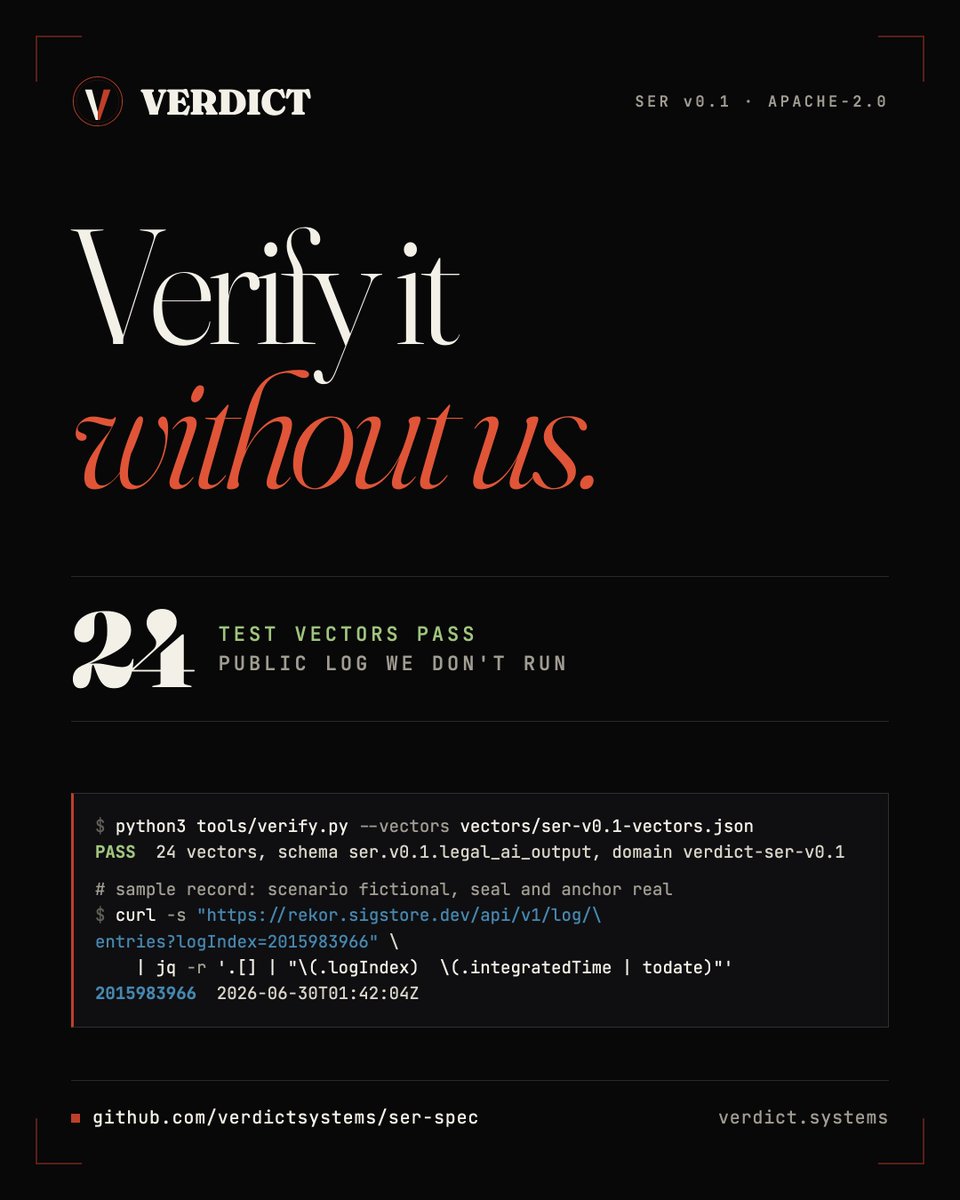
Each Verdict record gets a timestamp from Sigstore’s public log, which we don’t run. Anyone can check it without us.
If your agents will answer to an auditor or an insurer, DM me.
The company that runs your AI agent usually holds the key that signs its logs.
If last month’s logs ever got inconvenient, they could rebuild them and sign them again. Their own checks would pass.
That’s the problem I’m building Verdict for.
Every AI agent that moves money, reads patient records or signs contracts is going to get questioned. A log the operator can edit won't answer that.
Verdict seals what the agent did and anchors it to a public log we don't run. Anyone can verify it without us.
AI governance comes down to four layers: regulation, standards, roles, controls. Every one ends with the same request: show me the record.
So we drew where the record sits, and 12 industries that will be asked for it.
What a seal proves, and what it doesn't, is on the chart.
@alex404 Looked at Fleurir. That's where it fits: when Fleur's agents book the pottery class or the SF weekend, the record holds what the user asked and what each agent sent back, sealed as it happens. Which flow would you test first, the class booking or the trip?
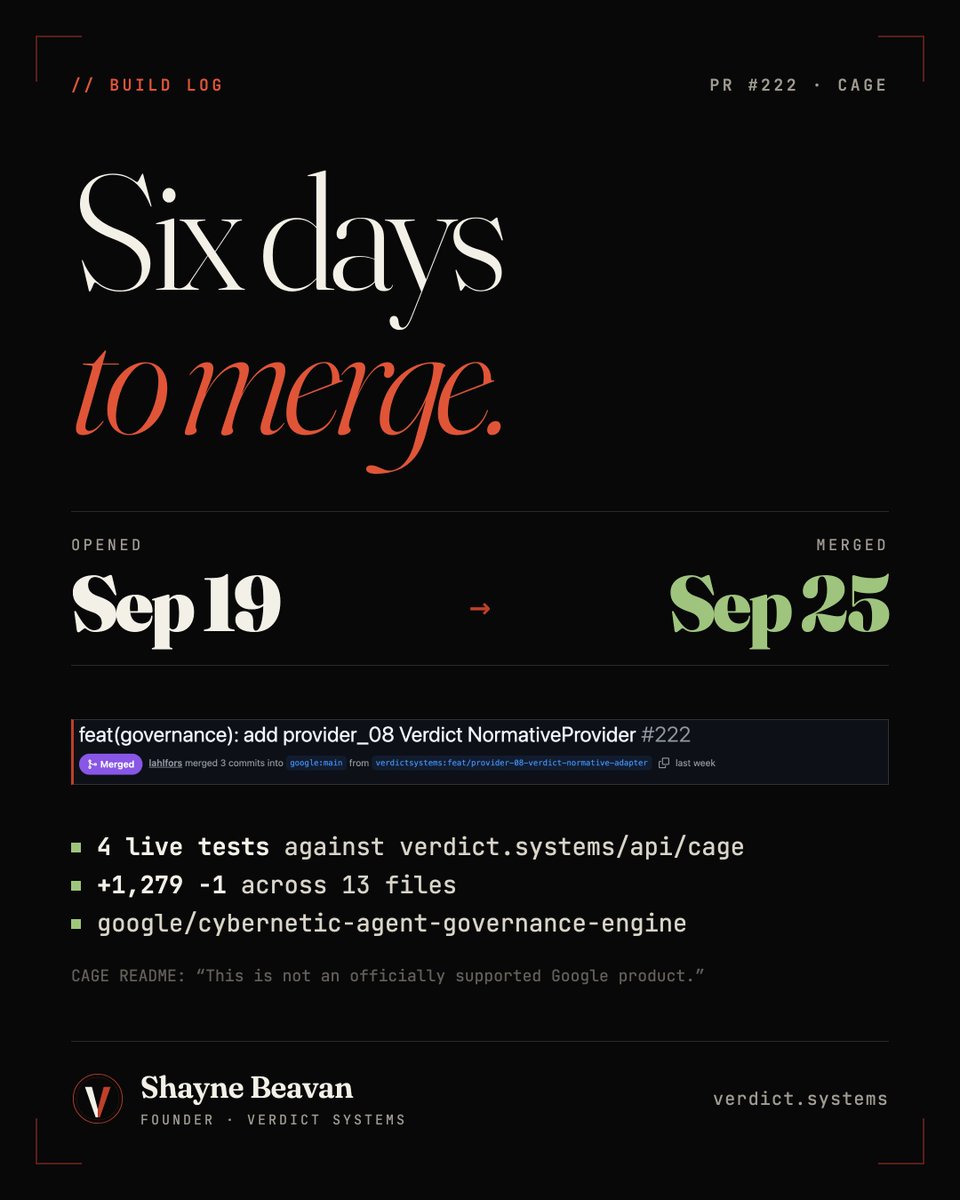
A Google open-source agent governance repo merged a Verdict adapter six days after I opened the PR. Then its maintainer wrote 4 live tests that hit our API over the wire.
AI agents are starting to move money, read patient records and sign contracts. When something goes wrong, someone will ask what the agent did. A log the operator can edit won't settle that.
Verdict seals what the agent did and anchors it to Sigstore Rekor, a public log we don't run. Anyone can check a record without asking us. The spec, 24 test vectors and verifier are open under Apache 2.0.
Right now I'm closing our first paid design partner. We meet every week with an insurance partner. A sovereign AI company in the Gulf has asked to build with us. And we filed comments on the NAIC's draft for evaluating AI risk at insurers.
If your agents will answer to an auditor or insurer, DM me.
@AthenaPrime Canonicalization. Our Python verifier leaned on json.dumps, which sorts keys and writes floats differently from the spec, so some genuine records failed. I rewrote it to the spec's own rules, and that fix went public today.
@alex404 Yes, if it's passed in. The record has separate hashes for the request and the tool's response, sealed together in one record. It can't capture the response on its own: whatever runs the tool hands it over. The CAGE adapter seals the hash the gateway sends.
I built Verdict, so a stranger can check our work without calling me.
The image is a real run. 24 test vectors pass, and the record checks against a public log we don’t run.
What do you need to see before you trust her record you didn’t make?
Every AI agent that moves money, reads patient records or signs contracts is going to get questioned. A log the operator can edit won't answer that.
Verdict seals what the agent did and anchors it to a public log we don't run. Anyone can verify it without us.
I’ve realized something about being a founder:
You have to be willing to see something that doesn’t exist yet, and believe in it long enough to make other people see it too.
That’s the part I love.
Starting with an idea.
Turning it into a product.
Turning the product into a company.
And eventually building something that can change an industry.
I’m not interested in building small.
I want to work with ambitious people, tackle difficult problems, and build technology that matters.
Still early. Still learning. Still building.
But the vision keeps getting bigger.
If you’re a founder, engineer, investor, or just obsessed with building the future, let’s connect.
Vijay, thanks for reaching out. Eighteen years in data engineering, six of those at CBRE running enterprise architecture, and then landing in the GenAI stack, RAG, function-calling, agentic workflows, is exactly the kind of background that actually holds up in production, not just demo-day AI work.
IndMinds is a genuinely complete build. NCERT/CBSE topic mapping down to the chapter level, multi-board support, the quiz engine with cognitive-level grading, WhatsApp auto-dispatch, certificate generation. That is a full pipeline, not a wrapper around a single prompt, and it shows in how specific the product is instead of generic "AI for schools" language.
What are you looking for on your end, contract engagements, a specific role, or partnering on builds like IndMinds? I run a few AI ventures and it helps to know what you're optimizing for before I point you at the right conversation.
Yesterday was incredible.
I connected with some seriously talented people, replied to everyone, and started building relationships that could lead to amazing opportunities.
Let’s keep the momentum going. 🚀
Hey, @X algorithm — let’s build something incredible.
I’m looking to connect with people passionate about:
⚡ Backend Development
⚡ Full-Stack Engineering
⚡ DevOps & Cloud
⚡ AI & Machine Learning
⚡ Data Science
⚡ UI/UX Design
⚡ Python
⚡ JavaScript
⚡ Java
⚡ SaaS
⚡ Startups & Founders
⚡ Marketing & Growth
⚡ DSA
⚡ Vibe Coding
Whether you’re building, learning, hiring, investing, launching a startup, or simply obsessed with technology—I want to connect with you.
👇 Drop a “Hi” and tell me what you’re working on.
Follow me, and I’ll personally reply, make introductions, and connect you with people in my network whenever I can.
Let’s build a powerful community where developers, founders, creators, marketers, and investors help each other grow.
No gatekeeping.
No competition.
Just collaboration, opportunities, and momentum.
Let’s build together. 🚀
#BuildInPublic #AI #Programming #Python #JavaScript #DevOps #MachineLearning #DataScience #Startups #SaaS #100DaysOfCode #TechTwitter #Coding #Networking
John, sorry for the late reply! I went through the Socrates demo. The four-state tracking, Unseen, Covered, Shaky, Proven, is the part that actually matters. Most ed-tech treats one correct answer as mastery and moves on. You're explicitly saying that's not understanding, it's recognition, and building the whole product around forcing the difference. That's a real insight, not a feature list item.
Voice is the right call for this specifically. Text lets people quietly copy-edit their way to a good-sounding answer. Live spoken reasoning is much harder to fake, and pairing it with the sketch grading for the networking example is smart, a diagram alone proves nothing and neither does narration alone, together they actually do.
Here's the question I'd want answered before recommending it to anyone. The whole system rests on the model correctly telling apart "genuinely explained it" from "confidently restated something almost right" in live, unscripted speech. That's a much harder grading problem than most people give it credit for. How are you validating that judgment, and where does it break down at the edges?
Good build. Following, and happy to connect.
The engines don't agree with each other, and that's the opportunity.
Across the same 38 questions:
Perplexity named 36 brands
ChatGPT named 30
Grok named 24
Claude named 21
Gemini named 21
Winning one engine ≠ winning. https://t.co/Xusq94bXHG
Sylvia, went through Hapta Labs. Building one unified standard for robot data, from the capture hardware through the models that transfer skills across embodiments, is the actual bottleneck in robotics right now. Everyone's chasing a bigger model and ignoring that the data pipeline underneath it is a mess of incompatible formats and dirty batches. You're solving the boring problem that makes the exciting one possible.
The audited, clean, exclusive-rights data claim is the part I'd want to dig into more. Provenance and chain of custody on training data is about to matter a lot more than most robotics teams realize, especially once a model trained on your data ends up making a real-world decision someone has to answer for. That's actually the exact problem I've been building Verdict to solve, tamper-proof records of what an AI system did and under what authority, sealed the moment it happens so the proof holds up later, not just a log someone could have quietly edited. Feels like it could sit naturally underneath your "audited" claim as something customers can independently verify instead of just taking your word for it.
Would love a coffee next time I'm in SF. And if the invite-only space is ever open to a visitor from outside pure robotics, I'd take you up on it. Following, real work here.
Andy, real background here, PhD in computer engineering from NTU, algorithm work at DSTA, then trading and arbitrage before founding HeLa. That's a rare combination of hard technical depth and actual market-making experience, most blockchain founders have one or the other.
Went through HelaSyn. The registry explorer plus reputation ledger plus slashing rules is the part that caught my eye, you're building an actual accountability layer for AI agents operating on-chain, not just a yield product with an AI label on it. Reputation ledgers and slashing only work if the underlying record of what an agent actually did is trustworthy in the first place, which is the exact problem I spend my time on.
Curious how HelaSyn verifies agent behavior before it hits the reputation ledger. That's the piece I'd want to dig into. Following, and good to connect.